


Your customer places an online order at 2pm for pickup. They show up at 4:30pm expecting a quick grab-and-go. Instead, they wait 12 minutes while your team scrambles through the stockroom, checks three different spots for the right size, and eventually hands them a bag missing the belt they ordered.
That customer doesn't come back for pickup orders. And honestly, can you blame them?
Small apparel shops lose roughly 30% of their BOPIS customers after just one bad pickup experience. Not because the clothes weren't right or the prices were off—because the operational flow broke down at the worst possible moment, when the customer was standing right there watching.
The real cost of chaotic pickup operations
Most small clothing stores treat BOPIS like an afterthought. Orders come in, someone grabs items when they get a chance, bags get left somewhere random, and everyone hopes for the best when customers show up.
Here's what that actually looks like in practice.
Your morning associate picks a medium blue sweater instead of a large. Nobody catches it until the customer opens the bag at home. They call angry, you offer a return, but they're already shopping somewhere else online.
Two team members both start picking the same order because nobody marked it as started. One wastes 8 minutes gathering items that are already bagged. Meanwhile, another order sits untouched.
A pickup customer arrives during your lunch rush. Your floor associate leaves three browsing customers to hunt for the order—can't find it, checks the back, asks another employee, finally locates it behind the counter in an unmarked bag. Those browsing customers? Two left without buying anything.
These aren't edge cases. Watch any small apparel shop during pickup hours and you'll see some version of this playing out regularly. Each one chips away at customer trust and staff efficiency.
Why standard retail workflows fail for BOPIS
Traditional retail operations assume customers browse, select, and checkout in a linear path. BOPIS flips this completely—selection happens remotely, fulfillment happens invisibly, and the only real customer touchpoint is the handoff.
Take control of your clothing store operations.
Werzly helps you manage stock, process orders, and engage customers effortlessly.
- Unified inventory and order management
- Automated customer notifications
- Sales and stock analytics
No credit card required
Small stores typically have 400–800 square feet of selling floor plus a cramped stockroom. Unlike big retailers with dedicated pickup areas and fulfillment staff, you're working with:
-
2–3 employees covering everything at once
-
Stock spread across floor displays, stockroom shelves, and sometimes still in boxes
-
No dedicated pickup staging area
-
The same POS system handling walk-ins and pickups simultaneously
When Jenny from the neighborhood places a pickup order for three items, your team needs to navigate around shopping customers, check multiple stock locations, verify sizes and colors precisely, pack correctly, stage for easy retrieval, and hand off smoothly—all while keeping the floor experience intact for walk-in traffic.
Standard retail training doesn't prepare anyone for that juggling act.
Building a pick-path template that actually works
Forget complex warehouse management systems. Your small store needs a dead-simple pick-path that any employee can follow without thinking.
Map your store into zones. Nothing complicated—just logical groupings:
-
Zone A
Front displays (nearest door)
-
Zone B
Wall racks (left side)
-
Zone C
Wall racks (right side)
-
Zone D
Center fixtures
-
Zone E
Stockroom shelves
-
Zone F
Stockroom overflow/boxes
The part that actually makes a difference: always pick in the same zone sequence, regardless of what items you need. A → B → C → D → E → F. Every time. No exceptions.
When employees pick randomly based on where they think items might be, they waste time deciding where to go next, double back constantly, and often miss items because they've lost track of where they already looked. A fixed path eliminates all of that.
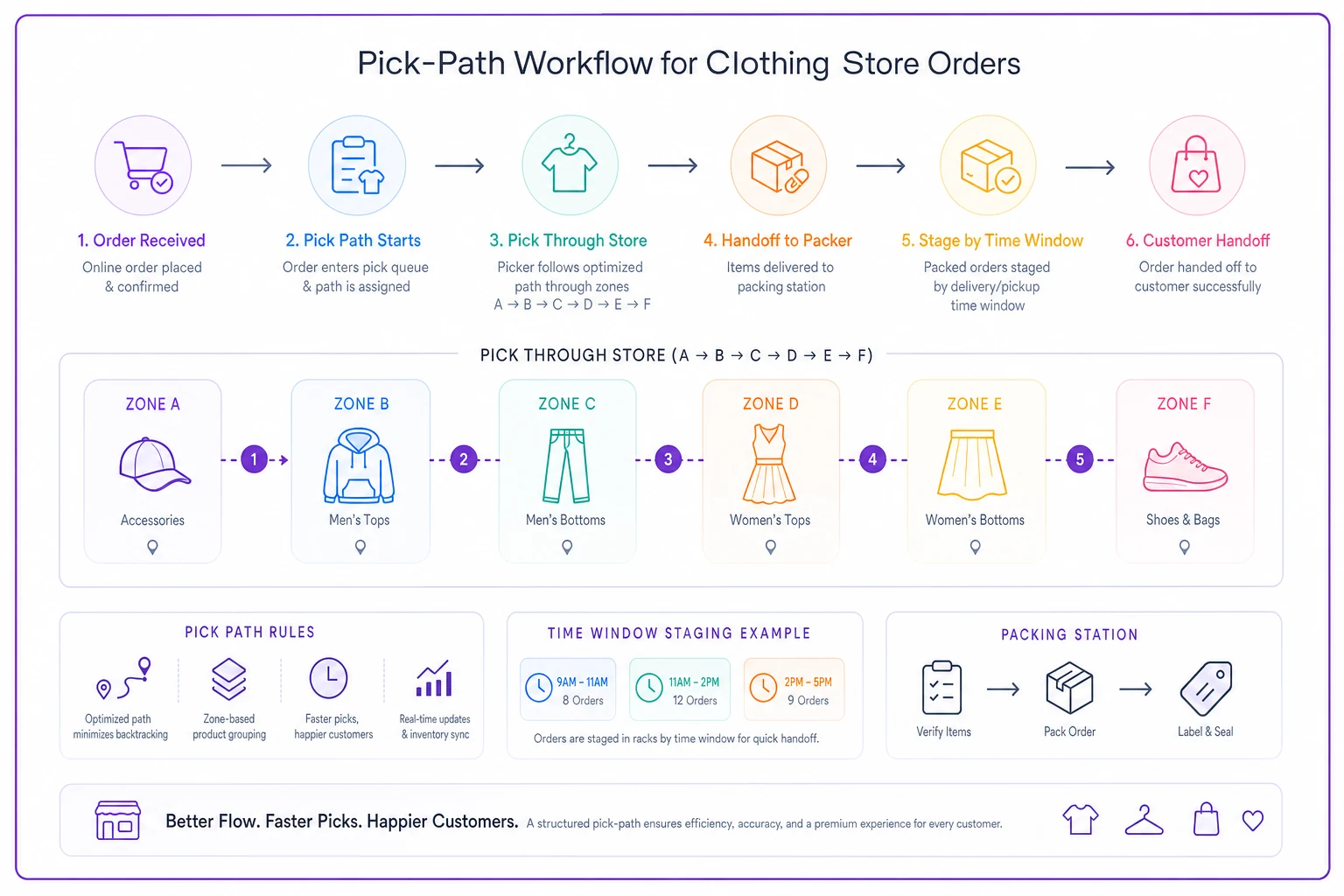
Use this diagram as a simple training aid for new pickers.
Your pick sheet—yes, print it, don't rely on phones—should list items in zone order, not order sequence. So instead of listing items as they appear in the order, you organize by zone:
Zone B: White tee - medium Zone C: Black jeans - size 30, Blue cardigan - small Zone E: (check if items weren't found on floor)
Employees move through zones once, grab everything in that zone, then move forward. No backtracking. No decisions.
The two-person fulfillment system nobody talks about
A boutique in Austin doing around 40 BOPIS orders weekly stopped treating fulfillment like a solo task. That one change transformed their pickup operations.
-
Picker navigates the floor with the pick sheet, gathering items into a basket
-
Packer stays at a fixed packing station, receives items, double-checks against the order, packs properly
Sounds like overkill for a small store? Consider what solo fulfillment actually looks like in practice.
Sarah picks three items, carries them to the counter, realizes she grabbed navy instead of black, goes back to exchange it, returns to pack, discovers the tissue paper is in the stockroom, leaves items on the counter to get supplies, comes back to find another employee moved them thinking they were returns.
Total time: 11 minutes. Constant interruptions, multiple error risks.
-
Picker focuses only on finding correct items — roughly 4 minutes
-
Packer has all supplies ready, checks items carefully, packs consistently — about 2 minutes
-
Total time
around 6 minutes, with far fewer errors
During slow periods, one person can do both roles sequentially. During busy periods, splitting the roles means your floor associate isn't disappearing for 10+ minutes per order.
This is one of those operational changes that feels almost too simple to matter, but it genuinely does. The picker isn't distracted by packing logistics, and the packer isn't rushing through verification because they're tired from walking the floor. The roles reinforce each other.
Packing checklists that prevent embarrassing handoff moments
Nothing tanks a pickup experience faster than discovering something's wrong while the customer is standing there. Yet most stores pack orders without any verification system at all.
Create a physical checklist card that goes in every pickup bag:
-
Order # Customer
-
- [ ] All items match order list
-
- [ ] Sizes verified against tags
-
- [ ] Colors checked in good light
-
- [ ] No damage/stains/missing buttons
-
- [ ] Receipt included
-
- [ ] Promotional materials added (if applicable)
-
- [ ] Bag sealed with store sticker
-
- Packed by Time:
-
- Verified by _ (different person when possible)
Keep an extra stack of printed checklist cards at the packing station so every bag gets one without thinking.
The "verified by" line matters more than people expect. A second set of eyes—even just 30 seconds—catches the majority of packing errors before customers ever arrive.
One Portland boutique started using these cards after three wrong-size incidents in a single week. Errors dropped to nearly zero, but more importantly, staff confidence improved. They stopped second-guessing themselves during handoffs because they knew items had been double-checked.
Handoff scripts that feel natural, not robotic
Your team needs structure for pickup handoffs, but reading from an actual script sounds terrible. Give them a framework with key checkpoints instead.
The effective handoff flow: Greeting (warm, acknowledge they're here for pickup) "Hey! Picking up an order? Perfect, let me grab that for you." Confirmation (verify it's the right order without making it weird) "This should be under [customer name]? Great, I've got it right here." Soft verify (let them check without pressure) "Here's your order—[mention 1–2 items casually]—want to take a quick peek to make sure everything looks good?" Add value (don't just hand over and move on) "That cardigan you ordered is one of my favorites this season. Super versatile. Also, just so you know, we're doing 20% off denim next week if you need anything else." Clean exit (friendly but clear) "You're all set! Thanks for ordering with us—really appreciate it."
Notice what's missing: no lengthy verification process, no making them sign things, no awkward "IS EVERYTHING OKAY?" energy. But you've still confirmed identity, given them a chance to check the items, and left them with a reason to come back.
Time targets that actually improve operations
Setting arbitrary speed goals makes teams rush and make mistakes. But having no time awareness at all leads to 15-minute pickup experiences that frustrate everyone.
Realistic time targets for small store BOPIS:
| Stage | Target |
|---|---|
| 1–3 items: order to ready | 45 minutes |
| 4–6 items: order to ready | 70 minutes |
| 7+ items: order to ready | 90 minutes |
| Customer arrival to handoff (ideal) | Under 2 minutes |
| Customer arrival to handoff (acceptable) | Under 4 minutes |
| Customer arrival to handoff (problem threshold) | Over 5 minutes |
These aren't arbitrary. They're based on what small stores with 2–3 staff can consistently hit without sacrificing accuracy or the walk-in customer experience.
One thing worth emphasizing: measure "ready for pickup" as when the order is completely packed and staged, not when picking starts. This forces actual completion instead of partial processing.
Common pickup failures and their fixes
The "I'll just remember" disaster Employee picks an order, gets interrupted by a customer question, sets items aside "temporarily," then can't remember which items went with which order.
Fix: Never pick without a printed pick sheet attached to your basket or bag. No exceptions.
The stockroom shuffle Customer waiting at the counter while an employee disappears into the stockroom for "just a second" that turns into five minutes of searching.
Fix: If an item isn't in its expected zone within 30 seconds, mark it as "investigate later" and keep moving. Check the stockroom in one batch after floor picking is done.
The afternoon scramble All online orders come in before noon, but nobody starts picking until 3pm when customers start arriving.
Fix: Pick in two waves—anything received before 11am gets picked by 12:30pm. Anything after 11am gets picked by 3:30pm.
The missing size mystery System shows size small in stock but nobody can find it anywhere. Customer arrives expecting it.
Fix: Daily "problem SKU" list. Any item not found during picking gets added to tomorrow's list for investigation during the opening routine.
The staging system that prevents handoff chaos
Where you put completed orders matters more than most stores realize. That random spot behind the counter turns into an archaeological dig site by 3pm—bags stacked on bags, no organization, everyone searching through receipts.
Set up your pickup staging like this:
-
Designate one specific area—a shelf unit, cubby system, or even just clearly marked sections of counter space. Organize by pickup time window, not order number:
-
Morning pickups (before noon)
-
Afternoon pickups (noon–4pm)
-
Evening pickups (after 4pm)
Within each section, arrange bags left to right by order number. Simple, visual, hard to mess up.
Attach order summaries to the outside of bags with the customer name in large text. When Jennifer arrives for her pickup, any employee can find her bag in seconds just by scanning names—no digging through receipts required.
When small stores should avoid complex BOPIS operations
Not every small apparel shop needs elaborate pickup systems. If you're doing fewer than 10 pickup orders a week, these processes might create more overhead than they're worth.
Skip the structured BOPIS approach if:
-
Online orders are mostly special requests or custom items
-
Your team is just you or you plus one part-timer
-
Pickup orders represent less than 5% of revenue
-
Your inventory system is entirely paper-based
In those situations, handle pickups as individual customer service moments rather than operational workflows. But once you're hitting around 15–20 weekly pickup orders, trying to manage without any process becomes genuinely painful.
Making pickup operations sustainable
The boutique owner who inspired this piece went from dreading online orders to preferring them. Her secret wasn't complicated technology or extra staff—she just built repeatable processes that removed daily decision-making from her team.
Her morning routine:
-
Check overnight orders (2 minutes)
-
Print pick sheets in zone order (1 minute)
-
First pick wave during opening tasks (15–20 minutes)
-
Orders packed and staged before the store opens
Her afternoon routine:
-
Second pick wave at 2pm (15–20 minutes)
-
Final pickup prep at 4pm for evening customers
-
Tomorrow's pick sheets printed before closing
With AI-powered operational software handling the order flow and inventory tracking, her manual work dropped even further. The platform sends pickup reminders to customers, tracks which orders are ready, and alerts staff when customers are on their way. But even without that layer of automation, the core workflows alone transformed her pickup operations.
The results after three months:
-
Average pickup time
down from 8 minutes to under 3
-
Wrong item incidents
from weekly to essentially zero
-
Customers choosing pickup
up from 20% to 35% of online orders
-
Staff stress around pickups
noticeably gone
Small stores often assume they need Amazon-level infrastructure to offer smooth pickup experiences. They don't. They need clear zones, simple checklists, defined roles, and consistent staging. These micro-operations—tiny, specific, repeatable actions—compound into genuinely professional pickup experiences.
Your customers don't care that you're a small store. They care that when they arrive for their order, they get their items quickly and correctly. Build the operational foundation to deliver that consistently, and they'll keep choosing pickup over shipping—driving foot traffic and cutting your delivery costs at the same time.
You can start tomorrow. Print zone maps, create pick sheets, set up staging areas. Within a week, your pickup operations will feel completely different. Within a month, they'll mostly run themselves.
Ready to elevate your apparel business?
Join 2,000+ retailers using Werzly to streamline operations, increase sales, and deepen customer loyalty.