

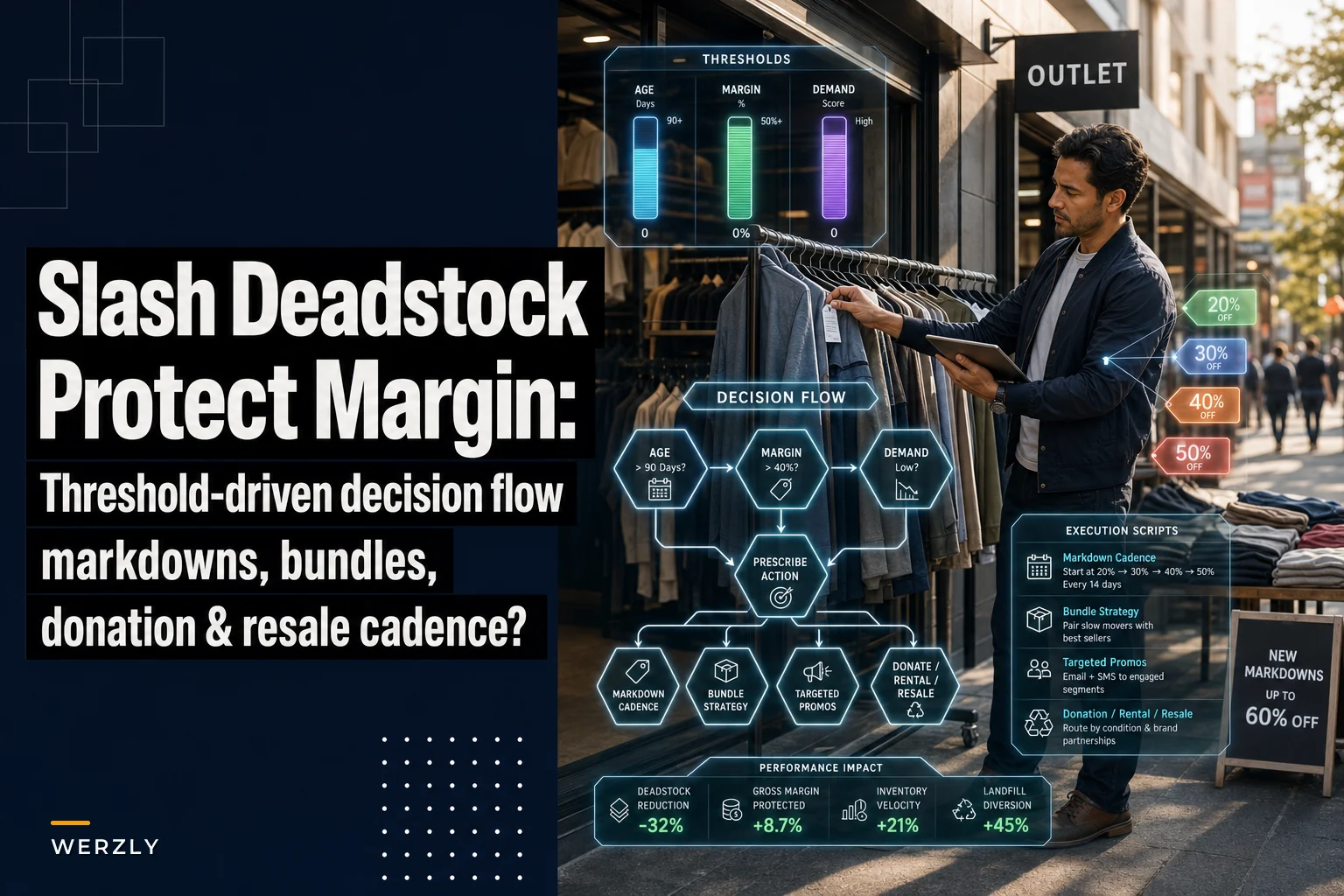

Your back room is basically a museum of bad buying decisions. That graphic tee from spring that didn't land. The jacket that looked amazing in the buying presentation but customers won't touch. Those pants in the weird colorway your vendor convinced you to take.
Most stores handle slow inventory the same way — wait until it's ancient, then slash it 70% off and watch the profit evaporate. There's actually a more methodical way to cut deadstock apparel without torching your margin completely.
The aging threshold system that triggers action
Dead inventory doesn't announce itself. It creeps up gradually until you're suddenly sitting on $30,000 in merchandise that hasn't moved in four months.
Stores that handle this well use specific aging thresholds to trigger decisions. Not vague "this feels old" gut checks, but actual numerical triggers based on sell-through velocity.
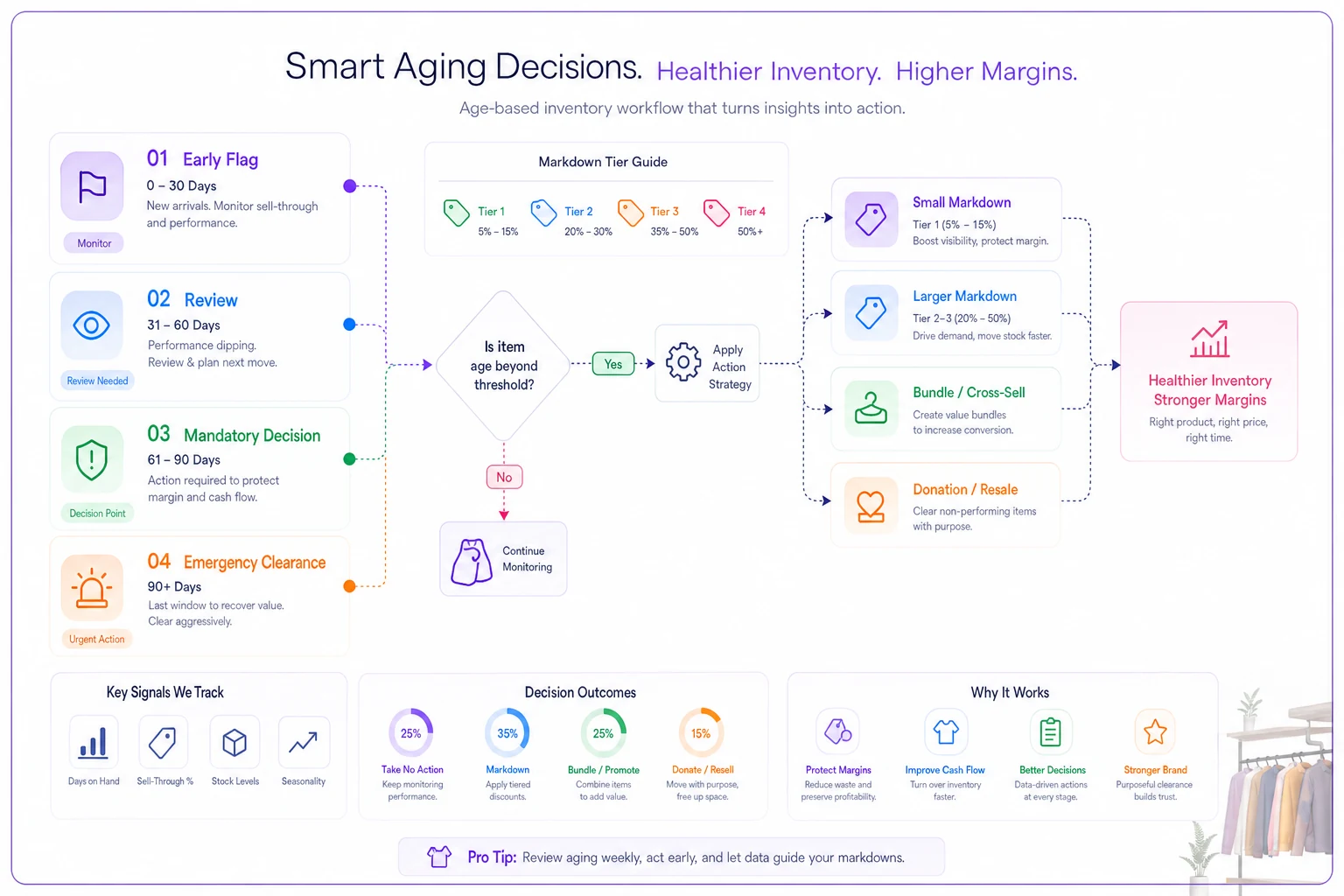
Start tracking from day one on the floor. Mark each SKU with its arrival date — physically if your POS doesn't do it automatically. Then set these thresholds:
30 days: Flag anything selling below 15% of initial stock
45 days: Review anything below 25% sell-through
60 days: Mandatory decision point for anything below 40%
90 days: Emergency clearance mode
This flow visualizes the threshold-based decision process.
These aren't arbitrary numbers. Healthy apparel products typically move 60-80% of stock within the first 60 days on the floor. When something falls significantly below that curve early, waiting longer almost never helps.
A boutique in Austin implemented this threshold system last year. Their deadstock dropped from $47,000 to around $12,000 within six months — not because they marked down faster, but because they caught problems earlier when smaller discounts still worked.
Building your markdown cadence without racing to the bottom
The biggest mistake stores make is jumping straight to deep discounts. You've got a $68 dress sitting for 45 days and your instinct says mark it 50% off immediately. But that leaves money on the table.
Take control of your clothing store operations.
Werzly helps you manage stock, process orders, and engage customers effortlessly.
- Unified inventory and order management
- Automated customer notifications
- Sales and stock analytics
No credit card required
Use graduated markdown tiers tied to your aging thresholds instead:
First markdown (30-45 days): 20-25% off Test if a small nudge moves it. Sometimes customers just need permission to buy something they've been considering.
Second markdown (45-60 days): 35-40% off This is the sweet spot for maintaining some margin while creating urgency. Most price-conscious customers bite here.
Third markdown (60-75 days): 50-55% off You're approaching break-even territory, but still protecting some contribution margin.
Final markdown (75-90 days): 65-70% off Recovery mode. Get your cash back and reinvest in better inventory.
Between each tier, give it at least 10-14 days to work.
Between each tier, give it at least 10-14 days to work. Customers need time to notice the change, especially if you're not broadcasting every price drop.
The key is sticking to this cadence consistently. No jumping from 25% to 70% because you're frustrated. No holding at 40% for three months hoping for a miracle. The system only works when you follow it.
Category-specific bundling that actually moves product
Bundling slow movers sounds great in theory. In practice, most stores create bundles nobody wants — like pairing two unpopular items together and calling it a deal.
Effective bundling follows one rule: pair weakness with strength. Your slow-moving scarf doesn't sell better bundled with another slow scarf. Bundled with a popular sweater at a slight discount? Now you've got something.
Here's the bundling decision matrix that actually works:
| Slow Item Category | Bundle Partner | Discount Structure | Success Rate |
|---|---|---|---|
| Accessories | Best-selling tops | Buy top, get accessory 40% off | ~65% clearance |
| Odd sizes | Same style, popular sizes | Buy 2, save 25% total | ~55% clearance |
| Last season basics | Current season trends | Mix & match, 30% off total | ~70% clearance |
| Single colorways | Multi-buy across colors | 3 for $X pricing | ~60% clearance |
The accessories bundle works particularly well because the perceived value stays high. A customer buying a $58 sweater feels like they're getting a deal on a $24 scarf at 40% off, even though you're really just trying to clear that scarf at any reasonable margin.
One warning: don't bundle deadstock with your hottest sellers unless the margin math truly holds. You're essentially discounting good inventory to move bad inventory, which backfires fast if overdone.
Targeted customer segments for different clearance strategies
Regular full-price buyers: Early access to first markdowns via email. These customers appreciate the exclusive heads-up and often buy at 20-25% off because they trust your curation. Frame it as "special access," not "clearance."
Deal seekers: Target them at the 40-50% markdown tier through your regular sale communications. They're already trained to wait for sales, so meet them there.
Dormant customers: Use deep clearance inventory (60%+ off) as a reactivation tool. "We miss you — here's 60% off select styles" brings them back to browse and often leads to additional full-price purchases.
Size outliers: Stuck with XXS or XXL? Build a targeted campaign for customers who've bought those sizes before. A focused email to 50 people beats a store-wide promotion that mostly attracts the wrong audience.
The math is straightforward. Sending a targeted 30% off offer to 100 previous buyers of similar items typically yields 8-12 purchases. Blasting the same offer to your full list of 2,000 might get you 15-20 purchases but trains everyone to expect discounts.
The donation and resale decision framework
Donation pathway (best for basics and seasonless items):
-
Tax write-off at original cost basis
-
Goodwill benefit from charitable giving
-
Clears space immediately
-
Works best for items under $40 retail
Bulk resale pathway (best for designer or premium items):
-
Consignment shops typically take 40-50% commission
-
Online resellers like ThredUp or Poshmark bulk pay 10-20% of retail
-
Takes longer but recovers more cash
-
Works for items over $60 retail
Liquidator pathway (best for large quantities):
-
Typically pays 5-10% of retail
-
Immediate cash and complete clearance
-
Minimum quantities usually 100+ pieces
-
Best option when you need cash flow now
Most stores hold onto deadstock past 90 days hoping for that one perfect customer. But every month it sits, it's blocking you from buying something that will actually sell. The opportunity cost kills you slowly.
A store in Portland had $22,000 in six-month-old inventory. They donated half (roughly $11,000 tax write-off) and sent the other half to a liquidator for $1,100 cash. Not glamorous, but that freed up space and cash for new inventory that generated $34,000 in sales the following quarter.
Scripts and communication that preserve brand value
How you talk about clearance matters almost as much as the discount itself. Most stores either apologize for their clearance rack or go full "EVERYTHING MUST GO" like they're closing down. Neither approach helps the brand.
In-store signage: "Final sizes in select spring styles — 40% off" beats "CLEARANCE" in red letters. It suggests scarcity rather than desperation.
Email messaging: "Making room for fall arrivals — save on remaining summer favorites" positions clearance as planned, not panicked.
Social media: Show styled looks incorporating sale items alongside new arrivals. "Mix seasons like a pro — pair this $32 sale tank with our new $89 blazer" keeps the aspirational energy while moving old stock.
Staff training: Your team needs specific language. Instead of "That's been here forever, I can probably discount it more," train them toward "That piece is from our earlier collection — it's currently 40% off, which is our best price on it."
The point isn't to hide that items are on sale. It's to frame clearance as curation rather than dumping.
When to override the system
Override for seasonal barriers: Swimsuits in October need aggressive markdowns regardless of age. Don't follow the 20-25% first markdown when the buying season is completely over.
Override for space emergencies: If a massive new shipment is coming and you physically don't have room, accelerate markdowns on whatever's taking up the most space, margin concerns aside.
Override for cash crunches: When you need immediate cash for rent or payroll, skip to 50-60% markdowns on your oldest inventory. Surviving with less margin beats not surviving.
Override for vendor returns: If you can return merchandise to the vendor for even 50% credit, that often beats marking down to 70% and still having to sell through it yourself.
The critical part — document every override and why you made it. Otherwise, overrides become the norm and the whole system falls apart.
The technology piece that makes this scalable
Managing thresholds, segments, and decision points manually burns a lot of time. You're tracking aging, calculating markdown tiers, spotting bundle opportunities, and trying to remember which customers buy which sizes.
Operational software built for apparel retail takes most of that off your plate. Instead of spreadsheet gymnastics, you get automatic aging alerts, suggested markdown schedules based on sell-through velocity, and customer segment targeting based on actual purchase history.
The better platforms now use AI automation to flag items likely to become deadstock before they actually do, based on early selling patterns. You can even automate the markdown cadence itself — the system implements price changes based on your thresholds while you focus on merchandising and the floor.
A boutique chain in Phoenix implemented an automated markdown system across three locations. Their deadstock percentage dropped from 18% to around 7% of total inventory value within eight months. Not because they marked down more aggressively, but because the system caught slow-movers earlier and applied consistent markdown strategies without anyone having to remember to pull aging reports.
Making peace with clearance as a profit center
Clearance isn't admission of failure. It's portfolio management.
Even strong buyers miss on 25-30% of what they bring in. The difference between profitable stores and struggling ones isn't perfect buying — it's how quickly and efficiently they handle the misses.
When you've got clear thresholds, graduated markdowns, targeted customer segments, and defined exit strategies, clearance becomes a planned part of your margin mix rather than a panic response.
The stores doing well right now treat clearance like any other operational system. They measure clearance margin separately from initial margin. They track time-to-clear by category. They know their optimal markdown cadence by season and product type.
Your deadstock will never hit zero. But with the right decision flow, you can cut deadstock apparel down to manageable levels while protecting enough margin to stay healthy. The key is having an actual system and following it — even when that piece you loved isn't selling and your ego wants to keep it at full price forever.
Stop treating clearance like defeat. Start treating it like the operational discipline it actually is.
Ready to elevate your apparel business?
Join 2,000+ retailers using Werzly to streamline operations, increase sales, and deepen customer loyalty.