


Most clothing stores stumble into omnichannel fulfillment backwards. You add buy-online-pickup-in-store because customers keep asking. Then ship-from-store because your competitor started doing it. Before you know it, your staff is confused about which orders to prioritize, you're eating shipping costs on low-margin items, and that promised "2-hour pickup" is taking half a day.
The real problem isn't offering multiple fulfillment options. It's not having clear rules about when to use each one. Your team needs a decision matrix, not another training session about "customer service excellence."
The margin math nobody talks about
Ship-from-store sounds great until you ship a $28 t-shirt that costs you $11 to fulfill. Between picking time, packaging, and shipping, you just turned a profitable sale into a loss leader. And that same item sitting in your store might have sold at full price to a walk-in customer tomorrow.
BOPIS looks cheaper on paper - no shipping costs, right? Except when your team spends 25 minutes hunting for a specific size that got mixed into the wrong section, then another 10 minutes trying to reach the customer because their pickup is running late. Suddenly that "free" pickup cost you more than shipping would have.
The clothing stores that make omnichannel work understand one thing: different SKUs need different fulfillment rules based on margin, velocity, and operational cost. A $180 jacket with 65% margin can absorb shipping costs. A $35 basic tank top probably can't.
Building your fulfillment decision matrix
Start with margin thresholds. Here's what works for most small apparel shops:
Take control of your clothing store operations.
Werzly helps you manage stock, process orders, and engage customers effortlessly.
- Unified inventory and order management
- Automated customer notifications
- Sales and stock analytics
No credit card required
| Category | Ship-from-store | BOPIS | Priority level | Exception |
|---|---|---|---|---|
| High margin items (55%+ after COGS): | Ship-from-store: YES if order value exceeds $75 | BOPIS: Always available | Priority level: Standard (24-48 hour fulfillment) | Exception: Limited quantities get BOPIS only |
| Medium margin items (35-54% after COGS): | Ship-from-store: Only if order exceeds $125 | BOPIS: Always available | Priority level: Standard | Exception: Bundle with other items to hit ship threshold |
| Low margin items (Under 35% after COGS): | Ship-from-store: NO unless part of $200+ order | BOPIS: Always available | Priority level: Low (48-72 hour fulfillment) | Exception: Clearance items = BOPIS only |
But margin is just the first filter. You also need velocity rules.
Fast-moving basics that you constantly restock? Those can ship because you'll get more inventory soon. That one-off designer piece you bought three of? BOPIS only - you need those for in-store discovery.
Seasonal items need their own rules. Early season when you're full-price? Ship anything over margin threshold. Final four weeks of season? BOPIS only for anything under $100 - you need every chance at full-price in-store sales.
Here's a quick visual of the fulfillment decision flow.
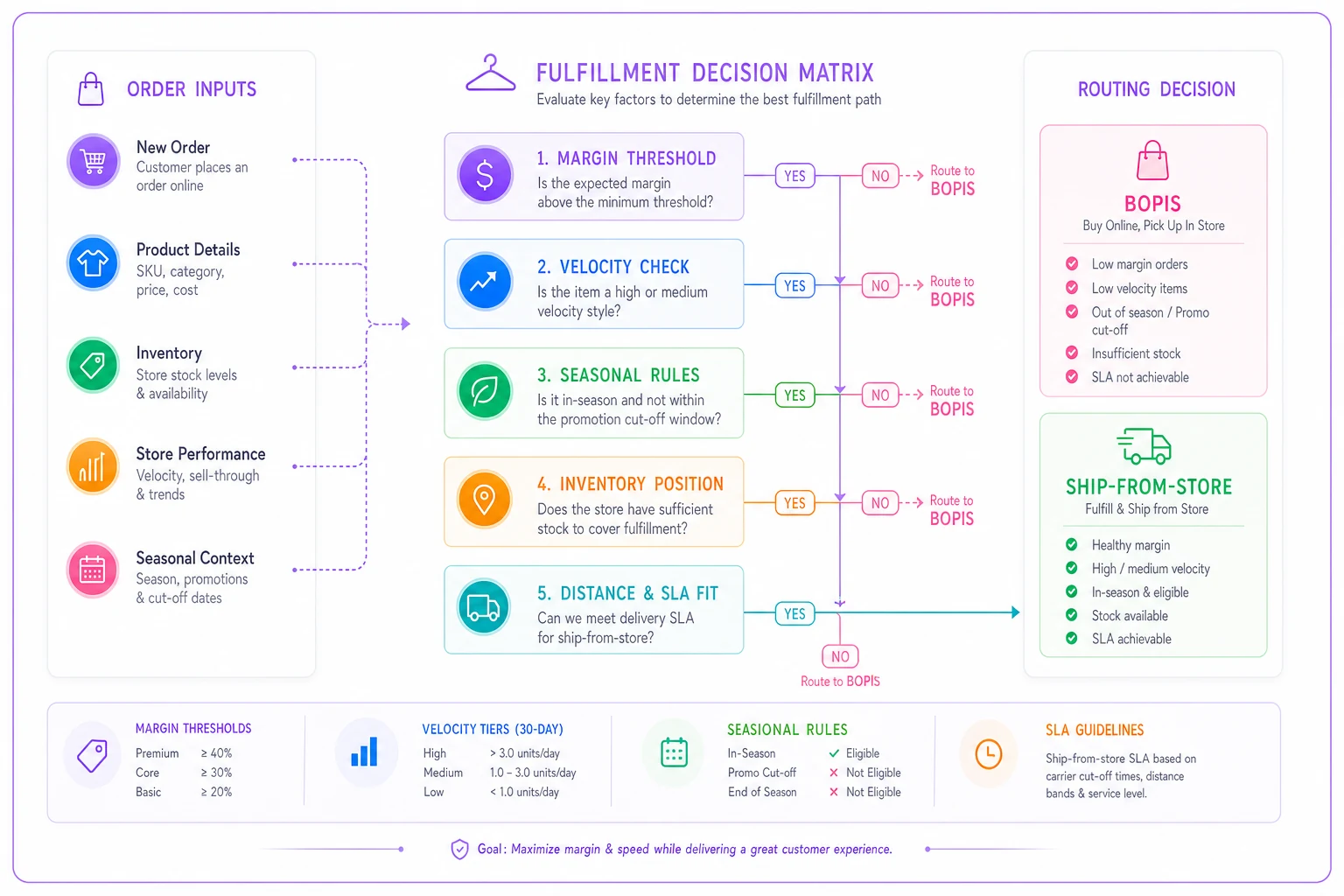
The visual maps margin thresholds to routing decisions and adds velocity and seasonal checks to avoid shipping low-margin, low-velocity items.
The staffing reality check
Small stores usually run with 2-3 people per shift. When an online order comes in during Saturday rush, who handles it? The person at register? The one helping customers on the floor?
What ends up happening: orders pile up until there's a lull, then someone rushes through picking, makes mistakes, and you get negative reviews about wrong items or delayed pickups.
-
Morning shift (opening to 11am) - Process all overnight orders - Pick BOPIS orders due before 2pm - Pack ship-from-store orders - One person owns this completely
-
Midday (11am-3pm) - No active fulfillment unless emergency - Focus on floor sales - Quick BOPIS handoffs only
-
Late afternoon (3pm-6pm) - Process morning/afternoon orders - Pick next-day BOPIS - Prep shipping labels - Again, one designated person
-
Evening (6pm-close) - Final BOPIS pickup window - Process any same-day requests - Stage next morning's fulfillment
The key is protecting these windows. When fulfillment becomes "whenever someone has time," it never gets done properly.
Exception handling that doesn't require a manager every time
Your team needs clear exception rules they can execute without calling you:
Item not found after 5-minute search:
-
Check system for alternate locations (stockroom, fitting rooms, hold area)
-
Offer customer substitute (same item different color, similar style same price point)
-
If no substitute accepted, offer upgrade at original price (max 20% price difference)
-
If declined, process refund and notify customer within 2 hours
BOPIS pickup running past deadline:
-
First 24 hours late
Hold as normal
-
24-48 hours
Call/text customer once
-
48+ hours
Move to sales floor with "return to stock" note
-
After 72 hours
Release for regular sale, auto-refund customer
Shipping cost exceeds 15% of order value:
-
Check for closer fulfillment location (if you have multiple stores)
-
Offer BOPIS with 10% discount code for inconvenience
-
If customer insists on shipping, get manager approval for override
Multiple items but only partial stock found:
-
Ship what you have immediately
-
Offer BOPIS for remaining items with free shipping on their next order
-
Or full refund on missing items plus 15% off next purchase
These aren't just rules - they're permission for your team to solve problems without freezing up.
Simple SLA templates that actually work
Forget complex service level agreements. You need three simple commitments your team can actually deliver:
-
BOPIS Standard - Order by 2pm = ready by 6pm same day - Order after 2pm = ready by noon next day - Hold for 72 hours - Text when ready + one reminder at 48 hours
-
Ship-from-Store Standard - Orders before noon ship same day - Orders after noon ship next business day - Tracking provided within 4 hours of shipping - 3-5 business day delivery (don't promise faster even if the carrier might deliver sooner)
-
Rush/Premium (if you offer it) - BOPIS: 2-hour ready guarantee for $5 fee - Shipping: Next-day processing for $15 fee - Only available on orders placed before 1pm - Automatically disabled during peak periods (Black Friday week, etc.)
Post these timelines everywhere - website, confirmation emails, in-store signs. When customers know what to expect, they complain less about timing and more about actual problems.
The inventory allocation trap
Selling your last unit online when a customer is literally walking toward it in-store - that's what kills omnichannel for small stores.
You need buffer rules. Reserve 20-30% of each SKU for in-store only. Sounds like you're limiting online sales, but you're actually protecting the immediate-gratification purchases that don't haggle over shipping costs.
-
For your top 10 sellers, keep an even tighter reserve - 40% floor-only. These items drive foot traffic and enable upselling.
-
Seasonal items need dynamic allocation. Early season when everything's fresh? Open 80% to omnichannel. Last month of season? Pull back to 50% online availability.
-
That customer who came in for the viral sweater everyone's talking about? They'll probably buy two other things if you actually have it.
Start with a 20% reserve and review top-seller allocation monthly to align with foot-traffic and promotions.
For your top 10 sellers, keep an even tighter reserve - 40% floor-only. These items drive foot traffic and enable upselling. That customer who came in for the viral sweater everyone's talking about? They'll probably buy two other things if you actually have it.
Technology coordination without enterprise systems
Small stores rarely have perfect inventory systems. You're probably running some combination of a POS system, a basic e-commerce platform, and maybe spreadsheets. The integration is manual, and that's where fulfillment breaks.
The stores making this work have simple coordination protocols:
-
Every morning, someone spends 15 minutes reconciling
- Yesterday's online sales against actual inventory - Pickup orders against the hold area - Shipping labels against packed boxes - Returns in transit against incoming receiving
-
When you catch mismatches daily, they stay small. Wait a week, and you're hunting for phantom inventory while customers wait.
-
For stores running AI-powered operational software, this coordination happens automatically. The platform tracks inventory across channels, flags discrepancies before they become problems, and suggests fulfillment routing based on your margin rules.
But even with basic systems, daily reconciliation keeps omnichannel from becoming chaos.
The real profit impact
A local boutique I know ran these exact rules for six months. Their situation is pretty typical for small apparel omnichannel.
Before implementing fulfillment rules, they shipped everything customers requested. Average order value was $67, but shipping and handling costs averaged $18. After factoring in labor, they were losing money on roughly 40% of online orders.
-
Ship-from-store orders dropped 35% (the unprofitable ones)
-
Average shipped order value climbed to $118
-
BOPIS adoption jumped from 12% to 45% of online orders
-
Overall online revenue increased 20% despite shipping fewer orders
More importantly, their in-store inventory stayed healthier. Instead of shipping out popular items at random, they kept better stock for walk-ins. In-store sales increased around 8% just from having the right inventory available.
Seasonal adjustments that protect margin
Your fulfillment rules can't be static. What works in February doesn't work in November.
-
Spring (new arrivals) - Open fulfillment wide - build excitement - Ship smaller orders to gain customer data - BOPIS minimum: none - Focus: customer acquisition
-
Summer (peak selling) - Tighten ship thresholds by 20% - Protect store inventory for vacation shoppers - Push BOPIS for locals - Focus: margin protection
-
Fall (transition season) - Different rules for summer clearance vs fall arrivals - Summer: BOPIS only - Fall: Full omnichannel - Focus: inventory turnover
-
Holiday (November-December) - Raise shipping thresholds by 40% - Extend BOPIS hours - Add gift wrap option for pickup only - Blackout shipping for items under $50 after December 15 - Focus: operational efficiency
-
January (clearance) - BOPIS only for items under 50% off - Bundle requirements for shipping sale items - Minimum 3 items for ship-from-store - Focus: clearing inventory without eating margin
Your fulfillment rules should flex by season to protect margin and optimize inventory.
When BOPIS beats shipping every time
Certain categories should almost always route to BOPIS:
-
Fit-sensitive items - Jeans, pants, fitted blazers - Reduces return shipping costs - Customer can try alternative sizes immediately - Your staff can suggest complementary items
-
High-theft items - Designer accessories, premium denim - Reduces porch piracy claims - Validates customer identity at pickup - Protects your insurance rates
-
Alteration-needed items - Formal wear, suit separates - Capture alteration revenue at pickup - Ensure proper fitting - Build relationship for future formal needs
-
Last units - Final piece in any size - Protects in-store availability - Prevents overselling across channels - Maintains discovery inventory
These category rules protect margin, reduce returns, and drive in-store discovery.
The coordination breakdown points
Even with solid rules, omnichannel fails at predictable points:
-
The morning surge Orders that came in overnight plus early morning shoppers create a pile-up. Solution: Stage overnight orders before opening. First employee arrives 30 minutes early specifically for fulfillment prep.
-
The weekend scramble Saturday and Sunday when you're busiest in-store but also getting the most online orders. Solution: Set different SLAs for weekend orders. Friday night through Sunday afternoon orders promise Monday evening fulfillment.
-
The inventory mystery Item shows available online but nobody can find it. Solution: Daily cycle counts on your top 20 SKUs. Weekly full counts on categories with the highest discrepancy rates.
-
The sizing scatter Customers order multiple sizes planning to return what doesn't fit. Solution: Charge a "fit insurance" fee that's waived if they keep everything, or limit multi-size orders to BOPIS only.
Addressing these breakdown points with specific process fixes prevents small problems from becoming business-stopping failures.
Making it sustainable for your team
The best fulfillment playbook means nothing if your team burns out executing it. Small stores can't throw bodies at the problem like big retailers.
Build in relief valves:
-
During any week with a holiday, extend all SLAs by 24 hours
-
If daily orders exceed 20% of normal, automatically switch to next-day processing
-
Give staff permission to offer a courtesy discount rather than rush a difficult fulfillment
-
Close one fulfillment channel temporarily when short-staffed (usually ship-from-store first)
Train everyone on basics but specialize roles:
-
Everyone should be able to do a BOPIS handoff
-
Only trained staff handle shipping
-
One person owns inventory reconciliation
-
Manager handles all exceptions over $200
The stores that sustain omnichannel success treat it like a marathon. They'd rather deliver consistently on longer timelines than promise speed they can't maintain.
Measuring what matters
Track these numbers weekly:
-
Fulfillment cost as percentage of order value (target
under 12%)
-
BOPIS no-show rate (target
under 15%)
-
Time from order to ready (target
90% meet SLA)
-
Inventory accuracy for top 50 SKUs (target
95%+)
-
Staff hours spent on fulfillment vs sales (target
no more than 20% on fulfillment)
The number that matters most? Contribution margin after fulfillment. Revenue means nothing if you're losing money on every order you ship.
The implementation sequence
Don't launch everything at once. Small stores that succeed with omnichannel phase it in:
-
Month 1 BOPIS only for online orders. Get pickup operations smooth before adding shipping complexity.
-
Month 2 Add ship-from-store for orders over $150. Test your packing and shipping processes with high-value orders that can absorb mistakes.
-
Month 3 Expand shipping to $100+ orders. Refine your picking and packing speed.
-
Month 4 Add margin-based rules. Now that operations are smooth, optimize for profitability.
-
Month 5 Layer in seasonal adjustments. You understand your baseline - now flex for demand patterns.
-
Month 6 Add rush options if sustainable. Only after everything else runs smoothly.
Phasing prevents overload and lets you refine processes before adding complexity.
Omnichannel fulfillment for small apparel shops isn't about matching what big retailers offer. It's about finding the point where customer convenience meets operational reality and margin protection.
Your customers don't need Amazon-speed delivery from a boutique. They need reliability, clear communication, and fulfillment options that make sense for both parties. The stores thriving with omnichannel understand this. They've stopped trying to be everything to everyone and started being strategic about which orders they fulfill and how.
The rules, thresholds, and processes outlined here come from watching small apparel shops struggle with and eventually figure out omnichannel operations. The ones who get it right all share one thing: they built rules that protect margin while actually delivering for customers, and they stuck to those rules even when individual customers pushed back.
AI-powered operational platforms can automate a lot of this decision-making - automatically routing orders based on your margin rules, flagging exceptions before they become problems, keeping inventory synchronized across channels. But even without sophisticated software, a clear playbook, consistent execution, and margin-focused thinking will turn omnichannel from an operational headache into a real competitive edge.
Start with the basics. Pick your margin thresholds. Set your fulfillment windows. Train your team on exception handling. Add complexity only after the foundation is solid. Your omnichannel fulfillment playbook doesn't need to be perfect on day one. It just needs to be clear, executable, and focused on sustainable profitability.
Ready to elevate your apparel business?
Join 2,000+ retailers using Werzly to streamline operations, increase sales, and deepen customer loyalty.