



Most outerwear retailers treat markdowns like a panic button. December rolls around, parkas aren't moving, and suddenly everything's 40% off. By February, you're practically giving away $400 coats just to make room for spring inventory.
The problem isn't that markdowns don't work—they do. The problem is reactive markdown strategies destroy margin unnecessarily and train customers to wait for desperation pricing.
A calendared markdown system changes the entire dynamic. Instead of waiting until inventory becomes a crisis, you build predetermined price drops based on sell-through thresholds, age triggers, and seasonal deadlines. Each SKU gets its own markdown roadmap before the season even starts.
Why Traditional Markdown Approaches Fail for Outerwear
Outerwear presents unique markdown challenges that generic retail strategies don't address well. A $600 Canada Goose parka behaves differently than a $40 t-shirt. The purchase window is compressed, the ticket price is high, and customers often delay purchases expecting end-of-season sales.
Traditional percentage-off-everything approaches fail with outerwear for a few concrete reasons.
Your highest-margin items get lumped with slow movers. That limited-edition technical jacket selling steadily at full price doesn't need the same markdown as the fashion puffer that missed the trend. They're completely different problems requiring completely different responses.
Customer perception also shifts dramatically with deep discounts on premium outerwear. A 50% markdown on a $500 coat signals either quality issues or desperation—neither does anything good for your brand.
The sell-through curve for outerwear isn't linear either. Most sales happen in two waves: early season when selection is best, and mid-season during actual cold weather. Miss those windows and no markdown saves you.
Building Your SKU-Level Markdown Calendar
A proper markdown system starts before you even receive inventory. Each style gets mapped against specific triggers that determine when and how much to markdown.
Take control of your clothing store operations.
Werzly helps you manage stock, process orders, and engage customers effortlessly.
- Unified inventory and order management
- Automated customer notifications
- Sales and stock analytics
No credit card required
Start with your seasonal timeline. For fall/winter outerwear in northern climates, the season typically runs September through February. Your markdown calendar might look something like this:
-
Pre-Season (September 1–30) - Full price only - No markdowns regardless of performance - Focus on presentation and education
-
Early Season (October 1–31) - First markdown eligibility begins - Only items below 15% sell-through qualify - Maximum 20% markdown
-
Peak Season (November 1 – December 15) - Core selling period - Items below 40% sell-through get 25–30% markdown - Strong sellers remain full price
-
Holiday (December 16–31) - Gift-focused pricing - Bundle opportunities over straight markdowns - 30–40% on items below 50% sell-through
-
Post-Holiday (January 1–31) - Aggressive clearance begins - 40–50% markdowns on items below 65% sell-through - Final push for current season goods
-
End Season (February 1–28) - Maximum markdowns - 50–70% off remaining inventory - Clear everything for spring arrivals
The calendar creates structure, but it alone doesn't drive every decision. Each SKU still needs specific thresholds tied to its own performance data.
Sell-Through Thresholds That Trigger Action
Sell-through percentage is your primary decision metric, but it needs context. A 30% sell-through means something very different in October versus January.
| Week of Season | Minimum Sell-Through Target | Action if Below Target |
|---|---|---|
| Week 4 | 15% | Review, no markdown yet |
| Week 6 | 25% | First markdown: 20% |
| Week 8 | 35% | Increase to 30% |
| Week 10 | 45% | Increase to 40% |
| Week 12 | 55% | Holiday special: 40% + gift |
| Week 14 | 65% | Post-holiday: 50% |
| Week 16 | 75% | Deep clearance: 60% |
| Week 18 | 85% | Final: 70% |
| Week 20 | 95% | Cost recovery: 75%+ |
These thresholds assume you're buying correctly to begin with. If you consistently hit week 6 with only 10% sell-through across multiple styles, the problem isn't your markdown strategy—it's your buying.
Age Triggers for Premium Inventory
Beyond sell-through, inventory age gives you a secondary trigger system. This matters especially for fashion-forward styles where being last season instantly kills resale value.
Consider a premium parka with these characteristics:
-
Wholesale cost
$200
-
Initial retail
$500
-
Initial margin
60%
0–30 days: Full price only. The coat is fresh, customers have full size runs available, and early-season shoppers will pay a premium for selection.
31–60 days: Eligible for 20% markdown if sell-through lags. At $400 retail, you maintain around 50% margin while creating some urgency.
61–90 days: Automatic 30% markdown regardless of sell-through if inventory stays above 40%. At $350, you're still above 43% margin.
91–120 days: Move to 40% off. At $300, margin drops to around 33% but you're avoiding deeper cuts later.
Beyond 120 days: Aggressive clearance mode. Better to take 50–60% markdowns now than carry inventory into next season.
The key insight here is that margins erode more from carrying costs and eventual deep discounts than from planned, incremental markdowns taken earlier. Most retailers get this backwards—they hold price too long trying to protect margin, then crater it anyway in a panic.
Customer Communication Templates That Drive Action
Markdowns without communication are just margin erosion. Every price change needs supporting messaging that creates urgency without sounding desperate.
First Markdown (20%) Email Template: Subject: Select styles now 20% off—limited time adjustment "We've adjusted pricing on select outerwear styles for this weekend only. These pieces remain fully stocked in most sizes, giving you excellent selection at a new price point. [Specific style] originally $500, now $400 [Specific style] originally $400, now $320 This adjustment runs through Sunday only. Prices return to regular levels Monday."
Notice what this doesn't say: clearance, sale, or final. You're positioning this as a limited adjustment, not desperation.
Mid-Season (30–40%) SMS Template: "Your favorited [specific coat] is now $120 off. Only 3 left in your size. Reserve yours: [link]" Personalization plus scarcity. You're not broadcasting a sale—you're solving their specific interest.
Final Clearance Email Structure: Subject: Final winter clearance: up to 60% off remaining inventory "Season-end pricing on remaining fall/winter outerwear. Once these pieces are gone, they won't return. What's available:"
-
14 styles under $200 (were up to $400)
-
8 premium parkas at 50% off
-
All remaining inventory priced to clear
No restocks. No exceptions. When it's gone, it's gone.
The communication shifts from value to scarcity as the season progresses. Early markdowns emphasize smart shopping. Late markdowns emphasize last chance. Both work, but only when you're consistent about which message belongs where.
The Margin Math That Matters
Here are real numbers on two strategies using the same $500 parka:
Scenario A: Panic Markdown
-
Weeks 1–8
Full price, sell 2 units = $1,000
-
Week 9
Nothing selling, panic 50% off
-
Weeks 9–12
Sell 6 units at $250 = $1,500
-
Remaining 2 units
70% off, sell at $150 = $300
-
Total revenue
$2,800
-
Total units
10
-
Average selling price
$280
-
Margin at $200 cost
28.6%
Scenario B: Calendared Markdowns
-
Weeks 1–4
Full price, sell 3 units = $1,500
-
Weeks 5–8
20% off sluggish SKU, sell 3 at $400 = $1,200
-
Weeks 9–12
35% off, sell 3 at $325 = $975
-
Week 13
Final unit at 50% = $250
-
Total revenue
$3,925
-
Total units
10
-
Average selling price
$392.50
-
Margin at $200 cost
49.1%
Same inventory, same period. Calendared markdowns captured an extra $1,125 in revenue and held 20 points higher margin.
That difference compounds across hundreds of SKUs. A 100-SKU outerwear department following calendared markdowns could easily preserve six figures in margin versus panic discounting across a full season. That's not a rounding error—it's the difference between a profitable winter and a break-even one.
Technology Integration for Markdown Management
Manual markdown tracking falls apart pretty fast once you're past about 20 SKUs. You need systems that monitor sell-through rates, flag markdown triggers, and record pricing changes automatically.
Basic requirements for markdown management:
Daily sell-through calculation by SKU. Not weekly averages or category rollups. Each style needs individual tracking against your thresholds.
Automated alerts when thresholds hit. You shouldn't be manually checking whether that wool coat hit its week-6 target. The system should tell you.
Price change history tracking. When did you mark it down? What was the sell-through impact? This data drives next season's calendar.
Customer segment tracking. Who buys at full price versus markdowns? This shapes your communication strategy.
Modern operational platforms can automate most of this workflow. Instead of spreadsheet gymnastics, you get dashboards showing exactly which SKUs need markdown attention today. The system tracks your thresholds, monitors performance, and can even generate customer communications when prices change.
Here's a simple workflow to visualize how the pieces connect:
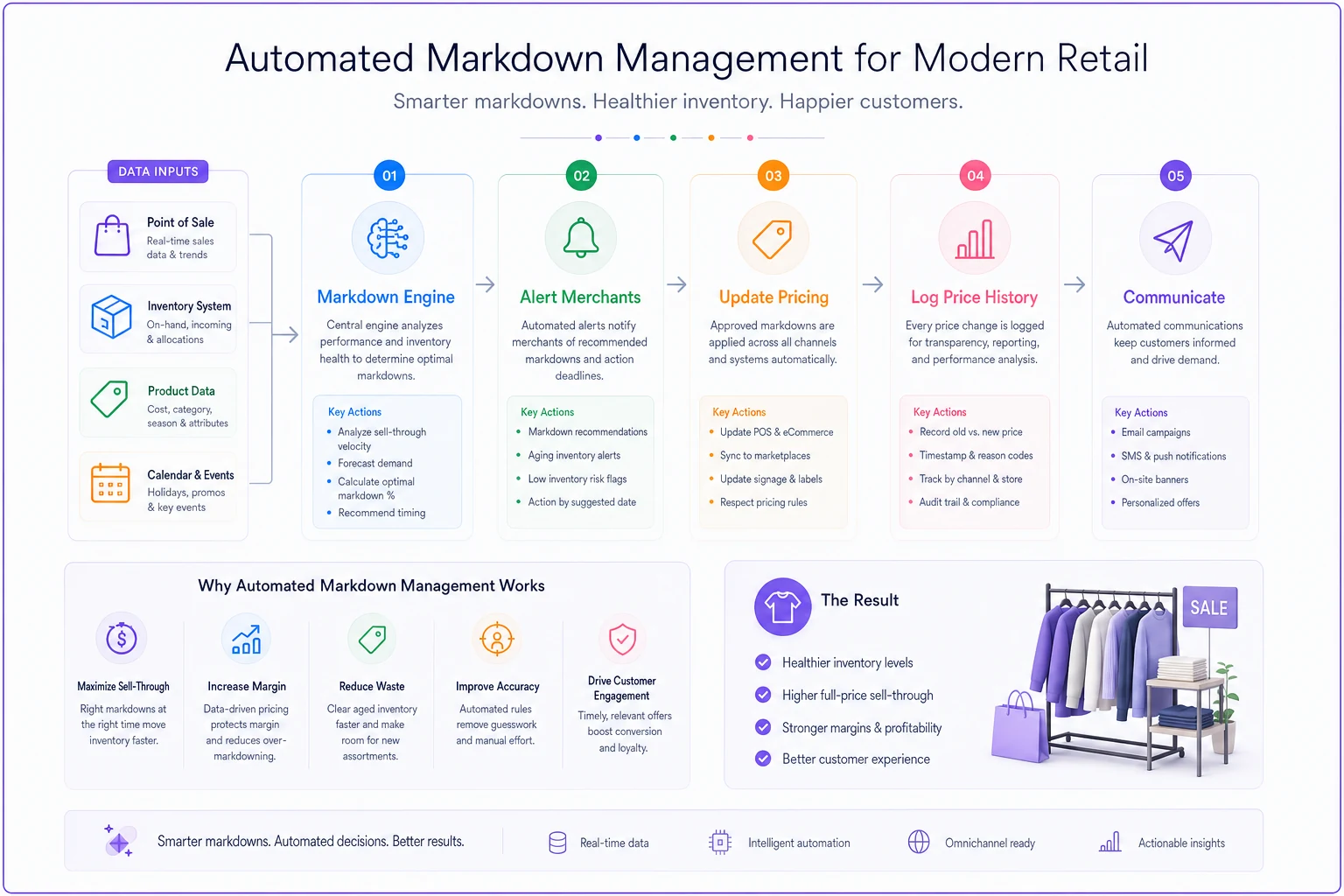
AI-powered analysis can also surface patterns you'd likely miss manually—maybe your technical shells consistently need earlier markdowns than fashion puffers, or size XS and XXL need different markdown timing than core sizes. Those kinds of insights refine your calendar season over season without requiring you to dig through data every week. Once the system is calibrated to your buying patterns, it starts working more like a second set of eyes than a reporting tool.
Common Markdown Mistakes That Kill Margin
Even with a solid calendar, execution errors undermine results. A few patterns that consistently destroy outerwear margins:
Marking down winners with losers. Your best-selling black parka doesn't need the same markdown as the orange one nobody wanted. SKU-level management prevents this costly mistake.
Ignoring size curves. If you're selling through medium and large but sitting on XS and XL, size-specific markdowns preserve margin on core sizes while still moving problem inventory.
Panicking over weather fluctuations. A warm November might delay purchases, but customers still need coats when cold weather arrives. Patience through a weird weather stretch prevents unnecessary early markdowns.
Competing with yourself. Marking down current season goods while last season's clearance inventory still sits there confuses customers and cannibalizes full-price sales.
Breaking your own rules. The calendar exists to prevent emotional decisions. Stick to the plan unless data genuinely supports deviation.
Building Your Implementation Plan
Converting from reactive to calendared markdowns takes some upfront preparation. Work through these steps before the season starts:
-
Analyze last season's data. When did you markdown? What triggered it? What was the margin impact? This baseline shows where the improvement opportunity actually is.
-
Categorize your SKUs. Not every style needs the same strategy. Core basics, fashion items, and premium pieces might follow different calendars.
-
Set your thresholds. Use the framework above as a starting point, then adjust based on your specific situation.
-
Create communication templates. Write these before the season starts. Emotional decisions during selling season lead to desperate-sounding messaging.
-
Build tracking systems. Whether spreadsheets or software, you need daily visibility into sell-through by SKU.
-
Train your team. Everyone needs to understand why calendar discipline matters. One rogue markdown decision can undermine the entire strategy.
-
Document and adjust. Track what works and what doesn't. Next season's calendar should reflect this season's learnings.
Automate daily sell-through alerts to keep the calendar honest and reduce manual errors.
Document and adjust. Track what works and what doesn't. Next season's calendar should reflect this season's learnings.
The Real Impact on Your Business
A boutique outerwear retailer in Minnesota implemented calendared markdowns three seasons ago. Previously, they'd run standard January clearance sales—typically moving to 40–50% off everything after the holidays.
Their first season with calendared markdowns:
-
Average selling price increased from roughly $180 to $235
-
Sell-through by February improved from 78% to 87%
-
Overall margin jumped from around 38% to 46%
-
Customer complaints about "missing sales" initially increased, then dropped as shoppers learned the new pattern
The owner put it simply: "Customers actually prefer knowing when markdowns happen. They can plan purchases instead of gambling on whether to wait."
That psychological shift matters as much as the financial one. Instead of training customers to wait for desperation pricing, you're creating predictable value moments throughout the season. Customers stop holding out for the panic sale because they know one isn't coming.
Making Markdowns Strategic, Not Desperate
Timed markdowns for outerwear aren't about avoiding discounts entirely. They're about controlling when and why you sacrifice margin. Every markdown should be intentional, data-driven, and part of your broader inventory strategy.
The calendar creates discipline. The thresholds provide clear decision points. The communication templates maintain brand perception. Together, they transform markdowns from margin-killing necessities into something you can actually plan around.
Some SKUs will still require aggressive clearance. Weather will still impact sales unpredictably. But with a calendared system, these become exceptions to manage rather than the default operating mode. Your outerwear margins depend more on when you markdown than whether you markdown—build the calendar, stick to the system, and the preservation percentages tend to take care of themselves.
Ready to elevate your apparel business?
Join 2,000+ retailers using Werzly to streamline operations, increase sales, and deepen customer loyalty.