


Your return rate sits at 24% while the boutique across town runs at 12%. Same neighborhood, similar price points, comparable brands. The difference? They fixed their product pages three months ago and changed how their fitting rooms handle uncertainty.
Returns kill apparel margins faster than markdowns. Processing costs somewhere between $8–12 per item. Lost selling time while inventory sits in transit. Customer acquisition costs that generate zero profit when the item comes back. Most clothing stores treat returns as inevitable, but the operational patterns tell a different story — stores that align product presentation with customer expectations consistently run return rates below 15%.
The disconnect between online promise and in-store reality
Product pages create expectations. When those expectations miss reality, returns follow. You see this pattern everywhere in apparel retail, especially when stores rush to add online selling without updating how they present products.
A typical scenario: customer orders a "dusty rose" sweater based on studio photos shot against a white background. The actual sweater arrives looking more mauve under normal lighting. Or they buy "relaxed fit" jeans expecting comfortable room, but the cut runs smaller than anything else they own in that size. These aren't defective products — they're expectation failures.
The measurement proves it. Track return reasons for 30 days and you'll find roughly 40% cite "not as described" or "different than expected." Another 25–30% mention fit issues that better sizing info would have prevented. The remaining returns split between impulse regret and genuine defects.
What makes this worse is that stores commonly use supplier photos without modification. Those images were shot to sell to buyers at trade shows, not to set accurate expectations for end customers. The lighting, angles, and styling all optimize for initial appeal rather than realistic representation.
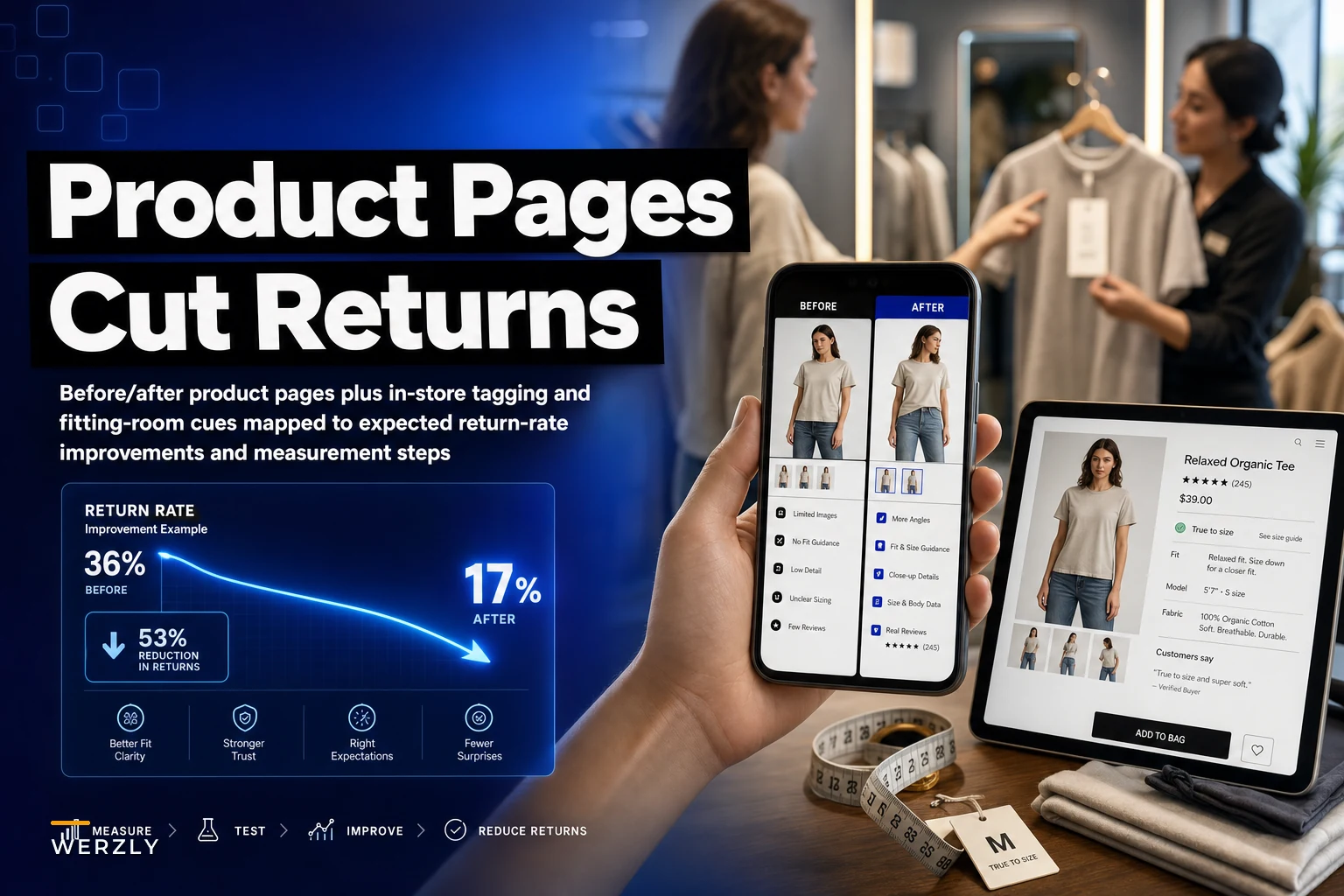
Before vs. after: product page elements that cut returns
Here's what actually moves the needle on return rates when you fix product pages:
Take control of your clothing store operations.
Werzly helps you manage stock, process orders, and engage customers effortlessly.
- Unified inventory and order management
- Automated customer notifications
- Sales and stock analytics
No credit card required
Photography changes:
Before: Single front-view photo on white background, supplied by vendor After: 4–5 photos including natural lighting, on-model shots, detail close-ups, and styled outfit examples
Before: Generic size chart buried on a separate page After: Item-specific measurements displayed prominently with "runs large/small/true to size" callouts based on actual customer feedback
Before: Basic color names like "blue" or "green" After: Detailed color descriptions like "navy with subtle gray undertones" plus comparison references ("similar to classic Levi's dark wash")
Description improvements:
Before: Marketing copy about style and trend relevance After: Practical details about fabric weight, stretch percentage, care requirements, and opacity
Before: Standard size guide applied to all items After: Product-specific fit notes mentioning where items run differently ("size up if between sizes" or "relaxed through hips, fitted at ankle")
The results show up fast. One boutique with around 400 SKUs reduced returns from 22% to 14% within 60 days of updating their product content. They spent roughly 3 hours per week maintaining accurate descriptions and gathering fit feedback — not a huge lift.
In-store tagging that prevents fitting room surprises
Physical stores have an advantage online retailers don't — customers can touch, try, and evaluate before buying. Most stores waste this by relying on generic tags and passive fitting room experiences.
-
"Fits small, consider sizing up"
-
"Dry clean only — budget $8–12 per cleaning"
-
"Sheer fabric, requires layering"
-
"No stretch — fits close to body"
These feel counterintuitive at first. Won't they discourage purchases? Not really. Customers who buy with full information return around 65% less often than those who discover issues after the fact. The slight drop in impulse buys gets offset by reduced processing costs and better long-term trust.
Tag placement matters too. Attach fit warnings at eye level on hangers, not tucked inside garments where nobody sees them. For online orders picked in-store, include these same warnings on packing slips. One store printed small cards with common warnings and attached them during receiving — added maybe 30 seconds per item but cut "surprise returns" by roughly half.
Fitting room interventions that surface doubts before purchase
The fitting room is where customers either confirm their choice or start having doubts they'll act on later — usually at the post office three days from now. Most stores treat fitting rooms as passive spaces, which is a missed opportunity.
The two-minute check: Train staff to check on customers after 2–3 minutes, not immediately. Ask specific questions: "How's the fit through the shoulders?" rather than a generic "How's everything?" Specific questions surface specific doubts that customers might otherwise suppress until they get home.
The movement test prompt: Post signs encouraging customers to sit, bend, and raise their arms while trying things on. Include a mirror at sitting height. Jeans that look perfect standing might gap at the waist when sitting. A blazer might restrict arm movement you'd never catch in a static pose.
The lighting reality station: Install a couple of different lighting options in fitting rooms — bright white, warm yellow, and a dimmer evening light. Let customers see how colors and fits look in different settings. That "perfect for the office" dress might read very differently under fluorescent lights.
Encourage staff to model the movement test so customers see how garments behave in motion.
The doubt card system: Place cards in fitting rooms listing common return triggers: "unsure about fit," "questioning color match," "worried about care requirements," "not sure it's worth the price." Encourage customers to hand relevant cards to staff, who can then address concerns directly or suggest alternatives.
Measurement framework and return rate tracking
You can't improve what you don't measure consistently. Most stores track overall return rates but miss the detailed patterns that actually point to fixes.
Build this simple tracking system:
| Return Reason Category | Target % | Current % | Primary Fix |
|---|---|---|---|
| Fit issues | <8% | Track here | Size-specific feedback on product pages |
| Color/appearance mismatch | <5% | Track here | Better photography and descriptions |
| Quality/defect | <3% | Track here | Receiving inspection process |
| Changed mind/impulse | <6% | Track here | Fitting room interventions |
| Wrong item/size shipped | <1% | Track here | Pick/pack accuracy checks |
Track at SKU level when you can. You'll find problem items quickly — that one dress generating 40% returns because the fabric photographs completely differently than it appears in person. Fix or discontinue these return magnets. For online sales, add a required return reason field to your process. For in-store returns, train staff to ask and record specific reasons rather than just processing the transaction and moving on.
Implementation timeline and resource requirements
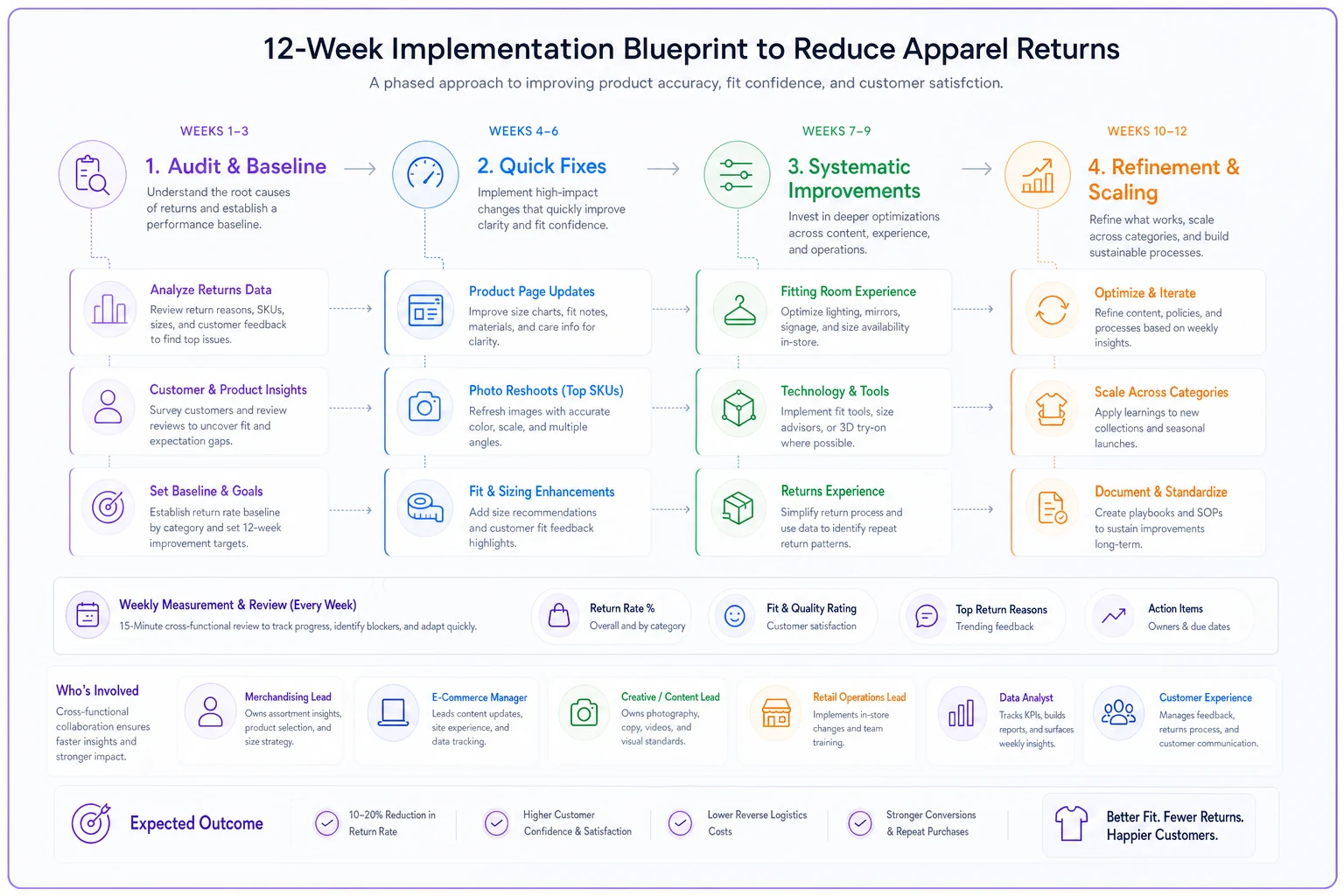
Don't try fixing everything at once. The stores that see lasting improvement tackle return rates in phases:
-
Week 1–2
Audit and baseline
— Pull return data for the past 90 days, categorize reasons using the framework above, identify your top 10 problem SKUs, and calculate the true cost per return including labor. -
Week 3–4
Quick fixes
— Update product pages for problem items, add fit notes to existing descriptions, create basic warning tags for common issues, and brief staff on fitting room check-ins. -
Week 5–8
Systematic improvements
— Reshoot photos for high-return items, implement consistent measurement documentation, install fitting room improvements, and build return reason tracking into daily operations. -
Week 9–12
Refinement and scaling
— Expand successful changes to the full catalog, create templates for common fit issues, develop a library of reusable product warnings, and establish weekly return pattern reviews.
The resource commitment stays manageable. Figure 4–6 hours weekly for a store with 300–500 active SKUs. Most of that time goes toward product page updates and photo management. The fitting room changes need a one-time setup, then just consistent staff execution.
Most of that time goes toward product page updates and photo management. The fitting room changes need a one-time setup, then just consistent staff execution.
The compound effect of expectation alignment
Every prevented return creates compound benefits. The obvious savings in processing and shipping. But also: inventory stays available to sell, customer satisfaction improves, and repeat business increases.
A store running 25% returns essentially needs a third more inventory just to maintain availability. Drop that to 15% and you free up meaningful working capital without buying a single additional unit.
Customers remember their return experiences more vividly than their purchases. The hassle of repackaging, driving somewhere, waiting for a refund — it all creates friction that quietly reduces future buying. When customers get exactly what they expected, that friction disappears.
The math becomes clear pretty quickly. Spending 5 hours weekly on better product content and fitting room processes to prevent 30–40 returns saves roughly $300–400 in processing costs alone. Add the recovered margin from those items actually staying sold, and the ROI hits 3–4x within the first quarter.
Beyond individual fixes: building return prevention into operations
During receiving: Flag items that photograph poorly or run differently than similar styles. Add notes to the product database immediately rather than waiting for returns to reveal the issue.
During merchandising: Position problem items where staff can provide guidance. That silk blouse requiring expensive dry cleaning? Display it where associates naturally engage customers rather than tucking it away on a back rack.
During selling: Train staff to proactively mention care requirements, fit quirks, and styling challenges. Better to lose a sale than process a return.
During analytics reviews: Weekly return pattern checks should be as routine as sales reviews. Which items returned this week? Why? What can be fixed before next week?
Modern operational software can centralize this return prevention data, making it easier to spot patterns across channels and flag high-risk items before they become a recurring problem. But even manual tracking in a spreadsheet beats the standard approach of just accepting returns as inevitable.
The reality check most stores need
Most apparel retailers don't fix their return problems because they assume customers return items because customers are difficult. The operational reality says otherwise — customers return items because stores set wrong expectations.
That customer who returns three items a month? They're responding rationally to unclear product information. Fix the information, the returns drop. This pattern holds across every store type and price point.
Start with your highest-return SKU. Update its product page with honest descriptions and multiple photos. Add warning tags in-store. Have staff mention its quirks during fitting room check-ins. Watch that item's return rate over the next 30 days. Then expand to your top five problem items. Then ten. Within 90 days, you'll have systems that prevent returns rather than just process them efficiently.
The boutique across town with 12% returns didn't get lucky with better customers. They got systematic about setting accurate expectations. Their product pages show items honestly. Their fitting rooms surface doubts before purchase. Their staff prevents returns rather than just processing them cheerfully.
Your return rate tells the story of your operational precision. High returns mean broken expectation-setting. Fix the product pages, adjust the in-store experience, measure the right patterns. The customers haven't changed — but their satisfaction will when what they receive matches what they expected.
Ready to elevate your apparel business?
Join 2,000+ retailers using Werzly to streamline operations, increase sales, and deepen customer loyalty.