

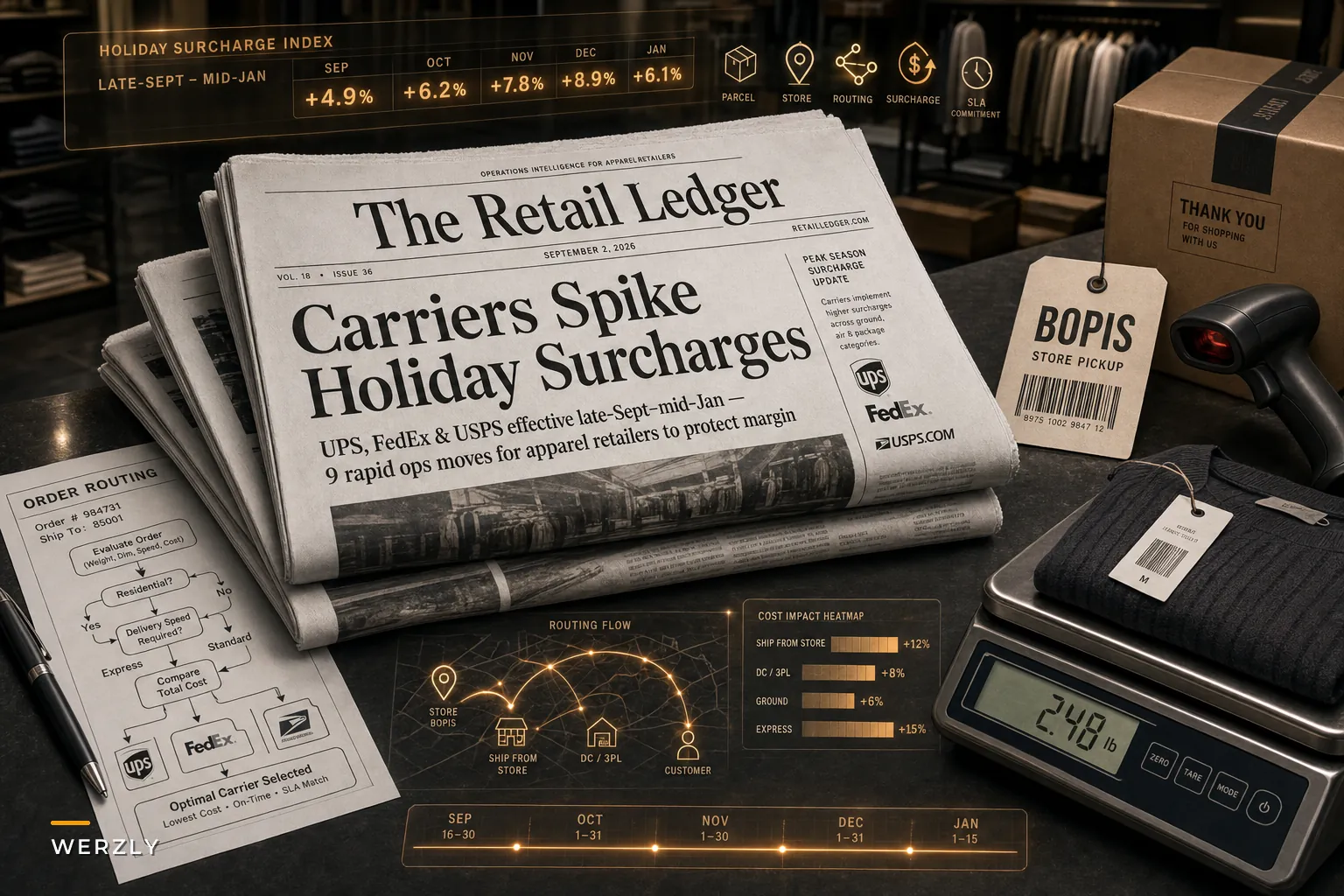

The parcel carriers dropped their 2026 peak-season pricing in late August, and if you ship any meaningful volume, the numbers deserve a slow read. UPS is layering higher demand and handling surcharges onto its schedule for the holiday window, as Supply Chain Dive reported, and USPS confirmed a temporary peak-season price increase running from October through mid-January. Translation: every box you send between now and the post-holiday return wave costs more, and the increase lands squarely on the season where you ship the most.
For a fashion boutique selling $34 tees and $58 dresses, that's not a rounding error. When your average order is low-ticket, a couple extra dollars of surcharge per package eats a real slice of the margin you fought all year to keep. So this isn't a "raise prices and move on" situation. It's an operations problem — carrier choice, fulfillment mix, promo thresholds, staffing — and the shops that adjust now will quietly outperform the ones that discover the damage on their January P&L.
Below are nine moves worth making before your peak volume hits. Not all of them apply to every store. Pick the ones that match your order profile.
First, actually understand which packages the surcharges hit hardest
Before you touch anything, pull your last holiday season's shipping data and sort it. The surcharges aren't flat — they're weighted toward specific package types, weight bands, and delivery speeds. What turns up pretty consistently across small apparel shops is that owners feel their shipping got expensive but can't point to which orders are actually driving it.
A typical breakdown once you dig in:
| Order type | Share of holiday shipments | Rough per-package cost impact |
|---|---|---|
| Single low-weight item (tee, accessory) | ~45% | Small surcharge, but high volume = adds up fast |
| Multi-item apparel orders | ~30% | Moderate — dimensional weight starts to bite |
| Bulky/heavy (coats, boots, denim stacks) | ~15% | Highest per-package surcharge exposure |
| Expedited/2-day requests | ~10% | Peak surcharges plus speed premiums stack |
Your biggest count is usually the cheap single items, but your biggest bleed per order is the bulky and expedited stuff. You defend those two ends differently. Cheap-and-frequent gets fixed with thresholds and packaging. Bulky-and-expensive gets fixed with fulfillment routing.
Skip this step and you'll apply the same blanket fix everywhere, which almost always over-corrects on orders that were never the problem.
1. Recalculate your free-shipping threshold — don't just nudge it
Most stores set a free-shipping floor once and never revisit it. With surcharges rising, that floor may now be underwater on a chunk of orders — meaning you're eating shipping plus the surcharge on baskets that barely clear the line.
Take control of your clothing store operations.
Werzly helps you manage stock, process orders, and engage customers effortlessly.
- Unified inventory and order management
- Automated customer notifications
- Sales and stock analytics
No credit card required
Run the actual math. If your blended shipping cost per order climbs from around $8 to somewhere in the $10–$11 range during peak, and your gross margin on apparel sits near 55%, then a $75 free-shipping order needs to generate roughly $18–$20 of contribution just to cover the ship cost before anything falls to profit. That changes what your threshold should be.
Two practical paths:
-
Raise the threshold modestly (say $75 to $95) to push baskets up
-
Or keep the threshold but exclude bulky items, since coats and boots are where dimensional surcharges hurt most
The mistake to avoid: killing free shipping entirely mid-season. Conversion drops hard when you do that during a period when shoppers are comparison-buying constantly. Adjust the number, don't remove the offer.
2. Rebuild your carrier decision as a per-order rule, not a habit
A lot of shops default to one carrier out of habit or a legacy account rate. But the 2026 surcharge structures shift the math by package type — the carrier that's cheapest for a lightweight tee might be the worst option for a heavy coat.
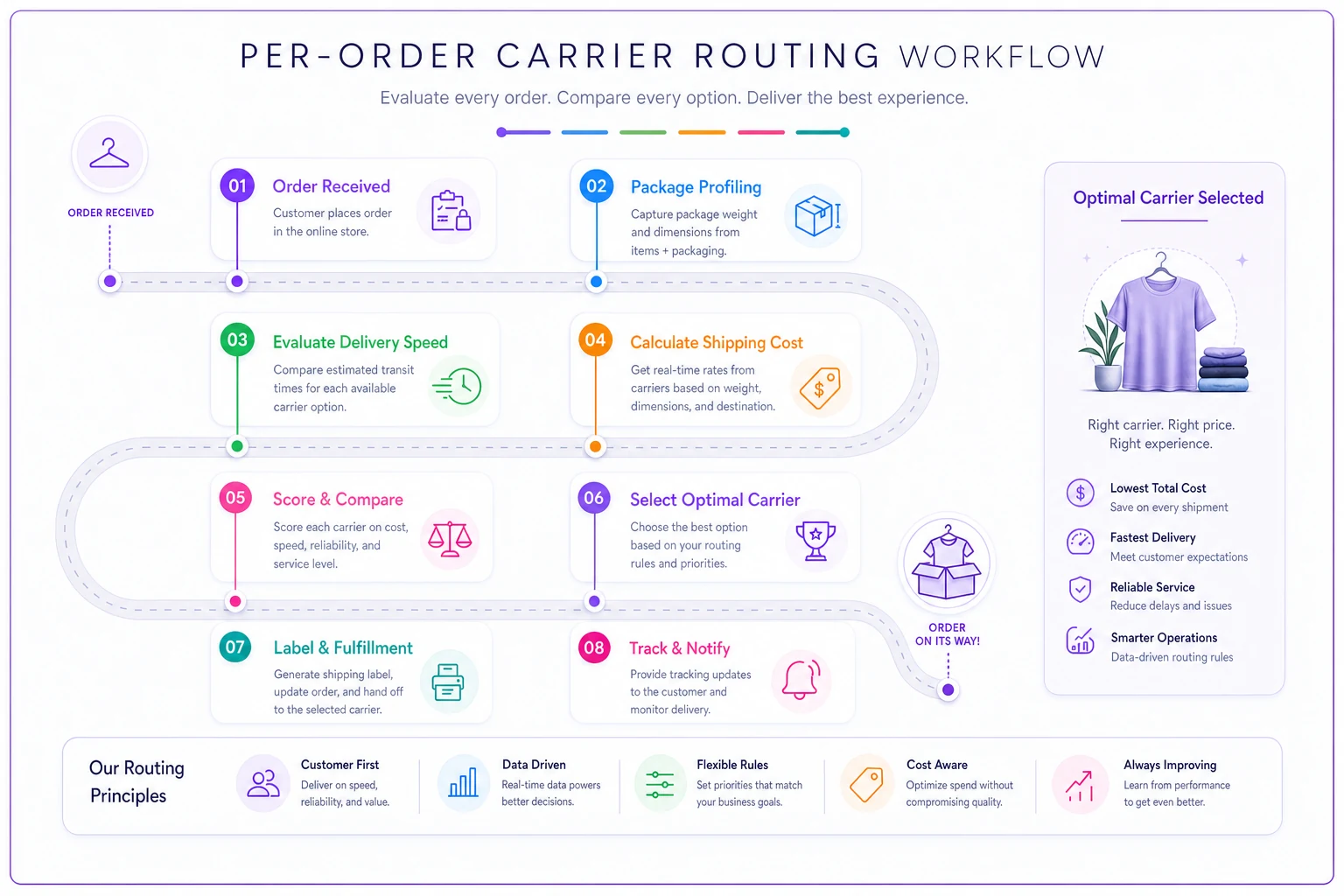
This visual shows a simple decision flow for routing each order to the carrier that minimizes surcharges while meeting delivery expectations.
-
Under 1 lb, non-urgent → cheapest ground option, likely postal
-
1–3 lb multi-item → compare the two lowest ground rates weekly, they'll flip
-
Bulky/heavy → whichever carrier's dimensional surcharge is gentler for that box size
-
Customer-paid expedited → pass the real cost through, don't subsidize speed at peak
Worth noting: carrier pricing during peak isn't static. The relative advantage shifts week to week as surcharge tiers kick in on different dates. Reviewing this once in September and locking it in for the season is how stores overpay for two months straight.
3. Attack dimensional weight with better packaging
This one's unglamorous and it's also where a lot of quiet savings live. Dimensional weight pricing charges you for the space a box takes, not just the weight. Apparel is light but people ship it in oversized boxes out of habit, and every surcharge tier is calculated against that inflated dimension.
A real example: a boutique shipping folded sweaters in a 12x12x6 box was getting dinged on dimensional weight. Switching most soft-goods orders to poly mailers and right-sized small boxes dropped their average dimensional charge enough to save roughly $1.50–$2 per applicable order. Across a few thousand holiday shipments, that's real money — the kind that funds a January markdown budget instead of vanishing into carrier fees.
Audit your packaging mix before peak:
-
Soft, unbreakable items → poly mailers, always
-
Multi-item → smallest box that fits, not the "one box fits most" default
-
Keep two or three box sizes stocked, not one giant catch-all
Keep a couple of right-sized poly mailer sizes and one compact box size on hand to avoid last-minute oversized packing.
Across a few thousand holiday shipments, reducing dimensional weight even slightly compounds into a meaningful line-item saving.
4. Push in-store pickup and local delivery hard this season
This is the biggest lever and the most under-used by small stores. Every order a customer picks up in-store is an order with zero carrier surcharge. Every local delivery you run yourself dodges peak parcel pricing entirely. When shipping gets more expensive, the economics of pickup improve by comparison — the gap widens exactly when you need it to.
The problem is that most shops treat pickup as an afterthought with no real process behind it, so it stays a tiny fraction of orders. If you want it to actually absorb volume during peak, you need clean pickup workflows, clear SLAs, and staff who know the handoff cold. That operational side is worth setting up properly — the BOPIS and ship-from-store playbook walks through the SLA and routing structure that keeps pickup from turning into chaos when volume spikes.
Simple ways to shift demand toward pickup:
-
Make "free pickup today" the default, most-visible option at checkout
-
Offer a small pickup-only incentive (a discount code, free gift-wrap)
-
For local ZIP codes, surface a same-day local delivery option instead of parcel
If you want pickup to actually absorb volume during peak, the operational side needs to be set up properly so the customer experience stays smooth as order counts rise.
When leaning on pickup makes sense — and when it doesn't
Pickup and local delivery are genuinely useful during surcharge season, but they're not a fit for everyone. If most of your customers live far from the store, or you're a primarily online brand with a national base, you can't pickup your way out of the problem.
Where it does make sense: neighborhood boutiques, stores with strong local followings, and anyone whose online orders already skew toward nearby ZIP codes. If a meaningful share of your shipped orders are going to addresses within a few miles, you're currently paying carriers to move packages you could hand off yourself.
Who should skip this: single-person shops with no bandwidth to run deliveries during the busiest weeks of the year. Adding a delivery route you can't staff creates worse problems than the surcharge. Be honest about capacity.
5. Reprice your bulky SKUs before the surcharges land
Coats, boots, and denim carry the worst surcharge exposure and often the thinnest room to absorb it. Rather than eating that quietly, bake the peak cost into the price or shipping treatment for those specific items now.
You don't need a store-wide price hike. A $2–$3 shipping-cost bump on a $140 coat is trivial to absorb in the price. The same bump on a $28 accessory is not. Segment your catalog by surcharge exposure and adjust only where it matters, so you're not sending the wrong signal to price-sensitive shoppers on your entry-level items.
Owners are often hesitant to touch prices during the holiday stretch, so they eat every cost increase and wonder why margin cratered in Q4. Selective, quiet repricing on bulky items is far less risky than a season of silent bleed.
6. Tighten your promo thresholds so shipping doesn't erase the discount
Here's a trap worth spelling out. You run a "20% off site-wide" holiday promo, and a shopper stacks it on a small order that also qualifies for free shipping. Now you've discounted the item and eaten a peak surcharge and covered the shipping. That order can go negative fast.
Set guardrails:
-
Free shipping and site-wide discounts shouldn't fully stack on low-ticket orders
-
Raise the free-shipping floor slightly during any percentage-off promo
-
Watch your smallest qualifying orders — that's where combined offers go underwater
Each offer looks fine in isolation. It's the combination on a small basket, hit with a higher surcharge, that quietly loses money. Model your worst-case stacked order before launching the promo, not after.
7. Prep staffing for the fulfillment mix shift
If moves 4 through 6 work, your fulfillment mix changes — more pickups, more local deliveries, fewer expensive parcel shipments. That's the goal, but it moves labor around. In-store pickup means more receiving, staging, and customer handoffs on the floor. You need people positioned for that, not just covering register and packing.
A realistic scenario: a shop that historically ran two people on ship-out during peak might now want one on packing and one dedicated to pickup staging and handoffs, because pickup volume tripled after they made it the default checkout option. Same headcount, different assignment. Plan the shift now so December isn't the moment you discover nobody's covering the pickup counter.
8. Communicate cutoff dates aggressively and early
Surcharges get worse on expedited shipping during peak, and last-minute shoppers are the ones demanding it. The fix is demand shaping — publish your shipping cutoff dates everywhere, early, so more orders come in during the window where you can use cheaper ground options.
Every order that arrives with enough runway for ground shipping is an order that dodges the expedited surcharge stack. Stores that bury their cutoff dates end up with a flood of "need it by Christmas" requests that force them into the most expensive service tiers exactly when those tiers cost the most.
Make cutoffs visible on:
-
Homepage banner
-
Product pages
-
Cart and checkout
-
Email and any SMS list you run
Publish the cutoff dates early and in multiple places so shoppers know the window for cheaper ground delivery well before they start last-minute shopping.
9. Track your true landed fulfillment cost weekly, not at season's end
The biggest reason surcharges hurt small stores is timing of awareness. The fees quietly accrue for three months, and the owner doesn't feel the weight until the January reconciliation — by which point every one of those expensive shipments is already gone.
Set up a weekly glance at your blended fulfillment cost per order. It doesn't need to be elaborate. You want to catch the trend line moving so you can adjust thresholds, packaging, or routing mid-season while it still helps. This is where having your order, shipping, and cost data connected in one place — instead of scattered across the carrier portal, your POS, and a spreadsheet — actually pays off. You see the number climbing in week two instead of learning about it in week fourteen.
The stores that come through peak with intact margins aren't the ones who guessed right in September. They're the ones watching the number weekly and nudging the levers as the surcharge tiers roll in.
A quick real scenario
A small women's apparel boutique — one physical location, decent local following, maybe 40% of orders shipping within 15 miles — went into last peak season shipping everything through a single default carrier with a $60 free-shipping floor. Their blended ship cost crept from about $7.50 to over $10 during peak, and post-holiday they realized shipped-order margin had thinned noticeably across Q4.
Going into this season they did four things: made in-store pickup the default checkout option, added same-day local delivery for nearby ZIPs, switched soft goods to poly mailers, and raised the free-shipping floor to $85. Pickup went from a small slice of orders to roughly a quarter of them. Their blended fulfillment cost per order held far closer to flat despite the higher surcharges, mostly because a big chunk of orders simply stopped touching a carrier at all.
Nothing exotic. Just routing more volume away from the fees and right-sizing the offers around them.
The underlying issue this exposes
Rising surcharges aren't really the problem — they're the thing that reveals whether your fulfillment operation has any flexibility built in. Shops that ship everything one way, through one carrier, with one static free-shipping rule, have no room to maneuver when the cost structure shifts under them. Shops with multiple fulfillment paths and a habit of watching their real costs just reroute demand and move on.
The carriers will keep adjusting peak pricing every year. That part's out of your hands. What's in your hands is building a fulfillment setup with enough optionality that a surcharge announcement in August becomes a Tuesday afternoon of adjustments rather than a January gut-punch.
Make the moves that fit your store now, keep an eye on the weekly number, and let the customers who can pick up in-store do exactly that.
Ready to elevate your apparel business?
Join 2,000+ retailers using Werzly to streamline operations, increase sales, and deepen customer loyalty.