

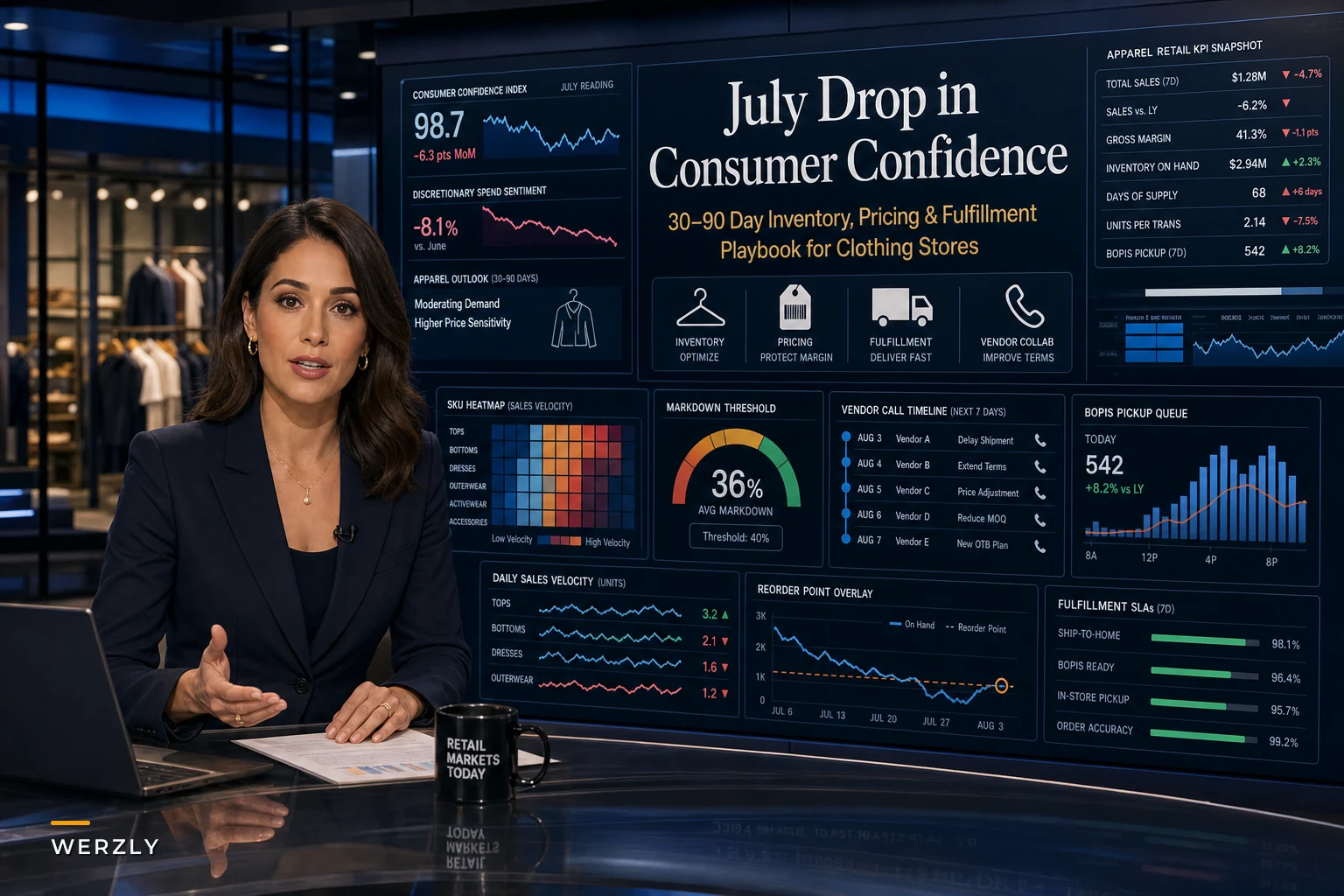

Consumer confidence dropped to 90.8 in July—down from 92.2 in June, per The Conference Board's latest release. Not a catastrophic plunge, but enough to signal that shoppers are getting more cautious about discretionary spending.
For clothing store owners, the timing is rough. Fall inventory is arriving daily, back-to-school product needs to move, and late-summer merchandise should already be clearing. When that pressure collides with cooling demand, most stores make reactive calls that compound the problem rather than contain it.
The predictable response: slash prices across the board, freeze all reorders, or do nothing and hope August traffic saves you. None of those are strategies.
After watching a lot of clothing stores work through similar dips, the ones that protect cash flow don't panic—they make specific operational adjustments in the first 30 days, then calibrate from there.
The 30-Day Sprint: Immediate Moves That Actually Matter
Your first month isn't about predicting whether confidence bounces back. It's about creating operational flexibility so you're not trapped if it doesn't.
Start with your actual inventory position—not what's on your balance sheet, but what's physically sellable right now.
Pull every SKU that's been sitting more than 45 days without a single unit sold in the last two weeks. That's your markdown pool. Don't hold it for Labor Day. Move it now at 30–40% off while customers still have some spending appetite.
Most owners hesitate because they're calculating margin on individual pieces. The problem is that carrying costs on slow-movers during a confidence dip will eat more margin than an aggressive early markdown ever would. One store in Minneapolis I worked with had $47,000 in 60-plus-day inventory spread across 312 SKUs. After marking to 35% off, they recovered around $29,000 in working capital within three weeks—cash they needed for rent and payroll, not just a metric to feel good about.
-
Start with your actual inventory position—not what's on your balance sheet, but what's physically sellable right now. Pull every SKU that's been sitting more than 45 days without a single unit sold in the last two weeks. That's your markdown pool. Don't hold it for Labor Day. Move it now at 30–40% off while customers still have some spending appetite.
-
Next, look at your incoming orders. Call every vendor with deliveries scheduled in the next 30 days. You're not canceling—you're asking for 2–3 week delays. Most vendors would rather push the ship date than lose the order entirely. If they won't move on timing, push for payment terms. Even flipping from COD to Net-15 buys you real breathing room.
-
Staffing is worth a quick adjustment too. Don't cut hours yet—redistribute them. Pull one person from the sales floor and put them on inventory management. Have them physically count your top 50 SKUs every day and keep your available-to-sell numbers accurate. When confidence softens, inventory accuracy matters more than it does during busy season. Every oversell or mis-pick costs you more than it normally would.
A simple visual of the 30-day sprint workflow can help align the team on priorities.
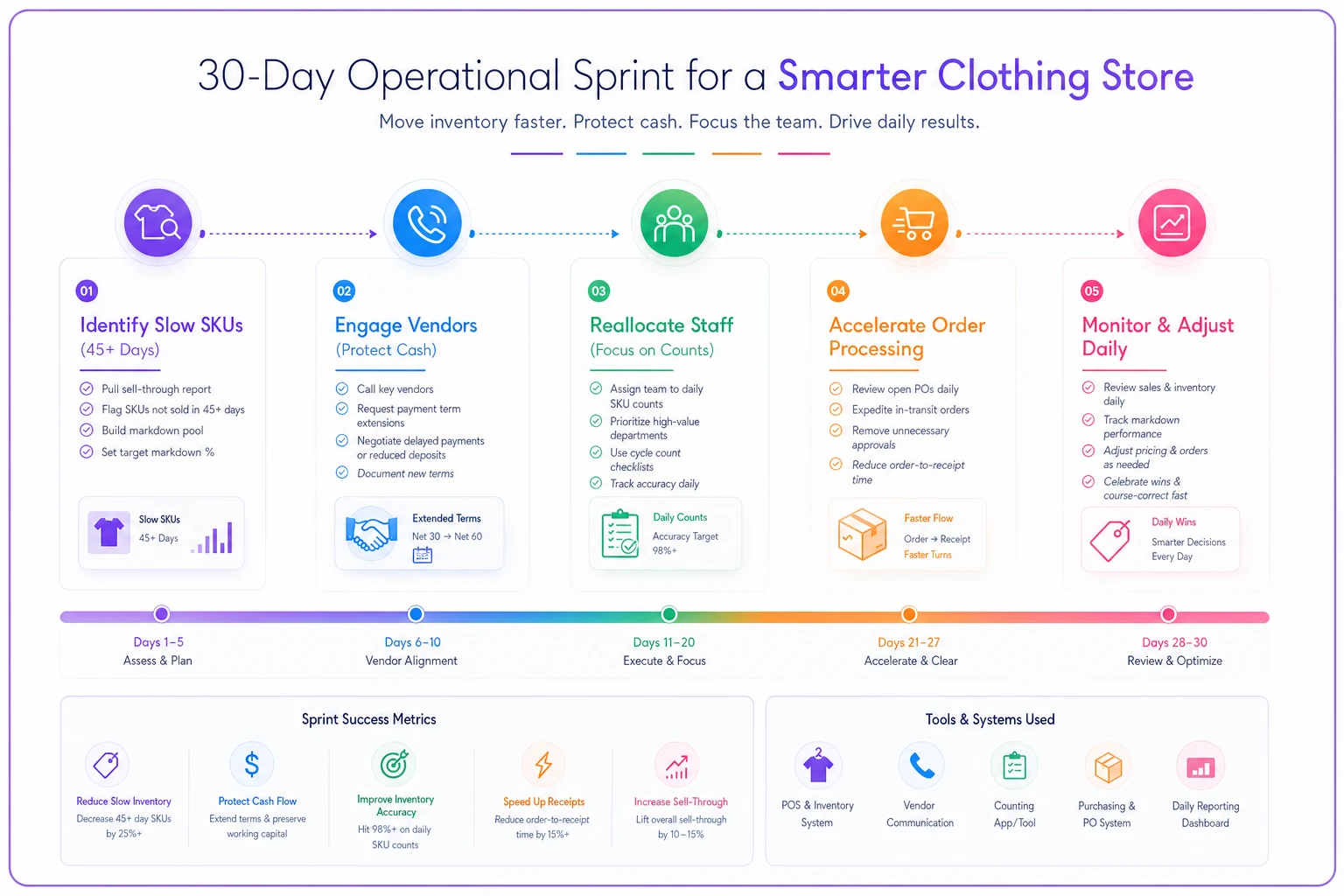
Use it to align vendor calls, markdowns, and staffing over the first 30 days.
Weeks 5–8: The Pricing and Promotion Recalibration
Once you've stabilized the immediate situation, the second month is about surgical pricing—not blanket discounts.
Take control of your clothing store operations.
Werzly helps you manage stock, process orders, and engage customers effortlessly.
- Unified inventory and order management
- Automated customer notifications
- Sales and stock analytics
No credit card required
Confidence drops don't hit every category equally. Pull your last 30 days of sales data and rank categories by velocity change. Basics and essentials tend to hold. Trendy pieces and higher price points slow first. That tells you where promotional energy is actually worth spending.
Bundle slow movers with steady sellers at a modest discount rather than marking down the slow stuff in isolation. A boutique in Austin paired graphic tees (stalled) with plain camis (steady) at 15% off the combined price. They moved about 70% of their stuck graphic tee inventory without wrecking the margin on the basics. It's a simple move that's easy to overlook when you're staring at a markdown spreadsheet.
Your email and SMS messaging needs to shift too—away from "new arrivals" and toward value without screaming desperation. "SALE SALE SALE" in the subject line is noise when consumers are already anxious. "Your favorite jacket, now with free shipping" or "Members get early access to our fresh markdowns" lands differently. The psychology matters here.
For online operations, consider dropping your free shipping threshold by $10–15. Small change, real impact on conversion. Watch your average order value daily—if it drops more than 20%, you've cut too far.
Weeks 9–12: The Inventory Reality Check
By month three, you'll have enough real data to make actual decisions about fall commitments.
Run this for every category: (Units sold in last 60 days) × (Gross margin %) × (1 − current markdown rate). If that number is less than your carrying cost for the next 30 days, you need aggressive action. Mark it to 50%+ off, bundle it with full-price items, or if you're running multiple locations, pull it into your highest-traffic store and concentrate it there.
Multi-location retailers often spread weak inventory thin across all stores, which means it moves slowly everywhere. One regional chain moved all their slow-moving denim to a single outlet location, priced at 60% off, and cleared about 85% of it in two weeks. That same inventory had been sitting across four stores for two months prior.
This is also when vendor conversations shift to spring orders. You're not threatening anyone—you're talking about payment flexibility and return arrangements. When consumer confidence is shaky, vendors who offer markdown money or return privileges are worth more than whoever's giving you a slightly better wholesale price. That tradeoff is easy to underestimate.
The Fulfillment Adjustment Most Stores Miss
Nervous consumers don't just buy less—they get pickier about the experience. A fumbled order or a slow pickup creates friction that confirms their hesitation to spend.
Tighten your shipping windows. If you're promising 3–5 days, deliver in 2–3. This isn't about upgrading to expensive expedited shipping—it's about processing orders faster internally. Moving from once-daily order processing to twice-daily is often enough. Morning orders ship same day. Afternoon orders ship next morning.
BOPIS becomes more appealing during confidence dips because it feels lower-risk to consumers. But most stores fumble the handoff—customers walk in and someone has to go hunt in the back. Put your BOPIS zone near the entrance, not tucked away. Assign one person per shift to own it. Arrival to pickup should take under 60 seconds.
Put your BOPIS zone near the entrance, not tucked away.
Returns will spike. Anxious buyers second-guess themselves. Rather than tightening your return window in response, extend it from 30 to 45 days temporarily. It sounds backwards, but removing the urgency around return deadlines actually reduces return rates—because it removes the purchase anxiety that causes buyers' remorse. Track your return rate weekly. If online returns exceed 15%, that's usually a product description problem, not a confidence problem.
The Data Points That Actually Matter Right Now
Forget conversion rates and traffic counts for the next 90 days. When confidence softens, those metrics become noise.
Track these instead:
| Cadence | Metrics |
|---|---|
| Daily: | Cash position, inventory turns by category, canceled orders |
| Weekly: | Gross margin after markdowns, weeks of supply by SKU, vendor payment aging |
| Monthly: | Working capital ratio, deadstock dollar value, customer acquisition cost |
Nothing fancy required—a spreadsheet updated consistently every morning is enough. Cash position and inventory turns daily. True gross margin including all markdowns every Monday. Deadstock value at month-end, no rounding up.
A store in Portland built this habit during a previous dip and discovered their actual gross margin was 31%, not the 42% they'd been reporting internally—because nobody was factoring in late-season markdowns. That number, ugly as it was, gave them what they needed to buy smarter the following season and actually improved their cash position despite lower overall sales.
Who Should Skip These Moves Entirely
Luxury boutiques with customers in the top income bracket can mostly ignore this playbook. Their buyers don't move in sync with consumer confidence indexes the way mid-market shoppers do.
If you're selling basics—white tees, underwear, socks—demand is relatively inelastic. Focus on inventory efficiency, not promotional strategy.
And if more than half your revenue comes from private label with 60%+ margins, you have room to sit tight. Hold your prices, accept slower velocity for a quarter, and let the confidence cycle run its course.
The Technology Stack That Makes This Manageable
Running this playbook with spreadsheets and manual counts will overwhelm your team at exactly the moment you need them customer-facing.
Operational software with built-in AI automation is genuinely useful here—not as some magic fix, but as a multiplier for decisions you're already making. Good inventory platforms can flag slow-moving SKUs automatically, suggest markdown levels based on actual carrying costs, and surface items trending toward deadstock before they fully arrive there.
On the pricing side, AI-assisted analytics can test promotional combinations across your catalog and show you which ones moved inventory versus which ones just eroded margin. That distinction is hard to see clearly when you're in the middle of a busy markdown cycle.
Fulfillment is where automation probably saves the most staff time—order routing, inventory allocation, pick list optimization. These are repetitive, high-frequency tasks that pull people away from the sales floor. A solid operational platform handles them quietly in the background.
Similar to the inflation-driven adjustments we covered back in May, the advantage goes to whoever can make fast, informed adjustments without getting paralyzed by too much data or too little of it.
Making It Through the Next Quarter
Consumer confidence recovers—it always does. The question is whether your inventory position and cash flow will let you take advantage when it does.
Stores that survive these dips don't do it through heroic sales pushes or clever marketing. They do it through disciplined operational moves in the first 30 days, careful calibration in the following 60, and honest inventory decisions by day 90.
Start with the basics: identify deadstock, call your vendors, adjust your receiving schedule. Don't wait for August sales reports to confirm what you can already sense. When Reuters reported the July confidence drop, the retailers who were already pulling inventory reports had a head start on everyone drafting sale emails.
The playbook isn't complicated. Execution discipline is what separates stores that come out of this in a stronger position from those still sitting on fall inventory come January. Your next 30 days matter more than the next 90.
The playbook isn't complicated. Execution discipline is what separates stores that come out of this in a stronger position from those still sitting on fall inventory come January.
Your next 30 days matter more than the next 90.
Ready to elevate your apparel business?
Join 2,000+ retailers using Werzly to streamline operations, increase sales, and deepen customer loyalty.