

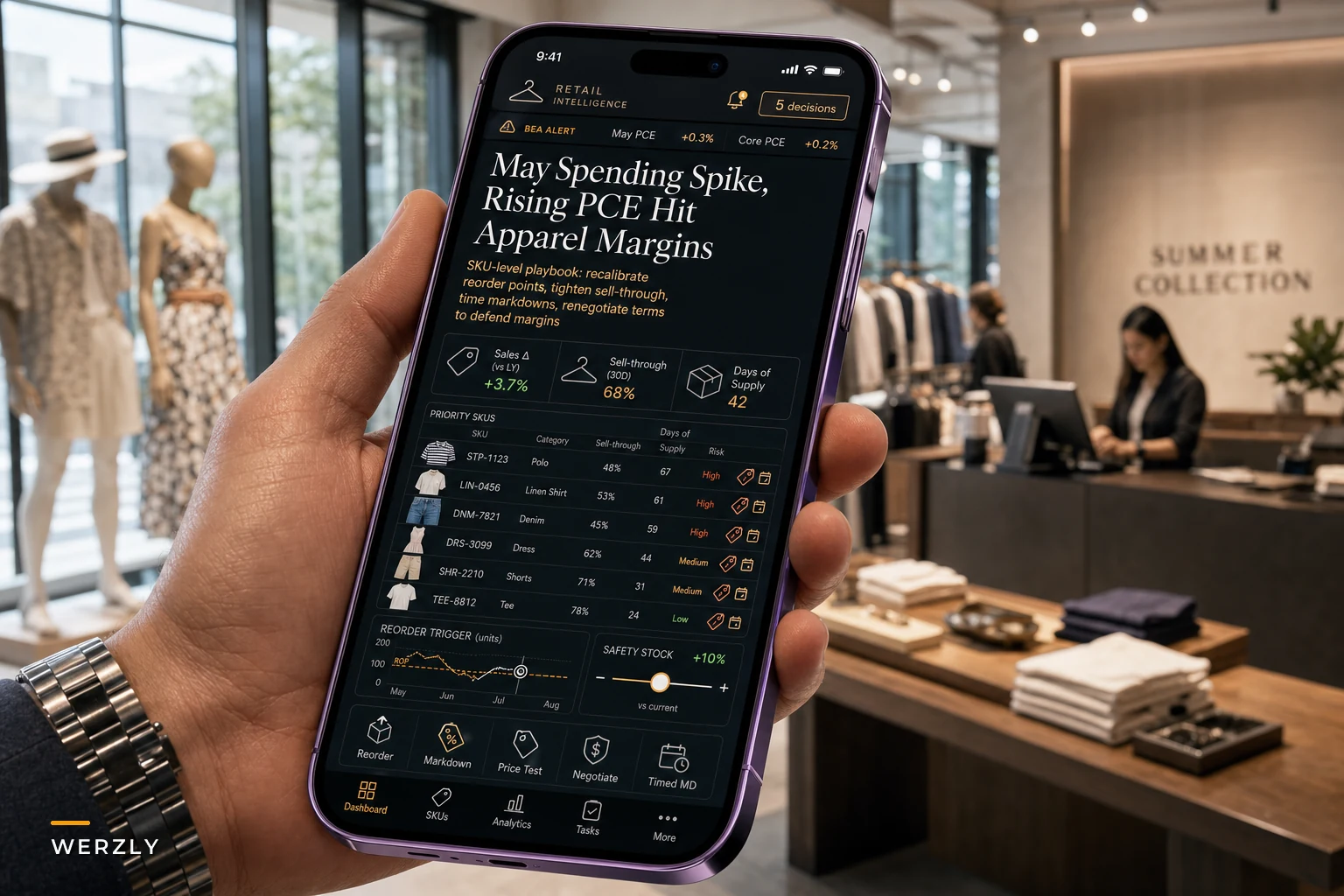

May's retail data genuinely made me rethink a lot of assumptions about current inventory strategy. The BEA's latest report shows PCE inflation hitting 4.1% year-over-year while consumer spending actually accelerated — which creates this weird situation where clothing stores are selling more merchandise at higher prices while margins get squeezed from both directions at once.
The mixed blessing of stronger consumer spending alongside rising costs
You're probably already feeling it. Sales are nominally up, but after accounting for higher wholesale costs, freight increases, and operating expenses climbing faster than retail prices can adjust, the actual profit per transaction keeps shrinking. Buying patterns have gotten genuinely strange too — certain categories flying while others sit longer than anyone expected.
What makes this harder for independent clothing stores specifically is that blanket price increases don't really work. Your customers know your store, know your prices, and they have options. So the margin protection has to come from somewhere else — surgical precision in inventory turns, reorder timing, and markdown decisions.
When sales growth masks what's actually happening
The gap between top-line revenue and real profitability becomes obvious once you start looking at SKU-level performance during inflationary stretches. A boutique owner in Austin walked me through her past quarter — total revenue up 11%, net margin down from 42% to 37%. The issue wasn't just higher wholesale costs. It was the operational chaos that inflation creates across the whole inventory cycle.
Take control of your clothing store operations.
Werzly helps you manage stock, process orders, and engage customers effortlessly.
- Unified inventory and order management
- Automated customer notifications
- Sales and stock analytics
No credit card required
Her denim category tells the story pretty well. Previously reliable sellers split into two camps almost overnight: premium styles customers still bought despite 15% price bumps, and mid-tier options that completely stalled because the new prices pushed them uncomfortably close to premium alternatives. She ended up marking down mid-tier inventory far more aggressively than planned, which ate into whatever gains the premium sales had created.
This kind of volatility spreads across every category. Athletic wear that normally turns in six weeks suddenly moves in three — or sits for twelve. Accessories that were almost afterthoughts become primary purchases as customers reach for smaller indulgences. Basic tees that should be steady fluctuate based on tiny price differences.
Reviewing performance monthly and adjusting orders quarterly doesn't work when conditions shift this fast. You need something that flags performance changes weekly, sometimes daily, especially on categories representing serious inventory investment.
The reorder timing trap
Rising prices create a specific reorder problem that tends to sneak up on stores. Your standard reorder formula — average daily sales multiplied by lead time, plus safety stock — breaks down in a few ways at once during inflationary periods.
When wholesale prices jump between orders, your planned budget buys less inventory. A summer dress you've been reordering at $24 wholesale now costs $28. Your allocated $2,400 for that SKU gets you 85 units instead of 100. That's before you even think about demand.
Then there's the unpredictable price sensitivity layer. Reuters reported strong overall retail sales in May, but the category-level variation underneath that number is massive. A $89 blazer might hold velocity at $95 just fine. A popular $45 cardigan might completely die at $52.
The fix isn't just adjusting reorder points more often. You need to change the underlying calculation. Weight recent weeks more heavily instead of using straight historical averages. Test price increases on a handful of items before rolling them broadly. Build separate reorder triggers for inflation-sensitive versus inflation-resistant items — because treating them the same is where most stores quietly bleed margin.
Practical reorder point adjustments for volatile periods:
| Item Category | Traditional Formula | Inflation-Adjusted Approach |
|---|---|---|
| Premium/Designer | Lead time × daily sales + 2 weeks safety | Lead time × (3-week weighted avg) + 1 week safety |
| Mid-tier fashion | Lead time × daily sales + 10 days safety | Lead time × (2-week weighted avg) + tiered safety based on margin |
| Basics/essentials | Lead time × daily sales + 2 weeks safety | Lead time × daily sales + 3 weeks safety + price increase buffer |
| Accessories | Lead time × daily sales + 1 week safety | Separate fast/slow movers, adjust weekly |
Getting these calculations right isn't a one-time fix. Revisit them every few weeks while conditions stay this volatile, because what worked in April may already be off by June.
Test price increases on a handful of items before rolling them broadly.
Getting these calculations right isn't a one-time fix. Revisit them every few weeks while conditions stay this volatile, because what worked in April may already be off by June.
Markdown timing matters more than most stores realize
The connection between inflation and markdown strategy is one of those things that seems obvious in hindsight but gets overlooked until damage is already done. Higher acquisition costs mean every markdown point hits the bottom line harder than before. A 30% markdown on inventory that cost 10% more to buy can wipe out all the profit on that SKU entirely.
That changes how you need to approach seasonal transitions. The old approach — gradual markdowns starting four weeks before season end — doesn't hold up when replacement inventory costs significantly more. You need to front-load markdowns enough to clear inventory while you still have margin left to absorb the cut.
For summer inventory heading into July, that means starting selective markdowns now on anything showing sell-through weakness. Don't hold out for traditional clearance timing. If something hasn't moved in three weeks, it needs attention even if it's technically still in season.
Your markdown calendar for seasonal items becomes even more important here. The same logic applies but compressed — what you'd normally execute over six weeks probably needs to happen in four, with steeper initial cuts to actually generate movement rather than just signal a sale.
Micro-seasons as a risk management tool
Something I've noticed across stores navigating this reasonably well: they've quietly abandoned traditional seasonal buying in favor of smaller, more frequent buys. Instead of one large spring shipment in February, they're running six to eight smaller windows throughout the year.
Less capital tied up if something doesn't land. Faster adjustment when prices shift. And shorter selling windows create a natural urgency that helps full-price selling hold longer.
A boutique in Denver restructured their entire buying calendar around this. Instead of 200 units of a spring blouse, they order 60 units for a three-week push, then decide whether to reorder based on actual performance. It limits exposure if wholesale pricing moves beyond what the retail price can support.
The tradeoff is operational complexity — you're managing more product launches, more purchase orders, more decisions across the year. But the risk reduction is real, especially when inventory software is tracking performance across those shorter windows and flagging reorder signals early rather than waiting until you're either stocked out or sitting on dead units.
Cash flow is where this gets genuinely dangerous
The cash flow impact of inflation on clothing retail doesn't get talked about nearly enough. Every day inventory sits represents actual erosion of purchasing power for your next orders — not just opportunity cost.
Quick math: say you typically carry $50,000 in inventory with an eight-week average turn. With 15% wholesale price increases, maintaining the same unit count requires roughly $57,500. If turnover slows to ten weeks due to price resistance, you're tying up more capital for longer while simultaneously needing more for the next order.
That extra $7,500 in inventory investment plus two additional weeks of carrying cost can mean delaying or shrinking your next order. Which creates stockouts on fast movers. Which reduces sales. Which extends the time needed to clear slow movers. It's a cycle that's taken out stores in previous inflationary periods, and it starts quietly.
What daily operations actually need to look like right now
A Monday morning sales review isn't enough when conditions shift week to week. What actually works is a daily micro-review focused on a tight set of metrics:
-
Items with zero movement for seven or more days
-
Categories where velocity changed more than 20% week-over-week
-
SKUs where current inventory exceeds six weeks of forward sales at current pace
-
Reorder points breached in the last 24 hours
This sounds like a lot, but it's exactly where AI-enhanced inventory platforms earn their place. Instead of manually checking dozens of SKUs across multiple metrics every morning, automated monitoring surfaces only the items that actually need a decision. The goal is getting to the five or ten things that matter each day — not drowning in dashboards.
Here's a simple daily workflow visualization.
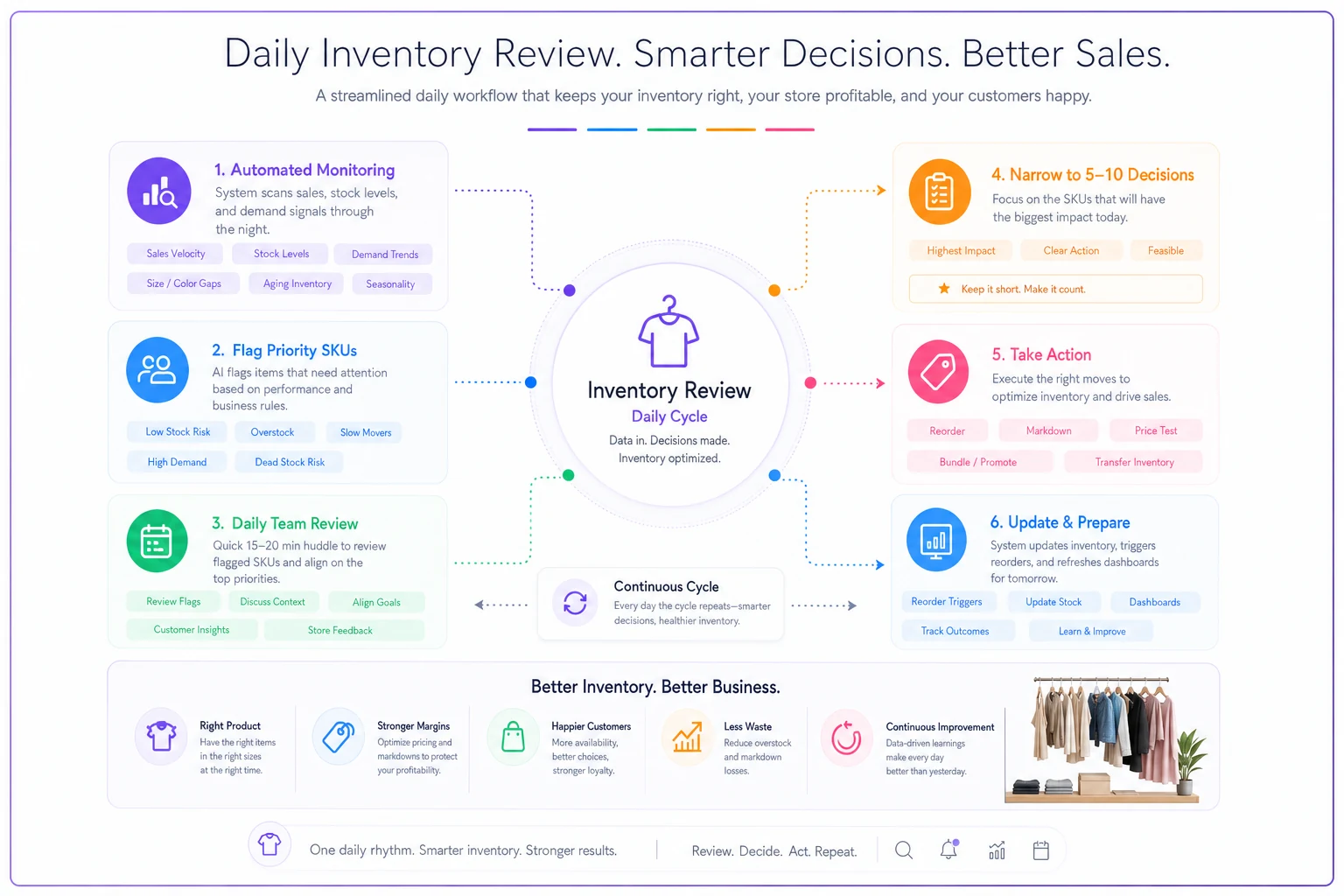
The goal is getting to the five or ten things that matter each day — not drowning in dashboards.
The tactical adjustment checklist
Based on what's actually worked across stores in similar conditions, here's a practical framework by week:
Week 1: Inventory reality check
-
Calculate true landed cost increases over the past 90 days
-
Identify the top 20% of SKUs by margin contribution
-
Flag everything with less than two weeks of recent movement
-
Review supplier payment terms and push for extensions where you can
Week 2: Pricing and markdown adjustments
-
Test 5–8% price increases on top performers before committing broadly
-
Start graduated markdowns on slow movers at 20%, not 10%
-
Bundle complementary items to maintain transaction values
-
Revisit free shipping thresholds — temporarily dropping them may improve margin
Week 3: Reorder and buying modifications
-
Reduce forward commitments to four-week coverage
-
Shift budget toward proven performers, not experiments
-
Negotiate smaller minimum order quantities with key suppliers
-
Build price adjustment clauses into new orders where possible
Week 4: Operational streamlining
-
Consolidate shipments to reduce freight
-
Renegotiate software and service subscriptions
-
Switch to cycle counting instead of full inventory counts
-
Set up automated reorder suggestions for basics
Run this checklist iteratively; the goal is to tighten decision cycles rather than to complete a perfect one-time overhaul.
The goal isn't perfect prediction
Running a clothing store through inflationary volatility means juggling fashion trends, cost pressures, and unpredictable customer behavior simultaneously. Some calls will be wrong. That's unavoidable.
What separates stores that are holding up from ones that are struggling isn't that anyone is predicting demand perfectly. It's how fast they identify what's working, move budget toward winners, and clear losers before they become actual problems. That requires both disciplined processes and systems that surface the right information at the right time.
Manual tracking and intuition-based ordering worked for a long time. In this environment, they're liabilities. Stores that tighten their operational discipline, build data into daily decisions, and maintain inventory velocity will come out of this period in better shape than competitors who are still reacting a month too late.
Customers are still spending — the data is clear on that. The operational challenge is protecting margin while costs rise, managing velocity while demand shifts unpredictably, and keeping cash flow healthy when every dollar of working capital actually matters. Get those fundamentals working, and this period becomes an opportunity to gain ground on competitors who can't adapt quickly enough.
Get those fundamentals working, and this period becomes an opportunity to gain ground on competitors who can't adapt quickly enough.
Ready to elevate your apparel business?
Join 2,000+ retailers using Werzly to streamline operations, increase sales, and deepen customer loyalty.