

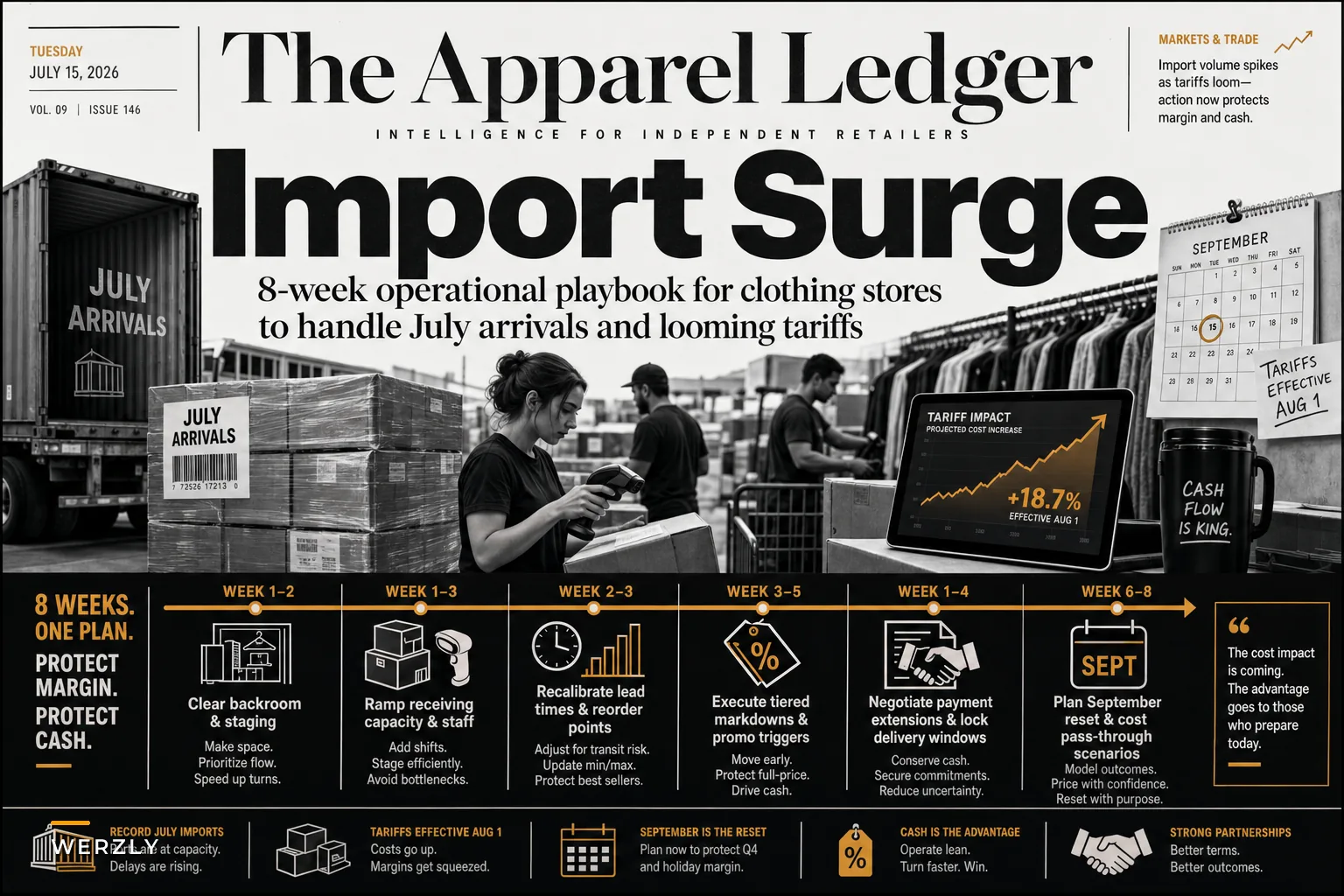

Container ships are literally stacking up at ports right now. The NRF's Global Port Tracker forecasts July 2024 will hit an all-time monthly import record as retailers rush shipments ahead of potential August tariff increases.
For independent clothing stores, this creates an immediate operational squeeze. Your fall merchandise is probably arriving 3-4 weeks earlier than planned. Suppliers are shipping whatever they can get on boats. And you're about to face a cashflow crunch from accelerated payables while sitting on inventory you can't sell until September.
I watched this exact pattern destroy margins across dozens of small apparel retailers during the 2018-2019 tariff waves. The stores that came out okay weren't the ones with the deepest pockets—they were the ones who adjusted their operational cadence fast enough to handle the surge without breaking their model.
The hidden cost cascade that's already hitting your P&L
Most clothing store owners think tariffs only matter if they actually happen. That's the wrong frame. The import surge itself—happening right now—triggers immediate operational costs that compound through your entire inventory cycle.
Your receiving dock becomes a bottleneck first. Instead of processing 200 units twice a week, you're suddenly dealing with 800 units arriving all at once. Your part-time receiver can't handle it, so you pull floor staff to help. Sales drop. Customer service suffers. Returns pile up because nobody's processing them.
Meanwhile, your backroom fills beyond capacity. Boxes get stacked in aisles, blocking access to your regular picks. Staff waste 15 extra minutes per shift just moving inventory around to reach what they need. Some stores end up renting temporary storage units during surges—paying $400-600 a month for space that shouldn't have been necessary.
The cashflow hit comes next. Accelerated shipments mean your 45-day payment terms just became 20-day terms in practice. You're paying for September merchandise with July's cash while still sitting on summer clearance that won't move until you mark it down another 20%.
Then there's the markdown acceleration problem. When fall merchandise arrives in July, you have two choices: hold your summer stock and eat the carrying cost, or slash prices now and blow up your margin plan for Q3. Most stores panic and choose option two, turning what should be a 35% summer margin into 18%.
Your 60-day operational checklist for margin protection
The difference between stores that survive import surges and those that actually come out ahead comes down to operational discipline in five specific areas.
Take control of your clothing store operations.
Werzly helps you manage stock, process orders, and engage customers effortlessly.
- Unified inventory and order management
- Automated customer notifications
- Sales and stock analytics
No credit card required
Week 1-2: Receiving capacity sprint
Clear your backroom now, before the surge hits. Actually clear it—not just reorganize. Move all dead stock to a markdown rack on the floor, even if it's not perfectly merchandised. Transfer slow movers between locations if you have multiple stores. The goal is roughly 40% empty space by mid-July.
Put your best processor on every receiving day through August. This isn't the time for training new staff on receiving procedures. Pay the overtime if you have to—it's cheaper than the compound mistakes from rushed processing. One store I worked with bumped their receiver from 24 to 40 hours temporarily and saved around $3,000 in error-related costs over six weeks.
Create overflow zones with clear labeling. Designate specific areas for early fall arrivals, separate from active summer stock. Bright colored tape on the floor works fine. The 20 minutes you spend marking zones saves hours of confusion later.
Week 2-3: Lead time recalibration
Your entire reorder system just broke. The lead times you've been using for calculations are now meaningless. A supplier who normally delivers in 21 days might ship tomorrow or in 45 days, depending on what they can get on boats.
Pull your actual receipt dates for the last 30 days and calculate new effective lead times. Don't use what suppliers promise—use what actually happened. If your denim vendor says 14 days but delivered in 8 days twice and 19 days once, your new planning lead time is 19 days with high variability flagged.
Adjust safety stock levels up by 20-30% for high-velocity basics only. This seems counterintuitive during a surge, but the variability risk is real right now. Running out of core items in August because you assumed normal lead times will cost more than carrying extra units for a few weeks.
For more detail on managing lead time variability, our piece on integrating supplier variability into reorder triggers is worth reading.
Label early arrivals with expected season and store to simplify placement and transfers.
A simple visual helps teams see the 8-week sprint at a glance.
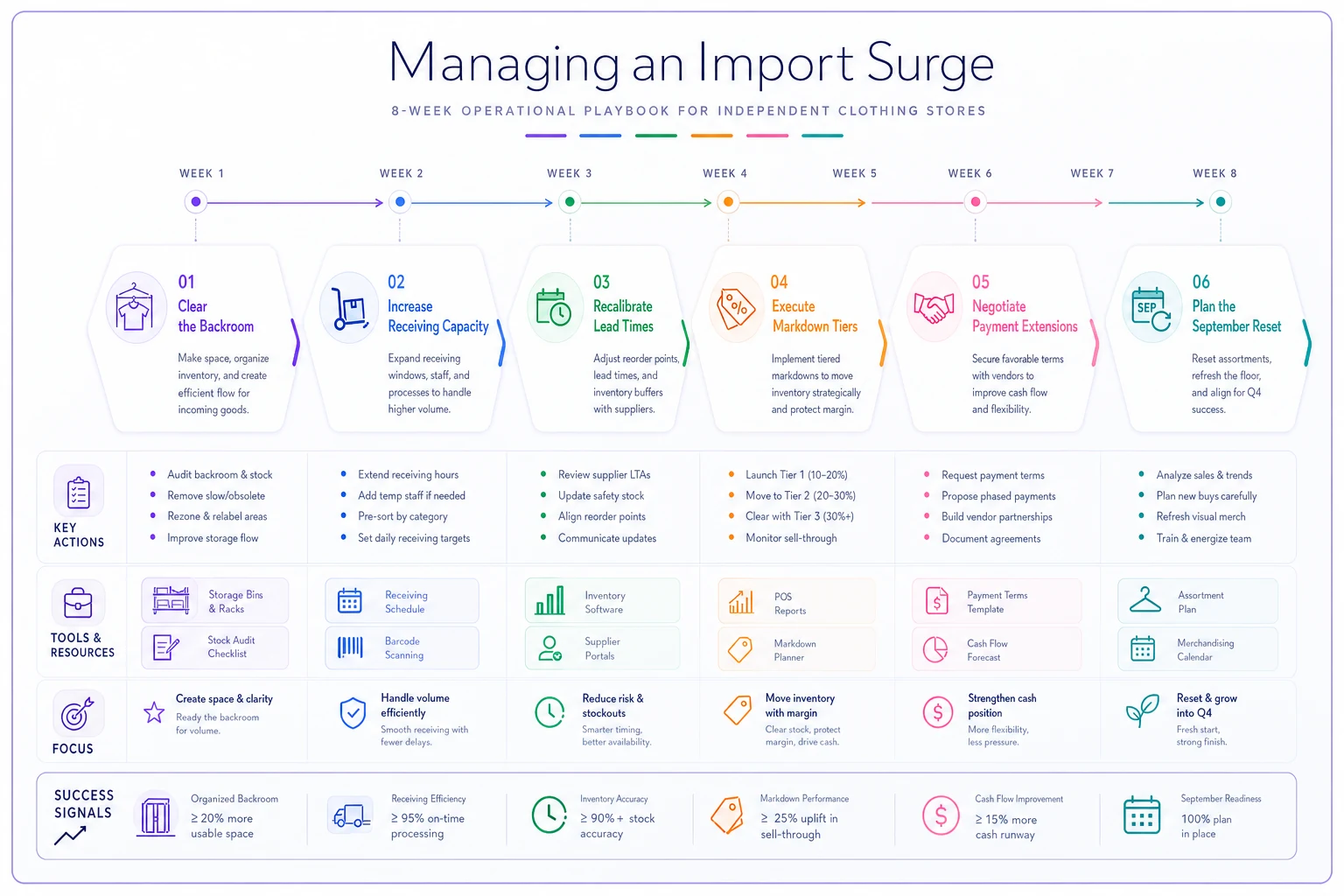
Use this workflow as a checklist during staff huddles.
Week 3-4: Surgical markdown execution
Stop following your normal markdown calendar. The import surge changes everything about timing and depth. Summer dresses that would normally go to 40% off in early August need to move now at 50% off, or you'll be stuck with them when fall arrivals need that floor space.
Create three markdown tiers based on storage impact, not just age:
-
Bulky items (coats, sweaters)
60% off immediately
-
High-cube basics (tees stacked 20 deep)
40% off
-
Small accessories
hold at 30% off
One retailer I worked with recovered over 4,000 cubic feet of storage space in five days using this approach, avoiding an external storage rental that would've run close to $1,800.
Week 4-6: Cash flow bridges without breaking the bank
Negotiate payment extensions now, before you need them. Call your top five suppliers and explain you're frontloading orders to avoid tariffs but need to maintain normal payment schedules. Most will agree to hold invoices for 15-30 extra days if you're upfront about why.
Consider factoring receivables if you have wholesale accounts or corporate contracts. The 2-3% fee stings less than missing vendor payments. Set this up as a backup even if you don't use it—approval takes 10-15 days and you don't want to be scrambling when cash gets tight.
Open a business line of credit if you don't have one. Even $10,000 in available credit provides breathing room when three suppliers invoice simultaneously. Banks are fairly understanding about tariff-related credit needs right now.
Week 6-8: September reset planning
Start planning your September floor reset now, while you can still influence what arrives and when. Map out where fall merchandise will live, which summer items get clearanced out completely, and what transitions when.
Build "capsule" displays that mix late summer with early fall—a lightweight cardigan with summer dresses, ankle boots with cropped pants. This lets you start moving fall items without looking seasonally confused.
Build your September staffing schedule assuming 30% higher processing volume than normal. The import surge effect runs for 60-90 days after the initial wave. September receiving will still be chaotic even if tariffs never materialize.
The margin math that determines your survival threshold
A typical independent clothing store with $400K annual revenue runs on roughly 52% initial markup and 38% maintained margin after markdowns. The import surge threatens both sides of that equation.
Here's what a realistic monthly impact looks like:
Pre-surge baseline (monthly):
-
Revenue
$33,000
-
COGS
$20,500
-
Gross margin
$12,500 (38%)
-
Operating expenses
$9,500
-
Net margin
$3,000 (9%)
During surge impact:
-
Revenue
$31,000 (staff pulled to receiving)
-
COGS
$21,500 (rush shipping, processing errors)
-
Gross margin
$9,500 (30.6%)
-
Operating expenses
$10,800 (overtime, storage, factoring fees)
-
Net margin
-$1,300 (-4.2%)
The stores that maintain positive margins through import surges do three things differently:
-
They adjust operations before the surge hits, not during
-
They protect revenue-generating activities even when receiving explodes
-
They treat the surge as a 90-day sprint, not a permanent change
Landed costs could jump 10-25% if tariffs hit—that's a meaningful chunk on an annual buy. But the operational drag from the surge itself often costs more.
Technology leverage points for surge management
The manual tracking systems most indie retailers use completely break during import surges. You can't spreadsheet your way through 3x normal volume while managing exception after exception.
ModernRetail reports that more retailers are turning to operational workflow tools to handle surge volume without adding headcount—not sophisticated AI systems, just solid platforms that handle the basics at scale.
A receiving management platform can process 800 units with roughly the same effort as 200 units. Automated reorder calculations adjust when lead times shift. Digital markdown tools prevent panic discounting when storage pressure builds. These aren't futuristic solutions—they're operational necessities when your normal volume triples overnight.
Clothing stores that implement even basic inventory management automation during surge periods tend to save 15-20 hours weekly in manual processing, cut receiving errors significantly, and maintain margins much closer to plan despite the chaos.
What happens next: your August decision tree
By early August, you'll face three realistic scenarios:
| Scenario | Probability | Recommended action |
|---|---|---|
| Scenario 1: Tariffs hit as expected | roughly 40% probability | Landed costs jump 10-25%. Focus on price optimization for items already in transit, aggressive clearance of tariff-exposed inventory, and supplier diversification for 2025 orders. Start testing price increases on low-elasticity items now. |
| Scenario 2: Tariffs delayed or reduced | around 35% probability | The import surge continues but pressure eases slightly. Maintain elevated receiving capacity through September, gradually normalize your markdown cadence, and use the breathing room to negotiate better terms with suppliers who over-shipped in panic. |
| Scenario 3: No tariffs materialize | roughly 25% probability | You're left with excess early inventory and compressed margins from surge-related costs. Execute gradual storage normalization, return to standard receiving schedules by late September, and document what happened for the next trade uncertainty cycle. |
The operational moves you make in July determine which scenario hurts least. Stores that wait until August to react typically lose 8-12% of annual margin. Those that adjust now lose closer to 2-4%.
The 90-day sprint that determines your year
Import surges aren't new. The pattern is always the same: panic, overcorrection, margin destruction, gradual recovery. Except some stores skip straight to recovery by getting their operations right early.
Your next 90 days will test every operational assumption you have. Standard procedures won't hold. Normal staffing breaks. Conventional markdown timing fails. But if you adjust the specific levers outlined above—receiving capacity, lead time calculations, markdown velocity, cashflow bridges, and reset planning—you can stay profitable through the surge.
The clothing stores that come out stronger from import disruptions aren't the ones with the most capital or the best locations. They're the ones with operational discipline and the ability to adjust quickly when conditions shift.
Start with clearing your backroom this week. Everything else builds from there.
Ready to elevate your apparel business?
Join 2,000+ retailers using Werzly to streamline operations, increase sales, and deepen customer loyalty.