

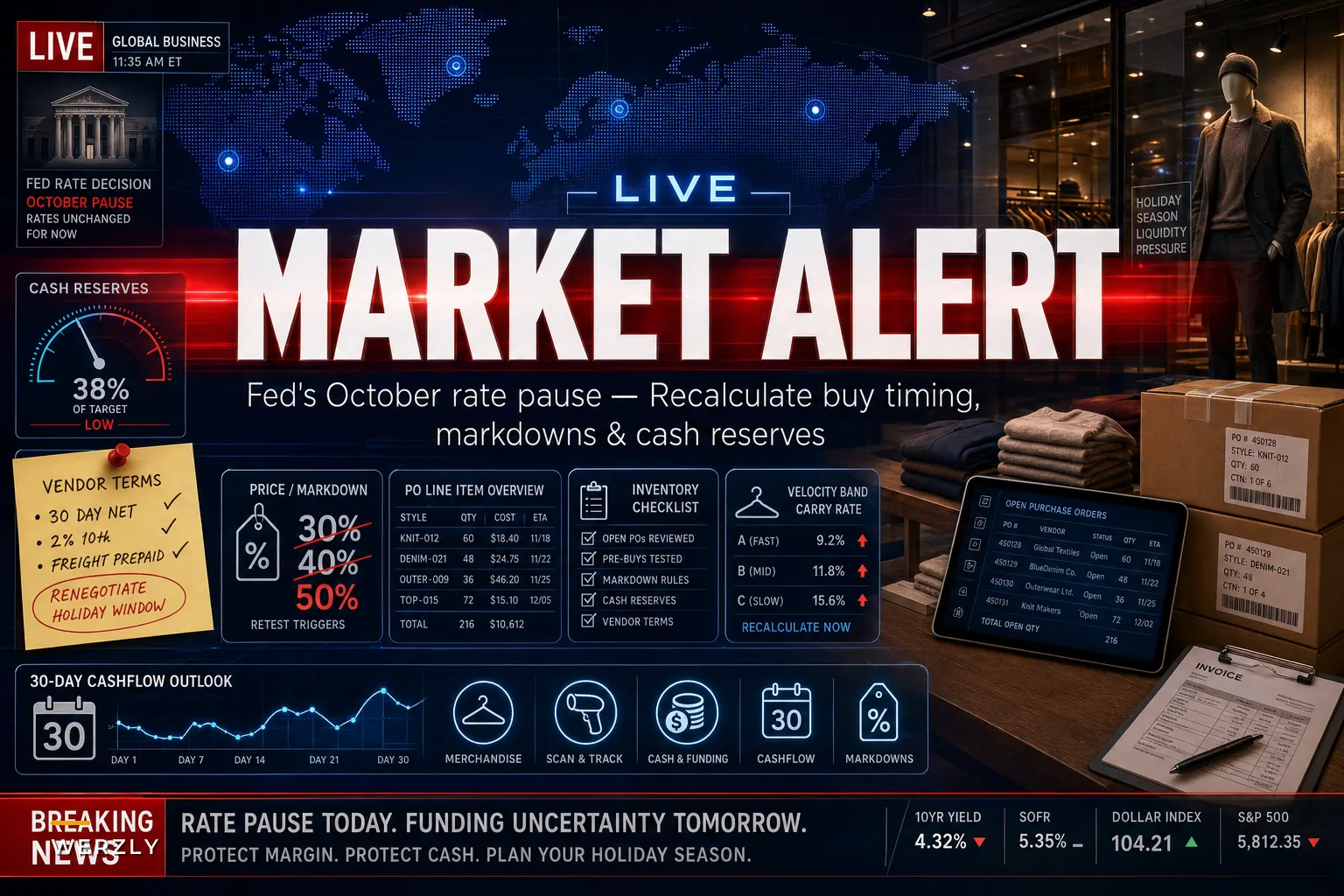

The Fed held rates steady in late October, and for most people that headline just blurs past. But if you run a clothing store and you're carrying a line of credit, floor-planning your spring buy, or sitting on holiday inventory you financed three months ago, this pause quietly changes the math you've been running — or should have been running.
The Fed went into what Reuters called "wait-and-see mode," holding rates after a stretch of hikes. The useful takeaway isn't the decision itself. It's that the ground under your carrying-cost assumptions just stopped moving for a bit — and that pause is a window to recheck numbers you probably set months ago under a different rate expectation.
Most owners won't touch any of this. They'll keep running buy and markdown decisions on autopilot, using a cost-of-capital number they picked back in spring and never revisited. That's the real problem, and it's worth two focused hours this week to fix.
What actually changes when rates pause (and what doesn't)
A pause doesn't lower your borrowing cost. Your variable line is still priced where it was. What changes is the expectation baked into your planning.
If you built your fall and holiday buy plan assuming two more hikes were coming, you probably padded your carrying-cost assumption — maybe you used a higher discount rate on slow SKUs, pre-bought more aggressively to lock units before credit got pricier, or sized your safety stock down to avoid holding expensive inventory. Those were reasonable moves under a "rates keep climbing" scenario.
With the pause, that scenario is off the table for now. CNBC's coverage of the decision framed it as the Fed waiting on more data before its next move, which means the near-term cost of capital is more stable than volatile. Stability is the thing to act on. It's easier to lock terms, easier to forecast carry, and easier to decide whether pre-buying still makes sense when you're not bracing for the next increase.
The subtle trap: a lot of owners treat "rates didn't go up" as "good news, carry on." But if your plan assumed hikes, the pause means some of your decisions are now over-conservative — you may be sitting on cash you don't need in reserve, or you passed on a reorder you could actually afford to carry.
The carrying-cost number almost everyone gets lazy about
Carrying cost is where this gets real. Most small apparel shops use one rough percentage — "call it 20% a year" — and apply it across everything. That number usually bundles interest, insurance, shrink risk, obsolescence, and the opportunity cost of tied-up cash. Fine as a shortcut. Dangerous when rates shift and you never revisit it.
Take control of your clothing store operations.
Werzly helps you manage stock, process orders, and engage customers effortlessly.
- Unified inventory and order management
- Automated customer notifications
- Sales and stock analytics
No credit card required
The interest component is the only piece that moves with the Fed, but it's also the piece people forget to isolate. If roughly half of your inventory is financed on a variable line, your blended carry rate is sensitive to credit pricing even when the headline rate holds flat.
A quick way to think about it:
| Component | Typical share of carry | Moves with Fed? |
|---|---|---|
| Interest on financed inventory | 25–40% | Yes |
| Obsolescence / markdown risk | 25–35% | No (demand-driven) |
| Storage, insurance, handling | 15–25% | No |
| Opportunity cost of cash | 15–25% | Indirectly |
Isolate the interest component of carry when you update rates so you don't let obsolescence risk get masked by a stable headline rate.
The thing most people miss: during a pause, your interest component is predictable, but your obsolescence component gets riskier heading into a discount-heavy holiday. So total carry might not drop even though rates held — the mix just shifts toward markdown risk. If you cut your carry assumption just because rates paused, you'll under-price your slow movers and hold them too long.
A two-hour, time-boxed re-run
You don't need a finance degree or a weekend. Block two hours and go in order.
-
Pull your current blended cost of capital (20 min). Grab your line's current rate, the balance you're actually carrying, and any supplier financing terms. Write down one real number, not last spring's estimate.
-
Rebuild your carry rate per velocity band (30 min). Split inventory into fast / medium / slow. Apply the interest piece evenly, but weight obsolescence heavier on slow movers. Slow SKUs heading into December should carry a higher effective rate than your core basics.
-
Re-test open POs and pre-buys (25 min). For anything you pre-bought to beat rate hikes, ask: does the pre-buy still beat buying later now that rates aren't climbing? If the only justification was "lock before it gets expensive," some of those pre-buys don't hold up anymore.
-
Recheck markdown trigger thresholds (25 min). Your markdown math depends on carry. If carry on slow SKUs is now higher — markdown risk up — your first markdown should trigger sooner, not later. Pull the trigger dates forward where sell-through is already lagging.
-
Resize your cash reserve (20 min). If you padded reserves expecting pricier credit, you may be holding idle cash. Decide whether some of it funds a targeted reorder on proven winners.
That last step is where the pause creates actual opportunity. Stable credit pricing means a reorder on a fast mover is less risky to carry than it looked two months ago.
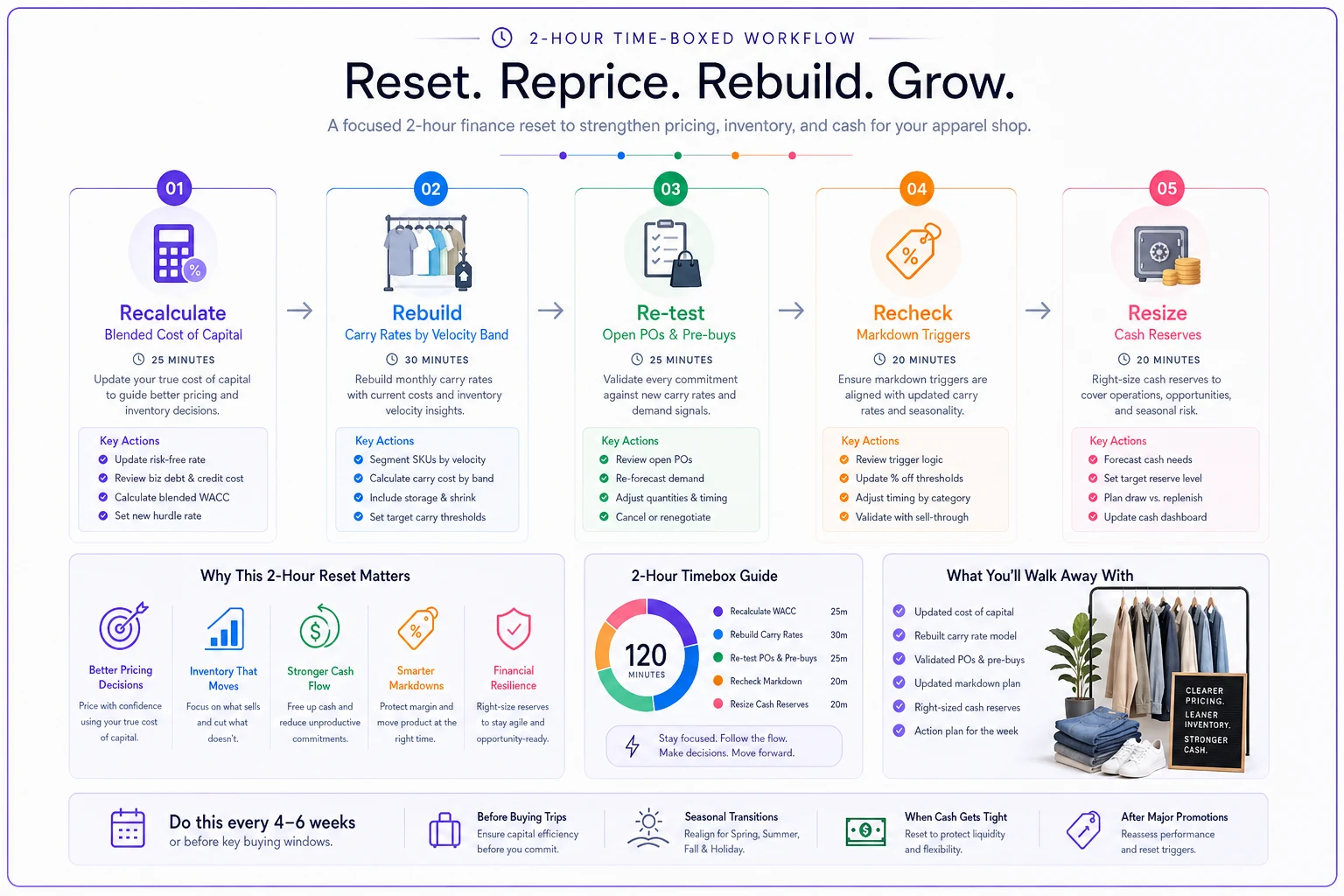
Here's a quick visual of the two-hour workflow.
A real scenario
A women's apparel shop doing somewhere around $900k–$1.1M a year had pre-bought heavily in late summer — roughly $60k of extra holiday inventory — specifically because the owner expected borrowing to get more expensive by Q4. She'd also bumped her cash reserve and set markdown triggers at a conservative 8 weeks for slow SKUs.
When she re-ran the numbers after the pause, two things surfaced. First, about $18k of that pre-buy was in categories that historically soften by mid-December — those units were now carrying real obsolescence risk, not interest risk. Second, her core denim and basics were selling through faster than planned and she'd been holding back on reordering because she assumed credit would get tight.
The adjustments weren't glamorous: she pulled slow-SKU markdown triggers forward from 8 weeks to about 5, cleared the at-risk pre-buy before the holiday discount flood, and freed up roughly $12k of reserve to reorder proven winners. The net effect wasn't a dramatic revenue jump — it was a cleaner January. Less deadstock to clear at 60% off, and she didn't stock out on the stuff that was actually moving.
The point isn't the exact figures. It's that the same pause cut two different ways in the same store — some decisions were too aggressive, others too cautious — and the only way she found both was by re-running the math instead of assuming "rates flat = don't change anything."
When re-running everything is a bad idea
Not every store needs to touch this.
-
If you're almost entirely cash-funded, the interest component of your carry is tiny and the pause barely moves your math. Spend your two hours on markdown timing instead.
-
If your holiday buy is already received and on the floor, pre-buy decisions are moot. Focus only on markdown triggers and reserve sizing.
-
If your line balance is small relative to revenue, don't over-engineer. A rough carry number is fine; put the energy into sell-through.
Re-running this makes the most sense for stores carrying meaningful variable-rate inventory financing, where a stable cost of capital genuinely changes whether pre-buys, reorders, and markdown timing still pencil out.
The quick checklist
Before the holiday season fully locks you in:
-
[ ] One current, real blended cost-of-capital number written down
-
[ ] Carry rate split by velocity band (fast / medium / slow)
-
[ ] Every open pre-buy re-tested against "buy later" now that hikes paused
-
[ ] Slow-SKU markdown triggers pulled forward where sell-through lags
-
[ ] Reserve resized — idle cash identified and assigned
-
[ ] Supplier terms checked for any fixed-rate or extended-dating options
-
[ ] One reorder decision on proven winners the old plan was blocking
Before the holiday season fully locks you in:
Where this connects to your ongoing system
A rate pause is a prompt, not a plan. The stores that handle these moments well aren't scrambling to react to the Fed — they already have a repeatable way to recalculate reserves and PO timing, so a pause is just a quick input change.
If you don't have that running yet, now's a reasonable time to build it. The approach in our seasonal cashflow and buy-funding system for small apparel shops walks through the calendarized reserve math and PO-timing rules that make re-runs like this a 20-minute task instead of a two-hour one. Once your carrying-cost inputs, sell-through data, and buy calendar live in one place — rather than scattered across spreadsheets and your memory of what rates were doing in spring — adjusting to a rate change becomes almost mechanical.
That's really the underlying lesson. The Fed pausing didn't create a problem. It exposed how many stores run buy and markdown decisions on stale assumptions and never revisit them until the deadstock piles up in January. Fix the revisiting habit, and the next rate move — up, down, or flat — stops being news you have to react to and becomes a number you just update.
Ready to elevate your apparel business?
Join 2,000+ retailers using Werzly to streamline operations, increase sales, and deepen customer loyalty.