



Most small apparel shops don't go under because they picked bad product. They go under because the money for next season's buy showed up two weeks after the vendor's cutoff date. The product was fine. The timing wasn't.
That gap — between when you owe deposits and when your current inventory actually turns into cash — is the thing nobody puts on a calendar. Owners track sell‑through, they track margin, some even track open‑to‑buy. But the funding of the next buy tends to live in the owner's head as a vague sense of "we should have enough by then." And that vague sense is where seasonal apparel businesses quietly bleed.
This is about building an actual seasonal buy funding system small apparel shops can run without a finance background. Not a budget. A calendar with reserve math and clear decision gates so that when a vendor's PO window opens, you already know whether you're paying from reserve, financing it, or pushing the buy.
Why the money never lines up with the buy
Apparel is one of the worst retail categories for cashflow timing, and it's structural — not a discipline problem.
You pay deposits on fall goods in late spring. The goods land in July and August. You don't recover that cash until October through December. Meanwhile spring buys need deposits in the fall — right when you're spending on holiday inventory. So every season, two cash outflows overlap while the recovery from the previous season is still trickling in.
A typical small shop with roughly $600k–$700k in annual revenue might be sitting on $180k–$220k in inventory at cost during peak. That's most of their working capital frozen on racks. When the vendor emails "spring pre‑book closes Friday, 30% deposit," the honest answer for a lot of owners is "I don't actually know if I can cover that." So they either overcommit and get squeezed later, or they hesitate, miss the early‑order discount, and pay more for less favorable terms.
Neither is a decision. Both are reactions. The whole point of a funding system is to turn those PO moments into pre‑made decisions.
The reserve is the missing piece
Shops that never seem panicked in March or September share one habit: they don't fund next season's buy from current cash. They fund it from a reserve they built during the previous season's peak.
Take control of your clothing store operations.
Werzly helps you manage stock, process orders, and engage customers effortlessly.
- Unified inventory and order management
- Automated customer notifications
- Sales and stock analytics
No credit card required
The mistake most owners make is treating peak‑season cash as profit. December closes strong, the bank balance looks healthy, and it feels like the business made money. Then January is dead, February is deposits‑due season, and suddenly that "profit" was actually next season's buy money that got spent on whatever felt affordable in December.
A reserve fixes this by carving buy money out of peak cash before it can feel like profit. The math isn't complicated. It just has to happen on a schedule instead of by gut.
The basic reserve calculation per season:
-
Next season's target buy at cost (from your open‑to‑buy plan)
-
× deposit percentage your vendors require (usually 20–40%)
-
+ landed costs you'll owe on receipt (freight, duties — this matters more with tariff swings)
-
÷ number of peak weeks you have to build it
So if your fall buy target is $120k at cost, vendors want 30% down ($36k), and you'll owe another ~$70k on receipt, you need to have set aside somewhere in the range of $100k–$106k across your build window. If your build window is the ten strongest weeks of the year, that's roughly $10k–$11k a week swept out of the register before it becomes "December money."
That sweep — automatic, boring, off‑limits — is the entire trick. Everything else is timing.
Building the calendar around vendor PO windows, not the calendar year
Retail runs on the calendar year. Apparel funding runs on vendor cutoff dates, and those don't care about your fiscal quarters.
Map your PO windows first. For most small shops the seasonal rhythm looks something like this:
| Season | Deposit due | Goods land | Cash recovery peak | Reserve build window |
|---|---|---|---|---|
| Spring | Sept–Oct | Feb–Mar | Apr–Jun | prior Nov–Dec |
| Summer | Jan–Feb | Apr–May | Jun–Jul | Apr–Jun |
| Fall | Mar–May | Jul–Aug | Oct–Dec | prior Jun–Jul |
| Holiday | Jun–Aug | Oct–Nov | Nov–Dec | Sept–Oct |
Notice the ugly overlaps. Fall deposits (Mar–May) land right when spring recovery is starting but not finished. Holiday deposits (Jun–Aug) hit while you're still paying for fall goods that just landed. This is why "we'll have the money by then" is so dangerous — the money is real, but it's committed somewhere else on the same dates.
The fix is to attach each reserve build window to the season it funds, not to the month it happens in. Your Nov–Dec sweep isn't "saving money," it's "funding spring." Naming it that way changes behavior. Once a dollar is labeled spring buy, it's a lot harder to spend it on a January markdown campaign.
If you've already built a P&L that turns sell‑through into monthly thresholds — the kind of system covered in this breakdown of turning sell‑through into monthly buy and markdown thresholds — the reserve calendar plugs directly into it. Your sell‑through numbers tell you what next season's buy should be; the reserve math tells you whether you can actually fund it.
A simple workflow visualization:
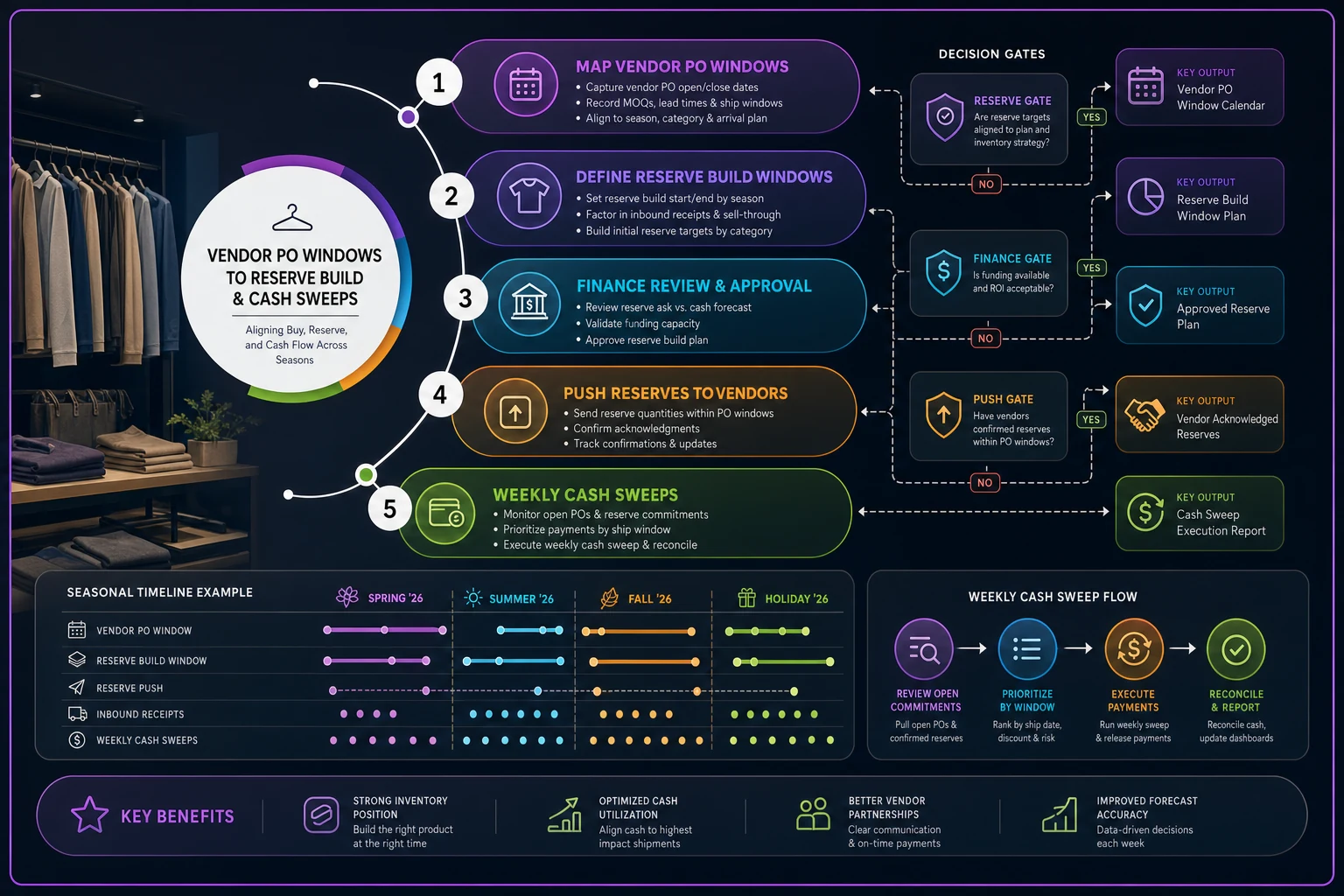
If your sell‑through numbers tell you the buy target, the reserve calendar tells you whether you can fund it — and when the decision gate should trigger.
The three decision gates: reserve, finance, or push
Every PO window should trigger the same short decision. Not a meeting. A gate. You look at three numbers and pick one of three paths.
The three numbers:
-
Reserve balance earmarked for this season
-
Required outlay (deposit + expected landed cost)
-
Confidence in this buy (based on last season's sell‑through for the same category)
Then you route:
Use reserve — when the earmarked reserve covers at least the deposit plus a comfortable buffer for landed costs, and the category's sell‑through last season was solid (say, above your 70–75% target). This is the clean path. You built the money, the buy is proven, you pay and move on.
Finance — when the buy is strong but the reserve is short by a manageable gap, and the financing cost is less than the early‑order discount or the margin you'd lose by waiting. A 2% early‑pay discount plus guaranteed size runs can easily justify short‑term financing. Financing to cover a weak, speculative buy is a different story — that's borrowing to gamble.
Push — when the reserve is short and the category underperformed, or when landed cost uncertainty (freight spikes, tariff changes) makes the real outlay unknowable. Pushing means delaying, splitting the order into smaller waves, or reallocating budget to a stronger category. Pushing is not failure. Pushing a weak buy is often the highest‑ROI decision you'll make all season.
When each gate actually makes sense
Use reserve is the default and should cover the majority of your core, proven categories — the basics and repeat performers that turn predictably.
Finance makes sense for a narrow band: strong buys, meaningful early‑order incentives, short payback windows. It stops making sense the moment you're financing more than one season at a time. If two consecutive buys need financing, the reserve system is under‑funded and that's the real problem to fix.
Push makes sense more often than owners want to admit. Fashion‑forward or untested categories, volatile‑cost imports, or any category where last season's sell‑through was under ~55% — these are push candidates. A smaller, later buy on unproven product almost always beats a large early commitment you have to discount away in eight weeks.
A worked monthly example
Let's run a realistic small shop through a single funding cycle.
The shop: women's contemporary apparel, roughly $650k annual revenue, four core categories. Fall buy target: $110k at cost. Vendors want 30% deposit in April, balance on receipt in late July. Expected landed cost adds about 8%.
The reserve build (prior June–July): Last summer they swept roughly $9k–$10k a week over eight weeks, landing a fall reserve of about $76k by end of July.
April, deposit due — the gate:
-
Deposit required
$33k (30% of $110k)
-
Reserve earmarked for fall
$76k
-
Balance due on receipt (July)
~$85k including landed cost
The deposit is easily covered. But the real problem isn't the deposit — it's July. Total outlay is closer to $118k and the reserve is $76k.
They break the buy by category confidence:
-
Core denim (78% sell‑through last fall)
use reserve, full commit
-
Knits/sweaters (72%)
use reserve, full commit
-
Outerwear (81%, but high landed cost)
use reserve for deposit, plan to finance $20k of the July balance against a 2% early‑pay discount — the discount plus proven sell‑through make financing rational
-
Contemporary dresses (51% last fall)
push — cut the initial buy by 40%, reorder mid‑season if it moves
That single set of decisions dropped the July outlay from ~$118k to roughly $90k, brought it inside reserve‑plus‑modest‑financing range, and quietly removed the category that would've become spring clearance.
The seasonal view: where it compounds
Run this across a full year and the effect isn't just smoother cash — it's a shift in what your inventory is.
A shop without the system tends to over‑commit early on optimism, then spend the back half of every season markdowns‑to‑the‑wall trying to recover cash they already spent. Their clearance racks aren't a merchandising choice; they're a funding emergency.
A shop running reserve math and gates does the opposite. Proven categories get funded confidently from reserve. Unproven ones get pushed small and expanded only when sell‑through data earns it. Financing shows up rarely, and only where it pays for itself. Over a year, the deadstock that used to be 12–15% of inventory drifts down toward single digits — not because they got better at picking, but because they stopped funding buys they weren't confident in.
The forecasting side matters just as much here. Your reserve target is only as good as your buy target, and your buy target is only as good as your demand read. If that piece isn't tight yet, the lightweight inventory‑forecasting approach for cutting stockouts and overstocks is the input layer that keeps the whole funding calendar honest. Garbage forecast, garbage reserve.
A real scenario
A menswear shop, about $480k in annual revenue, kept hitting the same wall every fall. Strong December, dead January, and by the time March fall pre‑books opened they were scrambling — usually financing deposits on a credit line at rates that ate most of their early‑order discounts.
They started sweeping peak‑week cash into a labeled fall reserve, roughly $6k–$8k weekly across their nine best weeks. First year, they only hit about 70% of the reserve target — old habits, plus one slow stretch in early summer. But even a partial reserve changed the March gate. Instead of financing the entire deposit, they financed a small slice, pushed one weak category (printed casual shirts, which had limped in at ~48% sell‑through), and paid the rest from reserve.
The measurable outcome wasn't dramatic on the surface. Interest costs on seasonal financing dropped by something like $4k–$5k over the year. But the bigger shift was that the following spring buy got made on time, at the early‑order discount, without a panic call to the bank. By year two the reserve was fully funded and financing became rare instead of routine.
Nothing about their product changed. The buying calendar just stopped ambushing them.
Where the system actually lives
You can run all of this in a spreadsheet, and plenty of shops do. The reserve math is simple arithmetic and the gates are three questions. What breaks down isn't the math — it's the remembering. PO windows sneak up. The weekly sweep gets skipped during a busy stretch. The reserve balance gets raided for an "emergency" that wasn't really one.
This is where keeping your buy plan, sell‑through numbers, and reserve balances in one connected place — rather than scattered across a POS report, a bank app, and a notebook — quietly does the heavy lifting. When your sell‑through data, open‑to‑buy, and reserve status sit together, the April gate becomes a two‑minute check instead of an afternoon of reconciling numbers you half‑trust. Operational platforms that pull these together and flag upcoming PO windows before deposits are due mean the calendar chases you, not the other way around. But the tooling is secondary. The discipline of labeling money by the season it funds is what actually saves the business.
Getting started without overhauling everything
You don't need to build the whole calendar in one weekend. Start narrow:
-
Pick your single biggest seasonal buy and calculate its full outlay — deposit plus landed cost.
-
Count the peak weeks before that deposit is due and divide. That's your weekly sweep.
-
Open a separate account for the reserve. Physical separation beats willpower every time.
-
Pull last season's sell‑through for each category so the confidence half of the gate is ready.
-
Write the three gates on one page and tape it wherever you make buying decisions.
Next season, add the second‑largest buy. Within a year you'll have a full calendar, and the seasonal panic that felt permanent will just be gone. Not because the cashflow got easier — apparel cashflow is always ugly — but because you decided how to handle each PO window months before it arrived.
The shops that survive the seasonal swings aren't the ones with the best cash position. They're the ones who never let a vendor's cutoff date catch them without a decision already made.
Ready to elevate your apparel business?
Join 2,000+ retailers using Werzly to streamline operations, increase sales, and deepen customer loyalty.