

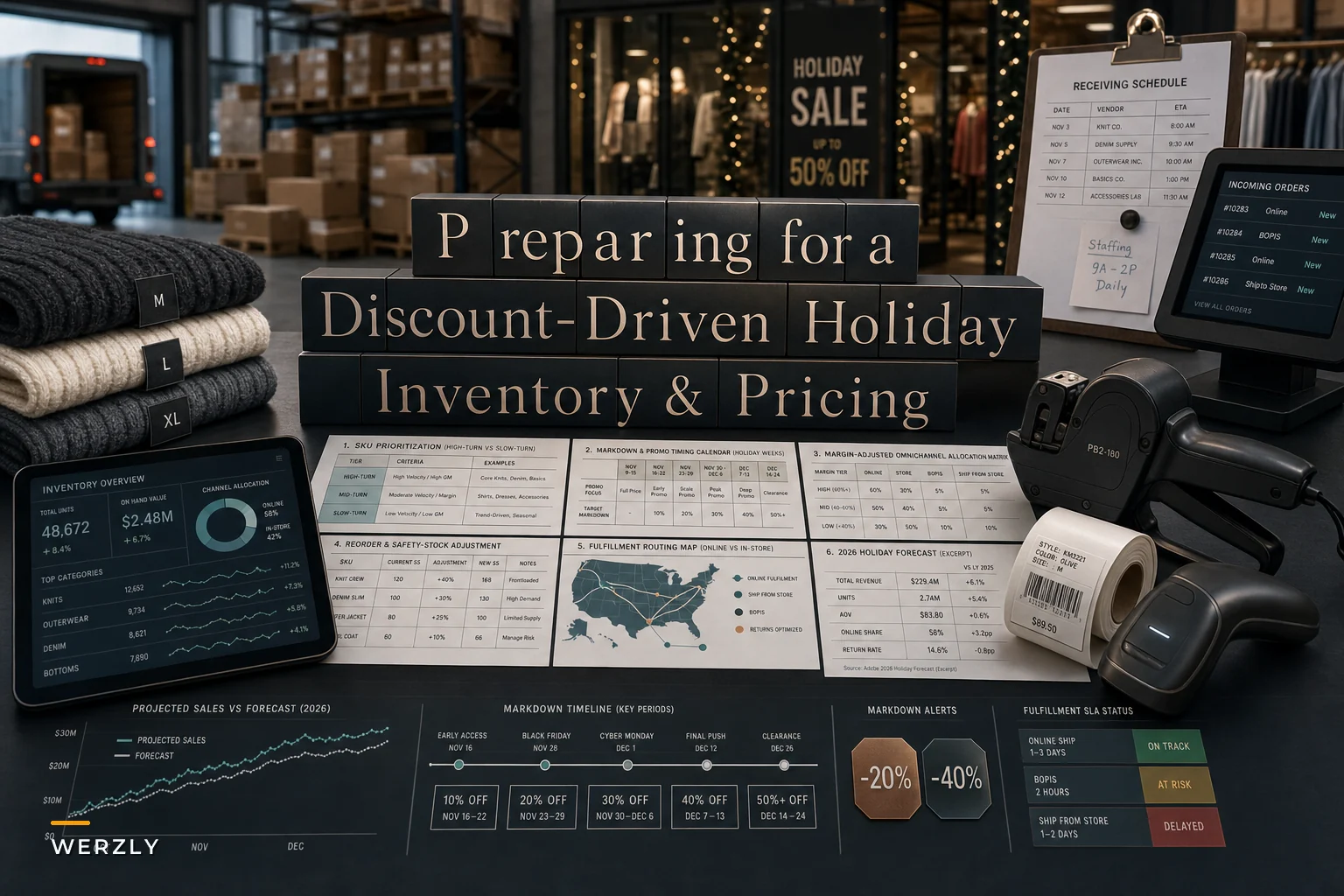

Adobe Analytics put a number on something a lot of small apparel owners already felt coming: U.S. online holiday spend is projected to climb about 6.7% year‑over‑year to roughly $275 billion between November and December, and the thing driving it isn't excitement — it's discounts. As Reuters covered the Adobe forecast, shoppers are pulling purchases earlier and leaning hard into promotions. The full Adobe breakdown goes further, showing the promotional cadence starting well before the usual Thanksgiving week spike.
For a single store or a small two‑ to three‑location operation, that's not just a headline — it's a scheduling problem. If deal‑hunting pulls demand forward by two or three weeks, every downstream decision you made based on "normal" holiday timing is now slightly off. Your receiving is late relative to demand. Your markdown calendar is behind. Your staffing is built for a peak that's already shifted. And your margin is the thing quietly paying for all of it.
This isn't a piece about running more sales. It's about making sure that when you do discount — because you will — you're discounting the right units, in the right channel, at the right time, without bleeding margin you can't recover.
The real problem a discount‑first holiday exposes
Most small stores plan holiday buys by category and vendor. Outerwear here, denim there, this brand, that brand. Fine for ordering. Falls apart the moment deal‑hunters show up early, because now you need to answer a different question fast: which specific units can I afford to discount, and which should I protect?
When demand pulls forward, the owners who struggle are usually the ones treating all inventory as one bucket. They run a storewide 20% off because it's simple, and in doing so they hand a discount to the exact SKUs that would've sold at full price anyway. The forecast practically guarantees your best‑moving, lowest‑return items will sell regardless — discounting those first is pure margin donation.
The pattern that shows up repeatedly: stores lose more margin to blanket early promotions than they ever would have lost to a slightly slower sell‑through on slow SKUs. The deal‑hunter trend makes this worse because it trains your most price‑sensitive customers to wait — and then you reward them with discounts on items that didn't need them.
Sort your assortment before you sort your sale
Before you build a single promotion, you need three piles. Not categories — behavior buckets. This takes an afternoon and it changes everything downstream.
Take control of your clothing store operations.
Werzly helps you manage stock, process orders, and engage customers effortlessly.
- Unified inventory and order management
- Automated customer notifications
- Sales and stock analytics
No credit card required
| Bucket | What goes here | Promo posture | Channel priority |
|---|---|---|---|
| Protect | High sell‑through, low return rate, limited restock | No early discount. Full price as long as possible. | Keep in‑store + reserve for full‑price online |
| Flex | Decent velocity, moderate margin, restockable | Targeted/early promo only if needed to hit traffic goals | Push online for reach |
| Move | Slow movers, seasonal‑dated, high return or deadstock risk | Discount early and aggressively | Online fulfillment + clearance tables |
The mistake isn't discounting. It's discounting without knowing which bucket a SKU lives in. A store that can tell you in thirty seconds which units are "Protect" versus "Move" will make better decisions under pressure than a store with twice the inventory data but no behavioral sort.
A quick note on returns, because it matters more in an online‑heavy holiday: items with high return rates cost you twice when sold online — shipping out, shipping back, and repackaging labor. A SKU returning at 30%+ should almost never be your online promo hero, even if it's slow. Discounting a high‑return item to move it online can net you less than holding it for an in‑store clearance event. That's not an edge case — it's common enough that it should factor into your sort from the start.
Reprice earlier, but narrower
If the market is pulling promotions forward, the instinct is to match the calendar — start your sale when everyone else does. The better move is to go narrow and early rather than broad and late.
The difference in practice: a broad late sale is "25% off the store starting Black Friday." A narrow early approach is "early‑bird pricing on these 40 Move SKUs starting the second week of November, full price everywhere else." You capture the deal‑hunters who are already shopping, you clear the inventory you actually want gone, and your Protect items keep earning full margin into the real peak.
-
Late October — Finish your Protect/Flex/Move sort. Tag every SKU. This is the foundation; skip it and everything after is guesswork.
-
Early November — Launch early pricing on Move SKUs only. Keep it quiet and targeted — email list, not storefront banners.
-
Mid November — Review Move sell‑through. Anything under roughly 40% through gets a deeper cut now, not in January.
-
Peak window — Hold Protect at full price. Let Flex items take light promotion only if traffic softens.
-
Early December — Second markdown pass on remaining Move inventory before shipping cutoffs kill your online clearance window.
-
Post‑peak — Clean up. Anything still sitting moves to in‑store clearance where there's no fulfillment cost.
What people miss in step 3: waiting for "the big sale day" to deepen a cut on a slow SKU means you're competing for attention on the noisiest day of the season. Slow movers clear faster in the quiet weeks before that, when a 30%‑off email actually gets opened.
Shift allocation toward fulfillment reality
An online‑heavy, early‑peaking season changes which units should sit where. If more of your holiday demand is coming online and arriving sooner, your allocation needs to favor SKUs that ship cleanly and come back rarely.
This is where margin‑aware allocation stops being optional. Putting your highest‑return, hardest‑to‑pack items into the online channel during a deal‑hunting surge is how stores end up with a busy December and a flat P&L. If you've never built a structured way to decide which units go to which channel, the margin‑adjusted omnichannel allocation matrix walks through the actual decision logic — it pairs naturally with the Protect/Flex/Move buckets above.
Practical rule of thumb for this specific season:
-
Online fulfillment priority low‑return, easy‑to‑pack, non‑size‑sensitive items — accessories, outerwear with consistent sizing, basics. These absorb the early online surge without generating a return wave in January.
-
In‑store priority fit‑sensitive items, anything with sizing drift, high‑touch pieces people want to try on. Keep these on the floor where the fitting room does your conversion work.
-
Split carefully anything restockable mid‑season — hold a buffer so a hot online SKU doesn't strand your in‑store customers.
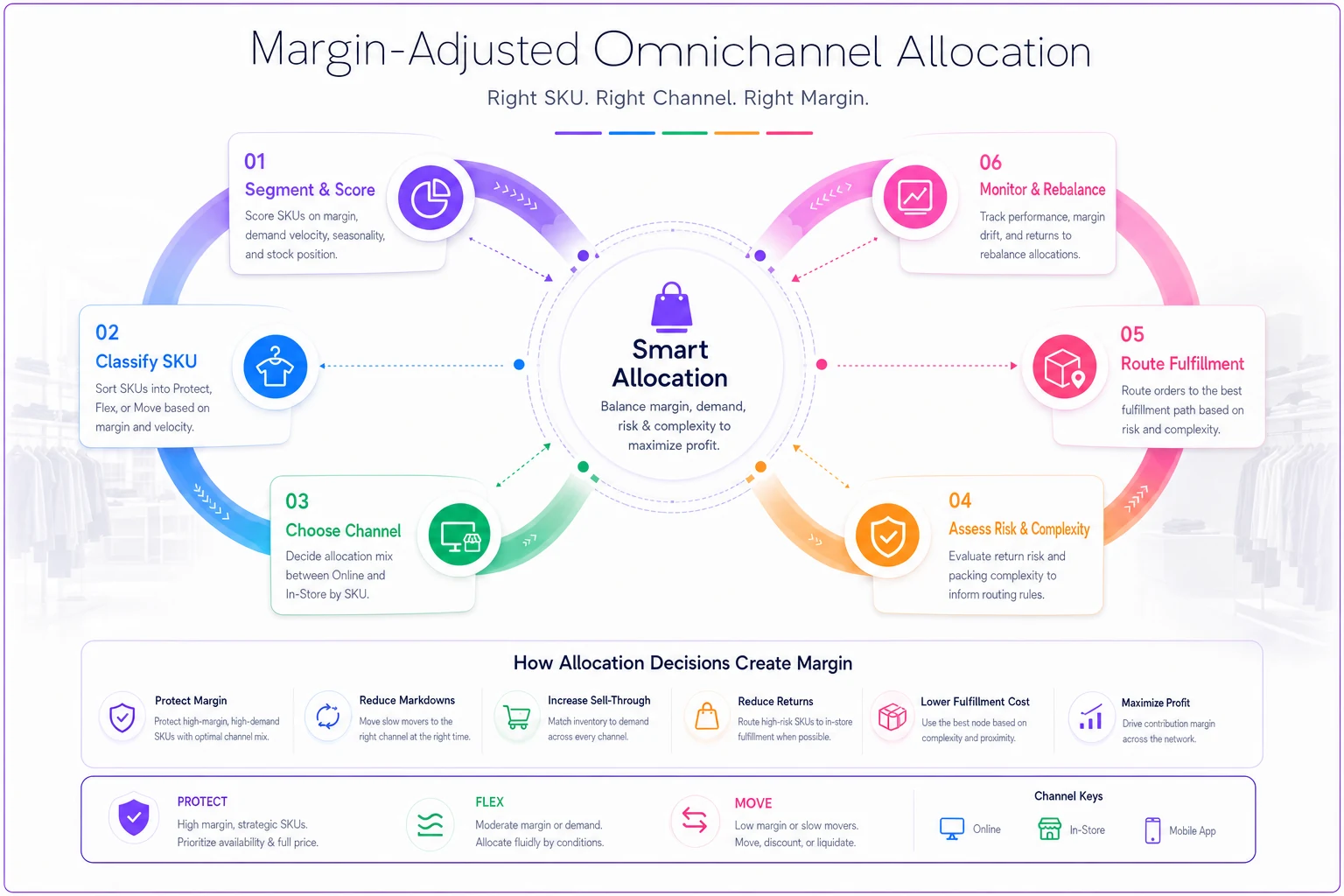
A simple workflow like this helps you visualize where to send inventory before demand arrives.
A small multi‑location operation has an extra lever here: position Move inventory in whichever location has the slowest foot traffic and fulfill online orders from there first. That turns your weakest store into a clearance‑and‑fulfillment node instead of a drag on the rest of the operation.
Fulfillment and staffing when the peak moves
Most small stores reuse the same staffing plan year to year because it mostly works — demand concentrates in the back half of the season, you staff up accordingly. But if the peak shifts forward even ten days, you end up overstaffed in late December and underwater in mid‑November, exactly when the early deal traffic arrives.
Two routing decisions matter most under an earlier, online‑heavy peak.
BOPIS vs. ship‑from‑store. Early deal‑hunters who want items now lean toward pickup. If your BOPIS process is slow or your pick‑paths are disorganized, you'll convert the sale and then bleed goodwill at the counter during your busiest window. Ship‑from‑store, meanwhile, needs your packing station staffed during the hours online orders actually land — which in an early season skews toward evenings and weekends, not the overnight rush you might expect.
Receiving and staging speed. If promotions start earlier, your floor needs to be holiday‑ready earlier. A shipment sitting in the back for three days during a normal October is a lost weekend of selling during a pulled‑forward November.
A short staffing checklist for the shift:
-
Move your heaviest coverage to the second and third weeks of November, not just the Thanksgiving‑through‑Cyber‑Monday block.
-
Cross‑train at least one person per shift to handle both BOPIS handoffs and ship‑from‑store packing, so you're not stranded when one spikes.
-
Set a hard same‑day receiving rule for the Oct–Dec window — nothing stages later than the next morning.
-
Block a 20‑minute daily sell‑through check so repricing decisions happen on data, not instinct.
-
Confirm carrier cutoff dates early and post them where staff and online customers both see them.
Getting staffing right in a shifted‑peak season is mostly a timing problem. The workload isn't dramatically heavier — it just lands earlier than your schedule expects.
When aggressive early discounting is actually a bad idea
Not every store should match the discount‑first cadence. A few situations where chasing the early‑promo wave works against you:
-
Your assortment is mostly Protect inventory. If you sell differentiated, hard‑to‑find, or genuinely scarce product, early discounting trains your best customers to wait for a sale that undercuts your whole model. Hold the line.
-
Your margins are already thin going in. If a 20% cut puts a SKU below its fully loaded cost — including fulfillment and expected returns — you're not promoting, you're liquidating at a loss. Run the real per‑unit math first.
-
You can't restock. Discounting a hot, limited item early just means you sell out of your best margin faster with nothing left to sell during the actual peak.
The owners who protect margin best in a deal‑heavy season aren't the ones who discount the most or the least — they're the ones who are selective and early on the right slice of their inventory, and stubborn on the rest.
A short real scenario
A single‑location women's apparel shop doing roughly $600k–$700k a year used to run one storewide holiday promotion starting Black Friday. Margins always compressed in December and never recovered until spring.
The owner changed two things. First, she sorted the full assortment into Protect/Flex/Move in late October — roughly 55% Protect, 30% Flex, 15% Move. Second, she ran early pricing in the second week of November on the Move bucket only, through email, while holding everything else at full price.
The outcome wasn't dramatic in the "triple your revenue" sense — it was better than that, because it was durable. Move inventory cleared about three weeks earlier than usual, freeing floor space and cash during peak. Protect items held full margin straight through December instead of getting swept into a storewide sale. Blended holiday margin came in a few points higher on comparable revenue, and January started clean instead of buried in leftover seasonal stock.
Nothing about that required new systems or more discounting. It required knowing which units could carry a discount and which couldn't — before the season forced the decision at full speed.
Pulling it together
A discount‑driven, early‑peaking holiday rewards preparation and punishes blanket reactions. The forecast tells you shoppers will show up early and hunt for deals. Your job isn't to resist that or drown everything in markdowns — it's to decide, ahead of time, which inventory you'll protect, which you'll flex, and which you'll move, and to line up your pricing, allocation, and staffing against that sort.
Do the behavioral sort first. Reprice narrow and early instead of broad and late. Point your cleanest, lowest‑return inventory at the online surge. Staff for a peak that arrives sooner than it used to. Get those four right and the discounts become a tool you're controlling — not a tide controlling your margin.
Ready to elevate your apparel business?
Join 2,000+ retailers using Werzly to streamline operations, increase sales, and deepen customer loyalty.