



Most indie apparel retailers run omnichannel allocation like they're still operating a single store in 2015. They ship online orders from wherever stock happens to sit, move inventory between locations on gut feel, and wonder why some SKUs generate 45% margin in-store but barely break even online.
The problem compounds when you factor in returns. That $89 blazer might look fine on paper, but when it ships from your downtown location to a customer three states away, gets returned, processed at your warehouse, then sits for another month before finding a buyer—you've eaten most of the profit through operational drag alone.
Running multiple channels without margin-adjusted allocation means you're essentially flipping a coin on profitability with every fulfillment decision. Some stores I've worked with discovered they were actually losing money on certain SKUs through specific channels, but their standard inventory reports never surfaced any of it.
Why traditional allocation fails the margin test
Standard inventory allocation treats all channels equally. Got an online order? Ship from wherever has stock. Store running low? Pull from the warehouse. This worked fine when margins were fat and channels were simple, but modern omnichannel retail runs thinner with a lot more complexity.
Think about what happens with a typical denim jacket. In-store, customers try it on, which keeps return rates around 8%. The same jacket ordered online faces 25-30% returns. Add shipping costs both ways, return processing labor, transit damage risk—suddenly that online sale needs to generate an extra $18-22 just to match in-store profitability.
Seasonal items make this worse. A wool coat sitting in your Phoenix location during March has almost no local sales potential, but shipping it to fulfill online orders in colder regions might still generate solid margins. Meanwhile, that same coat in your Chicago store could sell at full price locally through April. Traditional allocation systems can't factor any of this—they just see "coat in stock" and move on.
Returns add another layer that most systems ignore entirely. When a dress comes back to your e-commerce warehouse after an online purchase, the default logic is to hold it there for the next online order. But if that SKU shows 40% online return rates versus 12% in-store, you're setting yourself up for another margin-destroying cycle. The smarter move is routing returned items back to physical stores, even if the upfront transfer cost is a bit higher.
Building a margin-first allocation matrix
The solution isn't complex math or expensive software—it's a straightforward matrix that factors actual contribution margin by channel for each SKU category. That means looking beyond selling price to include all the operational costs that differ between channels.
Take control of your clothing store operations.
Werzly helps you manage stock, process orders, and engage customers effortlessly.
- Unified inventory and order management
- Automated customer notifications
- Sales and stock analytics
No credit card required
Start with your SKU roles. Not all inventory serves the same purpose. Traffic drivers might show negative margins but pull in customers who buy high-margin accessories. Core sellers need consistent availability everywhere. Margin champions should route through channels that preserve the most profit. Test items need controlled exposure before broader allocation.
SKU Role Definitions:
-
Traffic Drivers
Accept negative to break-even margins for customer acquisition
-
Core Sellers
Target 35-40% contribution margin across channels
-
Margin Champions
Route only through 45%+ margin channels
-
Slow Movers
Prioritize any channel that moves units profitably
-
Test Items
Limited allocation until performance data emerges
For each SKU category, calculate true contribution margin by channel. This includes obvious costs like shipping and returns, but also hidden ones—store labor for in-store pickup orders, packaging differences between channels, even customer service contact rates (online orders generate roughly 3x more service inquiries than in-store purchases).
The matrix becomes your routing reference. When an online order comes in for a margin champion item, the system checks which fulfillment location preserves the most margin after all costs. Sometimes that means shipping from a store 50 miles farther away because that location has lower processing costs or better packaging efficiency.
The monthly rebalancing routine that actually sticks
Elaborate rebalancing schedules fall apart fast. Retailers build detailed weekly reallocation plans that collapse by month two because they require too much coordination. The sweet spot is monthly rebalancing with clear, simple rules your team can actually execute.
Pick the first Monday of each month. You've closed out the previous month's data, but you're still ahead of most month-end promotional activity. For a typical 3-location indie retailer carrying 400-600 active SKUs, this should run about two hours.
Pull three reports: margin by SKU and channel from the previous month, current inventory positions across locations, and rough 30-day sales projections based on historical patterns. Don't overthink the projections—even ballpark estimates beat nothing.
Apply rebalancing rules in this order:
-
Identify margin leakers. Any SKU generating under 20% contribution margin in specific channels last month gets restricted to higher-margin channels immediately—unless it's an intentional traffic driver.
-
Check for channel mismatches. Any SKU selling at 40%+ margins in one channel but below 30% in another needs adjustment. This usually surfaces items where return rates vary dramatically between online and in-store.
-
Review concentration risk. If more than 70% of a high-margin SKU sits in one location, you're exposed to stockouts in profitable channels. Rebalance toward roughly a 50-30-20 split across primary, secondary, and backup locations.
-
Adjust for seasonal shifts. Winter items in warm climates after February should route exclusively through e-commerce to cold regions. Summer items in cold climates after August follow the reverse.
Here's a quick visual of the monthly rebalancing workflow.
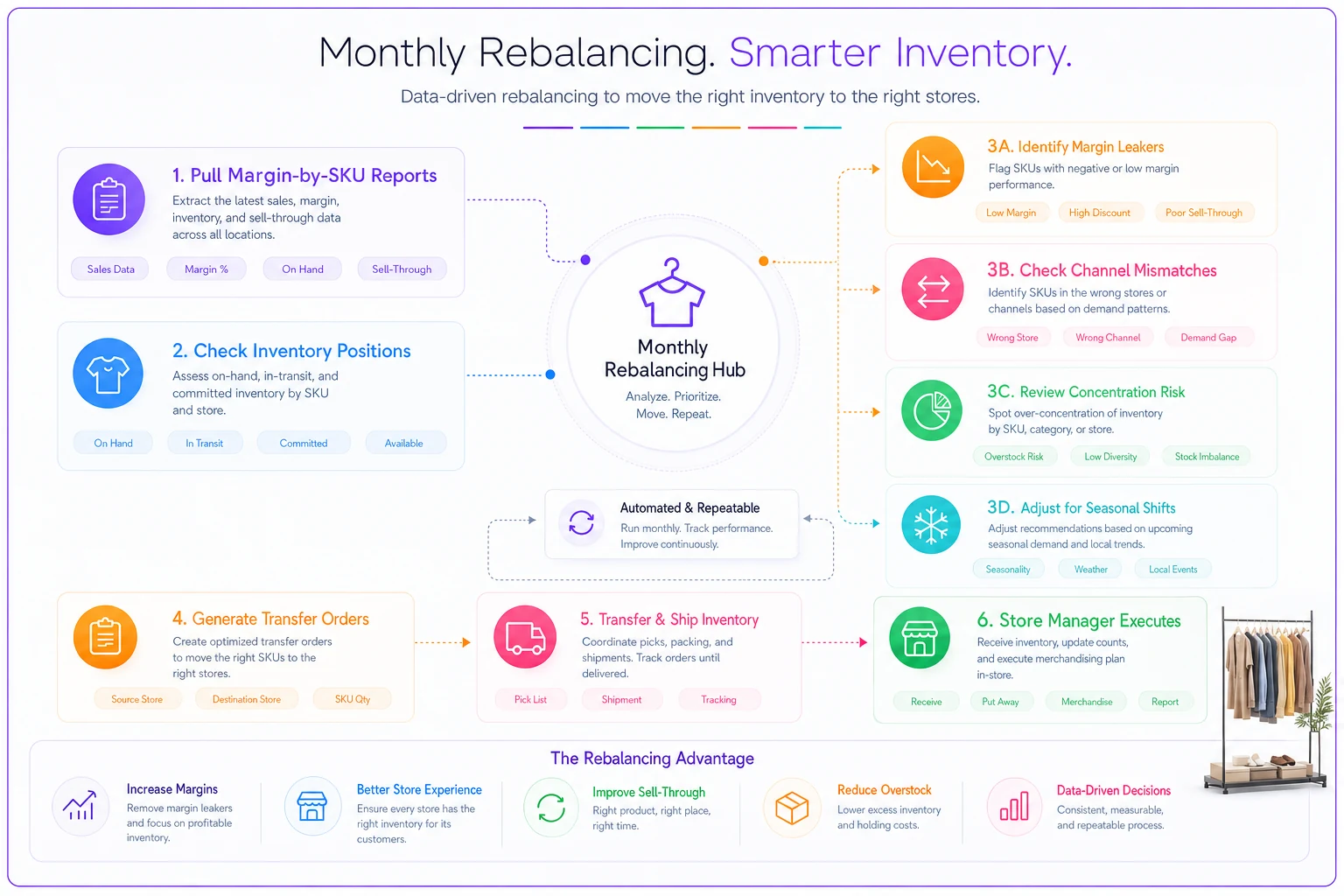
The actual execution happens through simple transfer orders generated from these rules. Don't try to optimize perfectly—just improve from last month's position. A store manager can usually process the resulting transfers in under an hour.
Routing rules that protect margins without crushing operations
Routing rules translate your allocation matrix into daily fulfillment decisions. Most retailers either have no rules (chaos) or rules so complex nobody follows them (also chaos). The effective approach sits somewhere in between.
A simple decision hierarchy for order routing:
Primary rule: Route from the location that preserves the highest contribution margin after all costs. This sounds obvious but requires actually calculating and comparing margins—not just picking the closest warehouse.
Override for velocity: If an item sells more than 5 units weekly in a specific store, maintain minimum stock there regardless of margin optimization. Empty shelves cost more than margin optimization gains.
Return routing special handling: Returns always route to the channel with the lowest historical return rate for that SKU. A dress with 35% online return rates but 10% in-store should always go to a physical location after return processing.
Clearance acceleration: Items marked down more than 40% off original price lose routing restrictions—fulfill from anywhere that moves units. At deep discounts, velocity beats margin optimization.
Bundle these into a one-page reference sheet anyone handling fulfillment can follow. Complex decision trees guarantee inconsistent execution. Your part-timer handling Saturday fulfillment needs rules they can apply without calling a manager.
Stores that implement these simple routing rules typically improve overall margins by 3-5 percentage points within the first quarter—not from any single dramatic change, but from hundreds of small decisions that finally align with profitability rather than convenience.
Real numbers from a 3-store indie chain
A boutique chain with locations in Austin, Dallas, and Houston plus an e-commerce channel implemented this framework last fall. Contemporary women's apparel in the $75-$300 range, roughly $2.8M annual revenue across all channels.
Before margin-adjusted allocation, their metrics looked like this:
| Metric | Before |
|---|---|
| Overall gross margin | 52% |
| Contribution margin after operations | 28% |
| Online return rate | 31% |
| In-store return rate | 13% |
Their previous system routed online orders from whichever store had stock—usually the flagship Austin location since it carried the deepest inventory. Returns went back to the warehouse for reprocessing. Nobody tracked margin by channel beyond basic gross margin reports.
The analysis revealed some uncomfortable truths. Dresses ordered online and fulfilled from stores showed 18% contribution margins after factoring returns and shipping. Those same dresses sold in-store generated 38%. Denim performed even worse online—certain fits with 45% return rates were actually losing money on net.
They built their SKU role matrix from the previous year's data:
-
Traffic drivers (15% of SKUs)
Basic tees and tanks
-
Core sellers (40%)
Dresses, most denim, core tops
-
Margin champions (25%)
Outerwear, leather goods, premium denim
-
Slow movers (20%)
Previous season items, poor-performing styles
The rebalancing started simple. Month one, they restricted margin champions to in-store only unless inventory exceeded 60 days of store supply. Month two, returns started routing to stores instead of the warehouse. Month three, full channel-margin routing rules went live.
| Metric | After | Change |
|---|---|---|
| Overall gross margin | 53% | +1pt |
| Contribution margin | 34% | +6pts |
| Online return rate | 28% | -3pts |
| Inventory turns | 4.8x | up from 4.1x |
The contribution margin improvement dropped straight to the bottom line—an extra $168k in profit on the same sales volume. More importantly, these weren't one-time cleanup gains. The monthly rebalancing routine sustains those margins while actually requiring less management time than their previous ad-hoc approach.
The warehouse question most retailers get backwards
Indie omnichannel retailers consistently make the same mistake: they treat the warehouse or back stock area as the default fulfillment center for online orders. Seems logical—inventory in one place, dedicated packing area, shipping supplies ready. But this approach often destroys margins for a reason most people overlook.
Warehouse inventory is dead inventory until it moves. Every day a blazer sits in your back room is a day it's not on a sales floor creating try-on opportunities. When you fulfill online orders from warehouse stock first, you're prioritizing the channel with higher return rates and lower margins while leaving your best-margin channel understocked.
Flip the logic. Use store inventory for online fulfillment first—but only from stores with excess stock relative to their sales velocity. Keep the warehouse as overflow and returned goods processing, not primary fulfillment. It feels counterintuitive until you actually run the numbers.
A typical scenario: 12 units of a popular dress across your operation—4 in each of two stores, 4 in the warehouse. Traditional logic says fulfill online orders from the warehouse to preserve store stock. But if that dress sells 2 units weekly in-store at 42% margins and 1 unit weekly online at 24% margins after returns, you're better off keeping warehouse units as store backstock and fulfilling online orders from the slower-velocity store.
This also solves the "return to warehouse" problem. Most fulfillment systems default to sending returns wherever they originally shipped from, creating a doom loop where high-return items accumulate in e-commerce inventory. Treating the warehouse as a reallocation hub rather than a fulfillment center naturally routes returns back to the highest-margin channel—your stores.
Store transfer economics that actually make sense
Traditional transfer logic focuses on inventory balance—Store A has too much, Store B needs more, make the transfer. This ignores the reality that transfers cost real money and tie up product during transit.
The real cost of transfers extends beyond shipping. There's labor to pick and pack (usually 15-20 minutes), receiving and processing at the other end (another 15-20 minutes), transit time when items can't sell (1-3 days), and some risk of damage or loss (around 0.5% of transferred items). For a $100 dress, the full transfer cost typically lands at $12-15 between locations in the same city, or $18-25 for longer distances.
| Margin Tier | Transfer Rule |
|---|---|
| High-margin items (40%+ contribution) | Transfer when receiving store velocity exceeds sending store by 2x or more |
| Standard-margin items (25-39% contribution) | Transfer only when receiving store is stocked out with recent lost sales |
| Low-margin items (under 25% contribution) | No transfers except for customer special orders or clearance consolidation |
The monthly rebalancing routine will surface transfer opportunities, but don't force transfers just because the calendar says so. Every transfer should pass the margin hurdle test, or you're just moving problems around while burning cash on logistics.
Why returns dictate routing more than distance
Return rates vary dramatically by channel, and that variance should drive routing logic more than shipping distance. A product with a 40% online return rate but 15% in-store rate shouldn't be fulfilling from e-commerce inventory even if it means higher upfront shipping costs.
The math is straightforward but gets ignored constantly. Say you're fulfilling a $150 coat. Shipping from your store costs $12, from your warehouse costs $8. That $4 savings looks smart until you factor in return differences. With 40% online returns from warehouse fulfillment versus 25% from store fulfillment—stores tend to pack more carefully and include better documentation—that $4 savings becomes a $15 loss after processing returned items.
| Category | Online Return Rate | In-Store Return Rate |
|---|---|---|
| Fitted items (blazers, pants) | 35-45% | Under 15% |
| Accessories | 15-20% | Under 8% |
| Shoes | 30-35% | Under 20% |
| Basics | ~20% | ~20% |
Use these patterns to preset routing rules. Fitted items should almost always fulfill from locations with the best packaging and quality control, regardless of distance. Accessories can ship from anywhere since return rates stay manageable either way.
The exchange dynamic matters too. Customers returning items to stores often exchange rather than refund, which preserves some revenue. Online returns almost always mean full refunds. That difference can swing margin math by another 10-15 percentage points for high-return categories.
Seasonal rotation beyond basic markdown schedules
Seasonal inventory creates margin challenges that standard allocation misses entirely. That winter coat sitting in your Phoenix store in April won't sell locally, but shipping it for online orders to Seattle might still generate full-price margins. Most retailers either ignore these opportunities or execute them poorly through panicked end-of-season transfers.
The smart approach uses geographic arbitrage systematically. As seasons wind down in warm climates, that inventory becomes online-only fulfillment stock for cooler regions. The reverse happens with summer items in cold climates as fall approaches.
-
February 15 Winter items in warm-climate stores shift to online-only allocation for cold regions
-
May 15 Summer items in cold-climate stores become priority fulfillment for warm regions
-
August 15 Fall items concentrate in cold-climate stores, with warm stores holding minimal floor stock
-
November 1 Holiday items distribute based on previous year's velocity, not equal allocation
Starting rotation before desperation sets in is the whole game. Moving winter coats in February when they're still selling at full price in cold markets beats marking them down 70% in warm stores come March. Yes, you'll pay more in shipping—but you'll preserve 20-30 margin points in the process.
Track rotation performance monthly. Which transfers resulted in full-price sales? Which items would have sold locally despite the season? This data shapes next year's timing. Most retailers find they rotate too late rather than too early—by the time they finally move seasonal goods, the receiving market is already winding down too.
Building your first margin matrix (start Monday)
Creating a margin-adjusted allocation system sounds complex, but the first version can be rough and still deliver results. Perfect calculations matter less than having any margin visibility in your routing decisions.
Start with five SKU categories, not your entire inventory. Pick your best seller, worst performer, highest-margin item, highest-return item, and one seasonal piece. Calculate actual contribution margins for these across your channels for last month only.
The calculation needs basic data:
-
Selling price by channel
-
Shipping costs (both ways for returns)
-
Return rate by channel
-
Processing labor (estimate $3-5 per touch)
-
Any channel-specific costs (packaging, customer service)
Start small: map five SKUs first so your team can iterate quickly without operational overload.
Build a simple grid showing each item's contribution margin by channel. You'll immediately spot problems—items losing money online, categories destroying margins through returns, SKUs that should never leave certain channels.
From this five-item test, create three routing rules. Maybe "denim always fulfills from stores" or "accessories ship from nearest location regardless of channel." Test these rules for two weeks. Track whether margins improve for these categories.
The incremental approach beats trying to revolutionize everything at once. Add five more SKUs to your matrix each week. Within two months, you'll have your top 50 SKUs—usually around 70% of revenue—mapped with routing rules. The long tail can wait.
Don't let perfect be the enemy of better. A rough margin matrix your team actually uses beats a perfect system that lives only in spreadsheets. Even basic margin visibility in routing decisions typically improves contribution margins by 2-4 points within the first quarter.
Software and automation
Managing margin-adjusted allocation manually works reasonably well for retailers under 1,000 active SKUs across 3-4 channels. Beyond that scale, the calculation burden and routing complexity need systematic support. But you don't need expensive enterprise software to automate the basics.
The core challenge isn't calculating margins—that's just math. It's maintaining updated calculations as costs shift and applying routing rules consistently during fulfillment. Most small retailers already struggle with basic fulfillment workflows, so adding margin complexity without any automation usually falls apart fast.
AI-powered operational software addresses this by continuously recalculating margins based on actual performance data rather than estimates. When return rates shift, shipping costs change, or seasonal patterns emerge, routing rules adjust accordingly. This eliminates the monthly manual recalculation burden while ensuring decisions use current data rather than last quarter's assumptions.
The automation also handles edge cases that manual rules miss. What happens when your highest-margin channel is stocked out but the second-best option is only 2% worse—do you wait for restock or fulfill immediately? Operational platforms with AI-driven logic can make these nuanced calls based on historical patterns and current demand, something nearly impossible to codify in simple static rules.
For growing retailers, automated rebalancing suggestions save significant time. Instead of manually reviewing hundreds of SKUs each month, you review AI-generated transfer recommendations that already factor margin impact, velocity differences, and transfer costs. The system might surface 15 specific items to move between locations, each transfer justified by margin math you can verify yourself.
The consistency angle is often underrated. Manual routing rules get quietly ignored during busy periods or by newer staff. Automated systems apply margin logic to every fulfillment decision regardless of whether it's a quiet Tuesday or peak holiday rush. That consistency alone typically improves margins by 2-3 points even without perfect optimization.
Common pitfalls that kill margin-based allocation
Even with solid frameworks, certain mistakes consistently derail these efforts. The biggest one? Overcomplicating the initial implementation. Retailers build 47-variable routing algorithms that no human can understand, let alone execute consistently. When complexity exceeds your team's capacity, they default to old habits within days.
Another frequent failure: ignoring the cultural shift required. Your store managers are used to protecting inventory for their own location. Now you're asking them to ship their best sellers to fulfill online orders. Without explaining the margin math and sharing the upside—tie bonuses to contribution margin, not just sales—they'll resist or quietly work around the system.
The "perfect data" trap catches analytically-minded retailers too. They spend months building elaborate models with precise cost allocations while bleeding margin daily from basic routing mistakes. Improving from random allocation to basic margin awareness captures probably 80% of available gains. The rest is diminishing returns.
Failing to account for customer experience creates long-term problems. Fulfilling an order from a store three states away might preserve 5% more margin, but if it adds three days to delivery, you risk losing the customer entirely. Factor lifetime value into your routing rules, not just transaction margins.
The measurement problem shows up quickly too. If you're still tracking traditional retail KPIs like sales per square foot or inventory turnover without looking at channel-specific contribution margins, you'll optimize for the wrong outcomes. A store crushing its sales targets might simultaneously be destroying margins through poor routing decisions.
And finally, rebalancing discipline breaks down. Month one goes great. Month two gets delayed because month-end was hectic. Month three never happens. By month six, you're back to chaos. Build rebalancing into your operational calendar with the same priority as payroll—margins don't maintain themselves.
The path forward for margin optimization
Margin-adjusted allocation isn't about perfecting every decision—it's about systematically improving from random to intentional. Most indie apparel retailers can capture 3-6 points of contribution margin improvement just by implementing basic routing rules based on rough margin calculations.
Start with visibility. If you don't know contribution margins by channel for your top 20 SKUs, that's week one homework. Week two, create three routing rules based on obvious margin disparities. Week three, test those rules. Week four, expand to your top 50 SKUs.
Monthly discipline matters more than the sophistication of your matrix. Simple rules executed consistently beat complex systems that get ignored. Your team needs to understand and believe in the approach, or they'll find workarounds that defeat the purpose.
For retailers ready to move beyond manual management, operational software that automates margin calculations and routing decisions provides the consistency that manual systems can't sustain long-term. But don't wait for perfect software to start—even spreadsheet-based routing rules will improve your margins starting next week.
The competitive reality is pretty simple: multi-channel retailers who ignore margin-based allocation are subsidizing unprofitable channels with profitable ones. In a market with rising customer acquisition costs and shrinking margins, that's a luxury indie retailers can't afford. Every routing decision either preserves or destroys margin—and the retailers winning at omnichannel aren't necessarily the ones with the most channels or the fastest fulfillment. They're the ones routing inventory through channels that preserve the most profit after all real costs are counted.
Ready to elevate your apparel business?
Join 2,000+ retailers using Werzly to streamline operations, increase sales, and deepen customer loyalty.