


Three months into working with a new supplier, a boutique owner discovered her spring collection was stuck in customs because the vendor never mentioned they don't handle import documentation. Another store got burned when their "premium denim" supplier's first bulk order looked nothing like the samples—different fabric weight, inconsistent washes, wonky sizing. These aren't rare horror stories. They're what happens when small apparel buyers treat vendor onboarding like filling out a contact form instead of building an actual operational foundation.
Most clothing store owners learn supplier management through expensive mistakes. You negotiate pricing, sign some paperwork, place an order, then hope for the best. When shipments arrive late, quality varies wildly, or minimum orders suddenly change, you scramble to fix problems that proper onboarding would have prevented.
The vendor onboarding checklist small retailers actually need isn't about collecting certificates and checking boxes. It's about understanding exactly how a supplier operates, where they typically fail, and building specific safeguards into your working relationship from day one.
The vendor onboarding checklist that catches problems before they cost you
A functional onboarding process for apparel suppliers covers three critical areas: operational capability, quality standards, and communication protocols. Miss any of these during setup and you'll discover the gaps when inventory is already committed and customers are waiting.
Start with operational fundamentals. Can they actually deliver what you need, when you need it, in the quantities that make sense for your store? Document their standard lead times for initial orders versus reorders. Get specific production capacity numbers—not "we can handle your volume" but actual weekly output figures. Clarify their minimum order quantities by style, color, and total order value.
One women's boutique learned this after their supplier's MOQ jumped from $2,500 to $5,000 between sample approval and production. The vendor claimed they'd "always" had higher minimums for certain fabric types. Without documented terms from onboarding, the store had no recourse except absorbing the extra inventory cost or walking away from their bestselling blazer line.
Your quality standards agreement needs teeth. Don't accept vague promises about "high quality" or "careful inspection." Define acceptable defect rates (typically 2–3% for mid-market apparel), specify fabric tolerances, and set color consistency requirements. Include photos of acceptable versus unacceptable quality issues.
Request their quality control process documentation. Do they inspect during production or only finished goods? What percentage gets checked? Who handles it—internal teams or third parties? A supplier who can't explain their QC process probably doesn't have one.
Communication structure determines whether problems get solved or spiral. Establish primary contacts for orders, quality issues, and shipping problems. Set response time expectations—24 hours for standard inquiries, same-day for urgent issues. Define what constitutes "urgent" so you're not flagging every routine question as a fire drill.
Get their holiday schedule, production blackout dates, and seasonal capacity constraints in writing. That affordable supplier might shut down completely for three weeks during Chinese New Year, right when you need spring inventory.
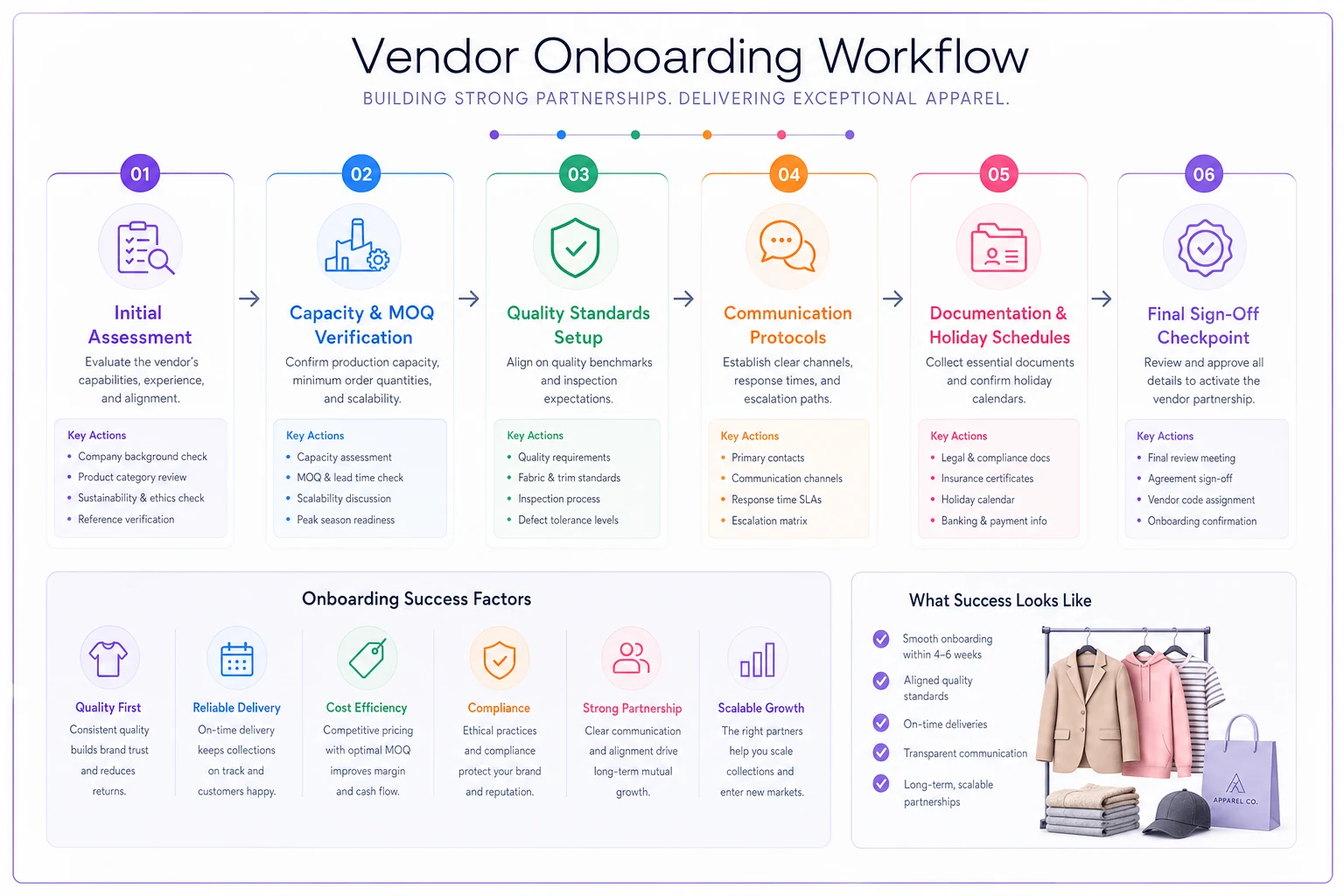
This diagram maps the onboarding checkpoints so you can audit each step during setup.
Building your quarterly scorecard around metrics that matter
Tracking supplier performance quarterly gives you enough data to spot patterns without drowning in spreadsheets. Focus on three core metrics that directly impact your business: on-time delivery percentage, defect rates, and MOQ compliance.
Take control of your clothing store operations.
Werzly helps you manage stock, process orders, and engage customers effortlessly.
- Unified inventory and order management
- Automated customer notifications
- Sales and stock analytics
No credit card required
On-time delivery isn't just about a shipment arriving on schedule. It's about the right products, in the right quantities, with the right documentation, ready to sell. Track these components separately:
-
Production completed on schedule
-
Shipping initiated as promised
-
Correct items shipped
-
Accurate quantities
-
Complete paperwork
A supplier might technically deliver "on time" while consistently shorting you on popular sizes or forgetting care labels. Breaking down the metric reveals where they actually struggle.
Defect tracking needs consistency to be meaningful. Photograph and categorize every quality issue—construction problems, fabric flaws, sizing errors, labeling mistakes. Calculate defect rates by total units and by issue type. A 2% overall defect rate might be acceptable, but not if it's concentrated in your highest-margin items.
MOQ compliance seems straightforward but often shifts subtly. Document every deviation from agreed minimums, including "exceptions" and "one-time changes." Suppliers who constantly push higher minimums are telling you something about their business model or how they value you as a customer.
A basic scorecard structure that actually drives decisions:
| Metric | Target | Q1 Actual | Q2 Actual | Q3 Actual | Q4 Actual | Trend |
|---|---|---|---|---|---|---|
| On-Time Delivery | >95% | 92% | 88% | 85% | 79% | ↓ Declining |
| Defect Rate | <3% | 2.1% | 2.8% | 4.2% | 5.1% | ↑ Worsening |
| MOQ Compliance | 100% | 100% | 100% | 75% | 50% | ↓ Declining |
| Avg Response Time | <24hr | 18hr | 22hr | 28hr | 36hr | ↑ Slowing |
The trend column matters more than individual quarters. Gradual degradation often signals bigger problems—new management, capacity issues, shifting priorities—before they become crises.
Remediation steps that fix problems without burning bridges
When suppliers underperform, small retailers often feel powerless. You can't threaten to pull massive orders you don't place. You need these relationships. But targeted remediation that acknowledges your position while protecting your business works better than empty threats or silent acceptance.
For delivery delays, implement graduated consequences tied to specific thresholds. First late delivery triggers a documented conversation about causes and prevention. Second requires written commitment to revised timelines. Third activates penalty clauses (even small ones matter symbolically) or adjusted payment terms.
One boutique chain started holding 10% of payment for 30 days after any late delivery. The amount barely impacted suppliers financially, but it forced attention to their account and usually improved subsequent performance.
Quality problems need immediate, specific feedback with visual documentation. Don't say "quality is slipping." Send photos comparing acceptable samples to defective products, with counts and percentages. Request their analysis of root causes and a prevention plan. If they blame "normal variation," tighten your specifications.
For persistent quality issues, require pre-shipment photos of random samples from production runs. This catches problems before freight costs lock you into bad inventory. One store reduced defect rates from around 6% to under 2% simply by requiring suppliers to photograph and measure ten random pieces before shipping.
MOQ creep happens gradually—exceptions become precedents, precedents become policy. Address every deviation immediately, even if you accept it. "We understand the $3,000 minimum for this order due to fabric constraints, but our agreement remains $2,000 for standard orders." Document their acknowledgment.
Consider negotiating graduated minimums based on relationship duration or annual volume. Start at higher MOQs with automatic reductions after successful quarters. This gives suppliers security while rewarding good performance.
The critical first 90 days with any supplier
Your first three months establish patterns that persist for years. Suppliers learn whether you catch problems, enforce standards, and follow through on consequences. They also learn whether you're organized, reasonable, and worth keeping happy.
Place smaller test orders across different product categories before committing to seasonal buys. Order your most quality-sensitive items first—if they can't get those right, nothing else matters. Include at least one reorder to test consistency and whether terms suddenly change.
Document everything obsessively during this period. Every conversation, every deviation, every success. You're building the operational history that determines whether this relationship scales or stalls.
A successful 90-day period shows:
-
Consistent quality across multiple orders
-
Reliable communication patterns
-
Stable terms and minimums
-
Proactive problem-solving
-
Capacity for your growth needs
One accessories boutique uses a simple 90-day review template that's prevented a lot of supplier headaches. They track five yes/no questions:
-
Did all orders arrive within agreed timeframes?
-
Were defect rates under 3%?
-
Did MOQs remain stable?
-
Were problems communicated proactively?
-
Did they provide helpful suggestions for our business?
Three or fewer "yes" answers trigger immediate renegotiation or replacement. Sounds harsh until you consider the cost of discovering supplier problems during peak season.
Communication templates that prevent misunderstandings
Most supplier problems come from assumption gaps—you assumed they understood your requirements, they assumed you knew their limitations. Clear templates eliminate these expensive misunderstandings.
Your order confirmation template should force clarity on every detail that matters:
-
Exact style numbers and descriptions
-
Specific colorways with Pantone references or physical samples
-
Size breakdowns with measurements, not just S/M/L
-
Fabric composition and weight specifications
-
Labeling and packaging requirements
-
Quality standards and inspection criteria
-
Delivery date (ex-factory and to your door)
-
Payment terms and conditions
Quality issue reports need similar precision. Include:
-
Order and style numbers affected
-
Number of units impacted
-
Specific nature of defects with photos
-
Commercial impact (can't sell, must discount, etc.)
-
Required resolution (credit, replacement, discount)
-
Timeline for response and resolution
The goal is making expectations explicit rather than implied. "Professional packaging" means different things to different suppliers. "Folded in poly bags with size stickers visible, maximum 12 units per carton, carton weight under 35 pounds" leaves no room for interpretation.
Technology and systemization for vendor management
Manual vendor tracking works fine until you have more than three or four active suppliers. Then details slip, follow-ups get missed, and you discover problems through customer complaints instead of catching them early.
Operational software that centralizes vendor information, automates performance tracking, and triggers follow-ups based on your rules transforms vendor management from constant crisis to predictable process refinement. The right platform pulls delivery data from your receiving process, quality metrics from inspection logs, and automatically calculates quarterly scorecards without you building a new spreadsheet every three months.
AI automation is particularly useful for pattern recognition across suppliers. When multiple vendors show similar degradation patterns around the same time, it often signals market-wide issues—material shortages, regulatory changes, shipping disruptions—that require strategic adjustment rather than individual supplier remediation.
The most valuable automation catches early warning signals before they become expensive. A supplier who typically responds within hours suddenly taking days. Quality issues clustering in specific product categories. MOQ exceptions showing up more frequently. These patterns are nearly invisible in manual tracking but obvious when your software is configured to flag them.
Flag spikes in average response time and MOQ exceptions automatically so you can investigate before patterns worsen.
These patterns are nearly invisible in manual tracking but obvious when your software is configured to flag them.
Moving beyond reactive vendor management
Small apparel buyers often accept supplier problems as an inevitable cost of doing business. But structured onboarding, consistent monitoring, and systematic remediation transform vendor relationships from unpredictable liabilities into a genuine competitive advantage.
The boutiques with reliable supplier networks didn't get lucky. They built operational discipline into vendor management from day one, caught problems early through systematic tracking, and addressed issues with specific, graduated responses that protected their business while maintaining relationships.
Your vendor onboarding checklist becomes the foundation for every supplier relationship. Not bureaucracy for its own sake, but protection against the expensive surprises that kill margins and disappoint customers. When suppliers know you track everything, measure consistently, and enforce standards, they deliver differently.
The quarterly scorecard turns subjective frustration into objective conversation. Instead of "you're always late," you discuss specific metrics and improvement plans. Instead of threatening to leave, you implement graduated consequences that motivate better performance.
This operational rigor sounds like overhead for small retailers already stretched thin. But the alternative—accepting whatever suppliers deliver, whenever they deliver it, however it looks—costs far more in markdowns, lost sales, and customer disappointment. The boutiques scaling successfully treat vendor management as core operations, not administrative burden.
Build these systems now, while your supplier base is manageable. Finding out your vendor management is broken when spring inventory arrives defective, late, and over-minimum is an expensive way to learn the lesson.
Ready to elevate your apparel business?
Join 2,000+ retailers using Werzly to streamline operations, increase sales, and deepen customer loyalty.