


Visual drift is sneaky because nothing dramatic ever happens. Nobody knocks over a table. You just walk in one Tuesday, look at the denim wall, and realize it's been slowly sliding toward chaos for eleven days — mixed washes, a size run that skips 30 and 34, two hangers facing the wrong way, and a markdown rack that's quietly bleeding into your full-price section. No single person broke it. It just settled into that state while everyone was busy ringing up customers.
This matters more for small stores than big-box chains because you don't have a dedicated visual team walking the floor every few hours. The person fixing the fold table is the same person on register, handling a return, and texting a vendor about a late shipment. So merchandising maintenance doesn't get a time slot — it gets whatever's left over, which is usually nothing.
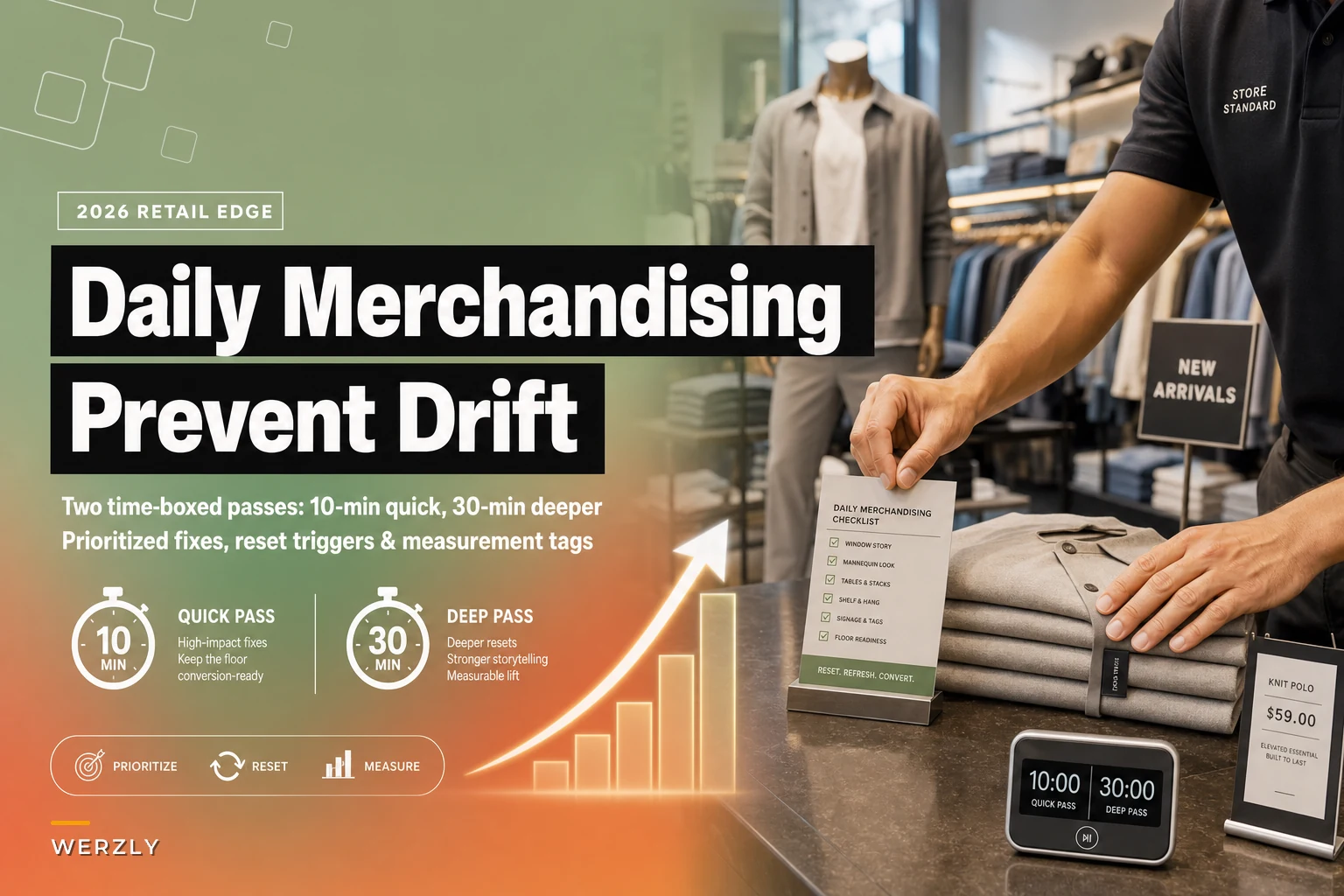
This post covers a tight, repeatable fix. Two time-boxed passes, a short list of what to actually look at, clear signals for when the daily routine isn't enough, and a few tags so you can tell whether the system is working or just making you feel busy. Not a merchandising philosophy — a daily merchandising checklist small store teams can actually run between customers.
Why drift happens even when your staff "cleans up"
The common assumption is that drift means people aren't tidying. Usually that's not it. Staff are straightening constantly. The problem is they're straightening reactively — fixing what a customer just messed up — instead of scanning systematically for what's actually degrading over time.
Those are two completely different behaviors. Reactive tidying fixes the obvious. It refolds the sweater a customer unfolded. What it misses is the slow stuff: the size holes opening up, the color story breaking down, the signage that's now technically wrong because the promo ended Sunday, the fixture that's 60% full and looks picked-over.
-
Restock lag. A size sells through, nobody backfills from the stockroom, and the gap sits there signaling "this store is out of stock" to every customer who walks the aisle.
-
Markdown creep. Clearance items migrate toward the front because that's where returns and go-backs land, slowly poisoning the full-price impression.
-
Hanger entropy. Direction, spacing, and hook alignment drift one wrong hanger at a time. No single one matters. Thirty of them read as "messy."
-
Dead signage. The promo's over but the sign's still up, which either confuses customers or trains them to ignore your signs entirely.
None of these get fixed by reactive tidying because the staff member doesn't notice them — they're not looking for them. That's the whole case for a structured pass instead of "keep the floor clean."
The real cost of a drifted floor
The expensive part of drift isn't aesthetics. It's that a drifted floor actively suppresses sell-through on inventory you already paid for.
Take control of your clothing store operations.
Werzly helps you manage stock, process orders, and engage customers effortlessly.
- Unified inventory and order management
- Automated customer notifications
- Sales and stock analytics
No credit card required
A size gap on a strong style is the clearest example. Say you've got a top that moves well, but mediums and larges sold through two days ago and nobody pulled replacements. Customers in those sizes glance, see nothing, and move on. You don't lose the sale to a competitor dramatically — you just quietly stop selling a proven item for 48 hours because the floor misrepresented what you actually have in back.
Markdown creep is subtler and arguably worse. When clearance product drifts into your full-price zones, it reframes the whole section in the shopper's head. Full-price items next to a 50%-off rack start feeling overpriced by association. You're not just failing to sell the clearance — you're softening willingness to pay on everything around it.
And there's a labor cost nobody tracks: the Saturday reset. When daily maintenance slips all week, Saturday morning becomes a frantic 90-minute full re-merchandise before the rush. That's premium-traffic labor burned on cleanup that two quick daily passes would've prevented. If you want to understand which of these actually hits your numbers versus just feels bad, tying the behavior to the apparel KPI framework that tells small stores what to act on is worth the time rather than guessing.
The 10-minute quick pass
This runs twice a day — once at open, once mid-afternoon before the evening traffic bump. It's deliberately shallow. The goal is to catch the fast-degrading stuff, not perfect anything.
Ten minutes, walked as one loop through the store, hitting only these:
-
Front-zone first impression. The first 15 feet. Is the lead table/fixture full, faced, and on-story? This zone sets the tone for the whole visit.
-
Size gaps on A-items. Only your best sellers. Scan the size runs. Any holes get a backfill note or a stockroom grab if it's fast.
-
Markdown containment. Anything that's drifted out of the clearance zone goes back. Takes 60 seconds and protects full-price perception all day.
-
Dead signage sweep. Any sign for an ended promo comes down. No exceptions.
-
Hanger quick-fix. Not every hanger — just the obvious wrong-facing or dropped ones in the main sightlines.
The discipline here is stopping at ten minutes.
The discipline here is stopping at ten minutes. If you find a problem too big for the quick pass — a whole fixture that needs rebuilding, a size run that's collapsed across multiple styles — you don't fix it now. You tag it for the deeper pass. Trying to fix everything during the quick pass is how a 10-minute routine turns into a 40-minute routine nobody runs consistently.
The 30-minute deeper pass
Once a day, ideally during your slowest hour, somebody runs the longer pass. This is where you fix what the quick passes flagged plus do the maintenance that genuinely needs time.
The deeper pass covers everything the quick pass does, but thoroughly, plus:
-
Full size-integrity check on all A and B items — not just the top sellers, and backfill from stock properly, not just spot-grabs.
-
Color and story rebuild on any fixture that's drifted off its intended grouping. This is the one that actually takes time and judgment.
-
Fixture fill-level audit. Anything under roughly 50% full gets consolidated or restocked. Picked-over fixtures depress sales on the items left.
-
Fitting-room-adjacent zones. Go-backs pile up here fast, and this area directly affects conversion. If try-on-to-sale is a focus, the mechanics in the fitting-room conversion playbook pair naturally with keeping these zones clean.
-
Clear the flagged queue from the quick passes — the stuff deliberately deferred earlier.
Thirty minutes is enough to do real work without becoming a project. The failure mode here is scope creep — starting a full department re-merchandise that should be its own scheduled task. If the deeper pass can't stay inside 30 minutes, that's a signal, which is the next part.
How the two passes connect day to day
The quick pass and deeper pass aren't really separate routines — they feed each other. The quick pass catches what's degrading fast and flags what it can't handle. The deeper pass clears those flags and handles the slower-burning stuff. Without that handoff, both passes start doing the same job badly.
Open quick pass (10 min) → Flag anything too big to fix on the spot → Mid-morning deeper pass (30 min) → Clears flagged items + full integrity check → Afternoon quick pass (10 min) → Catches post-lunch drift → Tag the day (Clean / Backlog / Overrun)
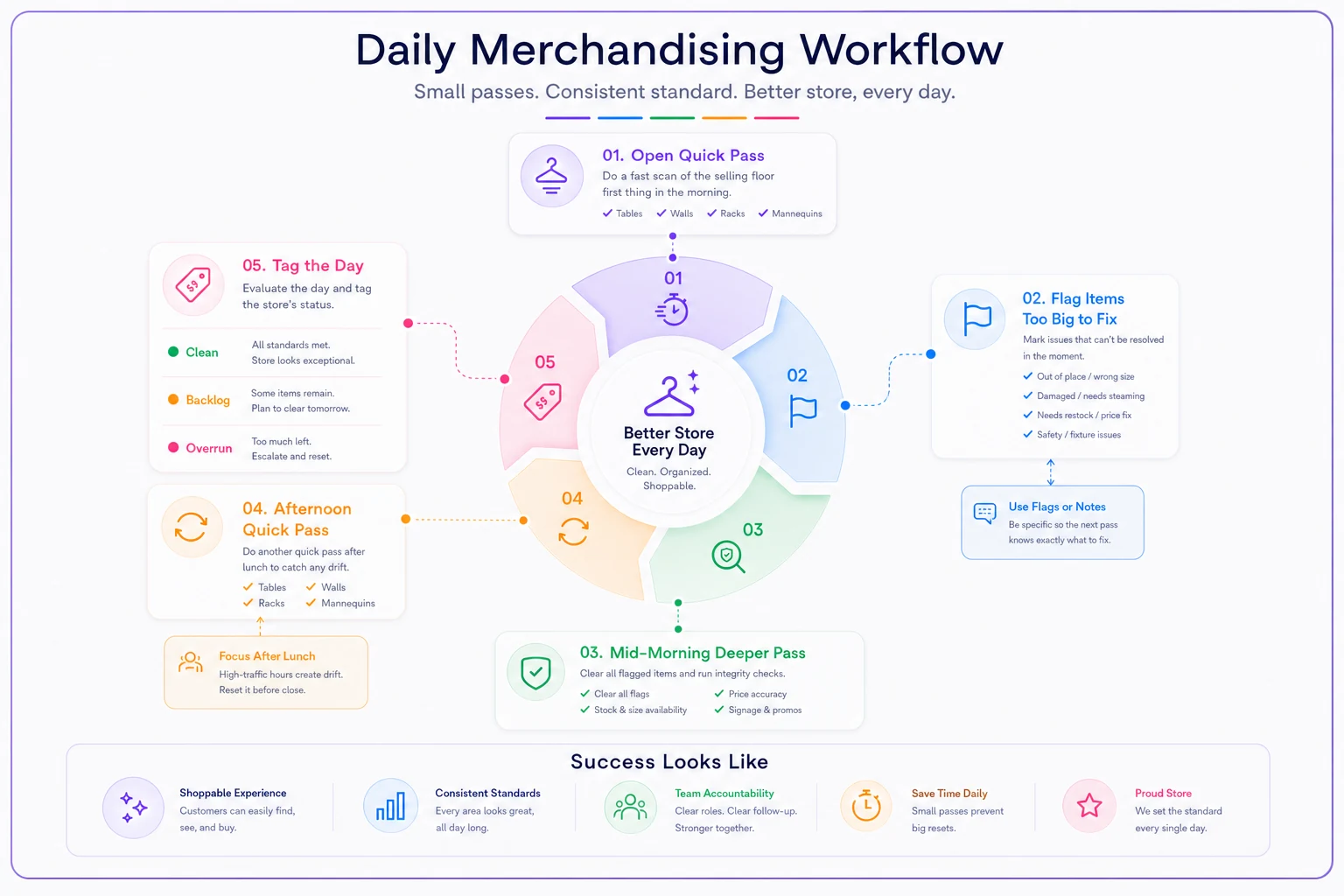
The tagging step at the end matters more than it looks. Without it, you're just running passes and hoping the floor holds. With it, you start seeing patterns.
Measurement tags: knowing if the system actually works
Without any tracking, you can't tell the difference between a routine that's working and one that's just happening. You don't need software or elaborate logs — three quick tags on a notecard or your phone per pass:
| Tag | What it means | Why it matters |
|---|---|---|
| Clean | Pass finished in time, nothing major found | System is holding — floor is self-maintaining between passes |
| Backlog | Finished in time but left flagged items for later | Normal occasionally; frequent means passes are falling behind |
| Overrun | Couldn't contain it in the time box | Warning sign — drift is outpacing the daily routine |
Jot the tag and a one-word reason. "Overrun — denim." "Backlog — sizes." After a week you'll see patterns: maybe the deeper pass always overruns on Fridays because Thursday restock didn't happen, or one zone is chronically in backlog because it's structurally hard to maintain.
The point isn't data for its own sake. Three Overrun tags in a week means your daily routine is no longer enough and you need to escalate. Tags turn a vague "the floor feels off lately" into a specific, actionable signal.
Escalation signals: when daily passes aren't enough
The daily routine handles normal drift. It does not handle structural problems — and trying to force it to is how both the routine and the floor fall apart. These are the signals that you need a full weekly reset, not just another daily pass:
-
Three or more Overrun tags in a rolling week. The clearest signal. Daily passes can't contain what's happening.
-
Same zone flagged four-plus days running. That zone has a structural issue — wrong fixture, bad adjacency, or chronic understock — that a daily pass will never fix.
-
Backlog queue never empties. If the deferred list only grows, you're accumulating debt faster than you're paying it.
-
A full category's size integrity collapses. Multiple styles missing core sizes usually means a restock or receiving problem upstream, not a merchandising one.
When you hit these, you schedule a weekly full reset — a dedicated 60–90 minute block before open, not during traffic — to rebuild from the fixture level up. The daily passes maintain. The weekly reset repairs. Don't let the reset's job leak into the daily routine where it'll blow your time boxes.
A real scenario
A two-person women's boutique, moderate foot traffic, around 40–50 transactions on a normal weekday. Their merchandising was "whenever someone had a second," which in practice meant Saturday mornings in a panic.
The recurring problem was markdown creep plus size gaps. Clearance kept migrating to the front, and their three best-selling styles routinely had holes in the size run because mid-week restock never happened consistently. They were essentially understocking proven winners on the floor while overstocking them in back.
They put in the two-pass routine — quick pass at open and around 3pm, deeper pass during the mid-morning lull — and started tagging. First week was rough: four Overruns, mostly the clearance zone and the denim wall. The tags made the structural problem obvious. The clearance rack was in a bad spot that funneled go-backs toward full-price, so they moved it. The denim wall needed a standing restock cue, not daily firefighting.
After the first full reset and that one fixture move, the daily passes started landing Clean most days. The Saturday scramble mostly went away — the floor was being held all week instead of rebuilt every weekend. Hard to measure precisely, but the owner noticed their A-items stopped stocking out on the floor while still full in back, which had quietly been costing sales for months.
When this routine is overkill — and when it's not enough
When it makes sense: most small apparel stores with one or two people on the floor and a layout that drifts under normal traffic. If you're running Saturday panic resets, this is for you.
When it's overkill: a tiny, tightly curated store with very low SKU count and light traffic might only need one short pass a day. Don't force a two-pass system on a floor that doesn't drift fast enough to warrant it.
When it's not enough: if you're consistently hitting escalation signals even with weekly resets, the problem isn't your routine. It's structural — bad layout, chronic understock, or a receiving pipeline that doesn't backfill. No amount of daily passing fixes an upstream supply problem. Solve the real bottleneck instead of merchandising around it.
The one thing to actually remember
Drift wins through patience, not force. It never breaks your floor in a single event — it just accumulates while everyone's heads-down on customers. The two-pass routine works not because it's clever but because it's time-boxed and systematic: short enough to actually run every day, structured enough to catch the slow stuff reactive tidying misses, and honest enough — through the tags — to tell you when daily maintenance isn't cutting it anymore.
Start with the quick pass tomorrow morning. Add the deeper pass when the quick pass starts flagging more than it can hold. Let the tags tell you when to escalate. That's the whole system, and it'll save you a lot more Saturday mornings than it costs you Tuesday afternoons.
Drift wins through patience, not force. It never breaks your floor in a single event — it just accumulates while everyone's heads-down on customers. The two-pass routine works not because it's clever but because it's time-boxed and systematic: short enough to actually run every day, structured enough to catch the slow stuff reactive tidying misses, and honest enough — through the tags — to tell you when daily maintenance isn't cutting it anymore.
Start with the quick pass tomorrow morning. Add the deeper pass when the quick pass starts flagging more than it can hold. Let the tags tell you when to escalate. That's the whole system, and it'll save you a lot more Saturday mornings than it costs you Tuesday afternoons.
Ready to elevate your apparel business?
Join 2,000+ retailers using Werzly to streamline operations, increase sales, and deepen customer loyalty.