

You watch customers carry armfuls of clothes into fitting rooms, spend 15 minutes trying things on, then walk out empty-handed. Your staff hovers awkwardly somewhere between helpful and annoying. The fitting room becomes this operational black hole where potential sales just disappear.
Most apparel stores convert somewhere around 20-30% of fitting room visits into purchases. That means 70-80% of customers who actually bothered to undress and seriously consider buying... don't. The fitting room is your highest-intent selling opportunity, and most stores treat it like a utility closet with better lighting.
The difference between stores converting at 25% versus 45%? It's not better merchandise or lower prices. It's having an actual playbook for what happens during those 8-12 minutes when someone's deciding whether to buy.
Why fitting rooms kill conversions (and it's not what you think)
Conventional wisdom blames poor fitting room conversion on sizing issues or unflattering mirrors. Sure, those matter. But when you look at operations across dozens of small apparel stores, the real conversion killers are timing and coordination problems.
What actually happens: A customer enters the fitting room at 2:47pm with six items. Your floor associate gets pulled to the register. Nobody checks in for 11 minutes. By then, the customer has mentally checked out, even if she found something she liked. The window closed while your team was handling other things.
Or your associate does check in, but catches the customer mid-struggle with a zipper. Now she feels rushed and self-conscious. Another lost sale.
The third pattern is a visual merchandising failure. Customers see a mannequin wearing a complete outfit, grab just the top, then can't visualize the full look once they're in the room staring at a mirror and harsh overhead lighting. They needed the visual context, but it stopped at the floor.
These aren't training failures. They're system failures. Staff can't optimize fitting room conversions through intuition when they're also covering the floor, running the register, and pulling inventory.
Building intervention timing that actually works
Fitting room conversion comes down to three timed interventions. Getting the timing wrong kills the sale faster than bad lighting.
Take control of your clothing store operations.
Werzly helps you manage stock, process orders, and engage customers effortlessly.
- Unified inventory and order management
- Automated customer notifications
- Sales and stock analytics
No credit card required
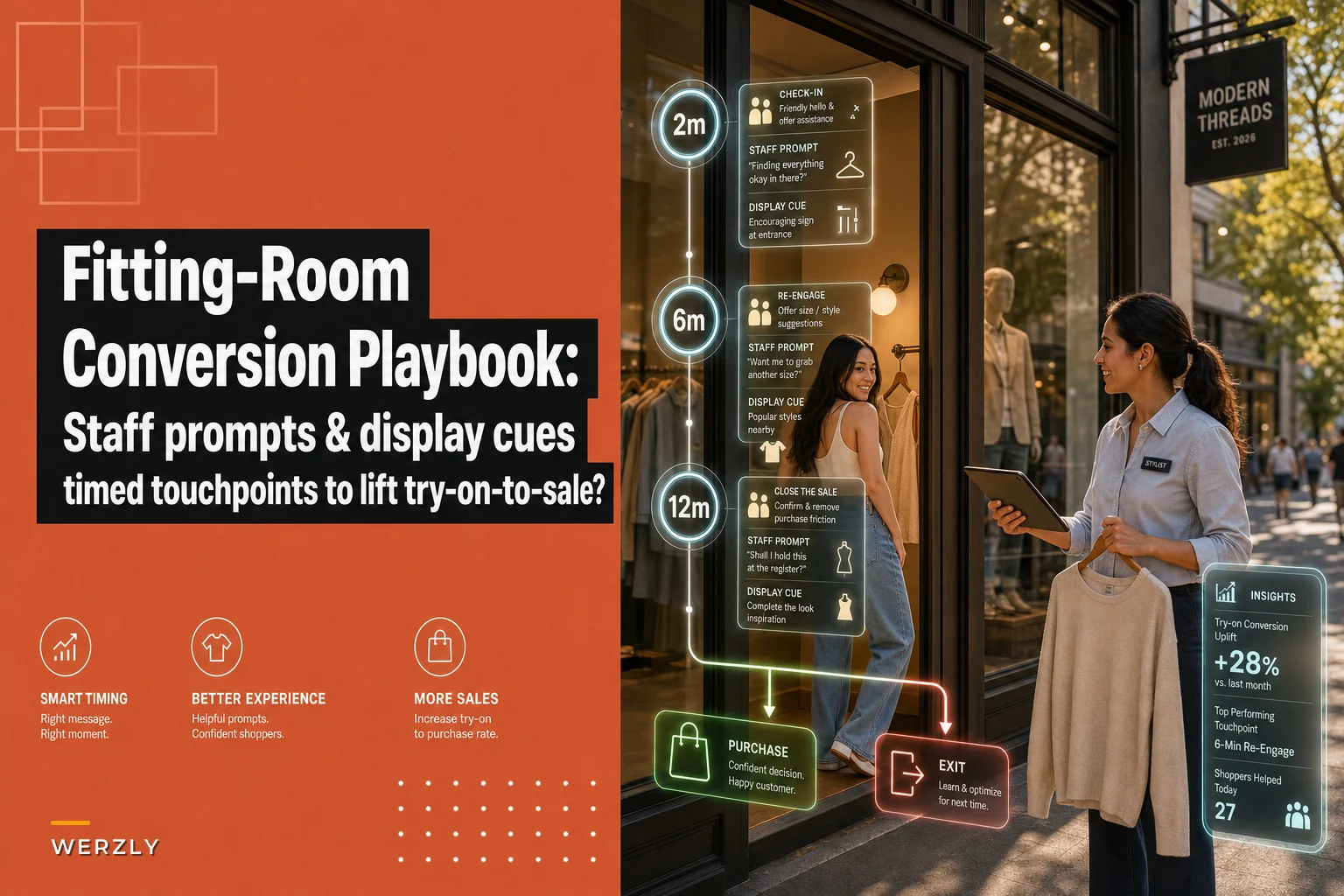
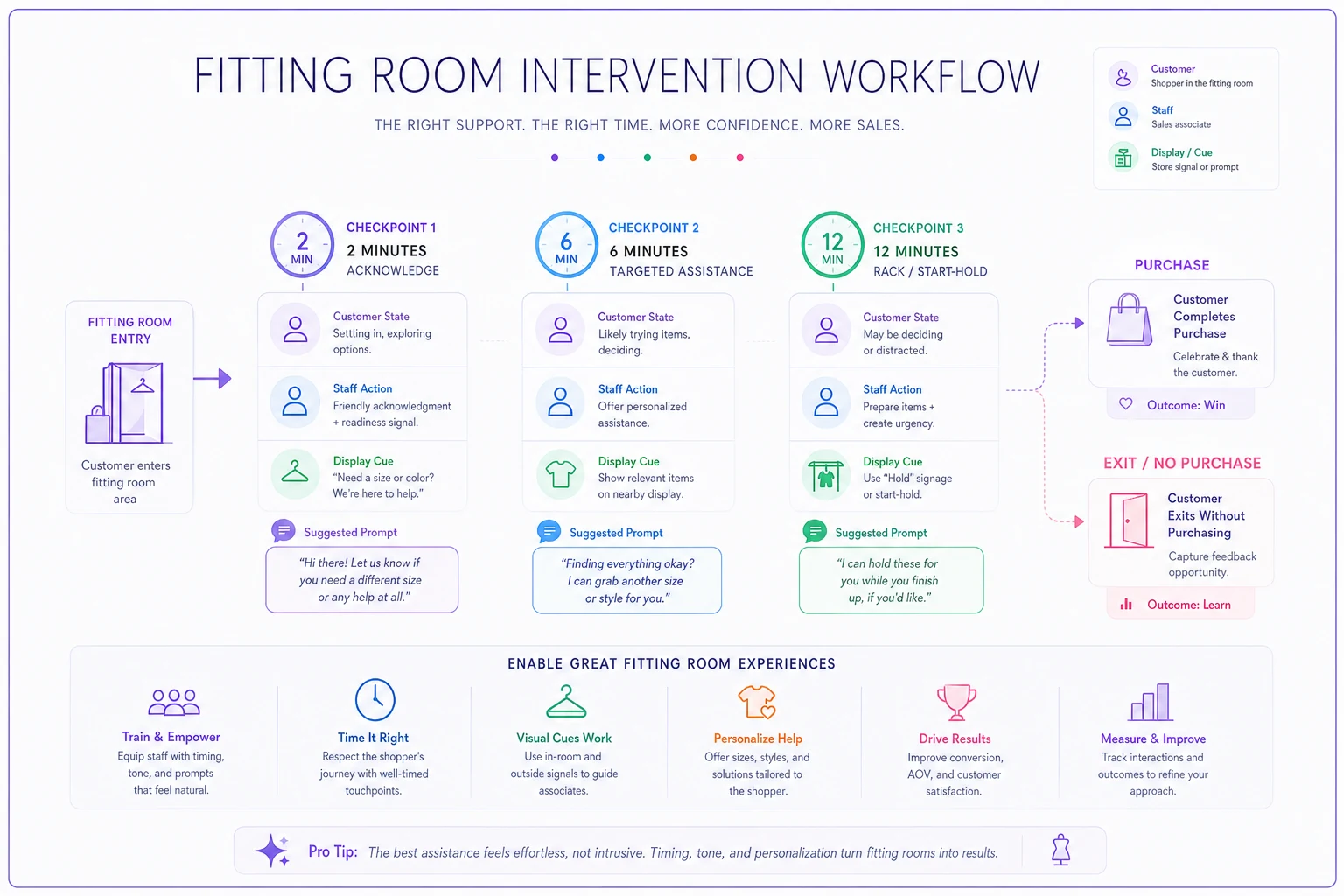
The 2-minute acknowledgment happens right after someone enters. Not a full service check — just eye contact and "I'll check on you in a few minutes." This prevents the abandoned feeling without crowding them. Stores using this simple acknowledgment consistently see immediate conversion lifts in the 5-8 percentage point range.
The 6-minute check is your critical window. This is when customers have tried things on but haven't made final decisions. The approach matters more than most retailers realize. "How's everything fitting?" gets you nowhere. Train staff to use specific prompts instead:
"I can grab different sizes of anything you're considering" opens the door without pressure. It addresses the primary fitting room concern — sizing — while positioning your associate as helpful rather than sales-focused.
"Would you like to see how that jacket looks with the pants from our new collection?" introduces complementary items when customers are already in buying mode. But only if they've shown positive body language about what they're trying on.
The 12-minute mark is when you need some kind of definitive move. Either the customer needs help, or they're using your fitting room as a decision-delay tactic. A gentle "Would you like me to start a dressing room rack for your favorites?" forces a sorting decision without being pushy.
Below is a simple workflow of the three timed interventions and suggested staff prompts.
One women's boutique implemented just these timing rules — nothing else changed — and fitting room conversion jumped from 28% to 41% over two months. The key was giving staff permission to prioritize fitting room checks over floor straightening during peak hours.
Display cues that trigger purchase decisions
The biggest missed opportunity in fitting room optimization isn't what happens inside the room. It's what customers see while they're deciding.
Start with decision anchors. Mount a small display board inside each fitting room showing three complete outfits built from current inventory. Not catalog photos — actual pieces from your floor, photographed on real bodies or mannequins. Update these weekly. A customer trying on a blazer suddenly sees how it pairs with pants she walked right past. This visual anchoring increases average transaction size by roughly 20-25% without any additional staff interaction.
Add size availability cards near the mirror. A simple laminated card — "Quick Size Check: S-M-L-XL-XXL" with checkboxes — lets customers mark what they need without leaving the room. Staff can see at a glance what to grab, which cuts down the back-and-forth that kills momentum.
The "outfit completion" rack outside fitting rooms is one of the higher-impact changes you can make. Instead of sending customers back to the floor to hunt for matching pieces, keep a curated rack of maybe 20 versatile items right outside fitting rooms — basic camis, layering pieces, belts, scarves. Stuff that solves the "this would be perfect if I had something to wear under it" problem that quietly kills purchases every day.
Scripts that convert without creeping anyone out
Your staff needs exact phrases, not vague direction to "be helpful." Generic sales training produces awkward interactions that drive customers away.
Opening acknowledgments that work:
-
"I'm Sarah — I'll give you a few minutes to get started, then check if you need any sizes"
-
"Those pieces run a bit small — let me know if you need size adjustments"
-
"I'll be right outside organizing — just call if you need anything"
Notice what these don't do? They don't hover, assume the sale, or create pressure. They establish presence and availability.
Mid-try-on interventions that convert:
-
"I have that dress in navy if you want to compare colors"
-
"Would you like to see the jacket that was displayed with those pants?"
-
"I can hold anything you're considering while you keep browsing"
These prompts solve specific problems rather than throwing out vague offers to help.
Closing sequences that feel natural:
-
"Should I start you a rack at the register with your favorites?"
-
"Would you like me to check our other location for your size?"
-
"I can put those on hold until tomorrow if you need to think about it"
Each gives the customer a next step without forcing an immediate yes/no decision.
The worst thing staff can say? "Is everything okay in there?" It sounds like you're checking if someone's shoplifting, creates no value, and makes people uncomfortable.
Measuring what moves the needle
Most stores track overall conversion but miss the fitting room specifics that actually drive improvement. Three numbers matter here.
Three numbers matter here.
| Metric | What it measures | Notes/Target |
|---|---|---|
| Fitting room entry rate | What percentage of store traffic uses fitting rooms? | Below 15% and you have a merchandising or display problem, not a fitting room problem. Fix the floor first. |
| Try-on to purchase rate | Of people who use fitting rooms, how many buy something? | This is your core fitting room conversion metric. Average performers hit 25-35%. Good execution gets you to 45-50%. |
| Items per fitting room purchase | When someone buys after trying things on, how many pieces do they take? | Minimum 1.8 items, ideally 2.3 or higher. |
Track these weekly, not monthly. Fitting room patterns shift with inventory changes, weather, and even day of week. Tuesday afternoon shoppers behave differently than Saturday morning rushes.
The 14-day experiment template
Before overhauling your entire approach, run a controlled test to actually measure impact.
Week 1: Baseline measurement Count fitting room entries and purchases for 7 days. No changes. Just document current state. Time 20 random customers in-room. Note which staff interactions happen organically.
Week 2: Implement one change Pick either timing rules, scripts, or display cues. Not all three. Run it consistently for 7 days using the same counting method.
Compare the two weeks. If you see 15%+ improvement in fitting room conversion, the change works. If not, try a different intervention the following week.
This approach prevents overwhelming staff and lets you identify what's actually driving results. A boutique in Austin tested just the 6-minute check-in rule and saw conversions go from 31% to 39%. They then added outfit displays and hit 44%. Each change proved itself before adding more complexity.
When fitting room optimization backfires
Not every store should run aggressive fitting room strategies.
Discount and outlet operations where customers expect self-service — heavy intervention annoys more than it helps. These stores do better with clear size charts and fast restocking than active selling.
Stores with thin staff coverage can't maintain consistent timing rules. Better to lean on visual cues and self-service tools than create expectations you can't reliably meet. Inconsistent service is worse than no service.
High-end boutiques often need longer intervention windows. Their customers might spend 20-30 minutes in fitting rooms. The 12-minute maximum would actively hurt their experience.
Teen-focused stores need different scripts entirely. The "helpful associate" approach that works for a 35-year-old professional makes a 17-year-old bolt for the exit. These stores need casual, peer-level interaction — not service-scripted prompts.
Small store adjustments that scale
Fitting room optimization doesn't require major investment. Unlike inventory micro-audits that demand consistent tracking systems, fitting room improvements can start with a notebook and a timer.
Start with timing rules during peak hours only. If Saturday 1-4pm drives 30% of your weekly revenue, nail your fitting room operations during those three hours before expanding to all-day coverage. Three hours of solid execution beats twelve hours of mediocre attempts.
For single-person operations, use technology assists. A basic motion sensor that chimes when someone enters a fitting room helps solo staff track timing without constant vigilance. Several stores use simple doorbell sensors — under $30 — that connect to their point-of-sale notification systems.
Use a basic motion sensor that chimes when someone enters a fitting room to help solo staff track timing without adding headcount.
Cross-train everyone on fitting room protocols, not just sales associates. Whoever's covering a lunch break needs the same scripts and timing awareness. Inconsistent execution confuses customers and wipes out the conversion gains you worked to build.
Coordination challenges that operational software solves
The hardest part of fitting room optimization isn't training staff on scripts or timing — it's maintaining consistency when your team is juggling multiple responsibilities at once. This is where manual systems break down.
Modern AI-powered operational platforms can track fitting room metrics automatically through door sensors or staff logging, send alerts at the right intervention moments, and flag which complementary items to suggest based on what customers brought in. The same system managing your in-store pickup operations can coordinate fitting room workflows across your team.
AI-assisted scheduling within these platforms ensures someone's always assigned to fitting room coverage during peak periods. Instead of hoping staff remember the 6-minute check-in, the system sends a discreet alert. Instead of guessing which items to suggest, it pulls combinations that actually sell together based on your own transaction history.
The longer-term value is in the learning loop. Every fitting room interaction gets logged — what worked, what didn't, which scripts convert for which customer types. Over time your fitting room approach stops being generic retail advice and starts being specific to your store and your customers.
The compound effect of fitting room excellence
Fixing fitting room operations creates ripple effects across the whole store. Higher conversion rates mean better inventory turn. Customers who buy after trying things on return items roughly 60% less often than those who grab-and-go. Your staff gains confidence from successful interactions, which improves their overall performance on the floor.
Start with timing rules. They cost nothing and show immediate impact. Add one display cue — probably the outfit board inside the fitting room. Give staff two or three specific scripts, not a whole manual. Measure for two weeks. Adjust based on what you actually see.
Most stores can improve fitting room conversion by 10-15 percentage points within a month. On $50K monthly revenue with 25% current fitting room conversion, moving to 40% adds roughly $7,500 monthly without increasing traffic or inventory. That's around $90,000 annually from optimizing eight square feet of selling space.
The stores winning at apparel retail right now aren't the ones with the best merchandise or the lowest prices. They're the ones maximizing every customer interaction — especially in the fitting room, where purchase intent is at its highest.
Ready to elevate your apparel business?
Join 2,000+ retailers using Werzly to streamline operations, increase sales, and deepen customer loyalty.