

Most indie apparel buyers treat every supplier the same way. Same attention, same anxiety, same annual chase for slightly better pricing. And that flat approach is exactly why so many small stores end up over-committed to the wrong vendors and under-invested in the ones quietly carrying their best margins.
The buyers who run tight operations don't think in terms of "my suppliers." They think in tiers. They know which vendors deserve a phone call and which deserve an email. They know where to spend negotiation energy and where a two-line concession request is enough. And critically, they never hand a new supplier a real purchase order until that supplier has proven they can ship on time, size consistently, and pack cleanly.
This is the part of buying that rarely gets written down. Everyone talks about assortment and markdowns. Almost nobody talks about the portfolio logic behind who you buy from and how you commit to them.
Why "treat everyone equally" quietly wrecks your buying
Here's the pattern that shows up again and again in small stores: a buyer has 18 to 25 active suppliers and, mentally, they're all sort of equal. When a new season comes, attention gets spread thin — a little back-and-forth with each, a rushed MOQ commitment here, an impulse reorder there.
What breaks is prioritization. Your top three suppliers might drive 55–65% of your revenue, but they get the same fifteen minutes as the novelty sock vendor doing maybe $2k a year. Meanwhile, the risky new supplier — the one you found at a trade show and got excited about — often gets the largest first order because the excitement is fresh and the sample looked great.
That's backwards. The supplier you know least should get the smallest commitment, and the supplier who reliably prints money should get your best negotiation effort and protected slots on the buy sheet.
The reason this happens isn't laziness. It's that most buyers don't have a framework telling them how much a given supplier is actually worth to the business, so everything defaults to gut feel and recency. Fix the framework and the rest gets easier.
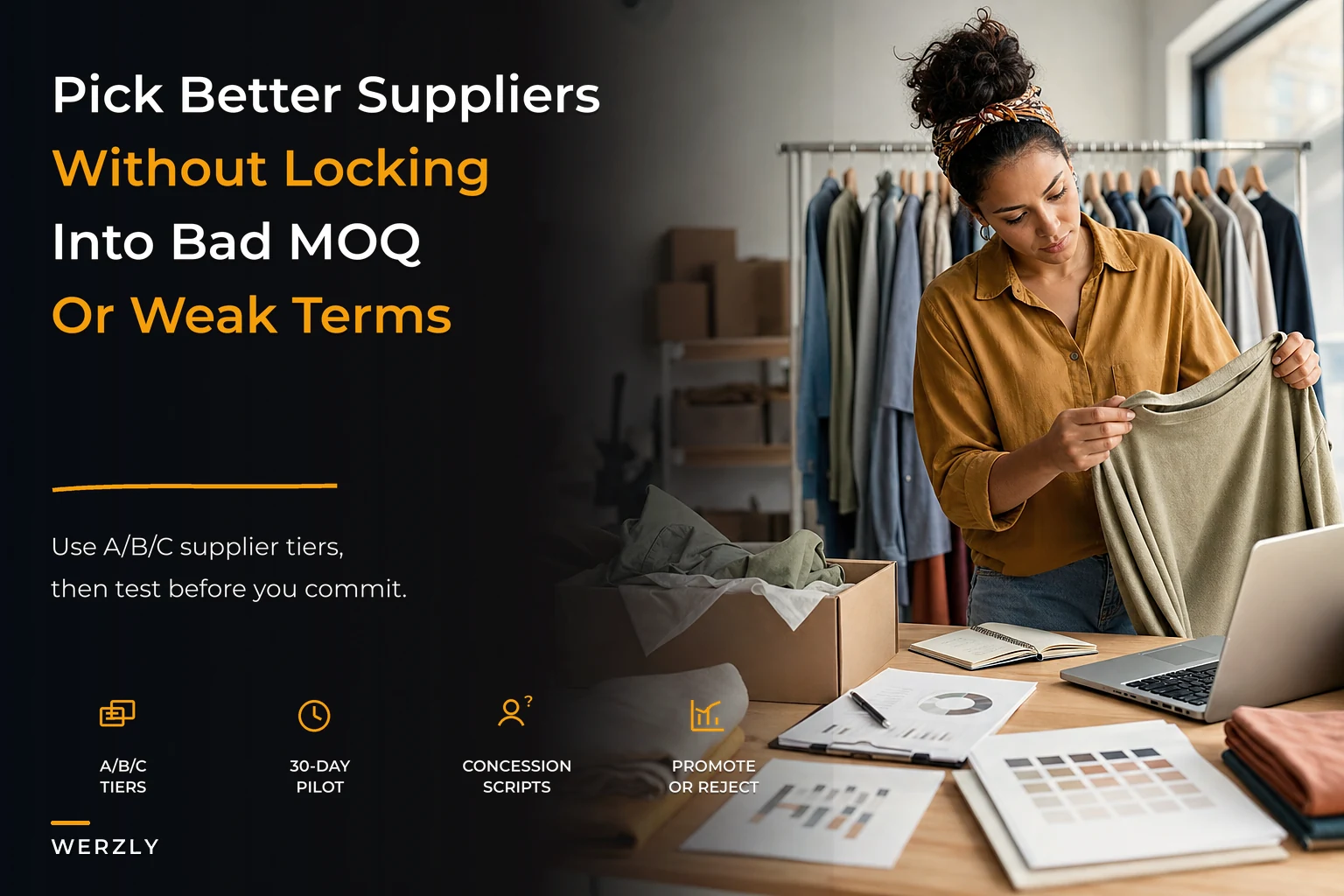
The A/B/C supplier segmentation that actually works
Forget the textbook version of ABC analysis that only looks at spend. For apparel, spend alone lies to you. A supplier can be high-spend and terrible — late, inconsistent sizing, defect-heavy — and you'd never see that if you only ranked by dollars.
Take control of your clothing store operations.
Werzly helps you manage stock, process orders, and engage customers effortlessly.
- Unified inventory and order management
- Automated customer notifications
- Sales and stock analytics
No credit card required
Segment on two axes: strategic value and operational risk. Strategic value is more than revenue; it's margin contribution, how hard the product is to replace, and whether the vendor gives you exclusives or category identity. Operational risk is the boring stuff that eats your time: fill rate, lead-time reliability, size consistency, defect rate, responsiveness.
Here's how the tiers shake out:
| Tier | What defines it | Share of vendors (typical) | How you treat them |
|---|---|---|---|
| A — Core partners | High margin contribution, hard to replace, reliable delivery | ~10–15% | Deep relationship, quarterly reviews, first access to your open-to-buy, real negotiation |
| B — Solid contributors | Steady sellers, decent terms, replaceable but useful | ~30–40% | Standardized terms, light annual review, opportunistic negotiation |
| C — Fill-ins & wildcards | Low spend, novelty, or unproven; includes all new suppliers | ~45–55% | Minimal time, strict pilot rules, no big MOQ commitments |
A few things worth noticing here.
Every brand-new supplier starts in C. No exceptions. It doesn't matter how good the samples looked or how charming the rep was — until they've shipped for you, they haven't earned a tier. This one rule prevents most of the over-commitment disasters.
Your A tier should be small and a little uncomfortable to keep small. If eight of your suppliers feel like "core partners," you've diluted the meaning. A-tier gets your strategic energy; you can't spread that across a dozen relationships.
B is where a lot of quiet money sits. These vendors don't get much attention because nothing's wrong, but they're often where a small term improvement — an extra 15 days on payment, free freight over a threshold — compounds nicely across the year without any drama.
If you already run a supplier scorecard, this segmentation sits right on top of it. Your quarterly supplier scorecard feeds the operational-risk axis directly — fill rate, defect counts, on-time percentage. If you don't have that scorecard yet, build it first, because segmentation without measurement is just opinion in a table.
Negotiation: where to spend your energy and where not to
Once you've tiered, negotiation stops being a single blunt activity and becomes tier-specific.
With A-tier partners, you're negotiating the relationship, not the transaction. You want terms that reflect that you're a predictable, valuable account: better payment windows, priority production slots during peak, first look at new lines, and protection when their costs move. These are worth a call or an in-person meeting.
With B-tier, you standardize. Pick your target terms and ask for them consistently. Don't reinvent each negotiation. The goal is efficiency — get to acceptable terms fast and move on.
With C-tier, barely negotiate on price at all. Your leverage is the pilot itself — you're negotiating the conditions under which you'll test them, not squeezing a few points off a small order.
A short negotiation script you can adapt
The mistake most buyers make is asking for one thing (usually price) and treating it as pass/fail. Experienced buyers walk in with a ladder of concessions, so if the vendor can't move on one, there's somewhere else to go.
Opening (anchor the relationship): > "We've been happy with the last two seasons and we're planning to grow our commitment to your line. Before we finalize the buy, I want to make sure the terms work for how we operate."
The ask (lead with your top priority, but signal flexibility): > "The two things that matter most to us are payment terms and freight. Ideally we'd move to net-45 and free freight over $[threshold]. If net-45 is tough, we could look at net-30 with a small early-pay discount instead."
The trade (give them a reason to say yes): > "In exchange, we can commit to a firmer seasonal forecast and consolidate our orders into fewer, larger drops so it's cleaner on your end."
The close (make the next step concrete): > "Can you check with your side and get me revised terms by Friday? I'd like to lock the buy next week."
Notice what's happening: you're never just taking. You're offering something the vendor actually values — forecast visibility, consolidated orders, faster payment — in return for terms that help your cash flow.
The concession checklist — know what you'd accept before you start
Walk into every negotiation with a ranked list of what you want and what you're willing to give. Here's a working checklist of concessions that tend to be available in apparel:
-
Extended payment terms (net-30 → net-45 or net-60)
-
Free or reduced freight above an order threshold
-
Lower or waived MOQ for the first season
-
Split shipments (get half now, half later) without penalty
-
Price hold across the season despite input cost changes
-
Defect/short-ship allowances credited automatically
-
Return window on unsold seasonal excess (rare, but ask A-tier)
-
First-access windows on new drops
-
Marketing co-op dollars or free samples for your floor
-
Firmer, earlier forecasts
-
Consolidated orders (fewer POs, larger units)
-
Faster payment in exchange for a discount
-
Case-pack or full-size-run buys instead of cherry-picking
-
A testimonial, referral, or feature if they're a smaller brand
-
Multi-season commitment on proven items
Keep this list somewhere you'll actually see it during a call. The number of buyers who leave free freight or a first-order MOQ waiver on the table simply because they didn't think to ask is genuinely high.
The 30/90-day pilot: test before you commit
This is the piece that saves the most money and the least glamorous to talk about.
A new supplier — even a promising one — is unproven data. The sample they sent is their best-case output under no time pressure. What you actually need to know is how they perform when there's a real order, a real deadline, and real volume. So you run a structured pilot before any meaningful MOQ or repeat commitment.
The 30-day pilot: does the product and the shipping work?
The first 30 days is a small, deliberate test order — the smallest quantity the vendor will accept, ideally across two or three SKUs and a full size run so you can check sizing consistency.
You're measuring five things during this window:
-
Delivery vs. promised date — did they ship when they said, and how far off was the actual arrival?
-
Order accuracy — right SKUs, right sizes, right quantities?
-
Size consistency — does their medium match their medium across units, and against your other vendors?
-
Defect rate on arrival — count flaws per unit received.
-
Packaging and receiving friction — did it come in a way your team could process quickly, or did it eat an afternoon?
That last one matters more than people expect. A vendor whose product sells fine but whose cartons are a mess creates hidden labor cost every single order.
The 90-day pilot: does it actually sell and reorder cleanly?
The 30-day test tells you if they can ship. The 90-day window tells you if the product and the partnership work in real conditions. Now you're watching:
-
Sell-through at the shelf — is the product moving at a rate that justifies a real buy?
-
Return rate specific to their items — sizing or quality issues show up here fast.
-
Reorder reliability — you place a second, slightly larger order and see whether performance holds or whether the first one was luck.
-
Responsiveness — how they handle a problem (a short-ship, a defect batch) tells you more than how they handle a smooth order.
Only after a clean 90-day run does a supplier get promoted out of C-tier and become eligible for MOQ commitments, seasonal buys, and real negotiation. This single discipline — no big commitment before a passed pilot — prevents the classic indie-store mistake of a $9k first order to a vendor who turns out to ship three weeks late with inconsistent sizing.
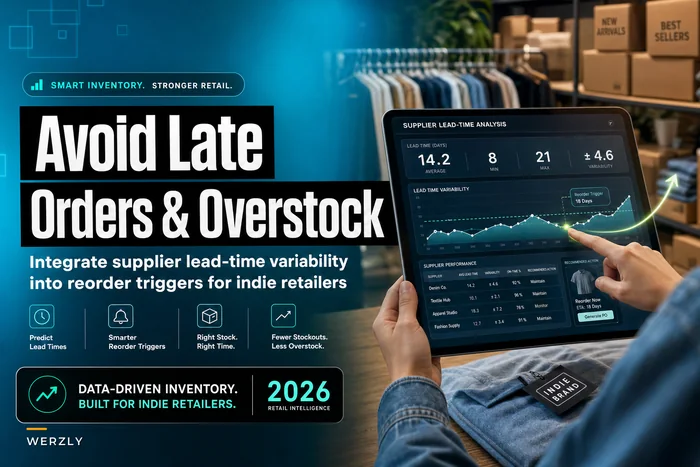
One thing worth folding into the pilot: track lead-time variability, not just the average. A supplier who's reliably slow is far easier to plan around than one who's fast one order and three weeks late the next. Building that variability into your reorder logic is its own discipline — there's a full breakdown of how to integrate supplier lead-time variability into reorder triggers that pairs naturally with pilot data.
Track lead-time variability, not just the average.
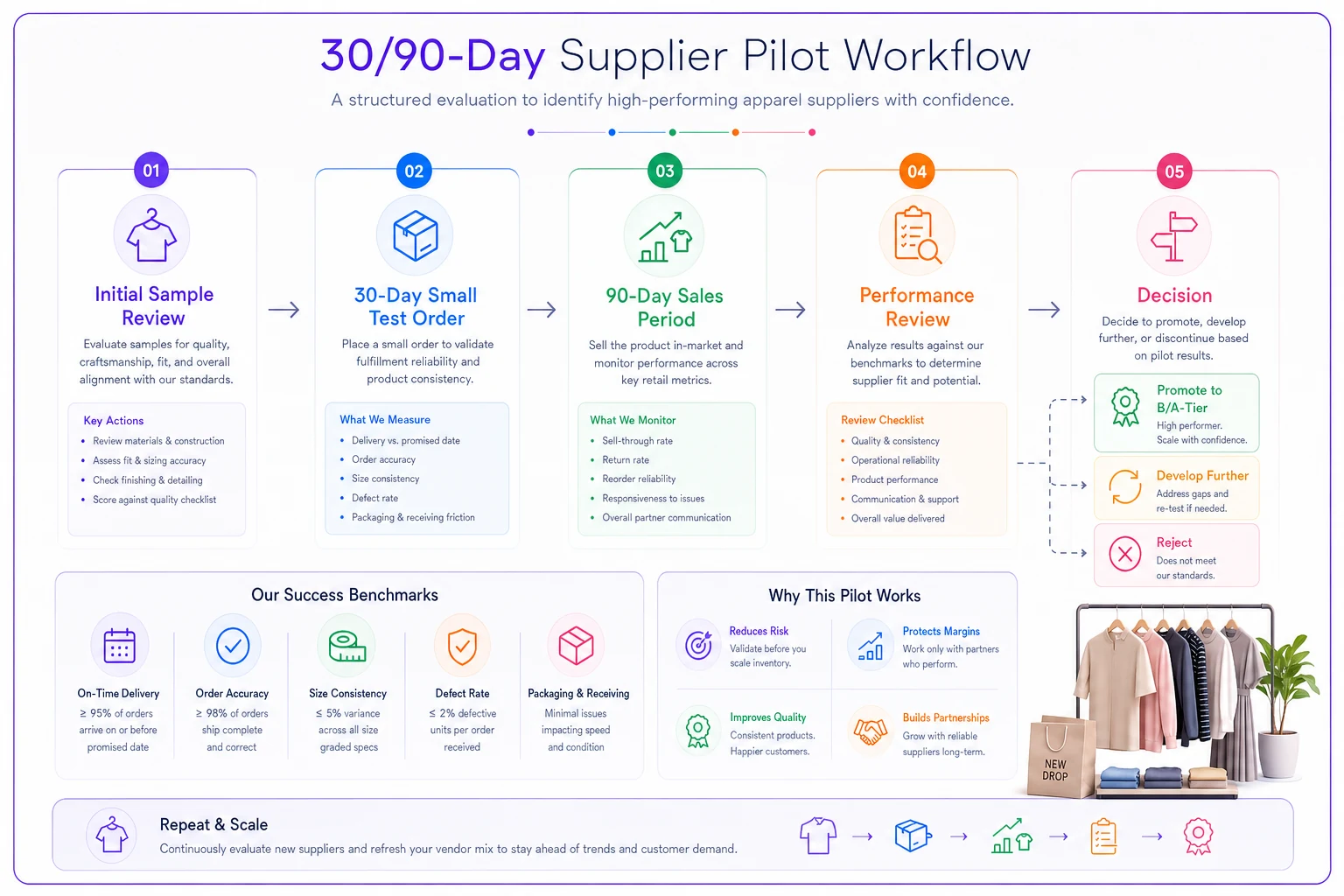
Use this workflow diagram to standardize 30/90 pilots.
A real scenario: how this plays out
A women's boutique running around $600k–$700k in annual revenue had roughly 22 active suppliers, all managed by feel. Their buyer got excited about a new contemporary line at a trade show and placed an $8k opening order — full commitment, real MOQ, no test.
The line shipped 16 days late, landing after the window it was bought for. Sizing ran small and inconsistent, driving a return rate near 22% on those items. By the time it sold through at markdown, the margin was thin enough that the "exciting" line actually lost money once labor and markdowns were counted.
After that season, they switched to the tiered approach. New suppliers went into C-tier with mandatory 30/90 pilots. The next promising vendor got a small test order first — around $1,400 — which surfaced a milder version of the same sizing problem before it became an $8k problem. They gave that vendor size-drift feedback, the vendor corrected it, and the eventual real order performed well.
Meanwhile they identified their three true A-tier partners and renegotiated. Two of the three moved them to net-45, and one added free freight over a $2,500 order. On their buying volume, that payment-term shift alone freed up somewhere around $12k–$15k of working capital across the year — cash that had been quietly locked up simply because nobody had asked.
Nothing dramatic. No new systems, no reinvented buying process. Just tiers, pilots, and a concession checklist they actually used.
When this makes sense — and when it doesn't
This works well when you're carrying more than a handful of suppliers, when your buying decisions involve real MOQ commitments, and when you've been burned at least once by a vendor who looked great and delivered badly. If you've got working capital tied up in inventory and you're feeling the cash squeeze, the negotiation piece alone tends to pay for the effort.
This is overkill when you're running a very small store with three or four suppliers you've worked with for years. At that scale, tiering is just labeling what you already know intuitively, and formal pilots add friction without much payoff. Keep it simple until your supplier count grows past the point you can hold it all in your head.
Who should be cautious: buyers who confuse "relationship" with "loyalty." The point of segmentation isn't to be cold to vendors — it's to be honest about where value actually comes from. If you find yourself protecting an underperforming A-tier vendor because you like the rep, the framework is telling you something you might not want to hear.
Keeping the system running as you grow
The real challenge isn't setting this up once — it's keeping the tiers accurate as things change. Suppliers drift. An A-tier partner has a bad season. A C-tier wildcard quietly becomes one of your best sellers and nobody notices they should be promoted.
The buyers who keep this alive review it on a rhythm: pilot results feed the tier assignments, the tier assignments shape how you spend negotiation energy, and the negotiation outcomes feed back into what each supplier is actually worth. It's a loop, not a one-time sort.
Where a real system helps is holding all this in one place — pilot metrics, tier status, term histories, scorecard data — so promotions and demotions happen on evidence instead of memory. Whether that lives in a shared spreadsheet or a proper platform matters less than the discipline of actually updating it. What kills these systems is the same thing that kills most retail systems: they get built once, look great in month one, and then quietly rot because nobody owns the update cycle.
Start with the segmentation. Get your A-tier down to a handful and your new suppliers firmly into pilot-only C-tier. Run the next new vendor through a real 30/90 pilot instead of a hopeful opening order. Then take your concession checklist into the next A-tier conversation and ask for the terms you've been leaving on the table. Those three moves, in that order, tend to change more about a store's cash position than any amount of extra buying.
Ready to elevate your apparel business?
Join 2,000+ retailers using Werzly to streamline operations, increase sales, and deepen customer loyalty.