

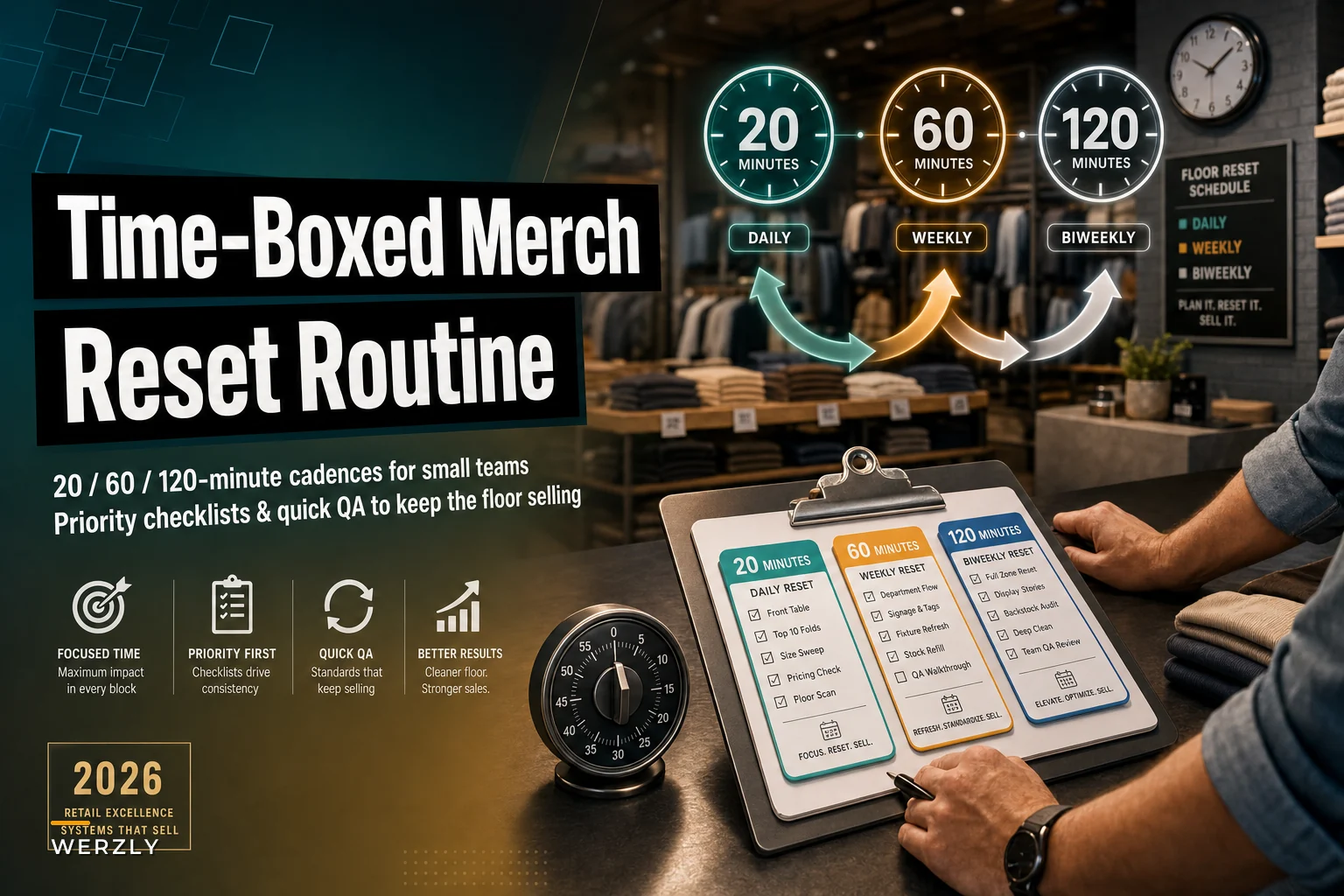

The problem with most merchandising advice is that it assumes you have time. It assumes someone whose whole job is walking the floor with a steamer and an eye for symmetry. In a one-to-three person shop, that person is also ringing up customers, answering the phone, processing a return, and chasing a vendor about a late PO. Visual standards slip not because owners don't care — they slip because the floor is the lowest-priority fire until it suddenly isn't.
So this isn't another "merchandising matters" lecture. It's a scheduling system. The core idea: you don't reset the whole floor. You reset a slice of it on a fixed clock, every day and every week, so drift never accumulates into the kind of mess that eats a full Sunday.
The three cadences — 20, 60, and 120 minutes — each do a different job. Confusing them is where most small stores go wrong.
Why visual drift happens faster in small stores (and why it's sneaky)
A big-box store has drift too. The difference is they have payroll hours budgeted specifically to fix it. You don't. In a small shop, every hour you spend folding is an hour you're not selling, buying, or reconciling. The honest goal isn't a magazine-perfect floor — it's a floor that stops costing you sales, fixed in the smallest amount of labor possible.
The pattern worth noticing: drift isn't linear. A table of folded tees doesn't degrade a little each hour. It holds for most of the day, then collapses in the last few hours when traffic peaks and nobody has a second to refold between customers. By the time you lock up, the best-selling stack looks picked-over and the slow stuff looks pristine — which is exactly backwards from what signals value to the next morning's shoppers.
The second pattern: the drift you see and the drift that costs you are different things. A crooked hanger annoys you. An empty size gap on your top seller costs you a sale and you may never know it happened. A time-boxed routine forces attention onto the second category instead of just the first.
The three cadences, and what each one is actually for
Think of these as three different altitudes, not three sizes of the same task.
Take control of your clothing store operations.
Werzly helps you manage stock, process orders, and engage customers effortlessly.
- Unified inventory and order management
- Automated customer notifications
- Sales and stock analytics
No credit card required
| Cadence | When | Purpose | What it is NOT |
|---|---|---|---|
| 20-minute | Daily, usually 2–3x | Stop active decay — refold, re-size, fill gaps on hero fixtures | Not a redesign, not deep cleaning |
| 60-minute | Weekly | Reset tired zones, rotate what's gone stale, fix size integrity | Not a full-floor overhaul |
| 120-minute | Every 2–4 weeks | Move product, rebuild a focal display, respond to sell-through | Not a monthly ritual you do "when you get to it" |
The mistake almost everyone makes is collapsing these into one giant occasional reset. They let the floor slide for three weeks, then burn a Sunday evening doing everything at once. That feels productive but it's the worst of all worlds: you lose sales through three weeks of drift and you lose a full day of labor to fix it. The whole point of time-boxing is to make the fix cheaper than the drift.
The 20-minute daily reset: stop the bleeding
This is the one that matters most and gets skipped most. It's not glamorous. You're triaging the three or four fixtures that actually drive revenue and ignoring everything else on purpose.
Do this once mid-morning and once in the late afternoon before peak. If you only do one, do the afternoon — that's when decay hits hardest.
The 20-minute daily checklist:
-
Refold or re-face your top 3 highest-velocity tables or stacks (ignore the rest)
-
Fill size gaps on hero wall fixtures — pull from back stock or note the stockout
-
Straighten the sightline from your front door inward (the first 15 feet decides whether people walk deeper)
-
Clear the fitting room return rack and re-home or restock those items
-
Spot-steam the two or three garments on your focal display that customers touch most
Make the fitting-room return rack a top priority — it's the highest-leverage item on the list.
Notice what's missing: no cleaning, no reorganizing by color, no touching the back wall nobody's standing near. The discipline here is about what you refuse to do. If you start "just fixing" the quiet corner, 20 minutes becomes 45 and you'll quit the habit by Thursday.
One thing that shows up consistently in stores that actually stick with this: the fitting-room return rack is the single highest-leverage item on the list. Items that came back from a try-on are, by definition, things a real customer was close to buying. Leaving them crumpled on a rack means the next shopper sees your near-sellers as rejects. Getting them back on the floor fast is directly tied to try-on momentum — the same logic behind a proper fitting-room conversion playbook.
The 60-minute weekly reset: rotate before it goes stale
Daily keeps things from collapsing. Weekly keeps things from going invisible. Regular shoppers stop seeing a display after they've walked past it four or five times. Product that hasn't moved in its spot for two weeks reads as "already there, already skipped" — even to new customers, because stale merchandising has a look to it.
Pick a slow-but-not-dead day. Tuesday or Wednesday morning tends to work. One zone per week, rotating through your floor so every area gets a weekly touch roughly once a month, with your two highest-traffic zones getting it more often.
A workable 60-minute flow:
-
Walk and photograph the zone first (5 min). A phone photo from the customer's entry angle shows you what's actually visible versus what you think is visible. You'll spot the dead middle shelf immediately.
-
Pull everything that's below-velocity or broken-size (15 min). A stack that's down to smalls and 3XLs isn't a selling stack — it's a clearance signal. Consolidate or move it.
-
Re-front with current-velocity product (20 min). Put what's actually selling at eye level and at the entry-facing edge.
-
Rebuild size runs and re-steam the facing pieces (15 min). Integrity over perfection.
-
Note stockouts and reorder flags as you go (5 min). This is where merchandising quietly feeds your buying.
That last step is the one small stores undervalue. You're already touching every size and every fixture — that's the cheapest inventory audit you'll ever run. If a hero SKU is blown out of its core sizes three weeks before you expected, that's a reorder signal you'd otherwise catch too late. The weekly reset is as much a data pass as a visual one, which connects directly to watching the handful of KPIs that actually deserve attention rather than vanity numbers.
The 120-minute deep reset: respond to what the numbers are telling you
The two-hour reset is where merchandising stops being maintenance and starts being strategy. Every two to four weeks, you rebuild a focal area based on what sell-through is telling you — not based on what looks pretty.
Schedule this like a real appointment. Close an hour early if you have to, or do it before open. The reason it slips is that it feels optional. It isn't. This is where you kill zombie displays — the ones that look fine but haven't moved a sale in weeks.
The 120-minute reset covers:
-
Rebuilding your main entry/focal display around current best-sellers and the season's priority category
-
Physically relocating slow movers to a consolidated clearance or secondary position
-
Reassigning your highest-value floor real estate to whatever's actually earning it
-
A full size-integrity sweep across the zone you're rebuilding
-
Refreshing signage and price communication on anything you've moved
The insight that separates this from a generic deep clean: your best floor positions are finite and they should be earned, not assigned once and forgotten. In a small store you might have four or five genuinely premium spots — the entry table, the front wall at eye level, the fixture people pass on the way to the register. If a product sitting in one of those spots isn't in your top velocity tier, it's occupying attention that a real seller could be using. The 120-minute reset is your recurring chance to evict underperformers from prime real estate.
When the 120-minute reset makes sense — and when it doesn't
Do it when your sell-through has clearly shifted, when you've taken in a meaningful new delivery, or when a season is turning. Those are real triggers.
Don't do it on a rigid calendar if nothing has changed. If your mix is steady and selling well, forcing a two-hour rebuild just to tick a box is wasted labor — and worse, you risk breaking a layout that's working. The cadence is a maximum interval, not a mandatory one. Skip it when the floor is earning; never skip it when sell-through has moved and the floor hasn't.
A quick visual of the 20/60/120 workflow:
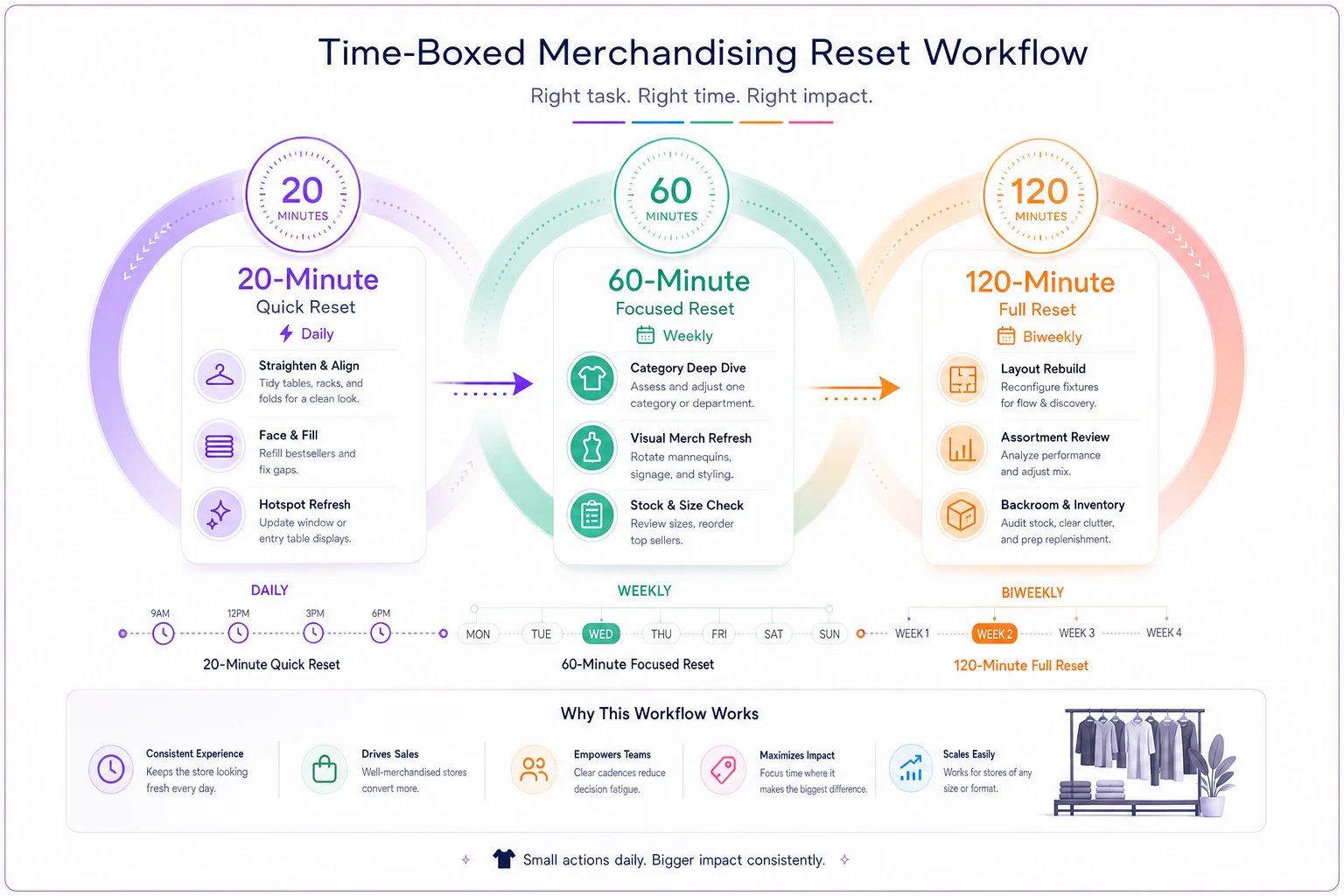
Use this as a quick reference when scheduling your resets.
A real scenario: the womenswear shop that was resetting backwards
A two-person women's boutique, roughly 1,100 square feet, was doing what a lot of small stores do — ignoring the floor all week, then both staff staying late every other Sunday for a three-hour overhaul. The floor looked great Monday morning and progressively worse until the next reset. They were losing the back half of every week to visible drift and burning around six combined labor-hours per cycle to fix it.
They switched to the cadence model: two 20-minute passes most days, a 60-minute zone reset every Tuesday, and a 120-minute focal rebuild roughly every three weeks. Total weekly time dropped to somewhere around four to five hours — but spread out, and front-loaded onto the fixtures that mattered.
The visible change was that the store never looked tired mid-week anymore. The less obvious change was in their buying: because the weekly reset forced a size-run check, they caught two core-size stockouts early enough to reorder, instead of discovering them at month-end when the window had closed. Best-seller sell-through improved noticeably over the following quarter, and the Sunday late nights disappeared. Nobody did more work — they just did it on a smarter clock.
Who shouldn't bother with all three cadences
If you're a true solo operator with low daily foot traffic — a quiet weekday shop that only gets busy on weekends — running three separate cadences is overkill. Collapse it: a daily 20-minute pass and a single weekly 90-minute combined reset will cover you. The three-tier system earns its keep once you have enough traffic that drift accelerates during peak hours, or enough staff that you can hand off a cadence to someone else.
If your inventory barely changes — a store with a tight, slow-turning core assortment — the 120-minute strategic reset can stretch to monthly or quarterly. Match the cadence to how fast your floor actually decays, not to what this post suggests.
Making the cadence survive a busy week
The routines above are easy to write and hard to keep. The failure point is almost always the same: the day gets busy, the 20-minute pass gets skipped, then skipped again, and within two weeks the whole system is dead. What keeps it alive isn't willpower — it's making the checklist unavoidable and simple enough to hand off without explanation.
Stores that sustain this treat the checklists as fixed, assigned, and tracked. Whoever's opening owns the morning pass. Whoever's closing owns the afternoon one. The weekly zone rotates on a set schedule so nobody has to decide what to do — they open the list and work it. A lot of small teams run this inside whatever platform already holds their daily operations, so the reset shows up as a recurring task with the zone pre-filled and stockout flags feeding back into reorder notes. The tool matters less than the fact that the task can't quietly disappear when things get hectic.
That's the whole philosophy. Visual drift in a small store isn't a taste problem or an effort problem — it's a scheduling problem wearing a merchandising costume. Give it a clock, give it a shrinking scope, and make the daily version small enough that skipping it never feels justified. The floor stays selling, and you get your Sundays back.
Ready to elevate your apparel business?
Join 2,000+ retailers using Werzly to streamline operations, increase sales, and deepen customer loyalty.