

Most indie shops treat their first wholesale order the way they treat a good buy from a trade show — gut feel, a handshake, a PO scribbled on an invoice pad. Then 60 days later they're chasing a boutique owner for $1,800 they already spent on the restock, the second order comes in with no packing slip, and three units got returned "damaged" that were actually just unsold.
The problem isn't wholesale itself. It's that small stores skip the pilot and jump straight to a full account. A wholesale pilot small store approach — a deliberately tiny 10–20 unit test with rules written down before the first box ships — is what separates a clean new revenue line from a slow-bleeding mess.
This is the playbook for running that first test without exposing your cash or your margin.
Why the 10–20 unit size is the whole point
The instinct is to make the first wholesale order big enough to "be worth it." That's backwards. The first order exists to answer questions, not to generate profit. You want to learn how the buyer pays, how they treat your product, how they handle returns, and whether their store actually moves it — all before you're in deep.
At 10–20 units you can afford to be wrong. If a $42 wholesale piece goes sideways, your total exposure is somewhere around $420–$840. That's a number you can write off and still sleep. At 80 units it's a cashflow event.
A pattern worth noting: the shops that lose money on wholesale almost never lose it on the test order. They lose it on order two or three, after they assumed the buyer was fine because the first one went smoothly. The pilot isn't just the first order — it's the first three, run under the same tight rules, with go/no-go checks between each.
Here's a realistic phasing for a pilot:
| Phase | Units | Terms | What you're testing |
|---|---|---|---|
| Test order | 10–20 | Prepay or 50% deposit | Product fit, packaging, their sell-through |
| Second order | 20–40 | Net‑15 | Do they pay on time? How do returns come back? |
| Graduation | Full account | Net‑30 | Only after two clean cycles |
The buyer who pushes hard for Net‑30 on the first 12 units is telling you something about their own cashflow. Note it.
The net-terms template that actually protects you
Net terms are where single-owner shops get burned, because "net 30" sounds standard and professional, so people agree to it without the surrounding structure that makes it safe. Net 30 without a late mechanism, a credit cap, and a clear ownership clause is just an interest-free loan to a stranger.
Take control of your clothing store operations.
Werzly helps you manage stock, process orders, and engage customers effortlessly.
- Unified inventory and order management
- Automated customer notifications
- Sales and stock analytics
No credit card required
Your pilot terms sheet should be one page and cover these non-negotiables:
-
Deposit on the first order. 50% upfront on the test, or full prepay. You eat zero risk while you learn their behavior.
-
A hard credit limit. Cap the total outstanding they can carry — for a pilot, keep it under ~$1,500. They can't place order three until order two is paid.
-
Short terms early. Net‑15 on the second order, not Net‑30. You graduate them to longer terms, you don't start there.
-
A late-payment consequence that's written down. A 1.5% monthly service charge past due, and — more importantly — orders pause automatically when an invoice goes past terms. The pause matters more than the fee.
-
Title and ownership clause. State that goods remain your property until paid in full. It's a small line that gives you real standing if things go bad.
-
Return window and condition rules. More on this below, but it belongs in the terms, not in a separate conversation.
A quick numbers example of why the deposit matters. Say you ship a 15-unit test at $38 wholesale — $570 invoice. With a 50% deposit, you've collected $285 before the box leaves. If they ghost you, your actual loss is the remaining $285 minus your cost of goods, maybe $150–$170 real dollars. Compare that to the same arrangement on Net‑30 with no deposit, where the entire $570 is at risk and you've already paid your own supplier. Same order, wildly different downside.
One mistake that comes up constantly: shops send the second order before the first invoice clears, because the buyer seems great and they don't want to look difficult. Then they're exposed on two orders at once. The whole point of staged terms is that payment behavior gates the next order. Don't override your own rules to be polite.
Packaging and labeling SOPs so your product shows up right
When you sell retail, your product lands on your own floor where you control the presentation. Wholesale is different — your product shows up in someone else's store, and if it arrives wrinkled, mislabeled, or in a jumble of poly bags with no SKU, you look like an amateur and you create returns and chargebacks you'll argue about for weeks.
A single-owner shop doesn't need an enterprise fulfillment operation. It needs a repeatable one-page SOP so the box goes out the same way every time, even when you're doing it alone at 9pm.
The core packaging SOP for a pilot:
-
Each unit individually poly-bagged with a visible size label facing out. Boutique staff should be able to read the size without opening the bag.
-
Hang-tag or label on every piece with your SKU and the buyer's expected retail, if you've agreed on MSRP. This kills the "we couldn't tell what it was" return.
-
One packing slip per carton, listing SKU, color, size, and quantity — matched exactly to the invoice. Mismatches between the physical box and the paperwork are the single most common cause of wholesale disputes.
-
A carton label with the buyer name, PO number, carton X of Y, and total unit count. Even for one box, label it box 1 of 1. It builds the habit.
-
Photograph the packed carton before sealing. This costs you ten seconds and settles most "it arrived damaged" or "we only got 9" arguments.
That photo step is underrated. Returns and damage claims in wholesale often come down to your word against theirs, and a timestamped photo of the sealed, correct carton flips the conversation immediately.
Photograph the sealed carton before shipping — a timestamped image settles most disputes quickly.
For shops that have already built internal labeling standards for their own POS, the pilot is a chance to extend those same barcode and SKU conventions outward so your wholesale accounts, your floor, and your returns all speak the same language. That kind of consistency is also what keeps your margin math honest — the same discipline behind a margin‑adjusted omnichannel allocation matrix applies when you add a wholesale channel into the mix.
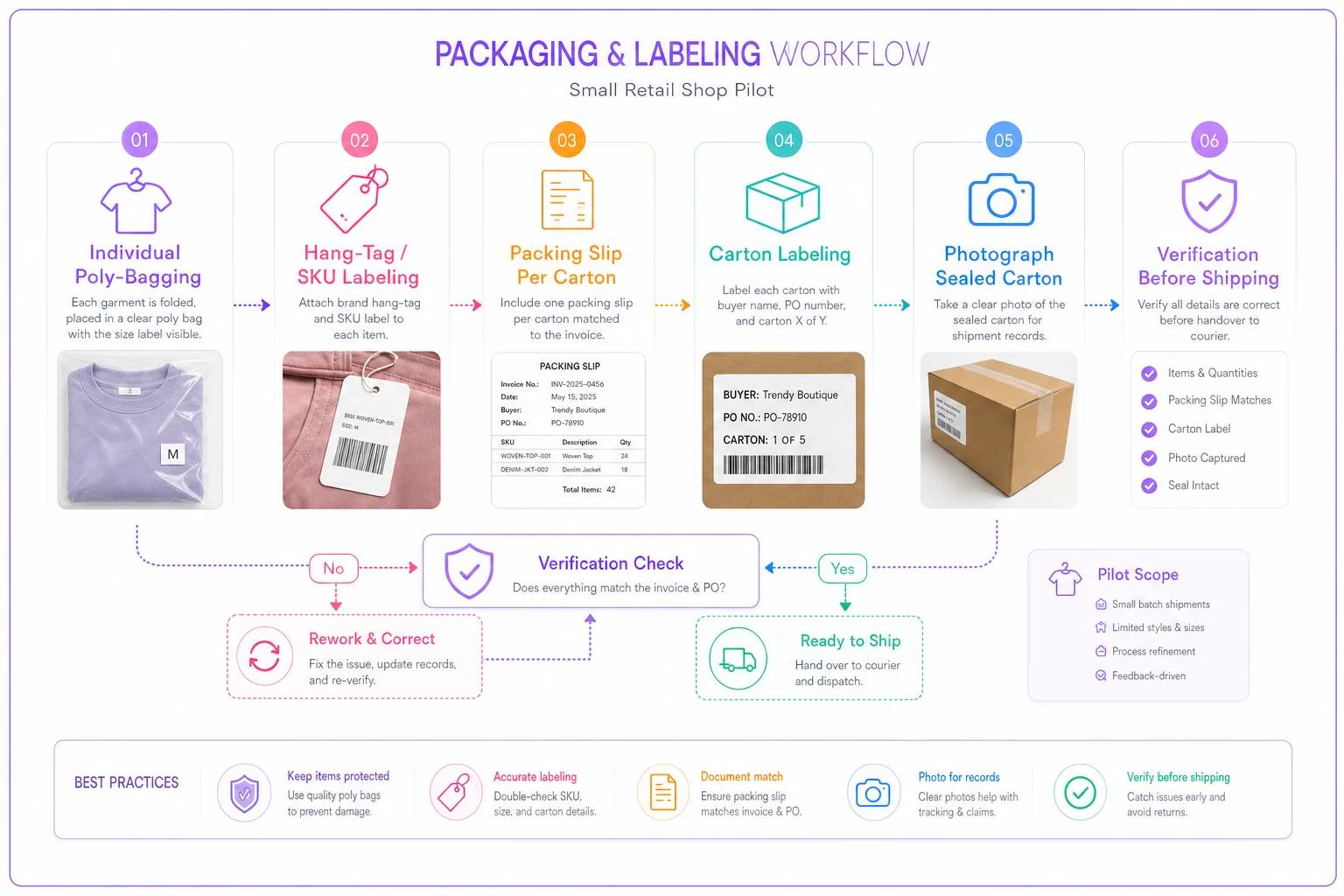
This visual shows the step-by-step packaging flow from unit prep to the photographed sealed carton and verification before shipment.
The fulfillment and returns policy sized to protect margin
Here's the part that quietly eats wholesale profit: returns. A retail customer returns one item. A wholesale buyer can return a chunk of the order because their customers didn't buy it — and if your policy is vague, they'll try to send it all back on your dime after the season's dead.
A pilot returns policy should be tight, specific, and short.
-
No returns for sell-through. State it plainly
unsold inventory is the buyer's risk, not yours. You're selling them goods, not consigning. If you want a consignment-style arrangement, that's a different deal with different margin math — don't blur the two.
-
Defects only, within a short window. Returns accepted only for manufacturing defects, reported within 7–10 days of receipt, with a photo. Not "didn't sell," not "wrong vibe for our store."
-
Buyer pays return freight unless it's a verified defect or your error. This one line stops casual returns cold.
-
Restocking logic for your own protection. If you do accept a discretionary return, a 15–20% restocking fee covers your handling and the markdown risk on a now-out-of-season piece.
-
Clear routing for what comes back. Decide in advance whether a returned unit gets restocked, marked down, or written off, so returns don't pile up in a corner untracked.
A quick margin illustration. Suppose your wholesale margin on a $38 unit is around $16 after cost. Accept three "didn't sell" returns on a 15-unit order and you've handed back $48 of margin, eaten return freight, and you're now holding three out-of-season units you'll mark down. One loose policy can turn a profitable pilot into a wash. Tighten it and most of those returns simply don't get requested.
How returns physically move back through your shop matters too — where they land, who inspects them, and how fast they get back into sellable or clearance status. If you've already got a fulfillment rhythm for your in-store and online orders, wholesale returns should plug into that same flow rather than becoming a side pile. The same thinking behind a clean BOPIS and ship-from-store playbook applies here: define who handles it, how fast, and what "done" looks like.
A real scenario
A women's apparel shop — single owner, one part-timer — got approached by two nearby boutiques who wanted to carry a few of her house-made pieces. Her instinct was to say yes to a 60-unit order split between them, Net‑30, because it felt like a real break.
Instead she ran it as a pilot. Order one: 12 units each, 50% deposit, no returns except defects with a photo inside 7 days. She individually bagged every piece, matched packing slips to invoices, and photographed both cartons sealed.
The first boutique paid the balance on time and sold through in about three weeks — a clean account. The second paid the deposit, then went quiet on the balance for roughly five weeks and tried to return four "unsold" units. Because the no-sell-through clause was written into the terms sheet she'd already signed, that return never happened, and the paused-order rule meant no second shipment went out while the invoice sat open.
Her total exposure across both accounts during the test was under $500 instead of the roughly $2,200 she'd have been carrying on the handshake version. She graduated boutique one to a Net‑15 second order and politely kept boutique two on prepay-only. A year later boutique one is a steady account. She'd have lost real money discovering boutique two's habits at full scale.
The outcome wasn't dramatic revenue. It was avoiding a loss — which is exactly what a pilot is for.
When a wholesale pilot makes sense — and when it doesn't
It makes sense when:
-
You have house-made or exclusive product other stores can't easily source.
-
You have enough production or stock headroom to supply 10–20 extra units without starving your own floor.
-
Your retail margin is healthy enough that a lower wholesale margin still clears your costs.
It's a bad idea when:
-
You're already fighting stockouts on your own floor. Wholesale will make that worse, not better.
-
Your margin is thin enough that wholesale pricing would put you at or below cost after freight and returns.
-
You can't commit to the paperwork discipline. Wholesale without consistent packing slips and terms enforcement loses money quietly, and you won't see it until the receivable is aged.
Who should skip it entirely: shops reselling other brands' inventory at standard markup. You usually don't have the margin room to wholesale someone else's product, and you may be violating your own supplier agreements by doing it. The pilot model is built for stores selling something they actually make or own exclusively.
Keeping the pilot honest as it grows
The failure mode isn't the first order — it's drift. After a couple of clean cycles, the deposit requirement quietly disappears, terms stretch to Net‑30 "because they've been good," and the packing-slip discipline slips when you're busy. Then one slow season the buyer's own cashflow tightens, and suddenly you're the unsecured creditor you promised yourself you'd never be.
Keep the pilot rules as living policy, not training wheels you throw away. Graduate buyers deliberately: longer terms and higher credit limits are a reward for a track record, granted on purpose, not a default that erodes over time. Track every wholesale invoice against its terms the same way you'd track your own supplier payments, and let late payment automatically pause the next order — no exceptions you have to feel guilty about.
A wholesale pilot works because it limits how wrong you can be. The 10–20 unit size, the deposit, the short terms, the written returns policy, and the photographed cartons aren't bureaucracy — they're the cheapest insurance you'll ever buy on a new revenue channel. Get the discipline right on the small orders, and the big accounts become a decision you make from a position of knowledge instead of hope.
A wholesale pilot works because it limits how wrong you can be. The 10–20 unit size, the deposit, the short terms, the written returns policy, and the photographed cartons aren't bureaucracy — they're the cheapest insurance you'll ever buy on a new revenue channel. Get the discipline right on the small orders, and the big accounts become a decision you make from a position of knowledge instead of hope.
Ready to elevate your apparel business?
Join 2,000+ retailers using Werzly to streamline operations, increase sales, and deepen customer loyalty.