


Most indie apparel owners buy the way they shop: intuition, a good eye, and a strong feeling about what "her customer" wants. That works right up until it doesn't. Somewhere between one store and three, the buying gets messy. You've got denim that never sells but you keep reordering, a category that quietly funds the whole business but gets no shelf priority, and a "test" that somehow became a $6k standing order nobody remembers approving.
The chains solved this decades ago with assortment planning teams and software that costs more than your annual rent. You don't need that. But you do need the skeleton of it — a way to decide what each category is for, how fast it needs to move, how much you're willing to gamble on unproven product, and who checks all of it once a month. That's what enterprise-lite assortment architecture is. Same logic the big players use, minus the bureaucracy.
This post walks through the whole structure: category roles, velocity bands, test-buy rules, replenishment allocation across stores, and a monthly governance rhythm. Tables and worked numbers included.
Start with category roles, not categories
The first mistake is treating every category as if it exists to make money. It doesn't. In a healthy assortment, categories play different roles, and confusing those roles is where margin quietly leaks.
-
Traffic drivers — the stuff people come in specifically for. Core denim, basic tees, a signature line. Margins aren't always great, but they bring bodies through the door.
-
Profit engines — higher-margin categories that ride on the traffic. Accessories, outerwear, jewelry, "add to the bag" items.
-
Identity / brand — the pieces that make you you. The buyer's picks, the local designer collab. These might barely break even but they're why customers pick you over the mall.
-
Utility / fill — socks, basics, the stuff you carry because a store like yours is expected to have it.
The pattern worth noticing: most struggling indie shops over-invest in identity and under-invest in profit engines. It feels good to buy the artsy, expressive stuff. It photographs well. But if 40% of your open-to-buy goes to identity product that turns twice a year, the whole store gets slow, and the profit engines never get enough dollars to actually carry the business.
Assigning a role forces a decision: what is this category supposed to do for me? Once you know that, everything downstream — how much you buy, how fast it should sell, whether you replenish it — becomes a lot more obvious.
Velocity bands: sort SKUs by speed, not by feeling
Velocity bands are just a way of grouping your SKUs by how fast they sell relative to each other. Not "good" and "bad" — fast, medium, slow, and dead. The reason it matters is that different bands get treated completely differently. You replenish fast movers aggressively, watch mediums, and put slow ones on a clock.
Take control of your clothing store operations.
Werzly helps you manage stock, process orders, and engage customers effortlessly.
- Unified inventory and order management
- Automated customer notifications
- Sales and stock analytics
No credit card required
A workable four-band setup for a small store, based on weekly sell-through:
| Band | Weekly sell-through | Role in the store | Buying behavior |
|---|---|---|---|
| A (fast) | 15%+ of stock/week | Backbone, reorder-worthy | Replenish, chase, protect size runs |
| B (steady) | 7–14% | Reliable earners | Hold levels, light reorders |
| C (slow) | 3–6% | Watch closely | No reorder, monitor for markdown |
| D (dead) | under 3% | Cash trapped | Markdown or clearance clock |
A typical example: a store carries around 900 active SKUs. When they finally band them, they find roughly 130 A-SKUs doing over half of revenue, a big soft middle of B and C, and somewhere around 180 D-SKUs sitting there doing basically nothing but eating floor space and buying dollars. Nobody decided to build that. It accumulated one "it'll sell eventually" order at a time.
The insight most owners miss: velocity is relative and seasonal. A sweater that's a D in July can be an A in October. So bands aren't permanent labels — they're a monthly re-sort. Which is exactly why the governance checklist later matters.
If you don't already have clean sell-through numbers to band with, that's the actual first job. A lot of the KPI noise owners drown in isn't helping them decide anything — worth reading the apparel KPI framework that tells small stores what to act on before you build bands, so you're sorting on numbers that mean something.
Test-buy rules: how to gamble without bleeding
Every good assortment has room for bets — new brands, new silhouettes, that trend you're not sure about. The problem isn't betting. It's bets without rules. A test with no exit becomes inventory with no plan.
-
1. Cap the test size. A test buy should be small enough that being wrong doesn't hurt. A common rule: no more than one size run per store, or a fixed dollar cap — somewhere in the $400–$800 range depending on your store size.
-
2. Set the read window before you buy. Decide up front how many weeks you'll wait before judging. For most fashion product, 3–4 weeks tells you plenty.
-
3. Define the pass line. What sell-through earns a reorder? Something like: hits 40%+ in the read window, it graduates to a B-band reorder. Under 20%, straight to a markdown plan. In between, hold and watch one more week.
-
4. Kill on schedule, not on hope. The single biggest test-buy failure is the "let's give it more time" loop. If it missed the pass line, it missed. Mark it down.
A worked example. Say you test a new outerwear brand: 3 styles, one size run each, roughly $1,900 at cost. Read window: 4 weeks. After 4 weeks, Style A is at 55% sell-through (reorder), Style B at 33% (hold one week), Style C at 12% (markdown now). You've turned a vague "let's see how the brand does" into three specific decisions, and protected yourself from reordering the whole brand just because Style A looked promising.
When test-buys are a bad idea: if your A and B bands are understocked. Chasing novelty while your proven earners have holes in the size run is how stores stay perpetually slow. Fund your backbone first, test with the leftovers.
Replenishment and allocation across stores
Single store, replenishment is simple: reorder A-band SKUs and protect the size run. The moment you have two or three stores, allocation becomes its own discipline — and it's where a lot of small chains lose money without noticing.
The core failure: buying to a total, then splitting evenly. Store 1 and Store 2 each get half. But Store 1 sells navy mediums like water and Store 2 can't move them, while Store 2 crushes the larges that Store 1 just sits on. Even splits ignore that stores have different demand shapes. You end up with the same SKU simultaneously stocked out and overstocked across two locations.
-
1. Allocate to demonstrated velocity by store, not by store size. Look at each store's recent sell-through for that SKU or its band, and weight the buy toward where it actually moves.
-
2. Protect size integrity per store. A broken size run kills sell-through faster than being slightly short overall. Keep runs whole at each location before spreading wide.
-
3. Hold a small reserve for chasing. Don't allocate 100% on day one. Keep maybe 10–20% back to feed whichever store proves the demand.
-
4. Rebalance instead of reordering when you can. If one store is drowning in a SKU another is stocked out of, a transfer is faster and cheaper than a new PO.
A simple allocation table for a two-store reorder of an A-band tee, 100 units:
| Store | Recent weekly sell-through | Base allocation | Reserve held |
|---|---|---|---|
| Store 1 | 22 units/wk | 55 units | — |
| Store 2 | 14 units/wk | 35 units | — |
| Reserve | — | 10 units | feed the winner |
It's not a clean 50/50 or even a perfect ratio — you're rounding to sensible size-run numbers, not chasing decimals. Allocation is directional, not surgical.
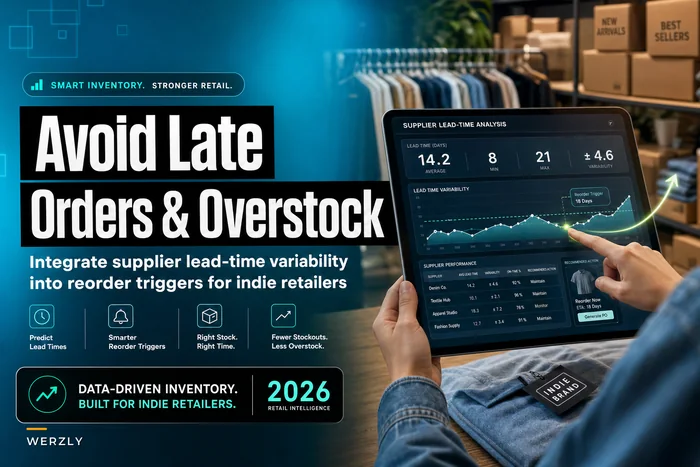
Two things that quietly wreck allocation: lead-time variability and stale demand data. If your supplier's "3 weeks" is actually 3–6 weeks, your reserve and reorder timing have to account for that swing, or you'll chase demand that's already cooled. That reorder-timing problem is worth its own read — integrating supplier lead-time variability into your reorder triggers is what makes replenishment actually reliable instead of just hopeful.
The monthly governance checklist
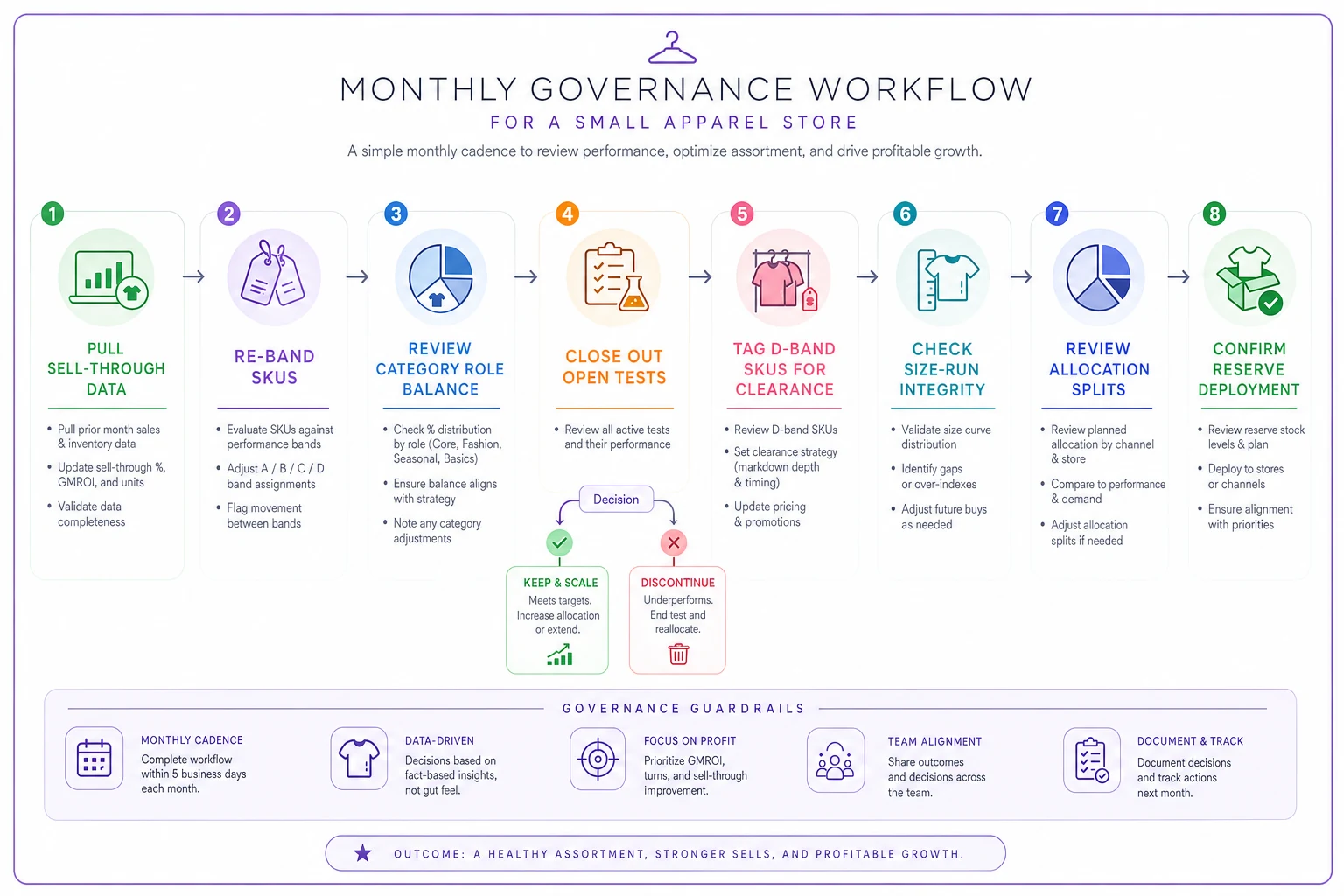
Architecture without governance decays. Roles drift, bands go stale, tests never get killed, and within two seasons you're back to intuition-buying with extra steps. The fix is a fixed monthly review — 45 minutes, same day each month, one person driving it.
Below is a simple workflow to run the monthly governance review.
-
Re-band the SKUs. Pull current sell-through and re-sort A/B/C/D. Flag anything that dropped a band.
-
Review category role balance. What share of open-to-buy went to each role last month? Are profit engines starved? Is identity product bloating?
-
Close out open tests. Every test past its read window gets a verdict: reorder, hold one week, or markdown. No orphans.
-
List new D-band SKUs. Anything freshly dead goes on the clearance clock with a markdown date.
-
Check size-run integrity on A/B SKUs. Broken runs get a reorder or transfer decision.
-
Review allocation splits per store. Did last month's split match where product actually sold? Adjust the weighting.
-
Confirm the reserve got deployed. Held-back units that never shipped are just slow inventory hiding in the stockroom.
The pattern to watch for across months isn't any single number — it's drift. When identity product creeps from 15% of buy to 30%, when your D-band count climbs three months running, when tests keep "holding one more week" — those are early signals that the architecture is quietly collapsing back into gut-feel buying.
Who should run it: whoever controls open-to-buy. In a single store that's the owner. In a small chain it should be one buyer, not a committee — governance by committee turns into governance by nobody.
When this whole system makes sense — and when it's overkill
When it makes sense: you carry more than a few hundred SKUs, you're reordering regularly, or you have more than one location. The moment allocation and reorder decisions repeat, you need rules so you're not re-deciding from scratch every week.
When it's overkill: a single small boutique that buys seasonally, sells through, and doesn't replenish mid-season. If you buy once, sell it down, and move on, formal velocity bands and allocation logic are more overhead than they're worth. A simple clearance clock is enough.
Where it usually breaks first: not in the design — in the follow-through. Owners build the bands, love it for two months, then skip a governance review during a busy season and never restart. The architecture is only as good as the recurring 45 minutes behind it.
A real scenario
A two-store women's apparel shop, roughly $70k–$80k in monthly combined revenue, came in with a familiar complaint: always buying, never any cash, floor felt tired. When they banded their SKUs, about a fifth of their active styles were D-band — dead stock they'd been passively reordering or just leaving out on the floor.
They did three things. Assigned category roles and capped identity product at around 20% of open-to-buy. Set a hard 4-week read window on all test buys with a written pass line. And switched allocation from even splits to velocity-weighted by store, holding back a small reserve to chase demand.
The change wasn't dramatic overnight. But over roughly a season, D-band count dropped by about half, size-run gaps on their best sellers mostly closed, and the "always buying, never any cash" feeling eased — not because they spent less, but because the dollars finally landed on product that moved. The buyer said the biggest change was psychological: buying stopped feeling like guessing.
The point
Enterprise-lite assortment architecture isn't about acting like a big chain. It's about making your buying decisions repeatable — so whether you're running one store or three, the choices about what to stock, how fast it should move, and where it should go aren't reinvented every week from a feeling. Roles tell you what each category is for. Bands tell you what to reorder. Test rules keep your bets honest. Allocation puts product where it sells. And the monthly review keeps all of it from quietly falling apart.
Build the skeleton once, protect the 45 minutes a month, and your assortment starts working with your cash flow instead of against it.
Ready to elevate your apparel business?
Join 2,000+ retailers using Werzly to streamline operations, increase sales, and deepen customer loyalty.