


Most small retail knowledge lives in three fragile places: the owner's head, one long-tenured employee's memory, and a random stack of sticky notes near the register. That works fine right up until the person who knows how to handle a vendor RA, reset the POS after a card reader glitch, or run the end-of-month markdown pull calls in sick during a sale weekend.
The instinct at that point is to "document everything." So someone starts a 40-page manual. It gets to page 12, the season changes, and the whole thing goes stale. Nobody opens it again. Six months later you're back to relying on memory, except now you also feel guilty about the abandoned Google Doc.
The problem isn't that small stores lack documentation. It's that they're trying to run enterprise-style documentation on a three-person team. Knowledge governance for a retail small store has to be sized to the actual staffing reality — a few people, no dedicated ops manager, thin margins for "admin time." That means less writing, more short-form capture, and a light recurring rhythm that keeps things current instead of one giant document that rots.
Why the "big manual" approach always fails in small retail
There's a pattern that repeats across small apparel shops. The owner knows the manual matters, blocks a weekend to write it, produces something genuinely good, and then never touches it again because maintaining it competes with actually running the floor.
-
Retail changes constantly. New vendors, new POS updates, seasonal receiving quirks, a fresh return policy after a bad month. A static document is out of date within a quarter.
-
Nobody reads long docs mid-shift. When the card reader freezes and there's a line, no one is scrolling to section 4.3. They text the owner. Every time.
-
Writing is the wrong format for physical tasks. Explaining how to steam and stage a delicate knit, or where the transfer bins live, is painful in prose and obvious in a 30-second video.
-
One author, no review loop. The manual reflects how one person did things in one month, with no mechanism to catch when reality drifts away from it.
The documentation itself is rarely the bottleneck. The maintenance is. A system that requires an hour a week of upkeep will die. A system that needs ten minutes a month has a chance.
What actually breaks as you grow past two people
At one or two people, informal knowledge works because everyone was there when the process was invented. The failure point shows up around the third or fourth hire, and again when you add a second location or a fulfillment channel.
Take control of your clothing store operations.
Werzly helps you manage stock, process orders, and engage customers effortlessly.
- Unified inventory and order management
- Automated customer notifications
- Sales and stock analytics
No credit card required
Solo / two people: Knowledge is shared by osmosis. You both saw the weird vendor situation happen. No governance needed, honestly.
Three to five people: Now there are shifts you're not present for. A new hire handles a return you'd have handled differently. Small inconsistencies creep in — different steaming standards, different ways of tagging held items, different phone scripts. Customers notice before you do.
Multi-location or multi-channel: The gaps compound. Store B does receiving differently than Store A. A BOPIS order gets packed one way on weekdays and another on weekends. Nobody's wrong, exactly — there's just no shared standard, so quality becomes a function of who happened to be working.
The thing most owners miss: inconsistency costs money quietly. It shows up as higher return rates, mis-tagged inventory, slower receiving, and customer complaints that never quite get traced back to a process gap. You don't see a line item called "we never wrote this down." You see margin leak.
The four-part system, sized for tiny teams
A governance program that survives on a small team needs exactly four components — no more. Playbooks for the what, video micro-modules for the how, runbooks for the when-things-break, and a monthly QA pass to keep it all honest.
| Component | Format | Length | Best for | Update cadence |
|---|---|---|---|---|
| Playbook | 1-page written | ~1 page | Policies, decision rules, "who owns this" | When policy changes |
| Video micro-module | Phone video | 30–90 sec | Physical, hands-on tasks | When the task changes |
| Runbook | Short checklist | 5–10 steps | Failures, exceptions, emergencies | After each incident |
| Monthly QA | Checklist review | ~20 min/mo | Catching drift, killing stale content | Monthly |
The reason this works where a manual doesn't: each format matches the type of knowledge it's holding. You stop trying to describe a steaming technique in paragraphs and start filming it. You stop burying the "POS is frozen" fix on page 30 and put it on a pinned one-screen runbook.
Name files by task, not date, so people search by action when they need something.
1. One-page playbooks (the "what" and "who")
A playbook is not a manual. It's a single page that answers: what's our standard, who decides, and where's the line. Keep it to one page on purpose — the constraint forces clarity.
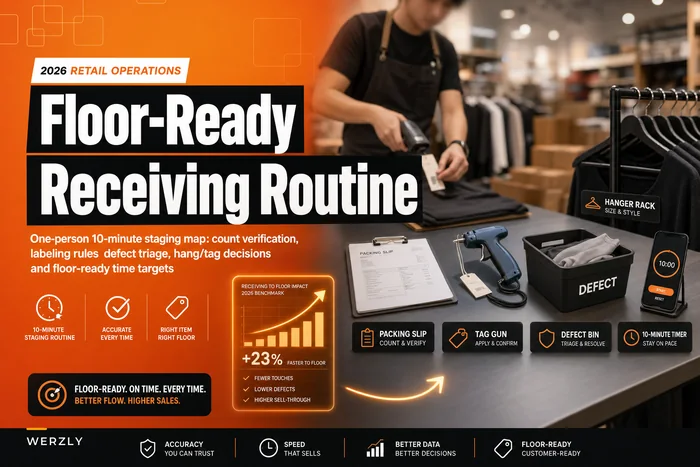
A good receiving playbook doesn't re-explain the whole process (you have a video for the physical steps). It states the standard and the decision rules: what counts as damaged, who authorizes a return-to-vendor, what the size-drift threshold is before you flag a supplier. The mechanics of the physical work belong in the floor-ready receiving checklist and staging routine — the playbook just points to it and sets the rules around it.
Playbooks worth having on a small team:
-
Returns and exchanges (decision rules, exceptions, who overrides)
-
Receiving standards (accept/reject criteria, escalation)
-
Markdown authority (who can discount, by how much, when)
-
Opening and closing (the non-obvious judgment calls, not the button-pressing)
-
Customer conflict handling (when to comp, when to escalate)
2. Video micro-modules (the "how")
This is the part small stores under-use, and it's the single biggest time-saver. Anything physical, spatial, or "you have to see it" should be a phone video between 30 and 90 seconds. Not polished. Not scripted. Just clear.
-
State the task in one line. "This is how we steam and stage delicate knits."
-
Show the setup. Where the tools/supplies live.
-
Do it once, narrating. Slow, real-time, no editing.
-
Call out the one common mistake. "Don't hover the steamer here — it'll leave a water mark on rayon."
-
Show the finished standard. What "done right" looks like.
Store the videos in a shared folder or your ops platform, named by task, not by date. The mistake people make is filming great videos and then burying them in a chat thread where they're unfindable two weeks later. Findability is the system.
Good candidates for micro-modules: steaming and staging, tag/sensor placement, transfer bin process, BOPIS packing standard, fitting-room reset, POS return workflow, end-of-day cash count.
3. Runbooks (the "when it breaks")
A runbook is what someone follows when something goes wrong and you're not there. It's the highest-value document in the whole system because it directly replaces the panic text to the owner.
Format: a short, numbered, if-this-then-that list. Five to ten steps. Written for the least-experienced person who might face it.
Example — "POS card reader frozen during checkout":
-
Tell the customer "one sec, quick reset" — stay calm, they're watching your face.
-
Unplug the reader from the base for 10 seconds, plug back in.
-
If it reconnects, retry the sale.
-
If not, switch to backup reader in the drawer under register 2.
-
Still down? Take payment manually via the [backup method] and log the sale on the paper sheet in the drawer.
-
Text [owner] after the customer is handled, not before.
Notice step 6. A good runbook tells people the order of operations under pressure, including when to escalate — which prevents the reflexive "text the owner first" that stalls everything.
Runbooks every small store should have: POS failure, payment/network outage, angry customer escalation, suspected theft in progress, opening when the key/alarm won't cooperate, and "someone called out and I'm alone." That last one connects directly to how you've set up coverage and cross-training — if you haven't mapped that yet, the staffing and cross-training approach is worth pairing with this.
4. The monthly QA pass (the thing that keeps it alive)
This is the piece that separates a living system from another abandoned Doc. Once a month, roughly 20 minutes, someone runs a short checklist against reality.
Monthly QA checklist:
-
[ ] Did any policy change this month that a playbook needs to reflect?
-
[ ] Are there any videos showing an outdated tool, layout, or process?
-
[ ] Did any incident happen that we don't have a runbook for? (If yes — write it now, 5 minutes.)
-
[ ] Pick one random playbook — is it still accurate?
-
[ ] Ask staff
what did you have to text me about this month? (Every answer is a missing document.)
-
[ ] Archive anything nobody used and nobody needs.
That last question — "what did you text me about" — is the engine of the whole thing. Every escalation to the owner is a gap in the system. Over a few months, closing those gaps one at a time is how the knowledge base builds itself organically, driven by real friction instead of imagined completeness.
The diagram below outlines the lightweight workflow linking playbooks, videos, runbooks, and monthly QA.
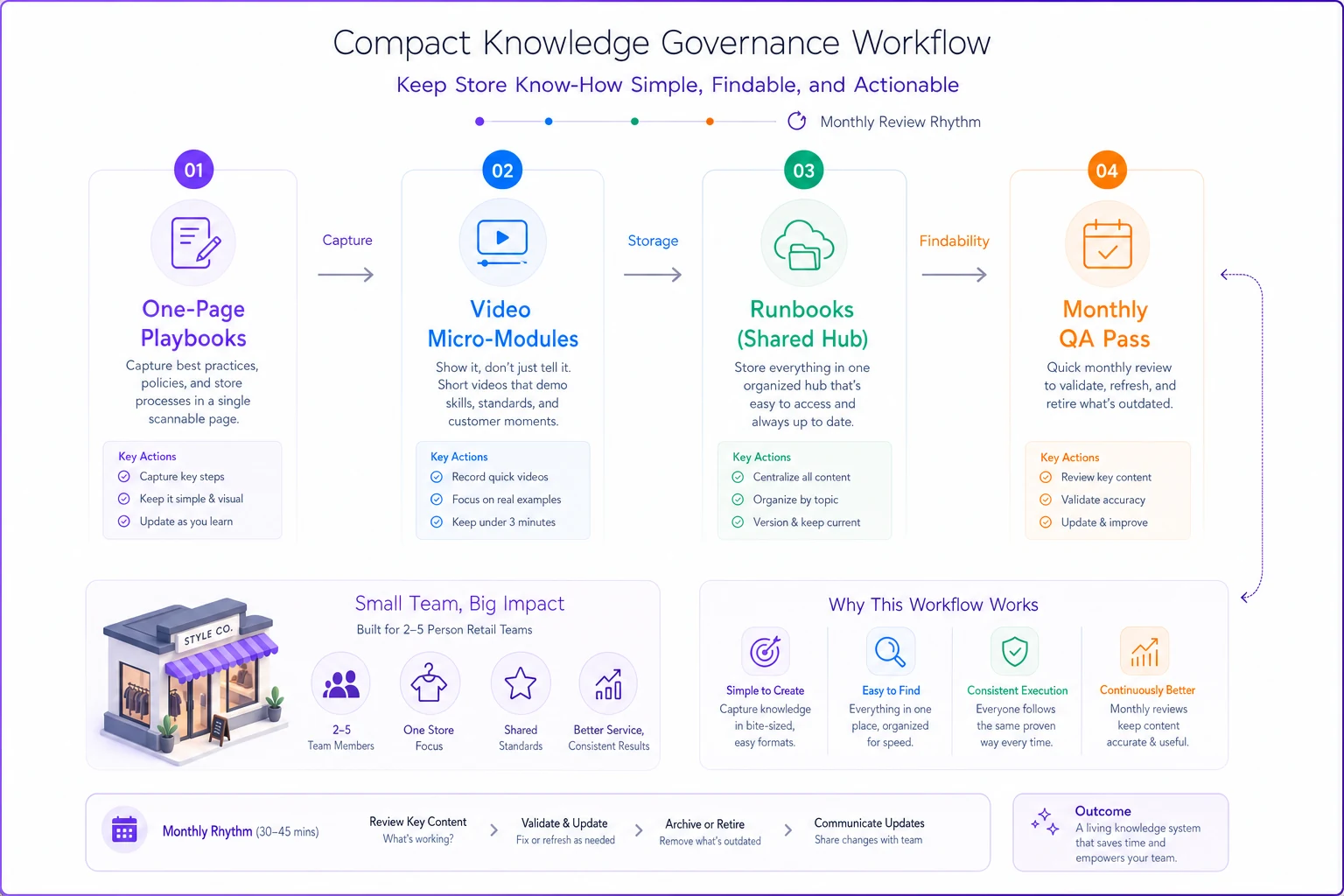
Use it as a simple mental model when you set up the four parts.
A real scenario
A two-location women's apparel shop, five staff total, owner splitting time between both stores. The recurring pain: fielding 15–20 operational texts a week — "which vendor for this return?", "can I discount this?", "reader's frozen again", "how do we tag the consignment stuff?" Half of it on her one day off.
They didn't build a manual. Over about six weeks they filmed roughly a dozen micro-modules on a phone, wrote five one-page playbooks and four runbooks, and started a 20-minute monthly QA on the first Monday.
The change wasn't dramatic on paper but it was obvious in daily life. Operational texts dropped to a handful a week, mostly genuine judgment calls rather than "how do I" questions. Onboarding a seasonal hire went from a chaotic week of shadowing to a couple of structured days of videos plus floor time. Receiving quality between the two stores got noticeably more consistent, because both locations were finally working from the same accept/reject standard instead of two people's habits.
Nothing here required software or a big budget. It required matching the format to the knowledge and building a light rhythm to keep it current.
When this makes sense — and when it doesn't
When it's worth it: You have three or more people, shifts you're not present for, any second location or sales channel, or seasonal hiring. Anytime knowledge has to travel between people who weren't in the room when the process was invented, you need this.
When it's overkill: True solo operation, or two people who work nearly every shift together. Don't build governance for a team of one. A running notes doc is fine until you add your first real hire.
Who should NOT do this: Anyone about to build the 40-page manual again. If your plan is "document everything comprehensively," stop. Comprehensiveness is the enemy here. The whole point is minimal — capture the high-friction, high-turnover knowledge, and deliberately ignore the rest. A system you'll actually maintain beats a complete one you'll abandon.
Where lightweight tools help — and where they don't
You can run this entire system on free tools: a shared drive for videos, a folder of one-page docs, a pinned note for runbooks. Plenty of small stores do exactly that and it works fine.
The one place a proper operational platform earns its keep is findability and the QA loop. When videos, playbooks, and runbooks live inside the same system your team already uses for shifts and tasks, people actually find them at the moment of need — instead of hunting through chat history. A platform that logs which runbooks got triggered, or nudges the monthly QA review so it doesn't get skipped, quietly solves the maintenance problem that kills most documentation efforts. That's the real value: not fancier documents, but a system that keeps them current without depending entirely on the owner's willpower.
Don't buy anything to fix this until the habit exists, though. Build the four components first with whatever you have. If you're spending real time hunting for the right video or the monthly QA keeps slipping, that's the signal it's time for something more structured.
The takeaway
Small retail doesn't fail at knowledge because owners are lazy or disorganized. It fails because the standard advice — write a comprehensive manual — is built for teams that have someone whose job is to maintain it. You don't. So the system has to be small enough to survive on ten minutes a month.
Four parts: one-page playbooks for the rules, short videos for the hands-on work, tight runbooks for the emergencies, and a monthly QA that turns every "sorry to bother you" text into a document. Build it from real friction, keep it deliberately minimal, and it'll still be alive next season — which is more than almost any manual can claim.
Ready to elevate your apparel business?
Join 2,000+ retailers using Werzly to streamline operations, increase sales, and deepen customer loyalty.