

Your receiving area probably looks fine from the outside. Boxes stacked, hangers ready, maybe even a pricing gun within reach. But what kills me about most clothing stores is they treat receiving like unpacking groceries. Open box, hang stuff, done.
That rushed approach creates a cascade of problems that compound throughout the day. Items hit the floor with wrong prices. Defective pieces slip through. Count discrepancies go unnoticed until inventory time. Staff waste hours fixing mistakes that shouldn't exist.
The difference between stores that run smoothly and stores that constantly firefight? A bulletproof receiving process that catches problems before they leave the stockroom.
Why receiving breaks down (and stays broken)
Most clothing store owners know receiving matters. They just don't realize how much time they're hemorrhaging because their process has too many decision points and zero structure.
Think about what actually happens when a shipment arrives. Someone opens boxes while helping customers. They make snap decisions about pricing based on memory. They eyeball quantities instead of counting. They set aside damaged items "to deal with later" — except later never comes because another delivery shows up tomorrow.
The real problem isn't laziness. It's that receiving feels urgent but not important, so it gets minimum viable attention, which creates maximum downstream chaos.
When you dig into stores with chronic operational issues, a huge chunk trace back to receiving mistakes. Wrong counts lead to phantom stock-outs. Inconsistent tagging creates register confusion. Missed defects trigger returns that could've been vendor credits. Small errors multiply fast.
The 10-minute staging map that actually works
After watching countless receiving processes fail, here's what separates efficient operations from constant scrambles: a rigid sequence that removes thinking from the equation.
Take control of your clothing store operations.
Werzly helps you manage stock, process orders, and engage customers effortlessly.
- Unified inventory and order management
- Automated customer notifications
- Sales and stock analytics
No credit card required
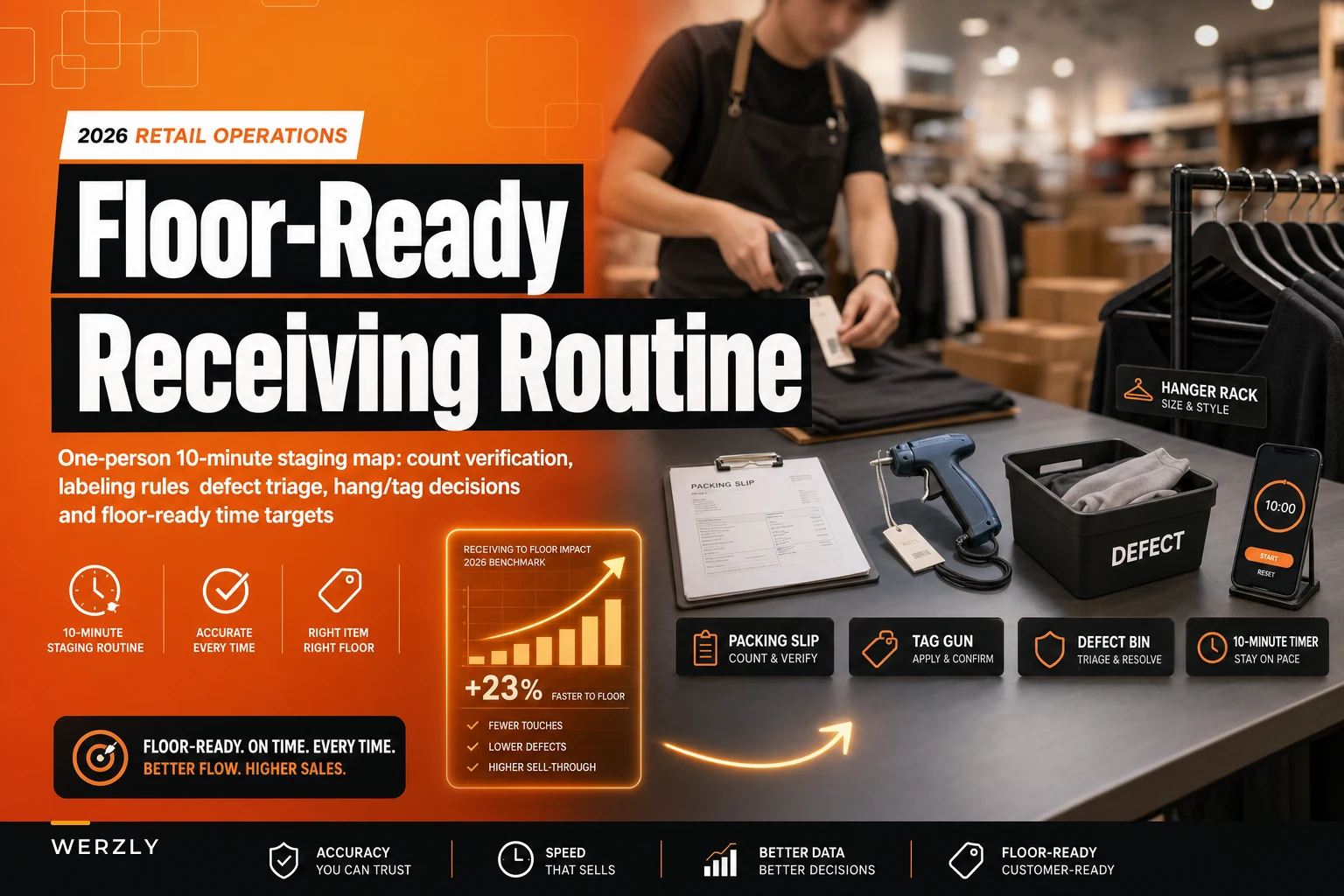
Station Setup (90 seconds)
-
Packing slip clipboard at arm's reach
-
Tagging gun loaded with correct tags for this delivery
-
Defect bin to your left
-
Hanger rack to your right
-
Phone or tablet for scanning/logging
This layout matters because it creates a physical workflow. Items move left-to-right through your process without backtracking or pile-ups.
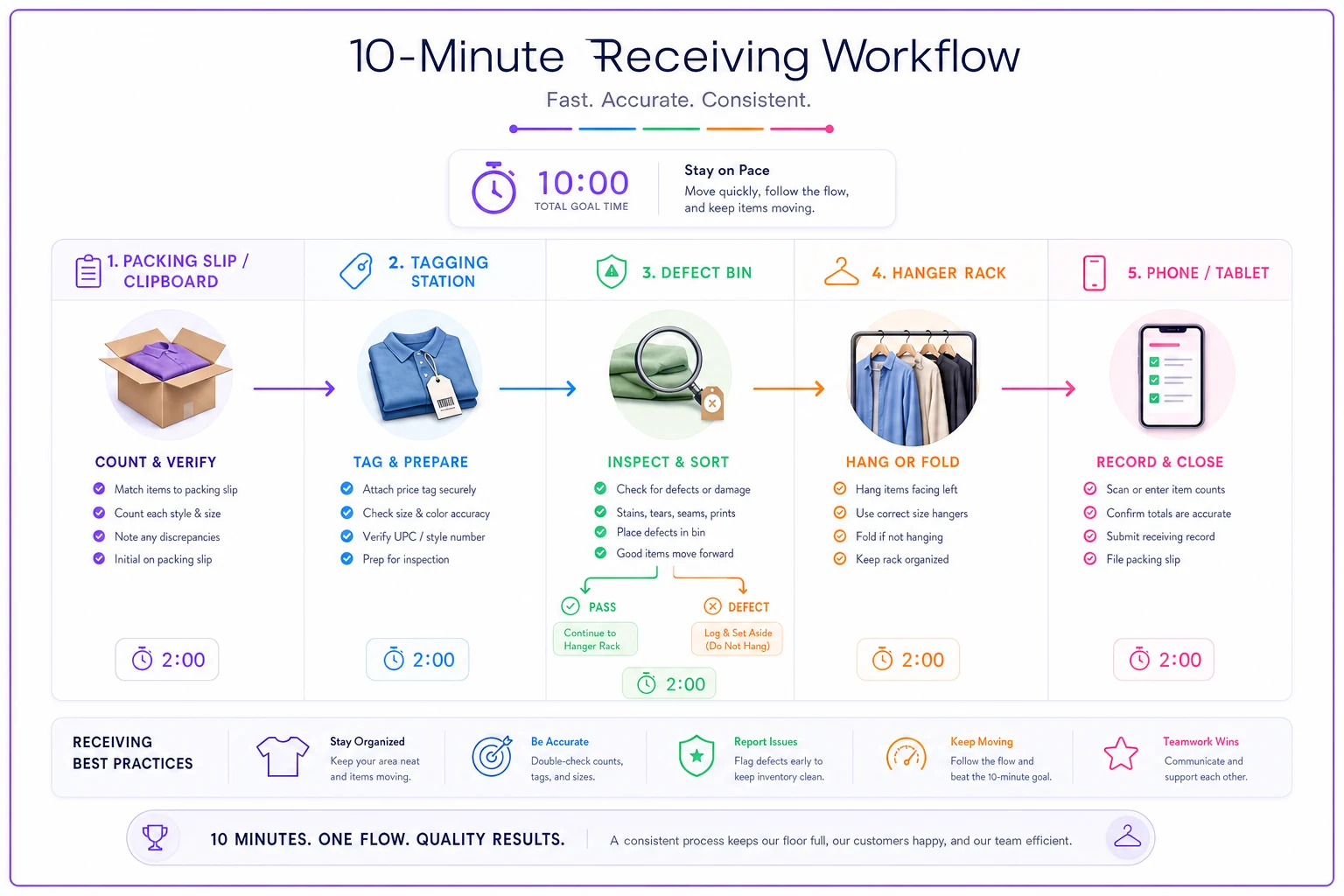
Visual map of the 10-minute flow:
Count and Verify (3 minutes)
Open everything first. Don't start processing individual items yet — just expose all merchandise and do a fast visual count against the packing slip.
SKU-level counting comes next. Group identical items together: all size small black tees in one pile, mediums in another. Count each group once, mark the packing slip, then count again if anything seems off. Discrepancies get flagged immediately, not after you've already tagged everything.
This dual-count approach catches vendor errors while boxes are still fresh. Much easier to dispute shortages when you can photograph the entire shipment spread out.
Defect Triage (2 minutes)
-
Visible stains or tears? Defect bin.
-
Missing buttons or broken zippers? Defect bin.
-
Weird smell or feel? Defect bin.
-
Wrong color from what was ordered? Defect bin with a note.
Don't try to fix anything during receiving. Don't debate whether something is "sellable with a discount." Binary decision only — perfect condition or defect bin. You can make nuanced calls later when you're not racing the clock.
Price and Tag Application (3 minutes)
This is where most stores waste insane amounts of time — figuring out prices on the fly. Pricing should already be decided before the shipment arrives. Either it matches your standard markup formula, or you've pre-planned special pricing for specific items.
-
Left sleeve seam for tops
-
Left hip for bottoms
-
Back neck for items without sleeves
-
Removable hang tag for accessories
Consistent placement speeds up both floor stocking and customer checkout. Cashiers know exactly where to look, customers don't struggle finding prices, and items look uniform on displays.
Hang/Fold Decision Matrix (90 seconds)
| Item Type | Display Method | Reason |
|---|---|---|
| Dresses | Hang | Shape retention |
| Blouses/Shirts | Hang | Wrinkle prevention |
| Jeans | Fold | Space efficiency |
| T-shirts | Fold | Stack higher quantities |
| Knitwear | Fold | Prevent stretching |
| Jackets | Hang | Maintain structure |
| Activewear | Fold | Customer expects folded presentation |
Mixed items in one shipment? Process all hanging items first, then folded items. Two separate workflows prevent constant switching between methods.
The compact checklist that catches everything
Print this, laminate it, keep it at your receiving station:
Pre-Receiving
-
[ ] Clear workspace completely
-
[ ] Gather supplies (tags, hangers, bins)
-
[ ] Pull up order info/pricing plan
-
[ ] Set 10-minute timer
During Receiving
-
[ ] Photo unopened boxes (evidence)
-
[ ] Open all boxes before processing
-
[ ] Group identical SKUs together
-
[ ] Count against packing slip
-
[ ] Mark discrepancies immediately
-
[ ] Quick defect scan (5 seconds per item)
-
[ ] Apply prices per predetermined plan
-
[ ] Tag in consistent location
-
[ ] Hang or fold per matrix
Post-Receiving
-
[ ] Move perfect items to floor-ready rack
-
[ ] Document defects with photos
-
[ ] Update system counts
-
[ ] File packing slip (physical or digital)
-
[ ] Reset workspace for next delivery
Print this, laminate it, keep it at your receiving station:
When this system breaks (and how to prevent it)
Even solid processes fail when reality hits. Here are the failure points that come up repeatedly and what actually fixes them:
The Multi-Tasking Trap
Someone starts receiving, a customer walks in, receiving gets abandoned half-done. Now you've got partial counts, untagged items, and no clear status on anything.
Fix: Receiving happens in complete batches only. If interrupted, items go back in boxes until you can restart fresh. No partial processing allowed.
The Premium Item Problem
Expensive items need extra documentation, but following different processes for different items slows everything down.
Fix: High-value items get the exact same process plus one step — photograph with the packing slip visible. Takes 3 seconds, saves massive headaches if something goes missing.
The Seasonal Surge
Black Friday shipments. Resort wear in January. Prom dresses in March. Volume spikes break your 10-minute timeline.
Fix: Don't extend time — add sessions. Three 10-minute blocks with breaks beats one exhausting 30-minute marathon. Preserve the timeline structure and the quality follows.
Measuring if your receiving actually works
Most stores think good receiving means "stuff got put away." That's like saying good cooking means "food got made." Completion isn't the point — quality is.
Track these three metrics weekly:
-
Receiving-to-floor time
How long from box opening to sales floor?
-
Defect catch rate
Defects found during receiving vs. found by customers
-
Pricing accuracy
Register corrections needed per 100 transactions
Healthy receiving looks something like:
-
- Under 2 hours receiving-to-floor
-
- 90%+ defects caught before floor
-
- Less than 3 price corrections per 100 sales
If you're nowhere near these benchmarks, your receiving process needs a complete overhaul, not minor tweaks.
The hidden ROI of tight receiving
Stores resist structured receiving because it feels like overhead. "Why spend 10 focused minutes when I can multitask in 5?"
Because those 5 rushed minutes create 50 minutes of downstream fixes. Missing items during monthly inventory audits. Wrong prices at checkout. Defective items returned by frustrated customers. Staff confusion about what's actually available.
One boutique was averaging close to 4 hours weekly on corrections — fixing prices, finding missing items, processing defect returns. After implementing structured receiving, those corrections dropped to under 45 minutes. That's 3-plus hours of labor redirected to selling instead of fixing.
The math gets even better when you factor in prevented losses. Every defect caught during receiving becomes a vendor credit instead of a customer return. Every accurate count prevents phantom stock-outs that kill sales. Every correct price maintains margin instead of honor-pricing mistakes at the register.
Making it stick when you're not there
The best process means nothing if it only happens when you're watching. Solo operators and small teams especially struggle with consistency because everyone thinks their way is better.
Build compliance through environmental design:
-
Physical checklist that must be initialed
-
Receiving supplies in a locked kit that forces proper setup
-
Timer that automatically starts when stockroom door opens
-
Before/after photos required for each shipment
For operations running AI-powered inventory platforms, receiving becomes even more critical because bad data compounds automatically. When reorder triggers rely on accurate counts, one bad receiving session can cascade into weeks of stock imbalances. Operational software can track receiving metrics, flag discrepancies, and guide staff through the proper sequence — but garbage in still means garbage out.
The brutal truth about floor-ready merchandise
Most clothing stores operate on hope. Hope that shipments arrive correctly. Hope that staff notice problems. Hope that customers don't find defects first.
Structured receiving replaces hope with process. Ten minutes of disciplined attention prevents hours of scattered fixes. A laminated checklist beats memory every time. Consistent tag placement saves seconds at every transaction.
The stores thriving despite thin margins and fierce competition aren't necessarily better at buying or marketing. They're better at the boring operational stuff that nobody notices until it breaks. Receiving might not be exciting, but neither is losing money to preventable mistakes.
Your next shipment arrives tomorrow or next week. You'll either unpack it like groceries and deal with the consequences for days, or you'll process it properly in 10 focused minutes and move on.
Start with one shipment. Set your timer. Follow the checklist even though it feels rigid. Track what happens over the next week — fewer price checks, fewer "where is this item?" hunts, fewer surprise defects at the register.
Once you see the compound effect of clean receiving, you won't go back. The ten minutes you invest upfront saves hours of operational friction throughout your store's daily flow.
Start with one shipment. Set your timer. Follow the checklist even though it feels rigid. Track what happens over the next week — fewer price checks, fewer "where is this item?" hunts, fewer surprise defects at the register.
Once you see the compound effect of clean receiving, you won't go back. The ten minutes you invest upfront saves hours of operational friction throughout your store's daily flow.
Ready to elevate your apparel business?
Join 2,000+ retailers using Werzly to streamline operations, increase sales, and deepen customer loyalty.