

The worst holiday shifts aren't the busy ones. They're the busy ones where you've got a new hire standing behind the cashwrap, frozen, while a line of eight people forms and someone's trying to return a sweater with no receipt. Your new person knows nothing because you hired them Tuesday and threw them on the floor Friday with a "you'll pick it up."
That's the core problem with holiday surge onboarding in a small retail store: you don't have two weeks. You need people productive fast, and "fast" usually means undertrained — and undertrained seasonal staff create the exact chaos you hired them to prevent. Long lines, botched returns, lost fitting-room sales, and a shrink problem that shows up in January when you're finally doing the math.
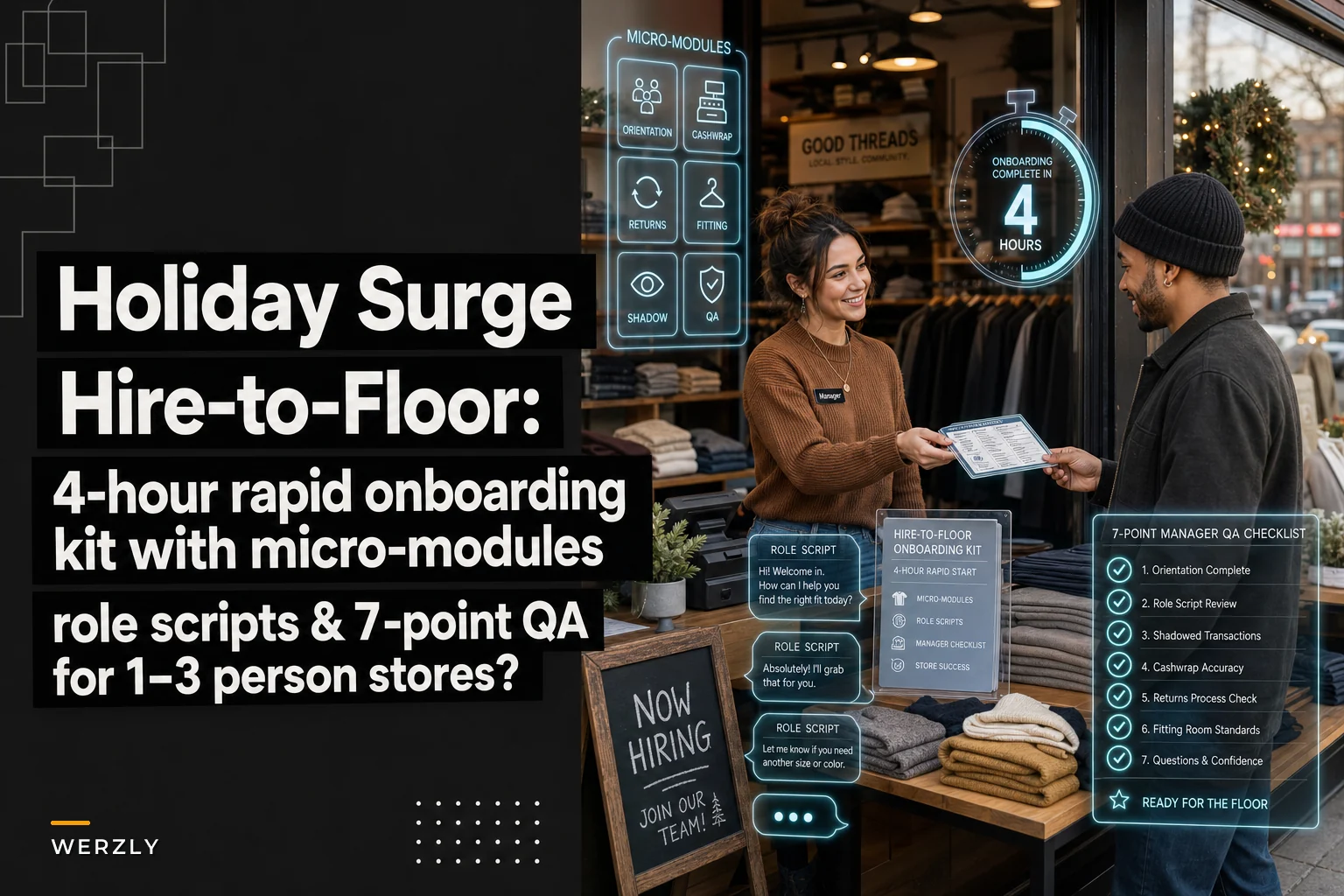
This is a tight, time-boxed kit. Four hours, broken into micro-modules, with role scripts and a short QA checklist built specifically for shops running three to eight people. Not a corporate training binder. Something you can actually run the morning someone starts.
Why the usual onboarding falls apart in December
Most small apparel shops onboard by osmosis. The new hire shadows whoever's working, picks things up over a few weeks, gradually becomes useful. That works fine in February. It completely breaks in the holiday window for one simple reason: your trainers are also your closers.
In practice, your two experienced people are both slammed — running transactions, recovering the floor, handling the return that needs a manager override. The new hire shadows for maybe twenty minutes before someone says "just watch me" and then gets pulled away entirely. By hour three the new person has absorbed a random, incomplete slice of knowledge: they can ring a basic sale but have no idea how to process a gift receipt, handle a price override, or what to say when a card declines.
The other consistent gap is that seasonal hires get taught tasks but never decisions. They know how to scan an item. They don't know what to do when the scan doesn't match the tag price — which happens constantly during markdown season. So they either hold up the line calling for help, or they guess, and your margin bleeds out one override at a time across a busy weekend.
The fix isn't more training time. You don't have it. The fix is sequencing — teaching the three or four things that actually break revenue or create risk in the first four hours, in the order they'll encounter them, and saving everything else for week two.
The 4-hour structure at a glance
Time-boxing forces you to cut. You cannot teach everything, so you teach what matters most, in the right order, and nothing else.
Take control of your clothing store operations.
Werzly helps you manage stock, process orders, and engage customers effortlessly.
- Unified inventory and order management
- Automated customer notifications
- Sales and stock analytics
No credit card required
| Block | Time | Focus | Who runs it |
|---|---|---|---|
| Block 1 | 0:00–0:45 | Store orientation + POS basics (ring, tender, void) | Any trusted staffer |
| Block 2 | 0:45–1:45 | Cashwrap micro-module (gift receipts, overrides, line recovery) | Manager or lead |
| Block 3 | 1:45–2:30 | Returns & exchanges micro-module | Manager only |
| Block 4 | 2:30–3:15 | Fitting-room prompts + floor coverage | Lead or strong seller |
| Block 5 | 3:15–3:45 | Shadowed live transactions | Trainer |
| Block 6 | 3:45–4:00 | QA sign-off + "what to ask when stuck" | Manager |
Returns gets its own full block and gets the manager's attention specifically. That's deliberate. Returns are where new hires lose the most money and create the most policy mess, and they're almost always undertaught because they feel like an edge case. During the holidays they aren't an edge case — they're a third of your January traffic.
Micro-module 1: The cashwrap
The cashwrap is where speed and accuracy fight each other, and new hires tend to lose both. The goal of this block isn't to make someone fast. It's to make them not-stuck — able to complete the five transaction types that actually occur without flagging someone down. Teach them in exactly this order:
-
Standard sale — scan, confirm count, tender, bag. Run it three times until it's close to muscle memory.
-
Gift receipt — where the button is, when to offer it ("Would you like a gift receipt?" as a default question through December).
-
Price override / price match — the single most skipped item in seasonal onboarding. Show them exactly what triggers an override, what they're authorized to approve without calling a lead, and where that line is.
-
Declined card recovery — the quiet script
"No problem, would you like to try another card?" said without making a face. New hires visibly panic on declines and that panic embarrasses customers out the door.
-
Line recovery — what to say when the line is six deep. One sentence: "I'll be right with you, thanks for waiting." The acknowledgment alone cuts walkouts.
The override piece deserves some extra attention. A common scenario: the store runs a "take an extra 20% off sale items" promo. The discount isn't coded into the system, so every clearance item needs a manual override at the register. A new hire who wasn't taught that flow either calls the manager over for every transaction — which defeats the purpose of a second register — or applies it wrong. Across a heavy weekend that's easily a few hundred dollars in margin errors and a line that never clears.
Role script for cashwrap hires:
-
Greeting
"Hi, did you find everything okay?"
-
Gift receipt default
"Want a gift receipt with that?"
-
Decline
"Let's try another card — no problem at all."
-
Stuck
"Let me grab someone who can sort this out in one second."
That last line matters more than it sounds. You want new hires to have a dignified way to escalate that doesn't broadcast panic to the customer standing two feet away. Teach the escalation sentence like it's a transaction type, because functionally it is.
Micro-module 2: Returns and exchanges
Run this block yourself. Returns are where guessing costs real money.
New hires process returns to be nice. A customer pushes a little — "I bought it three weeks ago, I don't have the receipt, it still has tags" — and the new hire, wanting to avoid conflict, just does the return at full price. Multiply that across the post-holiday return wave and you've handed back margin on items bought on promotion, or accepted returns that should've been exchange-only.
-
What's the return window, and where do they check the purchase date?
-
Receipt vs. no receipt — what each path allows (store credit at lowest recent price is a common no-receipt rule worth spelling out explicitly).
-
Tags attached vs. removed — hard line or judgment call for your store?
-
Final sale items — how to spot them and how to say no without making it awkward.
-
When to escalate
anything over a certain dollar amount, anything that feels off, anything the customer is pushing unusually hard on.
The "no" script is the most important thing in this block. New hires fold because they don't have words. Give them words:
> "I totally understand. For items without a receipt, I can give you store credit at the current price — would that work?"
> "This one was marked final sale, so I'm not able to take it back, but I'm happy to help you find a size that works better."
Practiced out loud twice, these stop being awkward. Unpracticed, they turn into expensive capitulation. The broader routing logic for what happens to accepted returns after they come back over the counter is outside this four-hour window — the hire only needs the front-counter decision, not the back-end disposition.
One practical note: tape a laminated one-page return rules card inside the counter, out of customer view.
Keep the laminated return rules card inside the counter and update it for holiday promos so exceptions are clear at a glance.
Even trained staff forget edge cases at hour seven of a Saturday shift. The card is faster than finding you.
Micro-module 3: Fitting-room prompts
The fitting room is the highest-conversion real estate in the store and the first thing that gets abandoned when you're short-staffed. New hires treat it as a storage problem — unlock the door, count the items, done. They miss that it's where the second and third sale happens.
The whole module comes down to three habits:
-
The handoff. When walking a customer to a room
"I'll start you a room — let me know if you need a different size and I'll grab it." That one sentence turns the fitting room from a solo activity into a served one.
-
The check-back. Knock after a few minutes
"How are those working out?" Not to hover — to catch the "the small's too tight" moment before it becomes a walkout.
-
The add. "That jacket looks great — we've got a scarf that goes really well with it, want me to grab it?" New hires never do this because nobody told them it was part of the job.
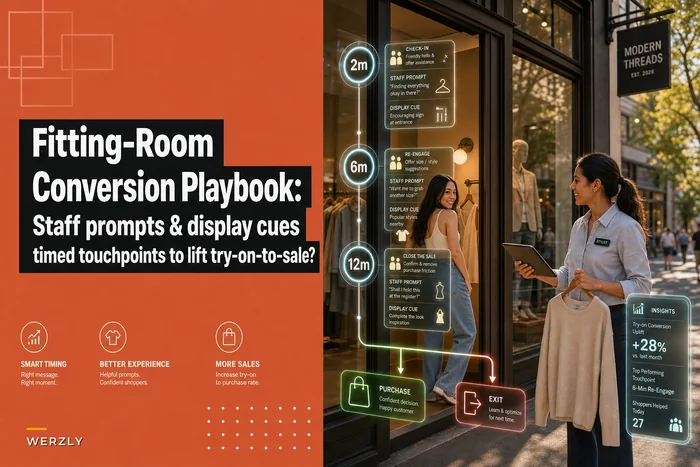
The staff-prompt specifics — timing, display cues, what to say in different situations — go deeper than a 45-minute block allows. The fitting-room conversion playbook covers the full version once your seasonal hire is past day one. For onboarding purposes, the three habits above are enough to make them useful in the room.
Worth noting: shops that specifically teach the check-back habit tend to see fewer "I'll think about it" walkouts, because the size or fit problem gets solved while the customer is still in the room rather than discovered at home later.
The 7-point QA manager checklist
Before a new hire comes off supervision and runs a register solo, sign them off against these seven points. Keep it literal — either they did it or they didn't. The goal is to catch the gap before it becomes a December problem.
-
[ ] Ran three standard sales start to finish without prompting
-
[ ] Processed a gift receipt and offered it unprompted at least once
-
[ ] Applied a price override correctly and stated their approval limit
-
[ ] Handled a decline without visible panic, used the recovery line
-
[ ] Completed one supervised return and correctly identified the no-receipt path
-
[ ] Walked a customer to a fitting room using the handoff script
-
[ ] Knows the escalation rule — can state out loud when to call a manager
Seven points because anything longer doesn't get used on a busy day. If someone misses a point, you don't fail the hire — you re-run that specific micro-module for ten minutes. The checklist is a map of what needs re-teaching, not a pass/fail gate.
A real scenario
A three-person boutique — owner plus two part-timers — brought on two seasonal hires in late November. In previous years they'd done the shadow-and-hope method, and the owner spent the whole season chained to the cashwrap because the new people couldn't handle overrides or returns on their own.
They ran the four-hour kit on each new hire's first shift. The returns block alone made a noticeable difference: no-receipt returns processed at full price had been a recurring leak in prior Januaries — the owner figured it ran into the hundreds across the return wave. With the new hires actually taught the store-credit-at-current-price rule, that leak mostly closed.
The bigger change was harder to quantify. The owner got off the register. Because both seasonal hires could handle the five core transaction types and escalate cleanly, she could work the floor during peak hours — which is where the selling actually happens. Fitting-room attention went up simply because someone was free to walk customers in and grab sizes. The Saturday walkout problem eased. Not a clean number, but it was obvious.
When this kit makes sense — and when it doesn't
It makes sense when you're bringing on two or more seasonal people in a short window and can't afford a long ramp. The time-boxing is the whole value — it forces you to prioritize the revenue-critical stuff first.
It's a bad fit if you're hiring one person for a longer-term role with actual ramp time. Compressing a career hire into four hours leaves out too much — product knowledge, relationships, the slower judgment calls that build a real employee. Use a longer version for that.
Who should skip it: shops where the owner is the only person who can run anything. If there's no second trusted person to lead Block 1 or shadow live transactions, this kit doesn't solve the structural problem — it just relocates it. Cross-training and shift structure need to be in place before the surge hits, not during it. That groundwork belongs in your staffing and labor planning, not in your onboarding sprint.
Making it repeatable
Once you've got the six blocks, the scripts, and the seven-point checklist written down somewhere, the second seasonal hire is faster than the first. Next year you're not rebuilding it from memory during your busiest month. Keep the whole thing as a single document — block timings, teaching points, role scripts, checklist — somewhere a lead can grab it without tracking you down.
Visualizing the six-block flow helps leads run it consistently.
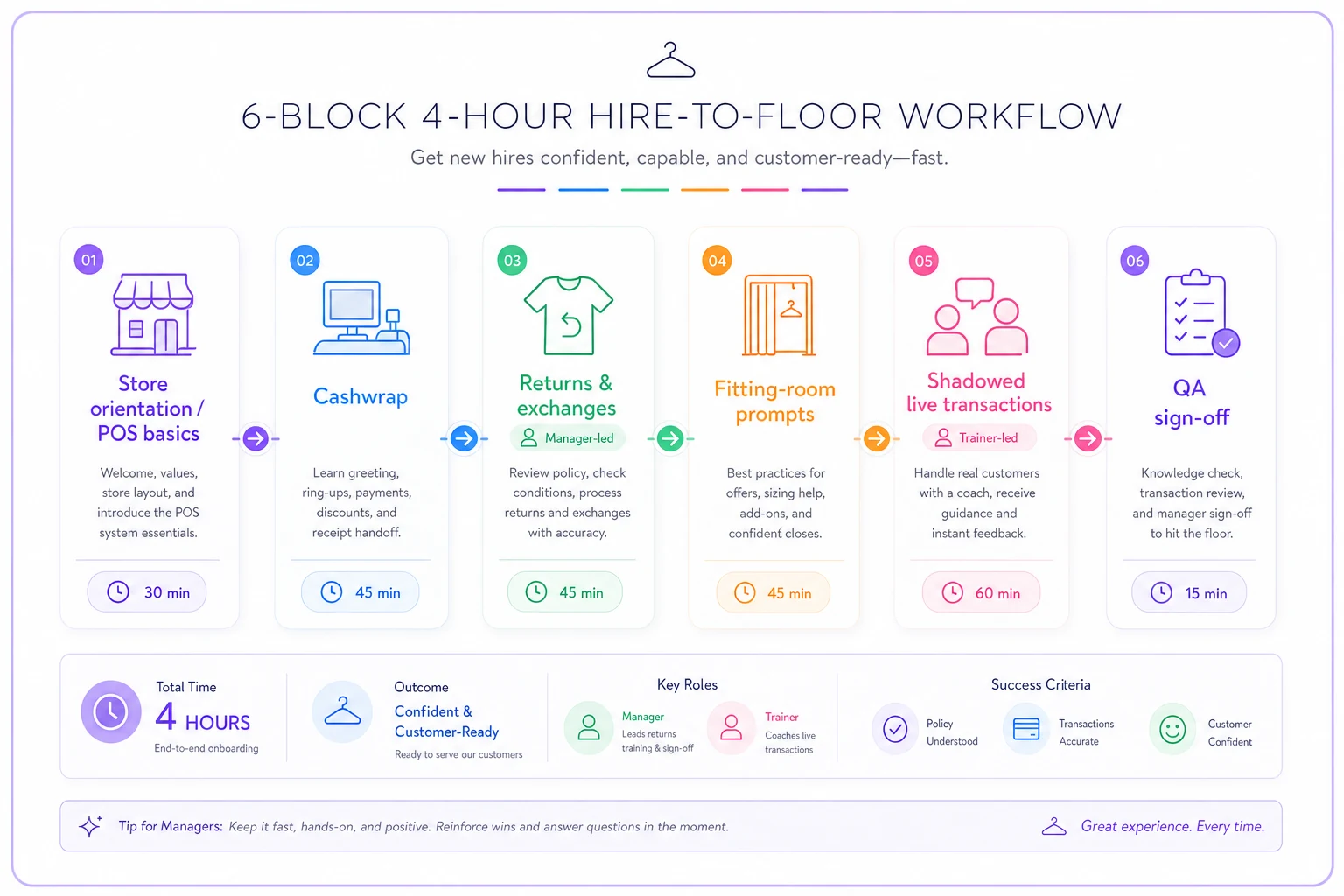
Use the visual as a quick wall reference when running an onboarding sprint so leads can follow the sequence without hunting for notes.
That's genuinely the difference between shops that dread seasonal hiring and shops that just handle it. The ones that dread it treat every new hire as a fresh improvisation. The ones that manage it well have turned onboarding into a routine that fits inside a single shift — tight enough to run in December, specific enough that the new person is actually useful by the time they clock out.
Ready to elevate your apparel business?
Join 2,000+ retailers using Werzly to streamline operations, increase sales, and deepen customer loyalty.