



The high‑ticket seasonal buy is where most small apparel stores either make their season or bleed cash for three months. A $480 wool coat, a $650 leather jacket, a limited handmade knit — you can't afford to stock these six deep in every size. So you pre‑sell them. Take a deposit, order against confirmed demand, and let customer money fund part of your buy.
That's the theory. In practice, deposit pre‑orders quietly create a pile of problems most owners don't see until January: refund arguments, forecast numbers that don't match what actually landed, customers ghosting on the balance, and a spreadsheet that no longer reflects reality.
This is a tight walkthrough of how to structure the deposit itself, how to talk to the customer at each stage, how to fold pre‑sold units back into your forecast without double‑counting, and exactly what your cancellation and refund process should say.
Why flat deposits quietly cost you money
Most small stores default to one number. "20% down, balance when it arrives." Clean, easy to explain. Also the reason a lot of pre‑order programs lose margin.
The mechanics of the leak are straightforward. A flat 20% deposit treats a $180 dress and a $650 jacket the same way in terms of risk — but your exposure isn't proportional. It's about the absolute dollars you commit to the vendor and how hard that specific unit is to resell if the customer walks.
A typical example: you pre‑sell six of a $600 designer coat, collecting $120 each. Two customers cancel before arrival. You now own two $600 coats you bought specifically because you thought they were spoken for. You refund $240, and you're sitting on $1,200 of inventory in a niche size run you never would have stocked speculatively. The 20% "protection" covered almost nothing.
The deposit isn't just a commitment device for the customer. It's your insurance against the resale difficulty of that exact piece. When those two things aren't aligned, the flat percentage always favors the customer who cancels and punishes you.
Deposit tiers: match the down payment to actual risk
Instead of one number, build three or four tiers based on how hard the item is to resell if the deal falls apart. Resale difficulty — not price — should drive the tier, though the two often correlate.
Take control of your clothing store operations.
Werzly helps you manage stock, process orders, and engage customers effortlessly.
- Unified inventory and order management
- Automated customer notifications
- Sales and stock analytics
No credit card required
| Tier | Item type | Deposit | Refundable? |
|---|---|---|---|
| A | Core seasonal, easy to resell (basic wool coat in run sizes) | 20% | Fully refundable to store credit before ship date |
| B | Elevated/branded, moderate resale (mid designer outerwear) | 30% | Refundable minus small restock hold |
| C | Limited/special order, hard to resell (custom size, unusual colorway) | 50% | Non‑refundable, transferable |
| D | Made‑to‑order or vendor special buy | 50%+ | Non‑refundable, no cancellation |
The point of tiers isn't to squeeze customers. It's honesty about what you can actually recover. A navy size‑8 coat you can sell to the next person who walks in — take a small deposit, be generous on cancellation. A size‑16 in a discontinued rust color that one specific customer requested? That's on them if they walk, and the deposit should reflect it.
Pro‑tip: Explain the tier in resale terms to the customer — that framing makes higher deposits feel fair and practical.
Stores that run this well tend to explain the tier in resale terms to the customer. "This is a special order in your size, so the deposit's a bit higher and it's non‑refundable — if you change your mind we can transfer it to a friend." Customers accept this easily when the logic is transparent. They push back hard when a 50% non‑refundable deposit shows up with no explanation.
The tier structure also gives you something to stand on when a customer pushes back on a cancellation. Instead of a policy conversation, it becomes a straightforward explanation rooted in the specific piece they ordered.
When higher deposits are a bad idea
Don't tier up on your bread‑and‑butter seasonal pieces. If you're pre‑selling a coat you'd happily stock anyway, a heavy non‑refundable deposit just kills conversion and makes you look greedy. Reserve the aggressive tiers for genuine special orders and hard‑to‑move specifics. Getting this wrong in the other direction — high deposits on easy‑resale items — is the most common overcorrection once owners get burned once.
The messaging that prevents 80% of refund fights
Refund disputes almost never come from the refund policy itself. They come from the customer not remembering — or never clearly understanding — what they agreed to. The fix is boring and it works: message at every state change, and put the terms in writing at the moment of deposit, not buried on a receipt.
Here are the touchpoints and templates. Keep them short.
-
1. At deposit (the most important one) > Thanks [Name]! Your [item] is reserved. Deposit received: $[X]. Balance due at pickup: $[Y]. Expected arrival: [window]. This deposit is [refundable to store credit before arrival / non‑refundable — special order]. We'll text you the moment it lands.
-
2. Order confirmed with vendor > Good news — your [item] is officially on order with [vendor]. Still on track for [window]. Nothing needed from you yet.
-
3. Delay (send this early, not when it's already late) > Quick update on your [item]: the vendor pushed the ship date to [new window]. Your deposit holds your spot and your price. If the new timing doesn't work, reply and we'll sort it out.
-
4. Arrival / balance due > Your [item] is here! Balance due
$[Y]. We'll hold it for you until [date]. Come try it on — pickup and final fitting anytime before then.
-
5. Balance overdue (the one people skip) > Hi [Name], your [item] is still waiting for you. We can hold it until [final date]. After that we may need to release it — reply and let us know.
The delay message is the one that saves you. Customers rarely cancel over a delay itself — they cancel when a delay arrives as a surprise on a piece they'd half‑forgotten about. Get ahead of it, frame the deposit as protecting their price and spot, and cancellations on delayed goods drop noticeably.
The overdue message matters for a different reason. It converts your legal right to release the item into a documented, fair heads‑up. That's the difference between "they just sold my coat" and "they warned me twice."
Folding pre‑sold units into your forecast without double‑counting
This is where the operational mess usually hides. Pre‑orders scramble your inventory math because a pre‑sold unit is simultaneously:
-
Committed demand (already sold)
-
Incoming inventory (on a PO)
-
Not yet delivered (not in stock)
If your forecast treats pre‑sold units as normal open‑to‑buy demand, you'll over‑order. If it treats them as regular incoming stock, you'll over‑promise the floor. Both happen constantly.
Here's the workflow that keeps it clean:
-
1. Tag pre‑sold units separately from speculative buy. When you place the seasonal PO, split the quantity: "6 pre‑sold / 4 open floor" for a given SKU. These are two different economic decisions and should never live in one number.
-
2. Zero the pre‑sold portion out of your sell‑through target. Those six coats aren't a demand signal for reorder — they're already gone. Only the 4 open‑floor units tell you anything about true market demand.
-
3. Reconcile cancellations back into open floor, not into reorder. When a pre‑sold unit cancels, it becomes floor stock. It should raise your on‑hand availability and lower any speculative reorder you were considering — not vanish from the model.
-
4. Track deposit dollars as a liability, not revenue. Until the item is delivered and the balance is paid, that deposit is money you might owe back. Booking it as revenue in November makes your season look better than it is and creates ugly surprises when refunds hit.
The double‑counting mistake shows up most often at reorder time. A store sees "10 units sold" on a hot coat and reorders deep — not realizing six of those ten were pre‑sold and represent zero incremental market signal. They restock into demand that was already satisfied at deposit. If you're building reorder triggers, this ties directly into how you handle lead‑time and demand signals; the logic in integrating supplier lead‑time variability into reorder triggers applies here — pre‑sold units have to be stripped out before the trigger reads the number.
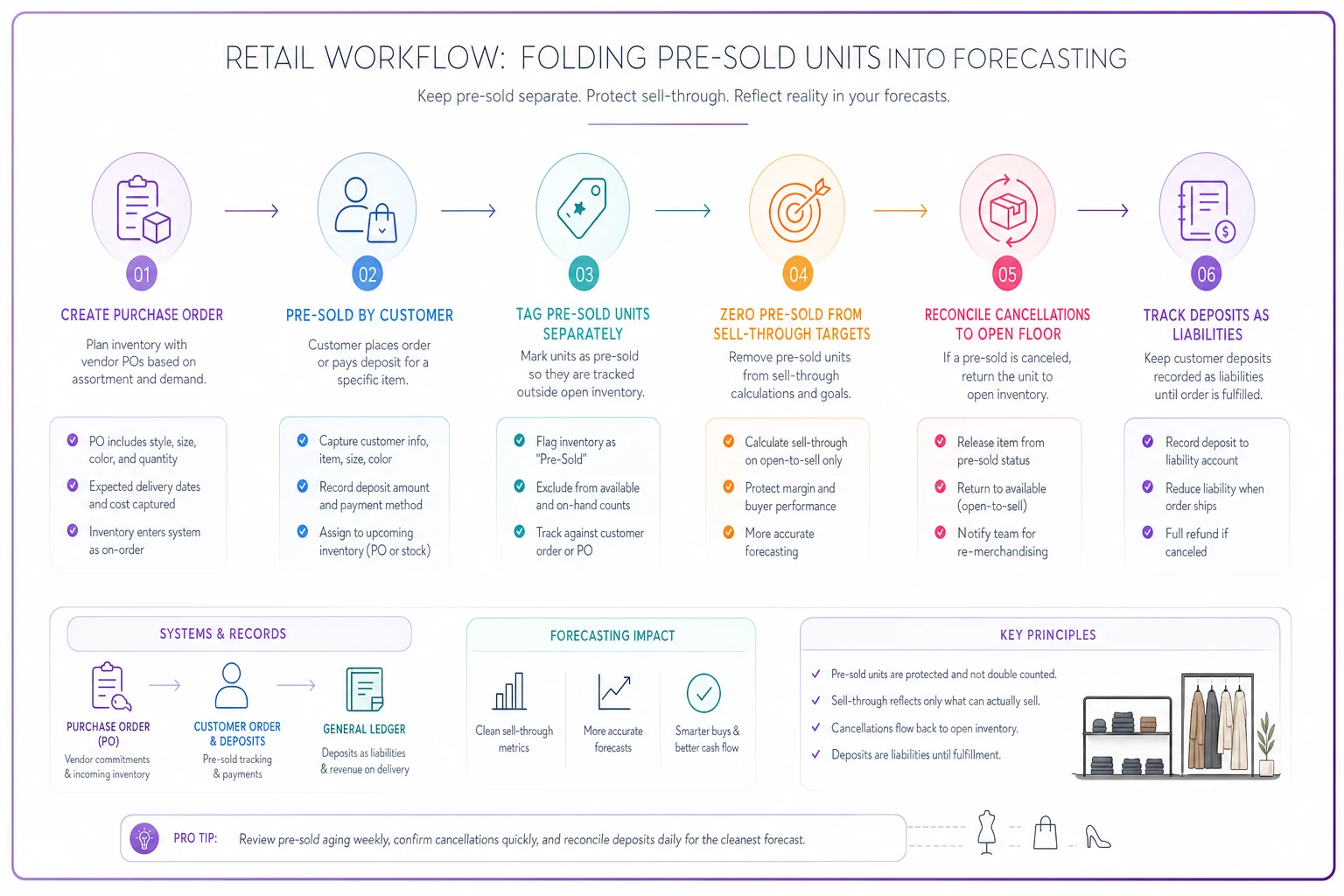
Getting this separation right also makes your end‑of‑season analysis more honest. If you're reviewing what actually sold through versus what was pre‑committed, you need those numbers separated from the start — not reconstructed after the fact from a muddled spreadsheet.
A real scenario
A women's boutique doing roughly $600k–$700k a year ran seasonal outerwear pre‑orders on a flat 25% refundable deposit. Their fall coat program had 22 pre‑orders across four styles.
What went wrong: seven cancellations after a three‑week vendor delay, all refunded in full, leaving them with about $4,200 in coats bought specifically against those pre‑orders — several in odd sizes. On top of that, their reorder read the pre‑sold units as demand and they'd committed to a second buy on the top style. That second buy sat until markdown.
The next season they changed three things: tiered deposits (30% on branded styles, 50% non‑refundable on special sizes), sent the early‑delay message the moment the vendor pushed dates, and split pre‑sold from open‑floor on every PO. Cancellations dropped to two across the whole fall program, both on refundable tiers, and the phantom reorder problem disappeared because the pre‑sold units were carved out of the trigger. Recovered margin landed somewhere in the $5k–$7k range for a single season — mostly from not over‑buying and not eating full refunds on hard‑to‑resell pieces.
Nothing exotic. Just aligning the deposit with real risk and keeping the forecast honest.
Cancellation and refund SOP
Write this down once and follow it every time. Inconsistency is what turns a refund into an argument — the customer who got a full refund tells the one who didn't.
The cancellation decision flow:
-
Refundable tier, before ship date → Refund to store credit (or original payment if you choose), no questions. Log it.
-
Refundable tier, after arrival → Refund minus any restock hold stated at deposit. Item goes to open floor.
-
Non‑refundable tier, customer cancels → Deposit forfeited, but offer to transfer the order to another person or apply the deposit to a different in‑stock item. This preserves goodwill without eating the loss.
-
Store‑initiated cancellation (vendor cancels the order) → Always full refund to original payment, plus a small goodwill gesture. This one is on you, not the customer.
-
Balance never paid, past final hold date → After two documented messages, release to floor. Deposit disposition follows the tier.
Your SOP checklist for every pre‑order:
-
[ ] Deposit tier assigned and reason noted at time of sale
-
[ ] Written terms sent to customer at deposit (not just verbal)
-
[ ] Deposit logged as liability, not revenue
-
[ ] Pre‑sold unit tagged separately on the PO
-
[ ] Delay message sent within 24 hours of learning of any delay
-
[ ] Balance‑due message sent on arrival with a firm hold date
-
[ ] Overdue message sent before releasing any item
-
[ ] Cancellations reconciled back into open floor and out of reorder signal
The transfer option in the non‑refundable path is underused and worth calling out. A customer who can't take a coat but can hand the order to a friend rarely leaves angry. You keep the sale, they save face, and the piece moves. It converts a lose‑lose into something workable.
Running the SOP consistently also protects you from the uncomfortable one‑off exception. The moment you bend the rule for one customer, you've set a precedent — and the next person who asks will know someone else got a better deal.
Who should skip deposit pre‑orders entirely
Not every store should run this. If your seasonal pieces are things you'd comfortably stock speculatively anyway — solid sell‑through, easy to move, run sizes — pre‑orders just add administrative overhead for little gain. The whole point is funding and de‑risking hard buys you couldn't otherwise justify.
Skip it if you can't reliably track deposit liability separately from revenue, because that's where the accounting gets dangerous. Skip it if your vendor lead times are so unpredictable that delay messages become a weekly apology tour — that erodes trust faster than the pre‑order helps. And skip it on anything under roughly $150 retail, where the deposit friction isn't worth the small commitment it buys.
Where deposit pre‑orders actually shine is the $400+ seasonal piece you'd never stock six deep, in a size range you can't speculate on, from a vendor you'd have to commit to early. That's the exact spot where confirmed demand plus a properly‑sized deposit turns a scary buy into a manageable one.
Pulling it together
Deposit pre‑orders aren't complicated, but they punish sloppiness. The three failure points are always the same: a deposit that doesn't match resale risk, silence between deposit and arrival, and a forecast that counts pre‑sold units twice. Fix those three and the program funds your season instead of haunting it.
Tier the deposit to how hard the item is to resell. Message the customer at every state change, especially delays. Carve pre‑sold units out of your reorder math so you don't restock demand you already filled. Write the refund SOP down so every customer gets the same answer.
If you're tracking whether the program is actually working, watch the real numbers — cancellation rate by tier, deposit‑to‑delivery conversion, and pre‑order margin after refunds — not vanity counts of how many pre‑orders you took. That distinction between numbers that look good and numbers that mean something is worth keeping front of mind, and it's the whole idea behind an apparel KPI framework built around what to actually act on. A pre‑order program that takes 40 deposits and refunds 15 isn't a success — the tiers, the messaging, and the forecast discipline are what turn those deposits into a season that holds.
If you're tracking whether the program is actually working, watch the real numbers — cancellation rate by tier, deposit‑to‑delivery conversion, and pre‑order margin after refunds — not vanity counts of how many pre‑orders you took. That distinction between numbers that look good and numbers that mean something is worth keeping front of mind, and it's the whole idea behind an apparel KPI framework built around what to actually act on. A pre‑order program that takes 40 deposits and refunds 15 isn't a success — the tiers, the messaging, and the forecast discipline are what turn those deposits into a season that holds.
Ready to elevate your apparel business?
Join 2,000+ retailers using Werzly to streamline operations, increase sales, and deepen customer loyalty.