


Most small clothing stores don't fail because of one big disaster. They wobble because three medium problems land in the same week. A late shipment collides with an unexpected sales spike, which drains cash right when a vendor asks for a deposit on the next season. Individually, each of these is survivable. Stacked together, they turn into markdown spirals, empty size runs, and that sick feeling of realizing your best-selling style has been out of stock for eleven days.
Resilience isn't about predicting which problem hits first. It's about knowing ahead of time what you'll do when any of them shows up. That's the whole point of stress-testing your inventory before the market stress-tests it for you.
This is a working framework — templates, trigger thresholds, and contingency buy rules — built for shops with limited cash and no dedicated planning team. If you've already set up lead-time-aware reorder triggers and a lightweight forecasting system, this is the layer that sits on top and tells you what happens when those forecasts are wrong.
Why small shops break under stress differently than big ones
Big retailers absorb shocks through scale. They've got safety stock buried in distribution centers, credit lines that stretch, and enough SKU diversity that one dead category won't sink the quarter. A small apparel shop has none of that cushion. Your working capital is mostly on the floor right now, wearing hangers.
That's the structural problem. When roughly 60–70% of your available cash is tied up in inventory at any moment, you don't have the flexibility to react. You can't "just reorder" the hot item because the money is sitting in the slow one. You can't ride out a supplier delay because that delay is happening during your peak sell-through window.
What tends to happen across small retailers is the breakdown almost never announces itself. It creeps. A vendor's lead time quietly drifts from 21 days to 34. A category you assumed was healthy is actually selling through on the backs of two SKUs while the rest sit. Then the holiday demand curve steepens a little faster than last year, and suddenly you're exposed on all three fronts at once — with no pre-decided move.
The fix isn't more forecasting accuracy. It's building a set of if-this-then-that rules while you're calm, so the decision is already made when you're not.
The three shocks worth stress-testing
You don't need to model twenty scenarios. For a small shop, almost every real crisis traces back to one of three shocks, or some combination of them:
Take control of your clothing store operations.
Werzly helps you manage stock, process orders, and engage customers effortlessly.
- Unified inventory and order management
- Automated customer notifications
- Sales and stock analytics
No credit card required
-
Supply shock — a shipment is late, short, or defective. Your reorder doesn't arrive when your triggers assumed it would.
-
Demand shock — sales run hot or cold versus plan. A style takes off, or a whole season stalls because of weather or a confidence dip.
-
Cash shock — money gets tight at the wrong moment. A big deposit, a slow month, or capital frozen in deadstock right when you need liquidity.
These shocks interact. A demand spike is only dangerous if you can't restock (supply constraint) or can't afford to (cash constraint). So the stress test isn't three separate checks — it's looking at what happens when they overlap.
A simple stress-test you can run in 30 minutes
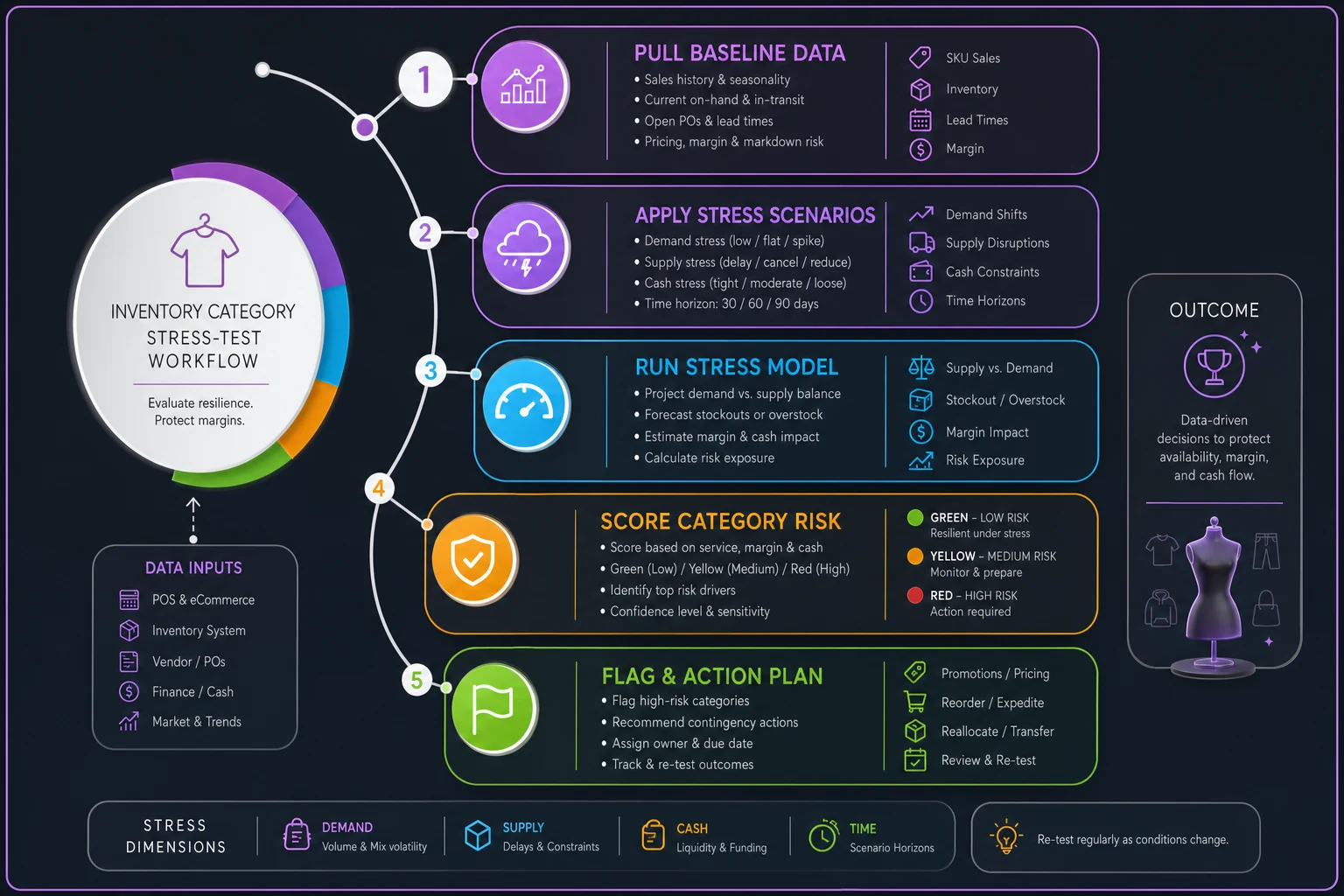
You don't need a data team for this. You need a spreadsheet and honesty about your worst realistic month. Run this per category, not per SKU — SKU-level stress testing is a rabbit hole for a shop your size.
-
Pull your baseline. For each category, note current on-hand units, average weekly sell-through (last 8 weeks), current cash reserve earmarked for buys, and the lead time you're actually seeing from that vendor — not the quoted one.
-
Apply the demand stress. What if sell-through jumps 40% for four weeks? Divide on-hand by the new weekly rate. That's your weeks-of-cover under pressure. If it drops below your real lead time, you've found a stockout risk.
-
Apply the supply stress. Add two weeks to your current lead time. Recheck weeks-of-cover against it. This is where "quoted 21 days, actually 34" bites.
-
Apply the cash stress. Assume one slow week cuts your available buy reserve by 25%. Can you still fund the contingency reorder from steps 2 and 3? If not, flag it.
-
Score each category. Green if it survives all three. Yellow if it survives two. Red if two or more shocks together create a stockout or a cash gap.
A quick visual of the process can help the team understand who does what when a threshold is crossed.
What a filled-in stress test looks like
| Category | On-hand (units) | Weekly sell-through | Real lead time | Weeks cover (normal) | Weeks cover (+40% demand) | Survives supply +2wk? | Cash-covered? | Score |
|---|---|---|---|---|---|---|---|---|
| Core denim | 180 | 22 | 4 wks | 8.2 | 5.8 | Yes | Yes | Green |
| Outerwear | 95 | 18 | 6 wks | 5.3 | 3.8 | No | Tight | Red |
| Knit tops | 140 | 30 | 3 wks | 4.7 | 3.3 | Barely | Yes | Yellow |
| Occasion dresses | 60 | 6 | 8 wks | 10.0 | 7.1 | Yes | No (deposit due) | Yellow |
Outerwear is the obvious problem. Under a demand spike it runs out in under four weeks, but the vendor's real lead time is six — meaning a mid-season sell-through surge leaves you empty for two weeks during your highest-margin window. That's the category you build a contingency plan around now, in August, not in October when the fleece is flying off the rack.
Triggerable reserve rules: money you don't touch until it's time
The most common mistake small shops make is treating their entire cash position as spendable. Then a great buy comes along, they take it, and three weeks later they can't fund the reorder on the thing that's actually selling.
Resilience requires a reserve that's rule-protected — cash you've mentally (and ideally literally) walled off, with clear conditions for when it releases. Think of it in three tiers:
-
Working buy fund — your normal open-to-buy for planned purchases. Spend freely against the plan.
-
Contingency reserve — roughly 10–15% of monthly buy budget, held back. Only released when a defined trigger fires (a Red category hitting its reorder point early, a defective shipment needing replacement).
-
Emergency floor — cash you don't touch for inventory at all. This covers rent and payroll if a month goes sideways. If you're dipping into this to buy stock, the business has a bigger problem than inventory planning.
Trigger thresholds worth setting
Different shops will tune these differently, but a reasonable starting set:
-
Restock trigger weeks-of-cover falls below your real lead time plus one week of buffer.
-
Contingency-buy trigger a Red or Yellow category crosses restock threshold AND you're inside the selling season for it.
-
Freeze trigger overall cash reserve drops below the emergency floor — at which point all discretionary buying stops, no exceptions.
-
Markdown trigger a category sits below 50% of planned sell-through at the season's halfway mark — release capital by moving stock, not by hoping.
Put the contingency release rule in writing and attach an example calculation so the team doesn't debate whether a trigger actually fired.
The reserve only works if the release conditions are written down. "I'll use it if things get tight" is not a rule — it's a feeling, and feelings get overruled by a persuasive vendor rep. A real trigger looks like: "Release up to 40% of the contingency reserve when a Red category drops below 3 weeks of cover during peak season."
Contingency buys and transfers: the actual moves
When a trigger fires, you need a menu of responses ranked by cost and speed. Not every shortage deserves an expedited air-freight reorder. Here's the decision order, cheapest and fastest first:
-
Transfer before you buy. If you run more than one location, or have a stockroom vs. floor imbalance, move existing stock first. It's fast and costs almost nothing. Check other-location availability before placing any emergency PO.
-
Partial expedited reorder. Don't reorder the full run at rush pricing. Order enough of the strong sizes and colors to cover the gap until a normal-speed replenishment lands. The middle sizes are usually where you can't afford to be empty.
-
Substitute within category. If the exact SKU can't arrive in time, is there a similar style already in stock or arriving that can hold the customer? A comparable dark-wash jean covers a lot of the same demand as the specific one that stocked out.
-
Full contingency reorder. Only when the item is a genuine core driver and the margin justifies the rush cost. Run the math: rush shipping plus expedite fees against the lost margin of being empty. Sometimes being out of stock for a week is cheaper than paying to avoid it.
Contingency buy checklist
-
[ ] Confirmed the shortage is real (not a receiving or POS count error)
-
[ ] Checked all other locations / stockroom for transfer stock first
-
[ ] Verified we're still inside the selling window for this item
-
[ ] Calculated lost margin of stockout vs. cost of the rush
-
[ ] Ordered only the sizes/colors that actually drive the category
-
[ ] Confirmed the trigger condition, not a gut feeling, justified the release
-
[ ] Logged the buy against the contingency reserve, not the working fund
-
[ ] Set a reminder to review whether this vendor keeps forcing these situations
That last point matters more than people think. A vendor who repeatedly triggers contingency buys because their lead times are unreliable isn't just a supply problem — they're a cost problem, because you're paying rush fees to cover their misses.
A real scenario: the outerwear crunch
A small mountain-town apparel shop — two locations, roughly $850k combined annual revenue — kept getting burned on cold-weather outerwear every fall. The pattern repeated for years: a cold snap in early November would spike jacket sales, they'd sell through the popular fits in about ten days, and the reorder wouldn't land for five to six weeks. By then the urgent demand had passed and they were left marking down late arrivals in January.
The owner ran the stress test and outerwear scored deep red, exactly like the table earlier. So before that season, they did three things: held back about 12% of the outerwear buy budget as a contingency reserve, set a restock trigger at three weeks of cover, and pre-arranged a transfer rule between the two stores so the location with slower sell-through would ship to the busier one automatically when the trigger hit.
That November, the cold snap came right on cue. The trigger fired on day nine. Instead of scrambling, they transferred about 40 units between locations the same week and released the contingency reserve for a partial expedited reorder of only the two best-selling fits. They weren't perfectly stocked — nobody is — but they cut the peak-window stockout from roughly two weeks down to a few days. Recovered margin came out somewhere in the $9k–$12k range for that category alone, and January markdowns on outerwear dropped noticeably because they weren't drowning in late-arriving inventory.
Nothing about that was luck. The moves were decided in August. November just executed the plan.
When this framework makes sense — and when it doesn't
When it's worth the effort: You carry seasonal inventory, you've felt the pain of stockouts during peak windows, and your cash is tight enough that a bad buy hurts. Basically, most independent apparel shops. The stress test alone, run twice a year before your two big seasons, pays for itself.
When it's overkill: If you're running a tiny curated shop with 20 SKUs and everything turns predictably, formal stress-testing is more structure than you need. Your "framework" can be a mental checklist. Don't build a spreadsheet system for a problem you don't have.
Who should NOT start here: If you don't yet have reliable weekly sell-through data by category, stop and fix that first. Stress-testing bad numbers just gives you confident bad numbers. Get your basic reporting clean, then layer this on top. The framework assumes you already trust your on-hand counts and your velocity numbers — if those are shaky, this whole thing produces false alarms and missed real ones.
Keeping the system alive as you grow
What changes as a shop scales: with one location, resilience is mostly about cash timing and supplier reliability. Add a second location and transfers become your cheapest contingency lever — but only if your inventory data across stores is accurate and current. A transfer rule is worthless if the system says the other store has 12 units and they actually have 3.
This is where the manual version of the framework starts to strain. Running stress tests by hand twice a year is manageable for one store. Doing it across multiple locations, keeping trigger thresholds updated as lead times drift, and catching a Red category crossing its threshold in real time — that's where spreadsheets fall behind. The counts go stale, nobody notices the trigger fired until three days later, and the contingency window closes.
Operational platforms that centralize inventory across locations and monitor reorder triggers automatically take the "did anyone check?" out of the equation. When weeks-of-cover on a flagged category drops below threshold, the system surfaces it instead of waiting for someone to pull a report. That doesn't replace the judgment — you still decide whether to transfer, substitute, or reorder — but it means the alert reaches you while there's still time to act, not after the shelf is empty. The value isn't the automation itself; it's that the contingency plan you built in August actually gets triggered in November instead of sitting forgotten in a spreadsheet tab.
The core idea to hold onto
Resilience is just pre-made decisions. The stress test tells you where you're fragile. The reserve rules protect the cash you'll need. The trigger thresholds tell you when to move, and the contingency menu tells you how — cheapest option first.
Run the stress test before each major season. Wall off a contingency reserve you won't touch on impulse. Write your triggers down where the whole team can see them. Then when a late shipment, a demand spike, and a tight cash week all show up in the same seven days — and eventually they will — you're not improvising. You're just running the plan.
Ready to elevate your apparel business?
Join 2,000+ retailers using Werzly to streamline operations, increase sales, and deepen customer loyalty.