

Your customer database probably looks like this: 60% bought once and vanished, 25% come back randomly when they remember you exist, 10% buy regularly but you're not sure why, and 5% are genuine loyalists who'd probably shop with you anyway. The frustrating part? Most small apparel stores treat all these segments exactly the same—generic email blasts, blanket discounts, and crossed fingers.
Running a clothing store means you're already juggling inventory counts, visual merchandising, staff schedules, and about seventeen other daily fires. The last thing you need is some complex loyalty program that demands constant attention. What actually works is simpler than most people expect: a four-stage lifecycle setup that runs mostly on autopilot, using segment-specific micro-offers that match where customers actually are in their relationship with your store.
The lifecycle stages that actually matter for small apparel retail
Forget the complicated funnels from business school textbooks. For clothing stores doing under $2M annually, customer behavior follows four distinct phases:
Acquisition happens between first visit and first purchase. This window typically runs 7–14 days for walk-ins, or up to 30 days for online browsers. The key metric here isn't conversion rate—it's qualified conversion rate. A customer who buys a single clearance tank top for $8 has different lifetime potential than someone picking up three full-price pieces totaling $240.
Onboarding runs from first purchase through their second or third transaction. This is your make-or-break window, usually 45–90 days. Data from operational platforms shows customers who make a second purchase within 60 days have roughly 3.5x the lifetime value of those who don't. Yet most stores completely ignore this period, assuming the sale itself was enough.
Repeat phase kicks in after that third purchase. These customers know your inventory style, trust your quality, and have incorporated your store into their shopping routine. They represent maybe 15–20% of your customer base but often drive 55–65% of revenue. The challenge is maintaining engagement without over-communicating.
Winback targets lapsed customers—anyone who hasn't purchased in 120+ days despite previous activity. Winback isn't really about discounts. It's about reminding customers you exist and giving them a reason to look again. Your competition isn't other clothing stores; it's the hundred other things competing for their attention and wallet.
Why generic loyalty programs fail small apparel stores
Traditional punch-card programs or points systems might work for coffee shops, but clothing retail operates differently. Purchase frequency is lower, average transaction values vary wildly, and seasonal patterns dominate buying behavior.
Take control of your clothing store operations.
Werzly helps you manage stock, process orders, and engage customers effortlessly.
- Unified inventory and order management
- Automated customer notifications
- Sales and stock analytics
No credit card required
A typical small apparel store sees regulars maybe 4–6 times per year. Compare that to a coffee shop's 3–4 visits per week. Points programs that require twelve purchases for a reward mean customers wait two years for any payoff. By then, they've forgotten the program exists or lost their card.
Generic percentage discounts create a separate problem. Offering 15% off to everyone trains customers to wait for sales. Margins shrink, and you've effectively commoditized your own inventory. A customer who would've paid full price for a blazer now waits for the next discount email.
Mass email blasts make this worse. Sending the same "New Arrivals!" message to someone who discovered your store yesterday versus your best customer from three years ago makes zero sense operationally. The new customer doesn't know your style yet—they need education and some trust-building first. Your regular wants to know what's actually different or special, not just that new stuff arrived.
Building micro-offers that match lifecycle position
Micro-offers are targeted incentives designed for specific customer segments at specific moments. Smaller than traditional promotions, but aimed precisely at moving customers forward in their journey.
Acquisition micro-offers focus on removing friction from that first purchase. Free shipping on orders over $75 (just above a typical first transaction of around $65), or a styling consultation for anyone who's browsed three times without buying. One pattern that works consistently: a "local shopper bonus" giving neighborhood customers $10 off their first $50+ purchase when they sign up with a local zip code.
Onboarding sequences need different psychology. That first-time buyer doesn't need another discount—they just proved they'll pay full price. Send a personal thank you with staff styling suggestions based on what they bought. Follow up two weeks later with care instructions or wearing ideas. At the 30-day mark, offer early access to new arrivals in the same category they purchased. You're building habit, not just driving transactions.
Repeat customer offers should feel exclusive, not desperate. Early access to sales, members-only shopping hours, or preview appointments for new collections work better than straight discounts. One store runs "Stylists' Picks" emails monthly to their repeat segment—three complete outfits, zero promotional language. Their repeat customers spend about 40% more per transaction than their general list.
Here's a simple workflow view of how micro-offers move across lifecycle stages.
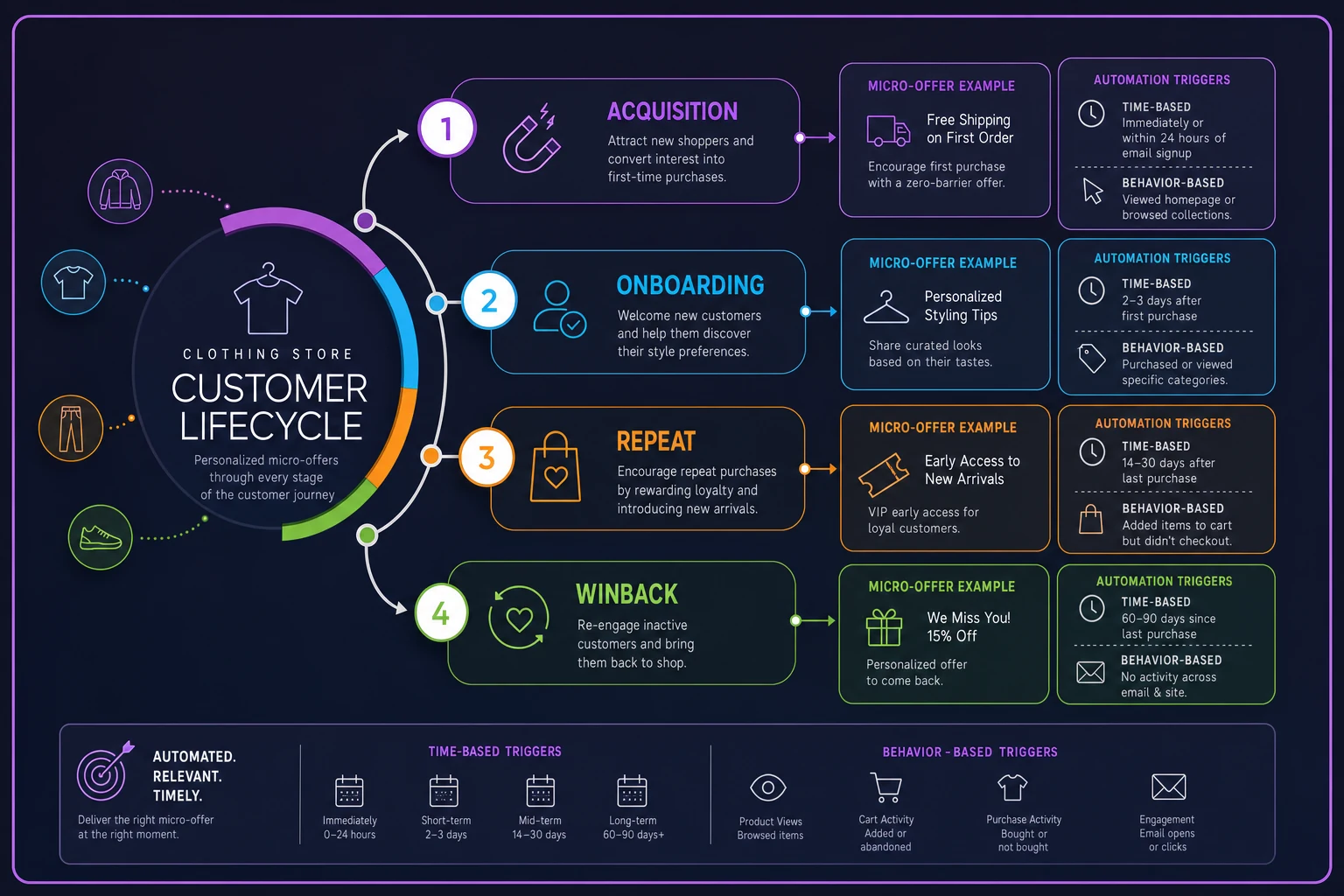
Winback campaigns require careful timing. The first touch should be informational, not promotional—what's changed at the store since their last visit. New brands, updated layout, extended hours. The second touch, two weeks later, might include a "we miss you" offer: $20 off a $75 purchase, valid for 30 days. Reference their past purchase history or style preferences where you can. The goal is to make it feel personal rather than obviously automated.
Measurable LTV levers for each lifecycle stage
Lifetime value in apparel isn't just total dollars spent. It's purchase frequency, average order value, margin quality, and referral behavior. Each lifecycle stage has different levers.
During acquisition, focus on initial basket composition. A customer whose first purchase spans multiple categories—top and bottom, or clothing and an accessory—shows higher lifetime value potential. Track your first-purchase category mix monthly. If it's skewing heavily toward sale items or single-category purchases, your merchandising or initial offers probably need adjustment.
For onboarding, the critical metric is time-to-second-purchase. Every week of delay drops eventual lifetime value by roughly 8–12%. If your average second purchase happens at day 67, test interventions at days 30, 45, and 60. Maybe it's a personal shopping appointment offer, a category-specific promotion, or simply a well-timed reminder about new arrivals.
Repeat customers need frequency and basket size optimization. Track purchase cadence by segment. Your workwear shoppers might buy quarterly while casual wear customers shop monthly. Adjust communication frequency accordingly. Also watch basket composition—are repeat customers exploring new categories or stuck in one section? Cross-category buyers typically show around 2x higher annual value.
Winback success isn't just about reactivation rate. Track what reactivated customers actually buy and how much they spend over the following six months. A 10% winback rate where customers make one small purchase and disappear is less valuable than a 5% rate where people return to regular buying patterns.
Automation triggers that actually work
The logic here is straightforward. You're creating if-then rules based on customer behavior.
New visitor triggers: If someone provides an email but doesn't purchase within 72 hours, send a welcome series. Not a discount—an introduction to your store's story, style philosophy, and what makes you different. Include customer photos wearing your pieces, not just product shots.
Post-purchase triggers: Seven days after purchase, send care instructions and styling tips. At 21 days, request feedback with a simple survey. At 45 days, if no second purchase, trigger a personalized recommendation email based on their initial purchase category.
Frequency triggers: When a regular customer breaks pattern—usually shops monthly but hasn't been in for six weeks—trigger a check-in. Not a sale notice. Highlight new arrivals in their preferred brands or invite them to an upcoming store event.
Threshold triggers: Set up alerts for meaningful spending milestones. When a customer's annual spend crosses $500, $1,000, or $2,000, trigger special recognition. A handwritten thank you, invitation to a VIP event, or early sale access. These moments matter more than points or percentages.
Category expansion triggers: When a customer who only buys tops views bottoms three times without purchasing, trigger a complete outfit suggestion email showing three ways to style pieces they already own with new bottom options.
Measurement windows that match retail reality
Most marketing automation platforms default to 30-day measurement windows. That's mostly useless for apparel retail where purchase cycles run 60–120 days. Here's what actually matters:
Acquisition window: Track 45 days from first interaction. This captures both impulse buyers and considered purchasers who need time to decide. Measure conversion rate, average order value, and category diversity.
Onboarding success: Measure 90 days from first purchase. Key metrics: second purchase rate, average days between purchase one and two, and category expansion rate. If less than 30% make a second purchase within 90 days, your onboarding sequence needs work.
Repeat engagement: Use rolling 6-month windows. Track purchase frequency, average order value trends, and response rates to different offer types. A declining AOV often signals discount dependence creeping in.
Winback effectiveness: Measure 180 days from reactivation attempt. Track not just response rate but quality of reactivation—did they return to previous buying patterns or make one courtesy purchase and disappear?
The segment-level approach that scales with small teams
Managing four lifecycle stages with multiple micro-offers sounds like a full-time job, but proper segmentation makes it manageable. Start with basic behavioral splits:
Acquisition segments:
-
Local browsers (visited store, no purchase)
-
Digital browsers (website/social, no purchase)
-
Event attendees (came to store event, no purchase)
Onboarding segments:
-
High-value first purchase ($150+)
-
Multi-category first purchase
-
Sale-only first purchase
-
Single-item first purchase
Repeat segments:
-
Monthly shoppers
-
Seasonal shoppers
-
Category loyalists (only buy specific types)
-
Full-wardrobe shoppers (buy across categories)
Winback segments:
-
Former VIPs (was spending $1,000+ annually)
-
Lapsed regulars (3+ purchases, now dormant)
-
One-time buyers (single purchase 6+ months ago)
| Segment Group | Examples |
|---|---|
| Acquisition segments | Local browsers (visited store, no purchase); Digital browsers (website/social, no purchase); Event attendees (came to store event, no purchase) |
| Onboarding segments | High-value first purchase ($150+); Multi-category first purchase; Sale-only first purchase; Single-item first purchase |
| Repeat segments | Monthly shoppers; Seasonal shoppers; Category loyalists (only buy specific types); Full-wardrobe shoppers (buy across categories) |
| Winback segments | Former VIPs (was spending $1,000+ annually); Lapsed regulars (3+ purchases, now dormant); One-time buyers (single purchase 6+ months ago) |
Each segment gets one primary offer and one follow-up. That's 12 segments with 24 total offers—sounds like a lot, but you build these once and let automation handle deployment. Start simple and add complexity gradually.
Practical implementation without overwhelming your team
The biggest mistake stores make is launching everything at once. Start with your highest-impact, easiest-to-execute stage: onboarding.
Test onboarding sequence variations on a small customer segment before rolling out system-wide to minimize disruption and measure impact.
Build a three-email onboarding sequence first. Email one goes out 7 days post-purchase with care instructions and styling tips. Email two at 21 days shows new arrivals in their purchase category. Email three at 45 days offers a modest incentive if they haven't made purchase two. Set this up once, let it run for 60 days, evaluate, then adjust.
Next, tackle winback. You probably have a pile of lapsed customers sitting in your database already. Export anyone who purchased 6–18 months ago but nothing since. Send a simple "here's what's new" email with no promotion attached. Two weeks later, follow up with a time-limited offer to those who opened but didn't purchase. This alone often recovers 5–8% of lapsed customers.
Acquisition offers can honestly wait until you've handled the other two. Most stores pour energy into acquiring new customers while ignoring the ones they already have. Fix retention first, then worry about filling the top of the funnel.
For repeat customers, start by simply segmenting your email list based on purchase frequency. Send regular buyers exclusive content—behind-the-scenes buying trip photos, early sale access, stylist picks. No complex rewards calculation needed.
The technology setup that makes this manageable
You don't need enterprise software to run effective lifecycle marketing. A decent email service provider with basic automation, your POS customer data, and maybe a simple customer data platform if you're selling both online and in-store.
The critical integration is between your POS and email platform. If these don't talk to each other, you're stuck doing manual exports and uploads—a workflow that breaks down within weeks. Most modern POS systems have built-in integrations with major email platforms, or you can use something like Zapier to connect them.
For measurement, you need unified customer records. If jane@email.com shops online and Jane Smith shops in-store, your system needs to recognize it's the same person. This is where proper KPI tracking becomes essential—you can't optimize what you can't measure accurately.
AI-powered platforms now handle much of this orchestration automatically. Instead of manually building dozens of rules and segments, operational software uses customer behavior patterns to trigger the right message at the right time. It tracks purchase patterns, identifies when customers deviate from normal behavior, and adjusts messaging frequency and offer types based on response rates—without someone manually monitoring all of it.
For stores managing omnichannel operations like buy-online-pickup-in-store, these platforms become even more valuable. They unify online browsing behavior with in-store purchases, creating complete customer profiles that inform better lifecycle marketing.
Common failure points and how to avoid them
Over-communication in early stages: New customers don't want daily emails. One acquisition attempt, three onboarding touches, then shift to your regular cadence. Bombarding new customers drives unsubscribes fast.
Discount dependency: If every lifecycle offer includes a price cut, you train customers to never pay full price. Mix in value-adds like early access, exclusive items, or services instead of always discounting.
Ignoring seasonality: Your summer dress buyer doesn't need winter coat emails in July. Build seasonal logic into your lifecycle flows or pause certain segments during off-seasons.
One-size-fits-all winback: Sending the same "we miss you" email to someone who bought once versus your former best customer tells them you don't actually value the relationship differently. Segment and personalize based on previous value.
Measuring wrong windows: A campaign showing zero results at 14 days might look completely different at 60 days. Apparel purchase cycles don't match typical ecommerce patterns. Be patient with measurement.
When this architecture makes sense (and when it doesn't)
This lifecycle approach works best for stores doing $500K–$5M annually with roughly 1,000–10,000 active customers. Below that threshold, you don't have enough volume to meaningfully segment. Above it, you probably need more sophisticated tooling and dedicated marketing staff.
Your average transaction value should sit somewhere between $50–$500. Lower than that, the economics don't really support detailed lifecycle marketing. Higher, and you're likely in luxury territory where personal relationship management matters more than automation.
You need at least a 40% repeat customer rate to make this worthwhile. If your store is primarily tourist-driven or relies on one-time event shopping—prom dresses, wedding guest—focus on acquisition and initial experience instead.
And don't implement any of this if you're still figuring out basic operations. Get inventory management, merchandising, and customer service solid first. No amount of clever lifecycle marketing fixes fundamental operational problems.
The difference between surviving and scaling
Most small apparel stores operate in reactive mode—chasing the next sale, responding to slow periods with panic discounts, hoping regulars keep coming back. That approach might keep doors open but it won't build sustainable growth.
A proper lifecycle architecture changes the dynamic. Instead of guessing why sales dropped last month, you know which segment underperformed. Rather than blasting everyone with the same promotion, you send targeted offers that actually shift behavior. Marketing spend becomes an investment with measurable returns instead of a prayer for traffic.
Stores implementing these systems tend to see real movement within 90–120 days. Repeat purchase rates climb, customer lifetime values improve, and marketing costs drop while effectiveness goes up. But the less obvious benefit is operational clarity—knowing you have systems in place to consistently nurture customer relationships without someone manually managing it all.
Small apparel retail is tough enough without making it harder through inefficient customer management. The lifecycle architecture here isn't complex or expensive to build. It just requires thinking systematically about customer relationships instead of treating every interaction as isolated. Build the system once, let automation handle execution, and focus your energy on what you actually do well—curating great products and creating memorable shopping experiences.
Your customers are already naturally moving through these lifecycle stages. The question is whether you're guiding that journey intentionally or letting it happen by accident. In a market where acquisition costs keep climbing and competition keeps intensifying, stores that build real systems around customer relationships are the ones that end up thriving.
Ready to elevate your apparel business?
Join 2,000+ retailers using Werzly to streamline operations, increase sales, and deepen customer loyalty.