

Most small apparel sellers don't lose chargebacks because they're guilty. They lose because the person who handled the order can't find the shipping photo, the tracking link expired, or nobody wrote down that the customer already returned and refunded a nearly identical dress two weeks earlier. The money's gone before anyone even understands what happened.
Big retailers have a whole risk function for this. You don't. You have a floor team, a couple of part-timers, and maybe one person checking the email inbox between ringing up customers. That's exactly why you need a simple, repeatable process — not a fraud team, just a staff-facing routine anyone can follow when a dispute lands.
This is that routine. A tight triage checklist, a five-field log that takes 90 seconds to fill out, evidence templates so nobody has to think under pressure, and a few prevention checks that stop the obvious stuff before it becomes a filed dispute.
Why small sellers lose disputes they should win
There's a pattern that shows up constantly in small apparel operations, and it has almost nothing to do with actual fraud.
A chargeback comes in. It sits in someone's inbox for four days because nobody's job is "handle disputes." When it finally gets looked at, the response window is half gone. The person writing the rebuttal wasn't the one who packed the order, so they're reconstructing what happened from memory and a fuzzy screenshot. They upload whatever they can find, write two sentences, and hope. The bank sides with the cardholder because the evidence was thin.
That's the real story behind most lost disputes at this size. It's a documentation and timing failure, not a fraud problem.
The other piece — and this one's quieter — is that sellers treat every dispute the same. A "friendly fraud" chargeback, where the customer got the item and still disputed, needs completely different evidence than an "item not received" claim or a "not as described" claim. When you throw the same generic response at all of them, you win the easy ones and lose everything else. Card networks want specific rebuttal evidence tied to the specific reason code. Generic doesn't cut it.
And then there's the repeat abuser problem. The same handful of customers file disputes across multiple orders because they've learned it works. Without a log, you never connect the dots. Julia in accounts sees "chargeback from J. Reyes" as a one-off. She has no idea it's the third one from that name and address this quarter.
The 5-field dispute log (the whole thing runs on this)
Everything else in this SOP depends on one simple log. Not a CRM, not fraud software — a shared sheet your team fills in the moment a dispute or suspicious order appears. Five fields, nothing more, because a 12-field form never gets filled out.
Take control of your clothing store operations.
Werzly helps you manage stock, process orders, and engage customers effortlessly.
- Unified inventory and order management
- Automated customer notifications
- Sales and stock analytics
No credit card required
| Field | What goes in it | Why it matters |
|---|---|---|
| Order ref + customer | Order number, customer name, email/last-4 of card | Lets you match repeat filers by name, email, and card |
| Reason code / claim type | "Item not received," "not as described," "unauthorized," etc. | Determines which evidence template you pull |
| Response deadline | The hard date the platform gave you | This is the field that saves you — miss it and you auto-lose |
| Evidence status | Not started / gathering / submitted | Tells anyone glancing at the sheet what still needs action |
| Outcome + notes | Won / lost / refunded, plus a one-line reason | Builds your pattern history over time |
The value isn't in any single row. It's that after two or three months you can sort by customer and instantly see who's filed multiple times, sort by reason code to see which claim type you keep losing, and never miss a deadline because it's sitting in its own column.
One boutique running two locations found that after logging disputes for a single quarter, three names accounted for roughly 40% of their "not as described" chargebacks. Two of those customers were placing new orders every few weeks and disputing about a third of them. They'd been invisible before the log existed.
Staff triage checklist: what to do the moment a dispute lands
The point of a triage checklist is that the first person who sees the dispute — whoever that is — can start the clock correctly without waiting for the owner. Print this. Tape it near the register or pin it in your shared chat.
-
Log it first, always. Fill the five fields before doing anything else. Thirty seconds now saves the whole case.
-
Read the reason code, not just the amount. The claim type decides everything downstream.
-
Check the deadline and put it somewhere visible. If it's under 5 days out, it jumps the queue.
-
Pull the order record. Confirm what shipped, when, to where, and how it was paid.
-
Run the repeat-filer check. Search the log for the customer's name, email, and card last-4.
-
Match the claim to an evidence template (below) and start gathering — don't freestyle the response.
-
Flag anything weird for the owner. Mismatched billing/shipping, rushed shipping on a first order, or a name already in the log.
The single biggest improvement most teams make is simply logging before investigating. Sounds trivial. But when the response deadline is captured in the first 30 seconds, the "we ran out of time" losses basically disappear.
The single biggest improvement most teams make is simply logging before investigating.
A quick visual of the triage flow:
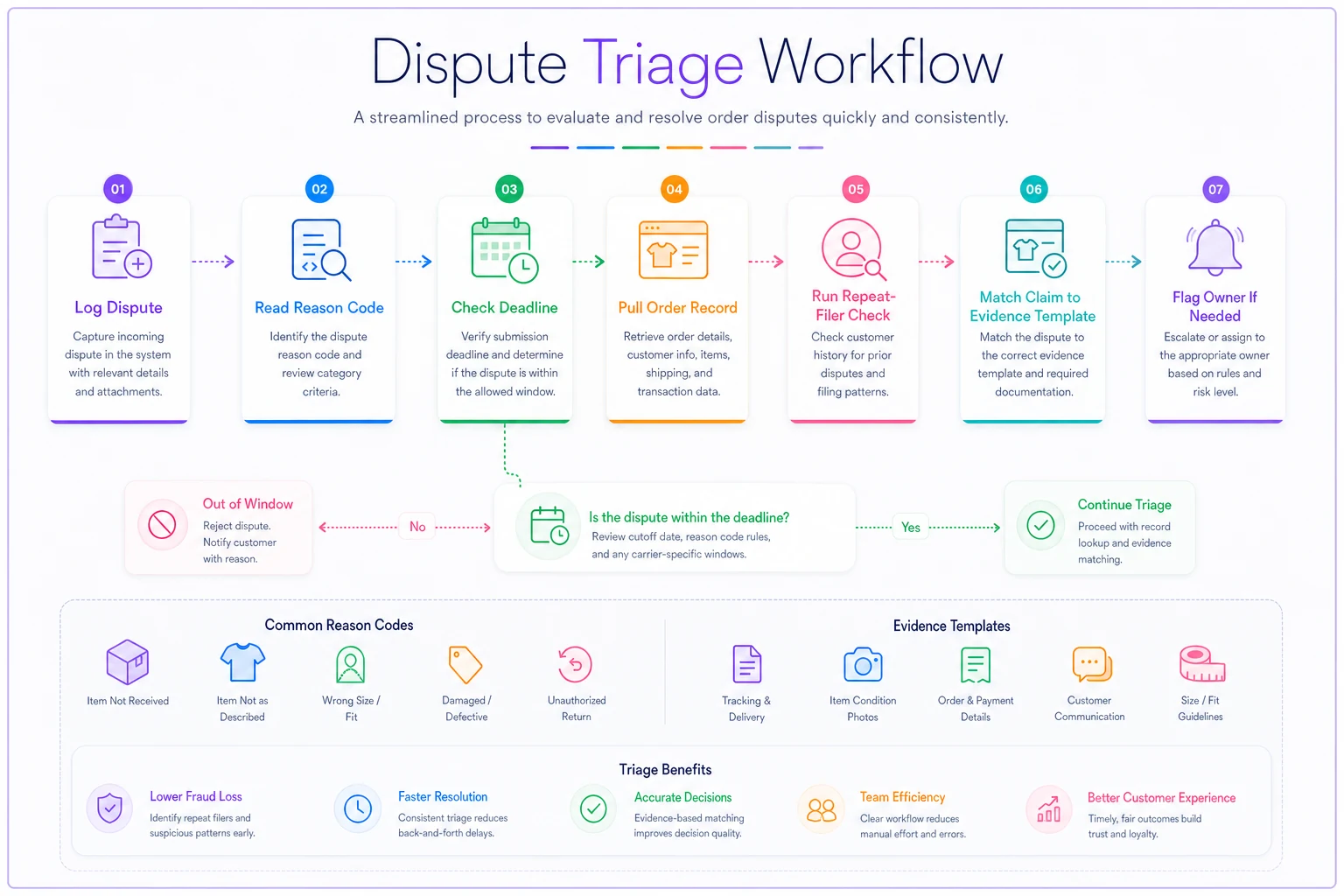
Print this. Tape it near the register or pin it in your shared chat.
Evidence capture templates by claim type
Each claim type has a short list of what actually moves the needle. Build these as saved templates so your team is filling in blanks, not composing from scratch under pressure.
"Item not received" (INR)
-
Tracking number with delivery confirmation and timestamp
-
Delivery address matching the order's shipping address
-
Photo proof of delivery if the carrier provides it
-
Signature confirmation on higher-value orders
-
Short factual note
"Order shipped [date], delivered [date] to [address] confirmed via [carrier]."
"Not as described / defective"
-
Product page photos and description as it appeared at time of sale
-
Packing photo showing the item that went out (this is the one people skip)
-
Any pre-sale messages where the customer confirmed size, color, or fit
-
Your return/exchange policy the customer agreed to at checkout
-
Note tying the shipped item directly to the listing
"Unauthorized / fraudulent" (true fraud)
-
AVS and CVV match results from the payment processor
-
IP/device data if your platform captures it
-
Any account login or order history for that customer
-
Communication confirming the order (order confirmation opened, tracking clicked)
-
Note
this is the hardest to win — focus on proving the cardholder authorized it
The packing photo is the underrated hero here. For both "not as described" and INR disputes, a timestamped photo of the actual item — folded, with the order slip and label visible — is often the difference between winning and losing. It costs your packer three seconds. On disputed orders it's worth its weight in refunds.
Getting the shipped item to clearly match what was ordered also depends on boring stuff upstream — clean SKUs and correct labels. If your bins and barcodes are messy, your evidence gets messy too. The same discipline behind barcode and labeling standards that prevent POS errors and costly return disputes is what lets you prove, later, exactly what left the store.
Quick prevention checks that stop disputes before they file
Winning disputes is defense. These are the cheap moves that reduce how many you ever have to fight.
-
Photo proof on every shipment over a set threshold. Pick a dollar amount — anything over $75 is a reasonable starting point — and require a packing photo. It becomes automatic evidence for any future claim.
-
AVS/CVV mismatch flag. If billing and shipping don't match on a first-time customer, hold for a quick manual look before shipping.
-
Rush-shipping-on-new-account flag. Fraud loves overnight shipping to a brand-new account. Worth a second glance every time.
-
Repeat-filer flag from your log. Before shipping to anyone with two or more prior disputes, decide consciously whether you want that order.
-
Delivery confirmation and signature on high-value orders. A $200 coat should never ship without tracking that proves delivery.
None of these require software you don't already have. They require someone to actually do the check. The pattern flags — repeat filer, billing mismatch, rush shipping on a new account — are the ones that catch deliberate abuse. The photo and delivery confirmation are the ones that win the honest disputes.
When to fight, when to just refund
Not every dispute is worth the hour it takes to build a case. Part of a real SOP is deciding fast when to walk away.
Fight it when:
-
The claim type is one you typically win (INR with clean tracking)
-
You have strong evidence already captured (photo, delivery confirmation)
-
The amount justifies the time — a $180 order, yes
-
The customer is a repeat filer and you want to build a paper trail against them
Just refund and move on when:
-
The order is small enough that staff time costs more than the loss
-
Your evidence is thin and the reason code is hard to win (true unauthorized)
-
It's a good, long-term customer making a reasonable one-time claim
One more thing worth saying: if you're spending more on dispute admin than you're recovering, you've overbuilt the process. The five-field log plus templates should take minutes per case, not a dedicated hire. If it's ballooning, tighten your prevention checks instead — stopping disputes upstream beats winning them downstream every time.
A real scenario
A single-location women's boutique doing modest online volume alongside the shop was losing almost every dispute — somewhere around 8 or 9 out of every 10 filed. No process, everything handled by whoever grabbed the email first. Losses ran somewhere in the $1,800–$2,400 range per quarter between the chargebacks and the fees stacked on top.
They put in exactly what's described above: the five-field log, packing photos on anything over $75, and saved evidence templates for the three common claim types. Nothing fancy. Within two quarters their win rate on "item not received" claims — their most common type — climbed to just over half, mostly because they finally had tracking and delivery photos attached in time. Quarterly losses dropped to roughly the $700–$900 range.
The most valuable part wasn't the win rate, though. It was the repeat-filer data. The log surfaced two customers responsible for a noticeable chunk of the "not as described" disputes. Both accounts got quietly flagged, required confirmation before any new shipment, and the abuse stopped.
Keeping the whole thing lightweight
If any of this starts feeling heavy, you've drifted from the point. This SOP works precisely because it's small enough for a team without a risk function to actually run. The log is five fields. The triage checklist fits on an index card. The templates are fill-in-the-blank. The prevention checks are yes/no.
Most sellers already track loss patterns elsewhere in the business — the same instinct behind a monthly shrinkage micro-audit for clothing stores applies here. Disputes are just another leak, and leaks get smaller once you can see them.
Once a month, spend ten minutes reading your log: which claim types you're losing, who keeps filing, whether your prevention flags are catching the right orders. Adjust one thing. That's the whole maintenance cycle.
The sellers who get this right aren't the ones with the fanciest tools. They're the ones who write things down the moment a dispute appears, respond with evidence that matches the specific claim, and remember who's abused them before. Do those three things consistently and you'll win the disputes worth winning — and stop most of the rest from ever landing.
Ready to elevate your apparel business?
Join 2,000+ retailers using Werzly to streamline operations, increase sales, and deepen customer loyalty.