

Most clothing stores that add a resale or consignment channel do it backwards. They agree to take in a friend's inventory, throw some vague splits together, jam the pieces onto a rack near the register, and figure they'll "sort out the numbers later." Six weeks in, nobody knows what's sold, who gets paid what, or whether the whole thing is actually making money or just eating floor space that could've held full-margin product.
A consignment pilot shouldn't work like that. Done right, it's one of the cheapest inventory experiments you can run — you're not buying stock, you're borrowing it — and it can tell you a surprising amount about demand, foot traffic, and pricing in your market. The catch is that "cheap to start" and "cheap to run" are two very different things. The running cost is administrative chaos, and that's exactly what an 8‑week structured pilot is designed to contain.
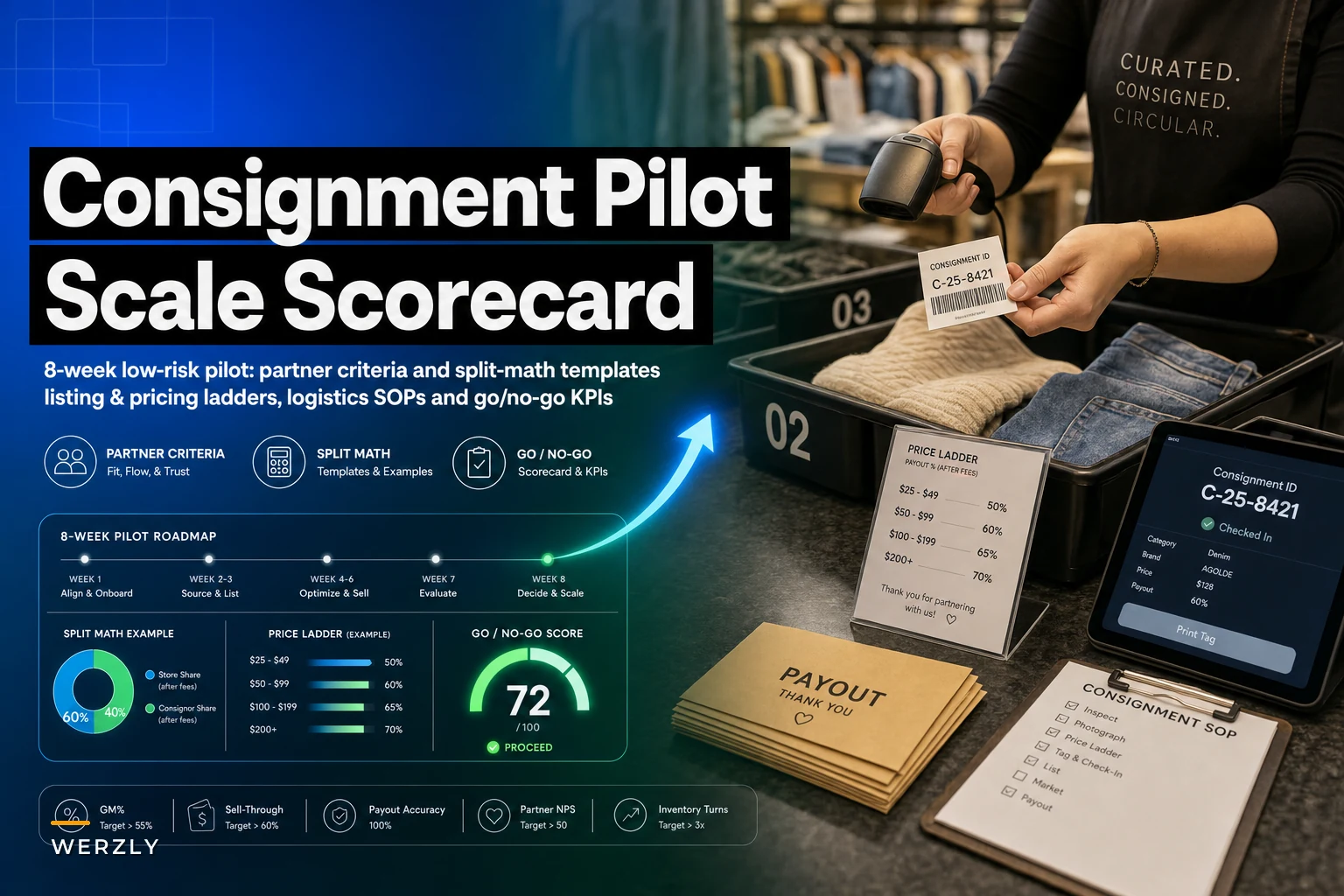
This is the version I'd hand to a store owner who wants to know, in two months, whether to scale the channel or quietly kill it — without betting the business on the answer.
Why 8 weeks, and why treat it like a real pilot
Eight weeks is long enough to see two full inventory turns on fast-moving pieces and at least one markdown cycle on the slow stuff. Anything shorter and you're reading noise. Anything longer and you've committed real labor and floor space before you've decided it's worth it.
The mistake almost everyone makes is skipping the "pilot" framing entirely. They treat consignment as a permanent addition from day one, which means there's no built-in decision point. No decision point means no exit. And a resale channel with no exit is how stores end up two years later with a back room full of other people's unsold sweaters and a spreadsheet nobody trusts.
Treat it as a time-boxed experiment with a scorecard at the end. You're not deciding "consignment forever." You're deciding "does this specific setup, with these specific partners, earn its keep."
Picking partners: the criteria that actually predict success
The single biggest driver of whether a consignment pilot works isn't your splits or your signage — it's who you take inventory from. A great partner sends clean, sellable, on-brand product in your customers' sizes. A bad one sends a bin of miscellaneous items and expects you to sort, price, and merchandise their closet clean-out.
Take control of your clothing store operations.
Werzly helps you manage stock, process orders, and engage customers effortlessly.
- Unified inventory and order management
- Automated customer notifications
- Sales and stock analytics
No credit card required
-
Brand and price-point overlap. If you sell $60–$120 contemporary womenswear, a partner bringing fast-fashion tees at a $12 resale price will confuse your floor and drag your average ticket down. Their stuff needs to look like it belongs.
-
Condition standards they'll actually meet. "Gently used, no visible wear, freshly laundered." You need a partner who pre-screens, not one who makes screening your job.
-
Volume in a workable range. Too few pieces and the admin overhead per item is brutal. Too many and you're drowning. For a pilot, somewhere in the 30–80 pieces per partner range is manageable.
-
Size distribution that matches your traffic. If your best-selling sizes are M–L, a partner heavy in XS won't move regardless of price.
-
Reasonable expectations on payout timing. Someone demanding cash on drop-off is a bad fit for consignment. The whole model depends on paying after the sale.
A practical filter: ask each prospective partner to send photos of 10 sample pieces before you agree to anything. If those 10 are clean, on-brand, and in-demand sizes, they're worth a trial intake. If half of them make you wince, pass. What you see in the sample is what you'll get by the bin-load.
The split math, laid out plainly
This is where pilots quietly bleed money. Owners pick a split that "sounds fair" — often 50/50 — without checking whether their half actually covers the cost of carrying and selling the item. Consignment isn't free just because you didn't buy the inventory. You're still paying for floor space, tagging labor, POS time, payment processing, and the markdowns you'll eventually take.
Start from your costs and work up. A rough template for a single consigned item:
| Line item | Example on a $60 sale |
|---|---|
| Sale price | $60.00 |
| Payment processing (~3%) | –$1.80 |
| Your consignment share (say 60%) | $36.00 gross to store |
| Consignor share (40%) | –$24.00 |
| Est. handling/tagging labor per item | –$2.50 |
| Allocated floor/overhead per item | –$3.00 |
| Store contribution | ~$28.70 |
The point isn't these exact numbers — it's the discipline of running them before you sign anyone. A 50/50 split on a $30 average sale looks generous until you notice your handling and overhead per item eats a third of your half.
For most small stores, a store share in the 55–65% range is where consignment starts making real sense. Below 50% and you're doing charity work with your floor space. If a partner pushes back hard on that, it tells you they value their inventory more than they value your channel — which is useful information on its own.
Two split structures worth knowing:
-
Flat percentage split. Simplest. Store keeps X%, consignor gets the rest, same across all items. Easiest to administer in a pilot — start here.
-
Tiered/declining split. The consignor's share drops the longer an item sits unsold (e.g., 45% first 30 days, 30% after). This nudges everyone toward realistic pricing and gives you room to mark down. Powerful, but adds admin — save it for after the pilot proves out.
Tiered/declining split. The consignor's share drops the longer an item sits unsold (e.g., 45% first 30 days, 30% after). This nudges everyone toward realistic pricing and gives you room to mark down. Powerful, but adds admin — save it for after the pilot proves out.
Listing and pricing ladders that keep things moving
Consigned inventory dies the same way owned inventory dies: it sits, ages, and quietly turns into deadstock that clutters your floor. The difference is you can't blame your buying — you invited it in. So you need a pricing ladder from day one that forces movement.
A clean pricing ladder for a pilot:
-
Days 1–14 Full resale price. This is your read on real demand.
-
Days 15–28 –20%. First automatic step-down.
-
Days 29–42 –35%. The "this needs to move" tier.
-
Days 43–56 –50% or pull. End-of-pilot clearance, then return to consignor or donate per your agreement.
Bake these steps into your agreement so nobody's surprised when their $60 blazer is 35% off in week four. The consignor agreed to the ladder when they dropped off — that's the whole point of writing it down.
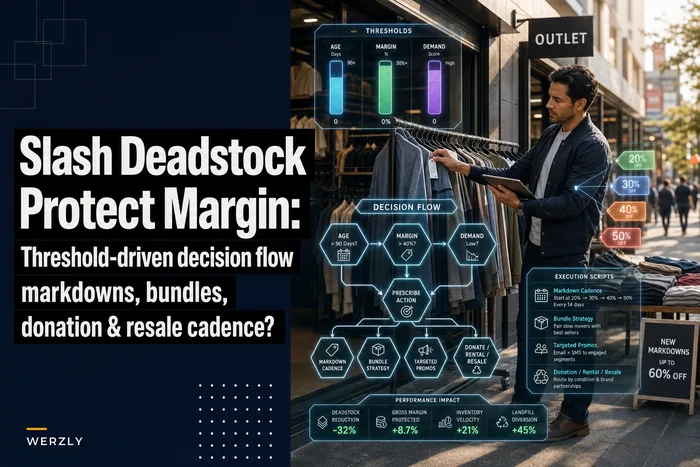
Items that don't sell at full price in the first two weeks rarely recover just because they're on your floor longer. They need the markdown, and the sooner you apply it the more traffic sees it at a compelling price. If you're wrestling with slow movers specifically, the same logic in the deadstock decision flow for slow-moving SKUs applies cleanly to consigned pieces too — the only twist is the return-to-consignor step at the bottom.
The logistics SOP: where pilots actually break
Splits and pricing are the fun part. Intake and tracking are where consignment pilots fall apart, because a single item that isn't logged correctly turns into a payout dispute, and one payout dispute can sour a partner relationship for good.
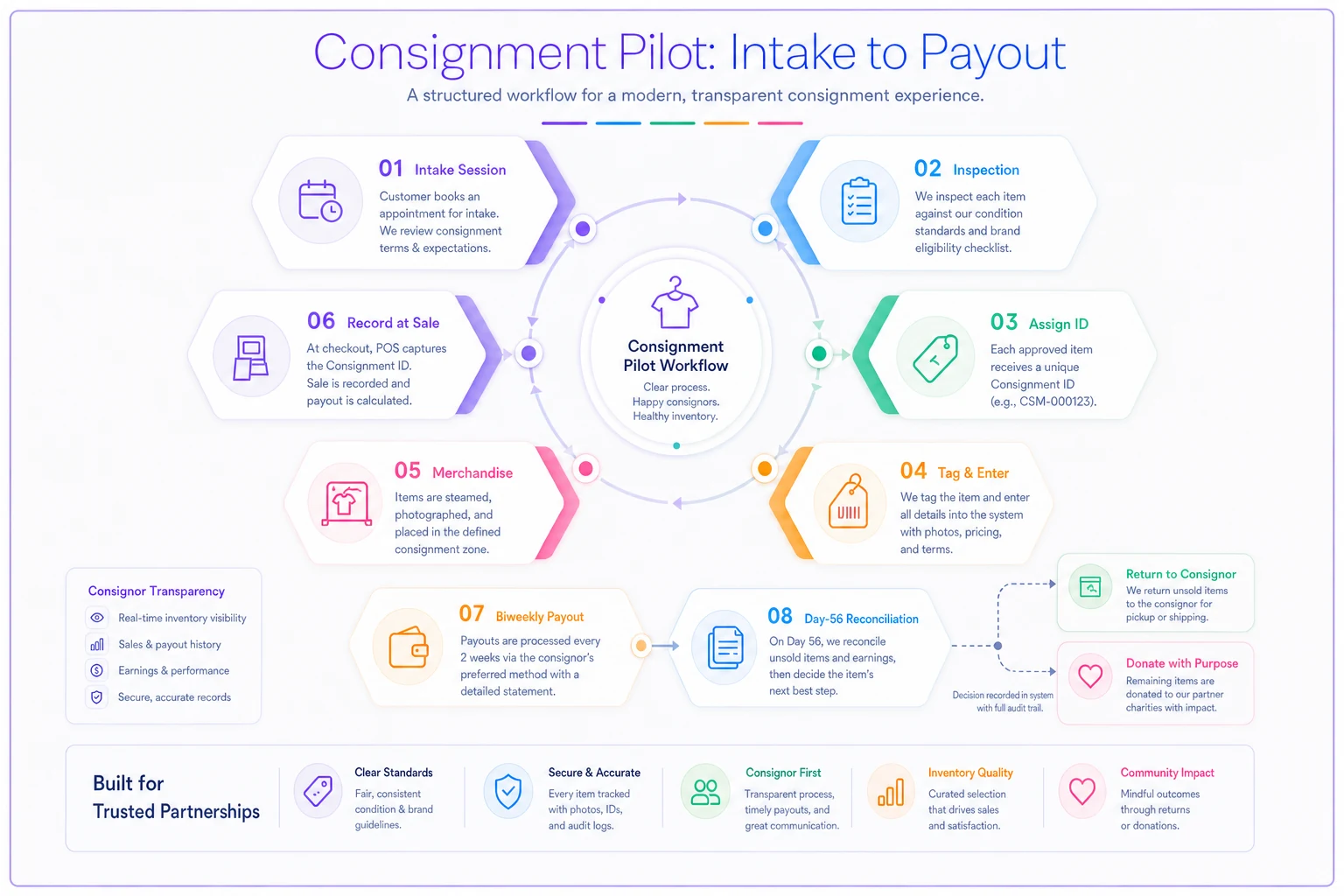
Here's the intake-to-payout workflow, in order:
-
Intake session, by appointment only. No walk-in drop-offs during business hours. You need focused time to inspect and log.
-
Inspect against condition standards. Reject anything that doesn't meet them, on the spot. Don't take it "to be nice" — rejected items you accepted anyway become clutter you can't sell and won't pay out on.
-
Assign a unique consignment ID per item. Not per batch — per item. This is the whole ballgame. Every piece gets its own tracked identity tied to the consignor, intake date, resale price, and markdown ladder start.
-
Tag and enter into your system with that ID, price, consignor, and date.
-
Merchandise onto a defined zone so consigned stock is trackable and doesn't blur into owned inventory.
-
At sale, the POS records the consignment ID so the sale attributes to the right consignor automatically.
-
Run payouts on a fixed cadence — biweekly is clean for a pilot — showing each consignor exactly what sold, at what price, and their share.
-
At day 56, reconcile what sold, what's returning, what's being donated. This is your pilot's raw data.
Here's a simple visual of the intake-to-payout steps to keep the team aligned.
The one rule that prevents most consignment disasters: every item has a unique ID and a paper trail from intake to payout. Batch tracking ("Sarah brought in about 40 things") is where the money goes missing and the arguments start.
For stores already running lean, this is where a workflow platform earns its place — not because consignment needs fancy software, but because per-item tracking, automatic markdown steps, and payout calculations are exactly the kind of repetitive, error-prone admin that quietly eats your evenings when you do it by hand. If your POS and inventory system can already tag items with a consignor field and trigger scheduled price changes, you've removed the main reason these pilots collapse. If it can't, a lightweight system that handles the tracking and split math keeps a two-partner pilot from ballooning into a spreadsheet nobody trusts.
The go/no‑go scorecard
At the end of week 8, you make one decision: scale, adjust, or sunset. Don't make it on vibes. Score it.
Weight these KPIs and decide your thresholds before the pilot starts, so you can't rationalize a bad result at the end:
-
Sell-through rate — % of intake sold by day 56. Below roughly 40% and the channel isn't pulling its weight.
-
Store contribution per item — after all the costs from the split table above. Is it beating what owned inventory earns in the same square footage?
-
Floor-space productivity — revenue per linear foot of consignment zone vs. the rest of the floor.
-
Admin time per week — be honest. If it's eating 6+ hours weekly for two partners, it won't scale without hiring.
-
Return/dispute rate — payout disputes, condition complaints, consignor friction. High friction predicts a miserable scaled version.
-
Incremental traffic — did resale bring in shoppers who also bought full-price product? This is the hidden upside; consignment sometimes pays off as a traffic driver more than a margin line.
A simple scoring frame: rate each on a 1–5 scale, weight sell-through and contribution double, and set a go threshold in advance (say, 70% of max points). If you clear it, expand to more partners with the tiered split. If you land in the middle, run one more cycle with tighter partner criteria. If you're below, sunset it cleanly — return inventory, thank the partners, and move the floor space back to what works.
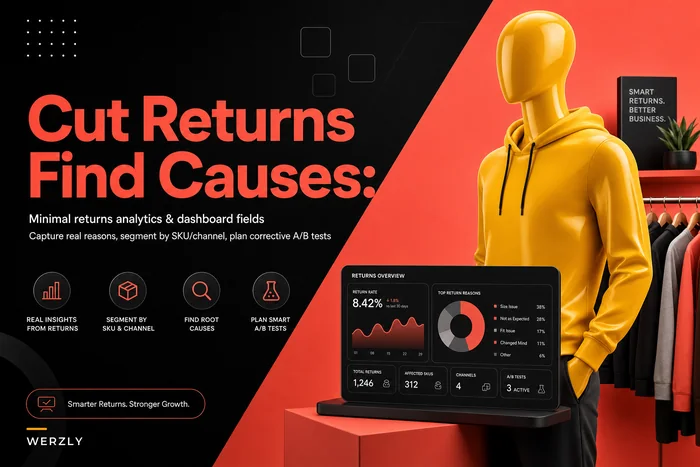
Worth keeping an eye on return-related friction the same way you'd watch it on owned goods. If consigned items are driving complaints, the same root-cause approach in a returns analytics pack will tell you whether it's a condition problem, a sizing problem, or a listing-accuracy problem — each of which has a different fix.
A real scenario
A small contemporary womenswear shop — one owner, two part-timers, somewhere around $28k–$32k in monthly revenue — ran this exact pilot with two partners. Combined intake was about 110 pieces across eight weeks, at a 60/40 store-favorable flat split and the four-step markdown ladder.
By day 56, sell-through landed around 52%, better than the owner expected. Store contribution per sold item came in near $22 after processing, handling, and overhead. The surprise was the traffic effect: a handful of regulars started checking the consignment rack every visit, and a few of them bought full-price pieces on trips they wouldn't have made otherwise.
The friction was real, though. Intake and tracking ate roughly 4–5 hours a week, mostly because the first partner's items came in inconsistent condition and needed heavy sorting. The go/no‑go call: scale, but with tighter partner criteria — drop the messy partner, add two who cleared the sample-photo filter, and move to a tiered split to protect against slow movers. The second cycle ran with half the admin time.
That's the whole value of running it this way. The owner didn't guess. She had numbers, a friction read, and a clear next move.
When this makes sense — and when to skip it
Consignment pilots are worth running when you've got underused floor space, a customer base that skews toward value-conscious or sustainability-minded shoppers, and at least one or two potential partners whose inventory genuinely fits your brand. It's especially strong if foot traffic is fine but you're looking for a low-capital way to add SKUs and freshness without more buying risk.
It's a bad idea if your floor is already tight and every rack is earning full margin — you'd be trading known revenue for an experiment. Skip it too if you don't have the bandwidth to run disciplined per-item intake, because the sloppy version of consignment costs more in disputes and clutter than it ever returns.
And it's genuinely not for you if you can't stomach saying no to partners. The whole model depends on rejecting off-brand, wrong-size, poor-condition inventory at the door. If you'll take anything to avoid an awkward conversation, your floor becomes a dumping ground and the pilot fails before week two.
Run it tight, score it honestly, and let the eight weeks make the decision for you. That's the entire point — you find out cheaply, before you commit expensively.
Ready to elevate your apparel business?
Join 2,000+ retailers using Werzly to streamline operations, increase sales, and deepen customer loyalty.