


Most apparel stores treat product content like a chore that lives in someone's browser tabs. A merchant writes a description, drops in whatever photos the vendor sent, guesses the fit note, and moves on. Six weeks later, that same SKU is quietly generating a 34% return rate and nobody connects the dots.
The problem isn't that stores don't know how to fix a product page. Plenty of teams know that a bad size chart or a missing "runs small" note causes returns. The problem is that fixes happen randomly — one page at a time, driven by whoever complained loudest that week. There's no cadence, no owner, no standard, and no measurement loop tying the work back to returns. It stays a pile of one-off tasks instead of becoming a program.
That gap is what a product content SLA for apparel actually closes. Not a style guide. Not a Notion doc full of "best practices" nobody follows. A real operating rhythm: a scorecard that grades pages the same way every time, a release cadence that controls when content goes live, batch QA that catches problems before customers do, and KPIs that hold the whole thing to a number — return rate.
If you've already read why most product pages cause apparel returns, think of this as the operational layer on top. That post covers what to fix. This one is about building the machine that keeps it fixed at scale.
Why content fixes never stick in most stores
There's a pattern that shows up once a store gets past a few hundred SKUs.
Someone notices a spike in returns on a dress. They rewrite the page, add a fit note, swap a photo. Returns on that SKU drop. Everyone feels good. Then the next 40 new arrivals go up the same broken way they always did, because the fix lived in one person's head and never became a standard. You're bailing water with a coffee mug.
The deeper issue is ownership fragmentation. In a typical small apparel operation:
-
The buyer decides what gets ordered but doesn't touch the page copy.
-
A part-timer uploads photos and pulls descriptions from vendor sheets.
-
The store manager hears the return complaints from staff but never sees the page that caused them.
-
Nobody actually owns whether the content is accurate.
So content quality becomes everyone's job, which means it's no one's job. When there's no owner and no deadline, quality drifts toward whatever is fastest to publish. Vendor copy gets pasted in verbatim — including sizing language written for a completely different fit block than what's hanging on your rack.
And this is the part that costs real money: content mistakes compound silently. A bad P&L number gets caught at month-end. A bad product page just keeps generating returns, week after week, until someone happens to look. The feedback loop is too slow for anyone to feel the pain in real time.
What breaks when you scale
At 150 SKUs you can white-knuckle it. One detail-obsessed person can eyeball most pages and catch the worst problems. At 600+ SKUs across multiple channels — your site, a marketplace, maybe a POS that syncs product data — that breaks completely.
Take control of your clothing store operations.
Werzly helps you manage stock, process orders, and engage customers effortlessly.
- Unified inventory and order management
- Automated customer notifications
- Sales and stock analytics
No credit card required
Release volume outpaces review. When you're dropping 30–50 new SKUs a week during buying season, there's no time to hand-check each one. Pages go live unreviewed, and return rates on new arrivals run noticeably higher than established inventory for the first 30 days simply because the content was never QA'd.
Inconsistency between channels. The fit note that got fixed on your website never made it to the marketplace listing. Now the same product has two different accuracy levels depending on where a customer buys it, and your marketplace returns run hotter for no obvious reason.
No shared definition of "good." Ask three people on your team whether a page is "done" and you'll get three different answers. Without a scorecard, quality is a vibe, and vibes don't scale.
Fixes get overwritten. A vendor feed refresh or bulk import wipes out the manual corrections someone made three weeks ago. This one is brutal — you can fix the same page twice and still ship the broken version.
The stores that get this right stop treating content as creative work and start treating it as an operational process with the same discipline they'd apply to receiving or reorder triggers.
The content scorecard: your quality standard, written down
Everything starts with a scorecard, because you can't run an SLA against a standard that doesn't exist. The scorecard turns "is this page good?" into a repeatable score anyone on the team can apply the same way.
Keep it tight — 8 to 10 line items, each tied to a real return driver. Here's a template that works for apparel:
| Element | What "pass" means | Weight | Return driver |
|---|---|---|---|
| Fit accuracy note | States runs small/large/true, with reference | High | #1 sizing returns |
| Size chart present | Garment measurements, not just S/M/L | High | Sizing returns |
| Material & stretch | Fabric content + whether it has give | Medium | Fit/feel mismatch |
| Model reference | Model height + size worn | Medium | Fit expectation |
| Photo set complete | Front, back, detail, on-body | High | "Not as pictured" |
| Color accuracy | Photo matches actual garment tone | Medium | Color returns |
| Care & construction | Wash, lining, closures noted | Low | Quality complaints |
| Length/dimension | Inseam, total length in inches | Medium | Length surprises |
Score each SKU pass/fail per line, weight it, and roll it into a single number. A page under, say, 80% doesn't go live until it's fixed. That's the whole point — the scorecard is a gate, not a report card you file away.
The insight most teams miss: don't weight every element equally. Sizing and photos drive the overwhelming majority of apparel returns. A page can have a beautiful lifestyle description and still torch you on returns because the fit note is wrong. Weight the scorecard toward what actually sends product back. Your returns analytics pack will tell you which drivers hit your specific catalog hardest — build the weights from that data, not from a generic template.
Release windows: control when content ships
Random publishing is where quality dies. If pages go live the moment someone finishes them, there's no natural checkpoint for QA. So you batch releases into windows.
A simple release cadence that fits most small teams:
-
Content prep window (Mon–Wed) New SKUs get their copy, photos, and scorecard fields completed. Nothing publishes yet.
-
Batch QA window (Thu) Every SKU queued for release gets run through the scorecard in one sitting. Fails go back for correction.
-
Release window (Fri AM) Everything that passed goes live together. Clean batch, one push.
-
No off-cycle publishing except for genuine emergencies — a hot restock that has to be live now. Those get flagged and QA'd retroactively within 48 hours.
Why batch instead of continuous? Two reasons. First, reviewing 40 pages in one focused session catches patterns a page-by-page review never would — you'll notice that a whole vendor's size charts are off, not just one. Second, it creates a hard deadline. "Content is due Wednesday for Friday release" is an SLA people can actually meet. "Content should be good, generally" is not.
For seasonal drops where volume spikes, add a second mid-week release window rather than abandoning QA. The moment you skip the gate "just this once" during a busy stretch, you've trained the team that the gate is optional.
Editorial SLAs: who does what, by when
The SLA layer assigns owners and turnaround times so nothing sits in limbo. This is where a content program actually differs from a to-do list — real accountability with names and clocks.
A workable SLA structure for a small team:
-
New SKU content complete within 3 business days of goods received. This ties directly into receiving — the SKU shouldn't sell before its page passes.
-
QA turnaround all batched SKUs reviewed within one QA window (same day).
-
Correction turnaround failed pages fixed and re-submitted within 2 business days.
-
Return-triggered content review any SKU that crosses a return-rate threshold (say, 30%) gets its page pulled for review within 5 business days.
-
Channel sync check website and marketplace content reconciled weekly.
That last SLA — the return-triggered review — is the one that closes the loop. Returns aren't just a lagging metric you report on. They're an input that automatically kicks a page back into the QA queue. When a SKU starts returning above threshold, the system should flag it, not wait for a human to stumble onto it in a report three weeks later.
The workflow in practice: goods arrive → SKU enters content prep with a 3-day clock → content completed → batched for Thursday QA → scored against the scorecard → pass goes live Friday, fail routes back with a 2-day fix clock → post-launch, returns data flows back and any SKU breaching threshold re-enters QA. It's a loop, not a line.
This diagram summarizes that loop.
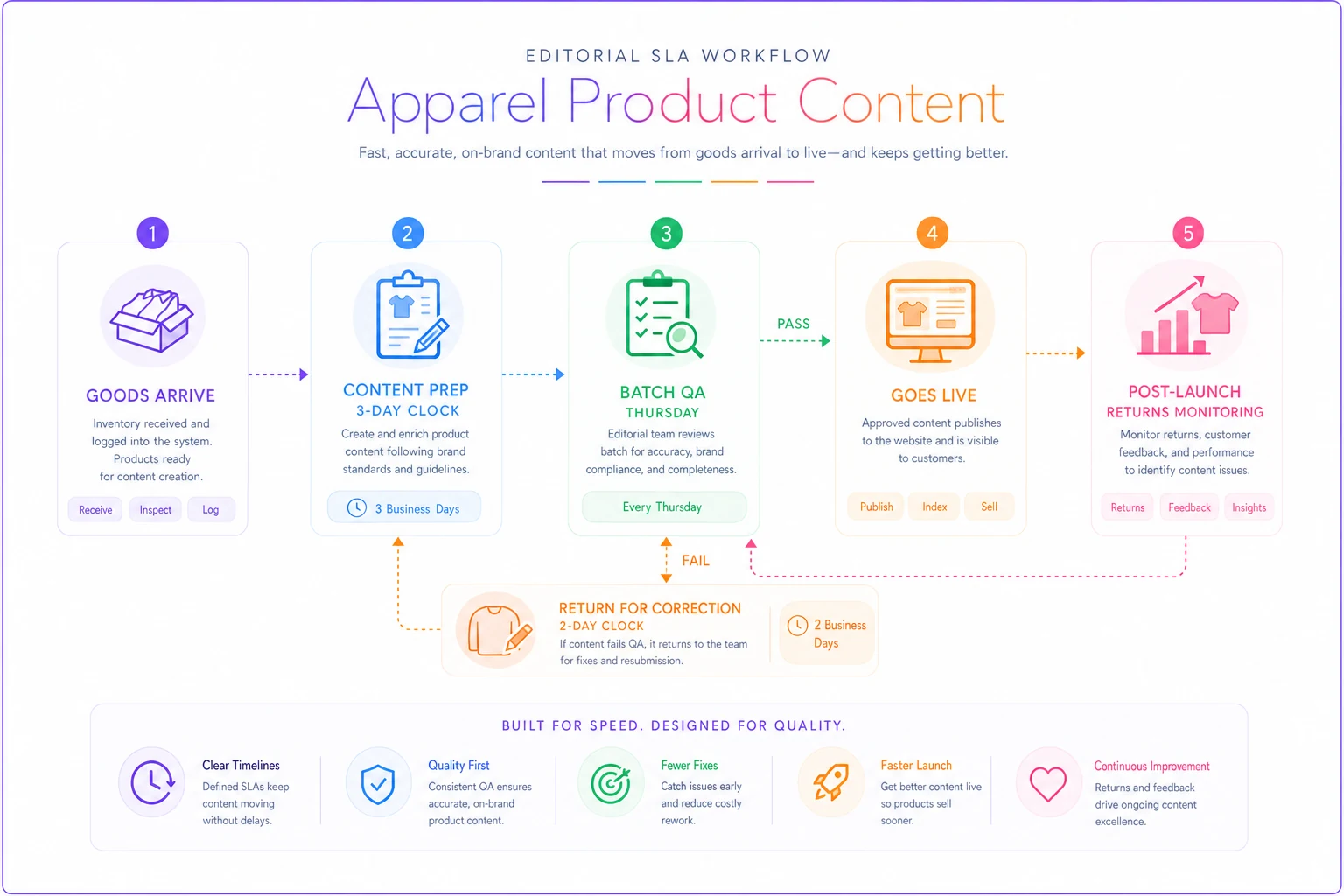
It's a loop, enforced by clocks and owners, not a list of suggestions.
Batch QA checklist
This is what your reviewer actually runs through in the Thursday window. Keep it physical or on one screen — anything that requires opening five tabs per SKU won't get done consistently.
-
[ ] Fit note present and matches the actual garment (verify against a sample if it's a new vendor)
-
[ ] Size chart shows real garment measurements in inches/cm, not just letter sizes
-
[ ] Material content and stretch/give noted
-
[ ] Model height and size-worn listed on lifestyle shots
-
[ ] Full photo set present
front, back, detail, on-body
-
[ ] Photo color checked against the physical item under neutral light
-
[ ] Length/inseam dimensions stated
-
[ ] Care instructions and construction notes included
-
[ ] Title and category correct (affects search and wrong-item returns)
-
[ ] Content matches across all channels it's listed on
-
[ ] Scorecard total ≥ threshold — if not, route to corrections
One habit that separates teams who cut returns from teams who don't: they QA against a physical sample for new vendors, not just the vendor's spec sheet. Vendor size charts lie, or they describe an idealized block that doesn't match production. Measuring one actual garment per new style catches size drift before it ships to a hundred customers.
QA against a physical sample for every new vendor style to catch size drift early.
Measuring an actual garment is a small upfront cost that prevents weeks of returns.
The measurement loop: proving it actually cuts returns
A content program with no measurement is just extra work. You need to tie the whole thing back to return rate, or nobody will keep doing it once the initial enthusiasm fades.
Return rate on scorecard-passed SKUs vs. legacy SKUs. Segment your catalog into pages that went through the new QA process and pages that predate it. If the program works, the passed cohort should show a measurably lower 60-day return rate. This comparison is your proof of ROI, and it's the number that keeps leadership funding the work.
Return reason codes over time. If your program is fixing sizing content, "size/fit" returns should shrink as a share of total returns. If they don't, your scorecard weights are wrong or your fit notes aren't actually accurate — which is useful information either way.
Run this monthly. Look at SKUs that still return above threshold despite passing the scorecard, because those tell you where your standard has a blind spot. Maybe your scorecard doesn't account for a fabric that photographs one color and arrives another. Every miss is feedback that improves the scorecard for the next cycle.
The stores that treat this as a living loop — scorecard informs QA, QA informs releases, returns inform the scorecard — get compounding improvement. The ones that build it once and walk away watch it decay back into random fixes within a quarter.
A real scenario
A women's boutique running roughly 500 active SKUs across their site and one marketplace was sitting at about a 31% blended return rate, with sizing and "not as pictured" making up most of it. New arrivals were the worst offenders — those pages went up fast during buying season with pasted vendor copy and whatever photos came in the box.
They didn't overhaul everything at once. They built an 8-line scorecard weighted heavily toward fit notes and photo completeness, set a Thursday QA window, and put a 3-day content SLA on all incoming SKUs. For legacy inventory, they only pulled pages that crossed a 30% return threshold — no point re-doing pages that already performed fine.
Over about four months, the new-arrival cohort that went through QA settled into the low-20s on return rate while legacy pages stayed high until they got touched. Blended return rate came down a few points overall — not a dramatic overnight drop, but a steady, compounding one as more of the catalog rotated through the program. The bigger win was that returns stopped being a surprise. They could predict which pages would cause trouble because they were grading them before customers ever saw them.
When this makes sense — and when it doesn't
This makes sense when you're above roughly 200 SKUs, releasing new product regularly, and your return rate is high enough to hurt margin. At that scale, ad-hoc fixing genuinely can't keep up, and the discipline of a scorecard plus release windows pays for itself.
This is overkill when you carry a small, slow-changing catalog — say under 100 SKUs you rarely refresh. If you can genuinely eyeball every page and returns are already low, a formal SLA program is bureaucracy you don't need. Fix the handful of problem pages and move on.
Who should not do this: anyone who hasn't first identified their actual return drivers. Build a scorecard weighted on gut feel instead of data and you'll gate on the wrong things and waste the team's time. Pull your return reasons first, then build the standard around what's actually sending product back.
Making it stick
The hard part of a product content SLA isn't the scorecard or the checklist — those take an afternoon to build. It's the release discipline and the ownership. Content quality decays the moment the gate becomes optional, and it becomes optional the first busy week you let unreviewed pages ship "just this once."
Whatever system you use to manage products — your POS, a spreadsheet, a proper workflow platform — the operational goal is the same: content shouldn't be able to go live without passing the gate, corrections shouldn't be silently overwritten by a feed refresh, and returns data should feed back into the review queue automatically instead of waiting for someone to notice. When those handoffs are enforced by your process instead of by memory, the program survives busy season. When they depend on people remembering, it doesn't.
Returns are a lagging symptom of an upstream content process that nobody owns. Build the ownership, the cadence, and the measurement loop, and the returns follow. Skip the program and keep fixing pages one at a time, and you'll be rewriting the same size chart next season.
Ready to elevate your apparel business?
Join 2,000+ retailers using Werzly to streamline operations, increase sales, and deepen customer loyalty.