


Most small clothing stores treat the returns pile and the "damaged" pile as two separate universes. Returns get processed, refunded, maybe restocked. Damaged goods get shoved into a bin behind the register and dealt with "when there's time" — which in practice means never. That bin is where margin goes to die.
What nobody really talks about: a surprising share of items that come back aren't actually unsellable. A popped button, a loose hem, a makeup smudge on a collar, a broken zipper pull — these are 10-to-40-minute fixes that, left unfixed, turn a $68 blouse into a $0 writeoff or a $12 clearance scrap. The gap between "writeoff" and "full-price resell" is almost entirely an operations problem. You don't have a damage problem. You have a decision-and-turnaround problem.
This post lays out a tight system: triage rules to sort incoming items fast, repair-vs-resell thresholds so you're not guessing, pricing templates for repaired and lightly-flawed goods, and a 7-day repair turnaround SLA that keeps that back-room bin from becoming a graveyard.
Why the damaged pile grows (and why it quietly bleeds you)
The bin fills up for a boring reason: nobody owns it and nobody has a rule for it. Staff process a return, see a flaw, and freeze. Is this fixable? Is it worth fixing? Who decides? Do we have thread that matches? Rather than answer those questions mid-shift, they toss it in the bin and move on.
Then three things happen, all bad:
-
The item ages. A trend piece that was sellable in March is dead by June, repaired or not.
-
It gets forgotten. By the time someone digs through the bin, you've got 40 items and no memory of what came from where.
-
The decision gets made by default. "This has been sitting forever, just donate it" — and a fixable $55 sweater becomes a tax receipt.
This usually happens when the store has decent returns handling but no real bridge between "return accepted" and "value recovered." If you've already built out your returns analytics to find root causes, you know how many items come back with minor, fixable defects. This is the step that actually captures the money those returns represent instead of letting it evaporate.
The hidden cost compounds too. Every item sitting in a bin for three weeks is cash you already paid your vendor for, frozen. It's shelf space you're not earning on. And when it finally sells at 70% off because it's now out of season, you've converted a near-full-margin recovery into a loss — all because the fix got delayed, not because the fix was hard.
Step one: triage every damaged item within 24 hours
The single biggest lever is speed of sorting. Not speed of repair — speed of decision. An item that gets triaged the day it arrives either enters the repair queue or gets routed out fast. An item that sits untriaged rots.
Take control of your clothing store operations.
Werzly helps you manage stock, process orders, and engage customers effortlessly.
- Unified inventory and order management
- Automated customer notifications
- Sales and stock analytics
No credit card required
Build a three-bucket triage that any staff member can run in under two minutes per item:
Bucket A — Resell as-is (flaw is cosmetic/minor): Loose thread, faint wrinkle, missing hangtag, slight pilling. No repair needed, maybe a light steam. Goes to a "second-chance" or "last one" pricing tier.
Bucket B — Repair then resell (fixable defect, item still in-season and in-demand): Popped button, loose hem, stuck zipper, small seam separation, replaceable hardware. Enters the repair queue with a 7-day SLA.
Bucket C — Route out (not worth the labor): Deep stains, fabric tears in visible areas, structural damage, out-of-season items where repair labor exceeds recoverable value. These go to vendor return, donation, or deadstock channels — not the bin.
Log the triage on the spot to make the 7-day SLA enforceable.
The triage decision should be logged the moment it's made: item, SKU, flaw type, bucket, date in. This is the part stores skip, and it's exactly why the bin becomes a mystery pile. A simple logged intake is what makes the 7-day SLA enforceable — you can't hold a deadline you never started the clock on.
The repair-vs-resell threshold (stop deciding by vibes)
The core question for every Bucket B candidate: is the cost of the fix worth the value it recovers? Most owners answer this by feel, which means they over-repair cheap items and under-repair valuable ones.
A cleaner rule: repair makes sense when —
Recoverable resale value − repair cost (labor + materials) > the next-best outcome (clearance/donation/vendor return value)
And the repair has to be completable within the item's remaining selling window.
To make this fast, set a repair labor ceiling by price tier. If the fix blows past the ceiling, it drops to Bucket C automatically. No debate.
| Item retail price | Repair labor ceiling | Typical fixes worth doing | When to route out instead |
|---|---|---|---|
| Under $25 | ~10 min | Button, loose thread, light steam | Zipper replacement, any stain treatment |
| $25–$60 | ~20 min | Hem, button, zipper pull, small seam | Lining tears, dye bleed, visible fabric damage |
| $60–$120 | ~35 min | Zipper swap, hem, hardware, seam re-sew | Structural tailoring beyond a quick alteration |
| Over $120 | ~45 min+ | Most repairs justify outside tailor if needed | Only true unfixable damage (burns, large tears) |
The logic is straightforward: at $18 retail, ten minutes of labor already eats your margin. At $95 retail, forty-five minutes of a tailor's time is cheap insurance against a near-total writeoff. The ceiling scales with what's actually at stake.
One pattern worth flagging: stores consistently over-invest in repairing cheap, high-volume items (because they feel guilty throwing them out) and under-invest in their best pieces (because the repair feels intimidating or they don't have a tailor relationship). Flip that instinct. Protect the expensive items aggressively; let the cheap ones go.
Pricing templates for repaired and second-chance goods
Once something's fixed or triaged as Bucket A, you need a pricing rule so staff aren't inventing numbers at the register. Inconsistent pricing on recovered goods confuses customers and trains them to haggle.
Three standing tiers:
-
Invisible repair → full price. If the fix is undetectable — new matching button, re-sewn interior seam, replaced zipper that functions perfectly — it goes back at regular price. It's a normal item again. Don't discount quality work out of misplaced honesty; the garment is sound.
-
Second-chance tier → 15–25% off. Cosmetic flaws that remain visible, or items where you want transparent disclosure. Faint mark, slight pilling, a repair that's functional but faintly noticeable. Tag it clearly ("Second Chance — minor flaw noted"). Customers respond well to honesty plus a modest discount; this tier often moves fast.
-
Clearance recovery → 40–60% off. Fixed enough to be sellable but not pretty, or in-season window closing. Move it, recover something, free the space.
A small but important detail: keep second-chance items visually grouped, not scattered through full-price racks. A single small rail or a labeled section does two things — it protects your full-price merchandising from looking marked down, and it gives bargain-hunters a destination. Stores that mix flawed goods into regular racks tend to erode perceived value across the whole floor.
The 7-day turnaround SLA that makes it all work
A threshold system is useless if items still sit for three weeks. The SLA is what converts good rules into actual recovered dollars. Seven days is the sweet spot for small stores: long enough to batch repairs efficiently, short enough that in-season items make it back before the window closes.
The workflow, start to finish:
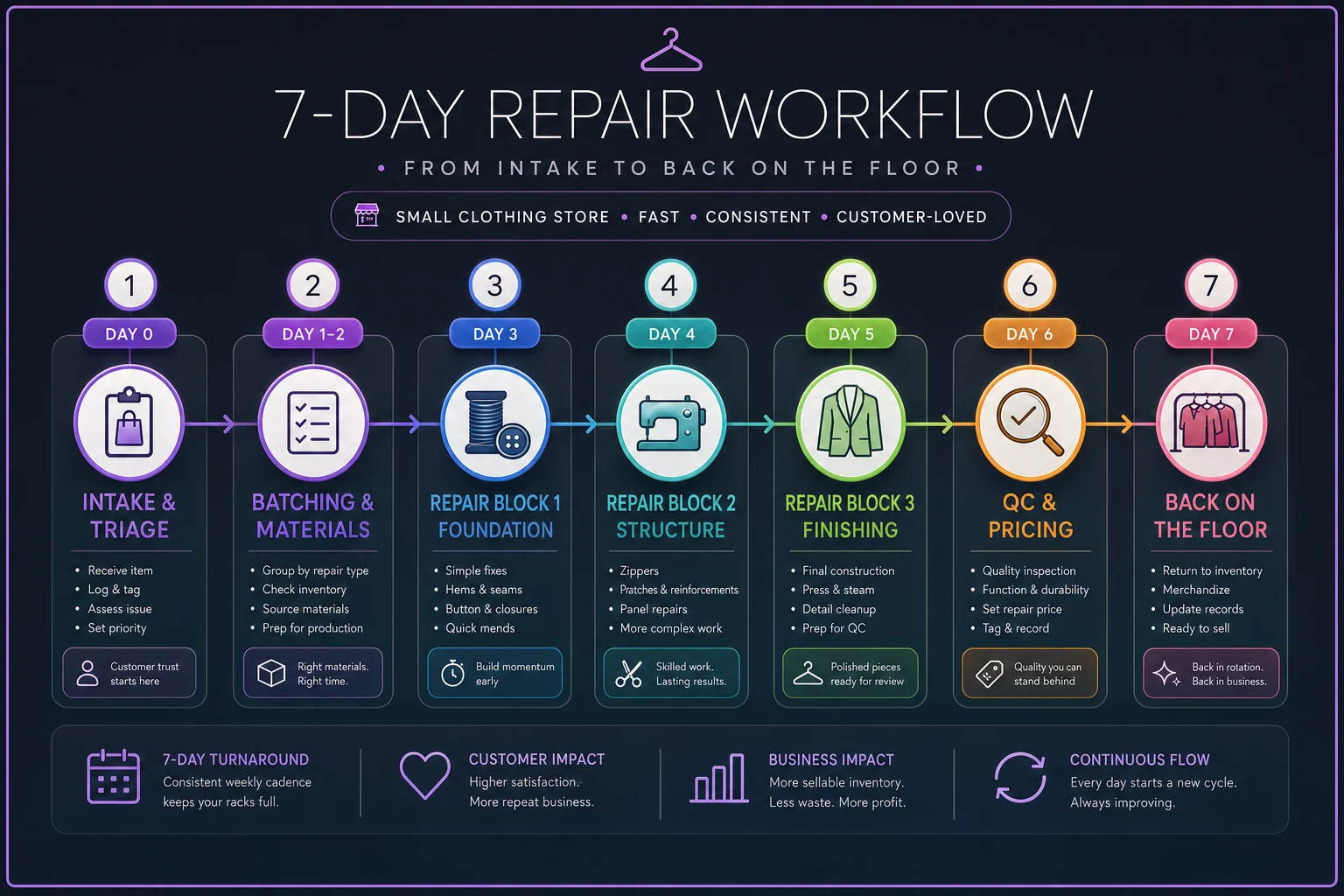
Day 0 — Intake and triage. Item arrives (from returns or floor damage). Triaged into A/B/C within 24 hours. Bucket B items logged into the repair queue with date-in, SKU, flaw type, assigned bucket.
Days 1–2 — Batch and source. Repairs get batched by type. All button jobs together, all hems together. This is where small stores waste the most time — fixing one item at a time instead of running a repair block. If you need matching thread, buttons, or a zipper, pull or order materials now so nothing stalls mid-week.
Days 3–5 — Execute. Dedicated repair block (even just 60–90 minutes, two or three times a week) clears the queue. In-house for simple fixes; hand off to your standing tailor relationship for anything above the labor ceiling that's still worth saving.
Day 6 — QC and price. Each repaired item gets a quick quality check — does the repair hold, is it invisible or visible — then gets tagged at the right pricing tier.
Day 7 — Back on the floor or online. Item is merchandised and live. Clock stops. Log the outcome: repaired-and-sold-tier, routed out, etc.
Anything that can't make the 7-day window — because materials are backordered or it needs specialist work — gets re-evaluated: is it still worth holding, or does it drop to Bucket C? The SLA has teeth only if missing it triggers a decision, not another indefinite wait in the bin.
Here's a quick visual of the repair workflow.
A simple weekly checklist to run the SLA
-
- [ ] All week's damaged/returned-with-defect items triaged within 24 hrs and logged
-
- [ ] Bucket B queue reviewed every Monday — anything approaching day 5 flagged
-
- [ ] Materials (thread, buttons, zippers, hardware) stocked for common fixes
-
- [ ] Repair block scheduled and actually held (don't let it get bumped by floor chaos)
-
- [ ] QC done before anything gets re-tagged
-
- [ ] Second-chance section tidied and clearly labeled
-
- [ ] Any SLA misses re-evaluated for route-out, not left to drift
The SLA has teeth only if missing it triggers a decision, not another indefinite wait in the bin.
A real scenario: the mid-size boutique and the $4-a-day bin
A womenswear boutique doing roughly $40k–$50k a month in revenue had the classic setup — a bin behind the counter that filled up and got cleared every couple months, mostly into a donation bag. When they actually counted one quarter's bin, there were about 60 items in it. Conservative average recoverable value: around $45 each if handled promptly. That's close to $2,700 in merchandise walking out the door as a tax receipt, or selling at steep clearance months too late.
They weren't losing because the items were unfixable. They were losing because nothing moved. Average time in the bin was somewhere north of three weeks, and by then half the seasonal pieces were dead.
The fix was unglamorous: a 24-hour triage rule, the labor-ceiling table taped to the back room wall, a Tuesday-and-Friday repair block of about an hour each, and the 7-day clock. No new hires. The owner handled triage; one staff member who could sew took the Bucket B queue.
Within two months, most Bucket B items were going back out at full price or in the second-chance tier instead of to donation. Rough recovery: a few hundred dollars a month that was previously a straight loss, plus the back room stopped being a source of low-grade dread. Not a dramatic revenue story — but it's near-pure margin, since you already paid for those goods once.
When this system makes sense — and when it doesn't
Worth building out: You carry mid-to-higher-priced apparel ($40+ AOV), you get a steady trickle of returns with minor defects, and you have at least one person who can handle basic repairs or a reliable local tailor. The higher your price points, the faster this pays for itself.
Marginal: Very low AOV, high-volume fast-fashion inventory where labor almost always exceeds recoverable value. Lean hard on Bucket A (resell-as-is at a small discount) and Bucket C (route out fast). Skip most repairs — the math rarely works under $25.
Not worth formalizing: If your returns volume is genuinely tiny — a handful of damaged items a month — a full SLA is overkill. Apply the labor-ceiling rule case by case and don't let anything sit longer than a couple weeks. The system earns its keep when the bin is a recurring problem, not an occasional one.
Keeping the whole thing honest
Two guardrails matter long-term. First, track your triage outcomes — what percentage of damaged items end up in each bucket, and what you recovered per item. If Bucket C is swallowing most things, either your thresholds are off or your incoming damage is worse than you thought, which is its own supplier or handling issue worth chasing down.
Second, watch for the same defect showing up repeatedly. A specific SKU that keeps coming back with the same popped seam isn't a repair problem — it's a vendor quality problem, and it belongs in your supplier conversations, not just your repair queue. The repair log doubles as early warning on this. It also ties into the kind of loss-hunting you'd already be doing in a monthly shrinkage micro-audit — damaged-goods leakage is just shrinkage that moves slowly enough to look normal.
Damaged returns aren't trash, and they aren't automatically resale-ready either. They're decisions waiting to be made fast. Put a clock on them, give staff a threshold instead of a judgment call, and most of that back-room pile turns back into inventory you can actually sell — usually within a week, often at a price that barely feels like a discount at all.
Ready to elevate your apparel business?
Join 2,000+ retailers using Werzly to streamline operations, increase sales, and deepen customer loyalty.