


Most small apparel shops don't lose money to fraud because they lack tools. They lose it because the four places fraud shows up — card chargebacks, refund abuse, in-store return scams, and marketplace disputes — are handled by four different people, in four different inboxes, with four different definitions of "suspicious." Nobody owns the whole thing. So the same bad actor who got a full refund at the register last Tuesday files a chargeback on an online order on Thursday, and nobody connects the two because the data never sits in the same place.
That's the real problem with retail fraud governance for small retailers: it's not a detection problem, it's a coordination problem. And coordination problems get worse as you add channels, staff, and order volume — not better.
This is a governance piece, not a fraud-detection piece. The goal is a single one-page artifact plus a 30/90-day rollout that a two-to-five person team can actually adopt in a week. Decision rights, evidence pipelines, SLA thresholds, KPI gates, and short triage scripts. Boring on purpose. Boring is what survives a busy Saturday.
Why fraud leaks through the seams, not the walls
Walk into almost any indie apparel shop and ask who handles chargebacks. You'll usually get something like "the owner, when the bank emails us." Ask who approves a no-receipt return over $150. "Whoever's on the floor." Ask who decides whether to fight a marketplace dispute or just eat it. "Depends."
Three different people. None of them talk to each other. That's the seam. Fraud doesn't break through strong controls — it slips through the gaps between controls that were each designed in isolation.
-
Returns and chargebacks are treated as unrelated. A refund processed at the POS and a chargeback filed with the card network are logged in completely different systems, so repeat offenders look like first-timers every time.
-
Evidence gets gathered only after a dispute lands. By then the tracking screenshot is buried, the signed pickup slip is gone, and the fitting-room camera footage has already been overwritten.
-
Deadlines are invisible until they're missed. Card networks give you a representment window — often 7 to 20 days depending on the reason code. Marketplaces give you even less. A missed window is an automatic loss, and small teams miss them constantly because nobody's watching a clock.
None of these are detection failures. They're governance failures. The shop had the evidence. The shop could have won. It just didn't have a system that moved the right information to the right person before the deadline.
What breaks as you add channels
A single-location store with no online sales has a simple fraud surface. One register, one return policy, cash and cards. You can run the whole thing on trust and a drawer count.
Take control of your clothing store operations.
Werzly helps you manage stock, process orders, and engage customers effortlessly.
- Unified inventory and order management
- Automated customer notifications
- Sales and stock analytics
No credit card required
| Stage | Channels | Where fraud concentrates | What usually breaks first |
|---|---|---|---|
| Single store | In-person only | No-receipt returns, wardrobing | One employee over-approving refunds |
| +Online | Store + web | Card chargebacks, "item not received" | Nobody tracking representment deadlines |
| +Marketplace | Store + web + marketplace | Platform disputes, A-to-Z style claims | Evidence scattered across 3 dashboards |
| +Omnichannel pickup | All of the above + BOPIS/SFS | "I never picked it up" disputes, buy-online-return-in-store abuse | No signed handoff tying a person to the pickup |
The last row is where small teams get hammered. Buy-online-return-in-store is a convenience feature customers love — and a gap fraudsters love more, because the online order system and the POS return system almost never reconcile automatically. Someone returns an online order in-store for cash or store credit, then files an "item not received" claim online. Two systems, one customer, zero connection.
If you've already mapped how your pickup and ship-from-store flows work, you've seen how easily a handoff can go unsigned. The fraud version of that same gap is just someone exploiting the unsigned handoff on purpose.
The one-page governance artifact
The whole point is to get this onto a single page someone can tape next to the register and pin in the shared drive. If it's longer than a page, it won't get used on a Saturday. Here's the structure.
1. Decision rights (who can say yes, and to what).
| Action | Floor staff | Shift lead | Owner/Manager |
|---|---|---|---|
| Refund with receipt, under $75 | ✅ | ✅ | ✅ |
| Refund no receipt, any amount | ❌ | ✅ (store credit only) | ✅ |
| Refund over $150 | ❌ | ❌ | ✅ |
| Fight vs. concede a chargeback | ❌ | ❌ | ✅ |
| Approve marketplace dispute response | ❌ | ✅ (template only) | ✅ |
| Flag a repeat-offender customer | ✅ | ✅ | ✅ |
The flagging row matters most. Anyone can flag; only a lead or owner can approve an irreversible decision. That split keeps the floor fast and the money decisions controlled.
2. SLA thresholds (the clocks nobody was watching).
-
Chargeback representment
respond within 48 hours of notification, never later than 3 days before the network deadline.
-
Marketplace dispute
respond same day it appears — these windows are brutal and often non-negotiable.
-
In-store return review (flagged)
resolved within 24 hours.
-
Refund abuse pattern review
weekly, every Monday.
3. KPI gates (the numbers that trigger action).
-
Chargeback rate above 0.65% of card transactions → owner review that week.
-
Return rate on any single SKU above 35% → pull the SKU and the content behind it.
-
Win rate on disputed chargebacks below 40% → the evidence pipeline is broken, not the customers.
-
No-receipt returns above 12% of total returns → tighten floor policy.
4. Evidence pipeline (what gets captured, always). Covered in detail below — but it lives as a checklist on the same page.
The evidence pipeline — capture before the dispute, not after
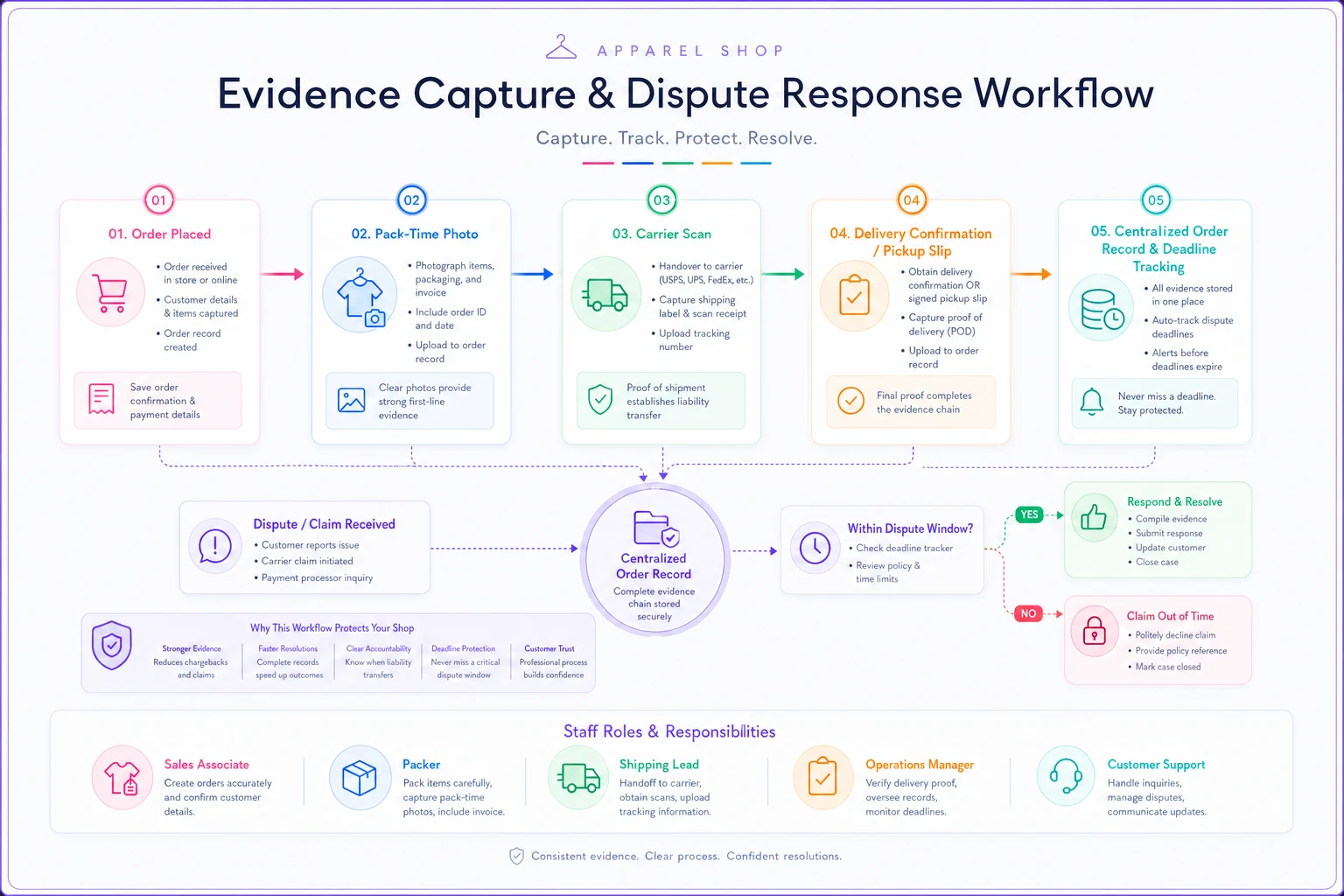
This is the single highest-leverage change most shops can make. You cannot win a chargeback with evidence you scraped together after a deadline panic. The evidence has to be captured at the moment of sale and fulfillment, then sit somewhere you can grab it in sixty seconds.
-
Order placed → system stamps timestamp, IP, billing/shipping match status
-
Item picked and packed → packer photographs the packed item and the label
-
Carrier scan and tracking number logged
-
Delivery confirmation or signed in-store pickup slip captured
-
All of it linked to one order record
When a dispute lands, you're not hunting. You open the order and everything's attached. That's the difference between a 40% win rate and a 70% one.
Here's a simple visual of that pipeline for your team to reference quickly.
Minimum evidence to standardize by dispute type:
-
Card chargeback (item not received) tracking with delivery confirmation, carrier timestamp, AVS/CVV match, customer's order confirmation email.
-
Card chargeback (not as described) product photos at pack time, listing description screenshot, return policy acknowledgment at checkout.
-
In-store return dispute signed receipt, POS timestamp, item condition photo, ID record if policy requires it for no-receipt.
-
Marketplace dispute platform message thread, shipping proof, any fulfillment SLA timestamps the platform tracks.
When possible, automate attaching pack-time photos to the order record so it's never missing.
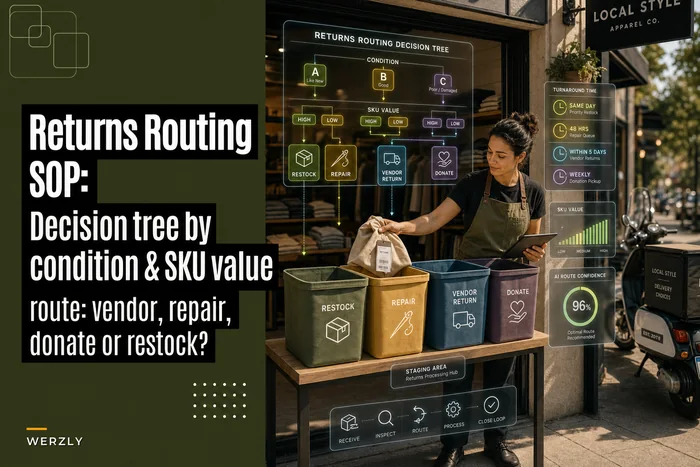
If you've already built out a returns-routing process, the evidence capture for returns should bolt directly onto it. The compact returns-routing SOP already decides where an item goes — vendor, repair, donate, restock. The governance layer just adds who logged the condition and when, so a later dispute can't rewrite history.
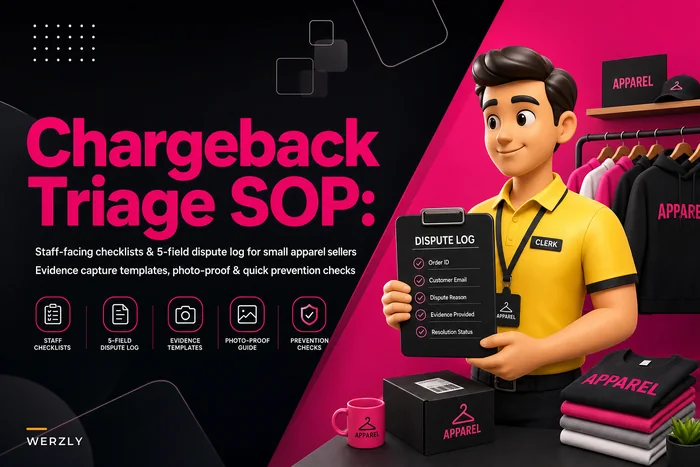
For the marketplace side, the staff triage flow and evidence templates in the marketplace fraud & chargeback SOP handle the front-line work. This governance framework sits one level above that — it's the thing that assigns the SOP to an owner and puts a clock on it.
Owner triage scripts — short enough to actually use
Scripts fail when they're paragraphs. On a busy floor, nobody reads a paragraph. These are four or five lines each, meant to be memorized or taped up.
Triage script — flagged in-store return:
-
Is there a receipt? No → store credit only, log the customer name.
-
Does this customer appear in the flag log in the last 90 days? Yes → shift lead decides.
-
Over $150 and no receipt? → owner approval required, hold the item.
-
Approved or denied, log the outcome. Always log.
Triage script — new chargeback notification:
-
Pull the order record and the attached evidence. All there? → build representment today.
-
Evidence incomplete? → note what's missing, decide fight vs. concede by value ($40 dispute probably isn't worth 90 minutes).
-
Repeat offender across channels? → fight regardless, and flag the account.
-
Log the decision and the deadline. Set a reminder 2 days before.
Escalation script — owner:
-
Chargeback rate crossed the gate this week → review the last 10 disputes for a pattern (one SKU? one shipping zone? one reason code?).
-
Win rate below 40% → the problem is evidence capture, not customers. Audit the pipeline, not the policy.
The pattern-hunting instinct is what separates governance from firefighting. One shop found that nearly all its "item not received" chargebacks came from a single zip cluster using a package-reship service. That's not random fraud — that's a repeatable exploit you can block once you can actually see it.
A real scenario
A two-location women's apparel shop added a marketplace channel and web store over about eighteen months. Monthly orders climbed to roughly 900 across all channels. Chargebacks, which used to be a once-a-month annoyance, became a steady drip — somewhere around 10 to 14 a month, and the owner was winning maybe a third of them because she was scrambling for evidence after the fact and missing a couple of deadlines each month entirely.
The real cost wasn't just the lost disputes. It was the cross-channel abuse nobody could see: a handful of customers returning online orders in-store for credit, then disputing the original charge. Because the POS and the web store didn't reconcile, those customers looked clean every single time.
They adopted the one-page artifact in about a week. Decision rights taped to both registers. Evidence auto-captured at pack time. A Monday review of flagged returns. Deadlines tracked against each open dispute instead of living in the owner's head.
Over the next quarter the win rate on disputes they chose to fight moved from about a third to a little over two-thirds. Missed deadlines dropped to basically zero. Three repeat cross-channel offenders surfaced once returns and chargebacks finally sat in the same view — accounts they could flag and stop. The dollar savings mattered, but the owner's actual quote was more telling: "I stopped being afraid of the bank emails."
Worth noting: getting returns and chargebacks into one reconciled view depends on clean month-end discipline. If your books and POS don't tie out, cross-channel fraud stays invisible. The groundwork in minimal month-end close and POS reconciliation is quietly what makes this whole framework detectable rather than theoretical.
The 30/90-day remediation playbook
You don't roll this out all at once. Here's the sequence that actually holds.
Days 1–7: Stand up the artifact.
-
Write the decision-rights table for your real staff and roles.
-
Set your four SLA clocks and your four KPI gates.
-
Tape the one-pager at every register and pin it in the shared drive.
Days 8–30: Build the evidence pipeline.
-
Standardize pack-time photos and label capture for every shipped order.
-
Create one order-linked place where tracking, timestamps, and condition photos live together.
-
Start a flag log for customers and run the first Monday review.
-
Begin tracking every open dispute against its deadline.
Days 31–90: Close the loops and read the patterns.
-
Reconcile online returns against the web store weekly to catch cross-channel abuse.
-
Run your KPI gates for real — pull SKUs over the return threshold, audit the pipeline if win rate is low.
-
Hunt for concentration
one zip, one SKU, one reason code, one repeat account.
-
Tighten decision rights or SLA thresholds based on what the first 60 days actually showed.
A quick readiness checklist before you call it done:
-
[ ] Every role knows exactly what they can and can't approve
-
[ ] Every shipped order has pack-time evidence attached automatically
-
[ ] Every open dispute has a deadline with a reminder set
-
[ ] Returns and chargebacks are visible in one place
-
[ ] A weekly flag review actually happens, on a set day
-
[ ] KPI gates trigger a named owner, not a vague "we should look into that"
A quick readiness checklist before you call it done:
When this makes sense — and when it doesn't
When it's worth it: you're running more than one channel, your chargebacks have gone from occasional to recurring, or you've added BOPIS/ship-from-store and your POS and web store don't talk. If fraud and disputes live in separate heads and separate inboxes, this framework pays for itself fast.
When it's overkill: a single register, cash-and-card, no online presence, a handful of returns a month, and the owner personally sees every transaction. At that scale, a clear return policy and a receipt requirement cover most of your risk. Don't build governance for a surface that doesn't exist yet.
Who should hold off: if your month-end books and POS don't reconcile at all, fix that first. This framework depends on being able to see a customer across channels. Without reconciled data underneath it, you're drawing clocks and gates on top of numbers you can't trust — and that just creates confident wrong decisions.
Fraud governance for a small apparel team isn't about catching every bad actor. It's about making sure the right person sees the right information before a deadline, and that the four places fraud shows up finally share one view instead of four. The shops that bleed money aren't the ones with the most fraud — they're the ones where returns, refunds, chargebacks, and disputes never talk to each other, so the same exploit works over and over again. Get it onto one page. Assign the decisions. Put clocks on the deadlines. Capture evidence before you need it. Then spend your Mondays reading patterns instead of fighting fires. A small team can genuinely run all of this in a week — and once it's running, the fraud you can finally see tends to be the fraud you can finally stop.
Ready to elevate your apparel business?
Join 2,000+ retailers using Werzly to streamline operations, increase sales, and deepen customer loyalty.