



Most indie clothing shops don't close their books. They estimate them. The owner glances at the POS dashboard, sees sales looked okay, pays the bills that are screaming loudest, and moves on. Then tax season arrives and the bookkeeper finds a $4,800 gap between what the POS reported in sales and what actually hit the bank. Nobody can explain it. Nobody wrote anything down. And now you're paying someone $150/hour to reverse-engineer eight months of mystery.
The frustrating part is that a real month-end close — one that ties POS sales to deposits, tracks returns properly, accounts for COGS and inventory movement — isn't complicated. It's just undocumented. Shops skip it because it feels like accountant territory, something you need QuickBooks mastery and a CPA to touch. You don't. You need a repeatable routine, a handful of journal entries you reuse every month, and a variance threshold that tells you when to stop worrying and when to dig.
This is that routine. One day a month, owner-run, built for shops that don't have finance staff. The goal isn't accounting perfection. It's tie-out you can trust and an exceptions list short enough to actually resolve.
Why POS and your bank statement never agree on their own
The core problem that trips up almost every small retailer: your POS tells you one number, your merchant processor deposits another, and your bank shows a third. None of them are lying. They're just measuring different things at different moments.
A typical example looks like this. Your POS says you did $38,400 in gross sales for March. But the processor holds funds for a day or two, nets out fees before depositing, batches weekend sales into Monday, and sometimes splits a single day's sales across two deposits. So your bank shows maybe $36,900 in card deposits spread across 31 uneven chunks. Then you've got cash sales that went to the deposit bag (some of which walked, let's be honest), gift card redemptions that aren't new revenue, and returns that reduced sales but show up as separate refund transactions.
The reason this breaks across almost every shop is that POS month end reconciliation for a small retailer isn't one reconciliation — it's four of them stacked on top of each other. Sales tie-out, returns, COGS, and inventory adjustments each move independently, and when you only look at the top-line number you can't see which one is off. A shop that tries to reconcile "the total" will chase a $600 variance for an hour before realizing it's two separate problems — a $900 missing cash deposit and a $300 refund that was double-counted — that happened to partially cancel out.
Once you separate the four streams, each becomes a small, boring, solvable check. That separation is the whole trick.
The four reconciliations, in order
1. Sales reconciliation (POS → merchant → bank)
Take control of your clothing store operations.
Werzly helps you manage stock, process orders, and engage customers effortlessly.
- Unified inventory and order management
- Automated customer notifications
- Sales and stock analytics
No credit card required
You're answering one question: did the money the POS said you earned actually arrive?
-
POS gross sales by tender type (card, cash, gift card) for the month
-
Merchant processor settlement report (gross card sales, fees, net deposits)
-
Bank statement card deposits
Card sales should flow like this: POS card sales − processor fees = net deposited to bank. If your POS shows $31,200 in card sales and processor fees run around $930 (roughly 3%), you should see about $30,270 land in the bank. If the bank shows $29,800, you have a $470 gap to explain — usually a batch that settled on the 1st of the next month, or a chargeback you didn't know about.
Cash is its own small check: POS cash sales should equal cash deposits plus any petty cash you pulled out. This is where shrink and till errors surface, which ties directly into the kind of monthly shrinkage checks worth running alongside the close.
2. Returns and refunds reconciliation
Returns are where small-shop books get quietly wrong. The mistake that shows up constantly: treating a refund as a new expense instead of a reversal of sales and COGS. When you refund a $78 dress, two things happen — sales drop by $78, and if the item comes back in sellable condition, inventory goes back up and COGS reverses too.
-
Restocked returns (item came back, resell-able) — reverse sales and reverse COGS
-
Non-restocked returns (damaged, kept by customer, vendor return) — reverse sales only, and the inventory becomes a write-off or vendor credit
A shop doing $38k in gross sales with a 12% return rate is processing roughly $4,600 in refunds a month. If even a third of those aren't being restocked properly in the system, your inventory count drifts by over $1,500 monthly — and that error compounds until your next physical count blows up.
3. COGS reconciliation
Now that returns are clean, you can trust cost of goods. For most apparel shops, the simplest reliable method is: COGS = (net units sold) × (unit cost). Your POS should carry a cost on each SKU. If it does, pull the cost-of-sales report and sanity-check it against your known margins.
If your blended margin runs around 58% and net sales were $33,800, your COGS should land near $14,200. If the POS cost report says $17,500, your SKU costs are wrong somewhere — usually a batch of items loaded at retail price instead of cost, or freebies and samples ringing through with a cost attached. This is exactly why having clean cost data upstream matters, and why a single source of truth for SKUs and vendor costs saves you during close.
4. Inventory adjustments
This is the cleanup bucket: damages, theft, samples, vendor defects, markdown write-downs, and the difference between what the system thinks you have and what's physically on the floor. You don't do a full count monthly — that's a quarterly job — but you do record the known adjustments that happened: the three defective sweaters you sent back, the display piece that got ruined, the markdown rack you re-tagged.
Every known adjustment gets a dollar value and a reason code. The reason codes are what make the exceptions roll-up useful later.
[POS Sales Data] → [Sales Tie-Out] → [Returns Split] → [COGS Check] → [Inventory Adjustments] → [Exceptions Roll-Up]
Each step builds on the one before it. If you skip returns and jump straight to COGS, you're reconciling against a dirty number.
Here's a quick visual of the process:
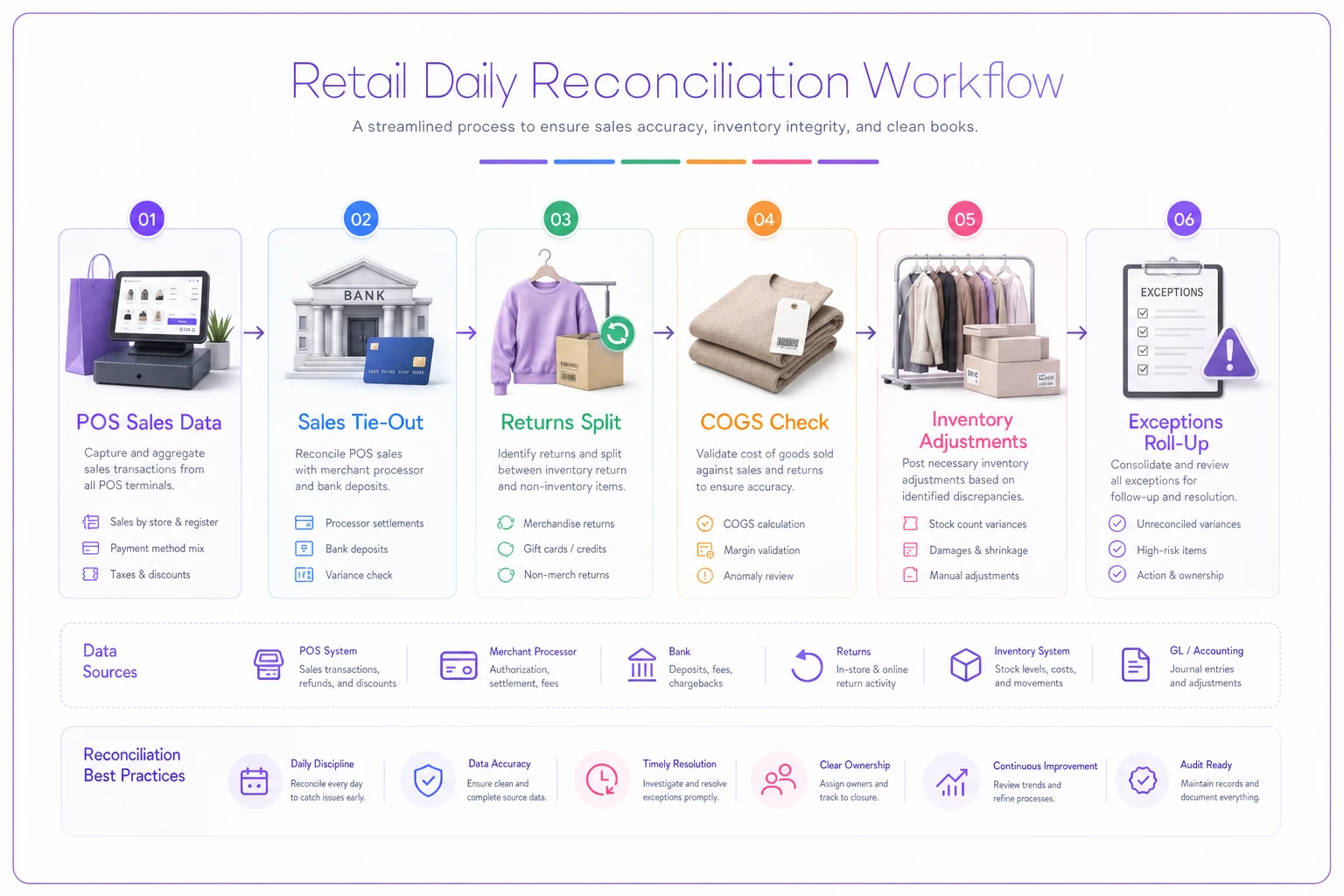
The graphic maps each reconciliation step so you can see how data flows and where exceptions originate.
Simple journal entries you'll reuse every month
You don't need to invent accounting. You need maybe six entries that repeat monthly. Here they are in plain form.
Recording net sales + fees: Debit Bank (net deposit) 30,270 Debit Merchant Fees (expense) 930 Credit Sales Revenue 31,200
Recording a restocked return: Debit Sales Revenue (returns) 78 Credit Bank / Refunds Payable 78 Debit Inventory 33 (cost of the item) Credit COGS 33
Recording monthly COGS: Debit COGS 14,200 Credit Inventory 14,200
Recording an inventory write-off (damage/theft): Debit Inventory Shrink/Damage 420 Credit Inventory 420
Create a template in your accounting system so you only update numbers each month.
That's basically the whole month in five entries plus your cash deposit. Once you've written these five once, you copy the template and change the numbers. The structure never changes.
Variance thresholds: when to investigate vs. let it go
This is the part nobody tells small owners, and it's why month-end becomes a nightmare. You are not going to tie out to the penny, and chasing pennies is how a one-day close turns into a three-day close. You need thresholds that tell you what's noise and what's a real problem.
A practical threshold table tuned for a shop doing roughly $30k–$50k monthly:
| Reconciliation | Acceptable variance | Investigate if over | Common cause when over |
|---|---|---|---|
| Card sales → deposits | Under $25 or 0.1% | $50+ | Batch timing, chargeback, held funds |
| Cash sales → deposits | Under $20 | $40+ | Till error, skimming, missed deposit |
| Returns (sales reversal) | $0 (should be exact) | Any mismatch | Refund processed outside POS |
| COGS vs. expected margin | Within 2 points of blended margin | 3+ points off | Wrong SKU costs, miscategorized items |
| Inventory adjustments | N/A — all should have a reason | Unexplained delta | Uncoded shrink, receiving error |
Timing differences are fine and self-correct next month. What you're hunting for is structural errors — a cost loaded wrong, a refund that bypassed the system, cash that didn't make it to the bank. A $30 card variance in March that reverses in April is nothing. A $30 variance every single month in the same direction is a leak.
The exceptions roll-up: the one document that makes this worth doing
If you only take one thing from this, take this. The output of your close isn't a balanced ledger — it's an exceptions roll-up: a short list of everything that didn't tie out cleanly, with a dollar amount, a suspected cause, and a status.
-
Date identified — when you spotted it during close
-
Category — sales / returns / COGS / inventory
-
Amount — the variance in dollars
-
Suspected cause — your best guess
-
Status — open / resolved / recurring
-
Action — what you did or need to do
A typical month might produce three to five exceptions:
-
Sales / $470 / card deposit short — batch settled April 1, will appear next month → resolved, timing
-
Returns / $156 / refund not in POS — staff refunded cash directly → open, retrain staff
-
COGS / 3.1 points high — new vendor's items loaded at retail → resolved, costs corrected
-
Inventory / $420 / water-damaged display stock → resolved, written off
The magic of the roll-up is the "recurring" flag. The first time staff refunds cash outside the POS, it's a one-off. The third month in a row it shows up, you've found a process hole — or a trust problem. The exceptions list turns reconciliation from a box-ticking chore into an early-warning system for the actual business.
A real scenario: the boutique that found $600/month hiding in plain sight
A two-location women's apparel shop — roughly $44k combined monthly sales — had never done a structured close. The owner did a gut check against the bank balance and called it done. Her bookkeeper eventually flagged that reported sales and deposits had drifted apart over the year by close to $7k, with no explanation.
When she switched to the four-stream routine, the first month surfaced two recurring issues the gut check could never have caught. First, gift card redemptions were being counted as new revenue at one location — inflating sales by about $350/month and throwing off every downstream number. Second, the second location's manager was processing some returns as "no sale" voids instead of refunds, which meant inventory never got added back. That was quietly understating inventory by $250–$300 a month.
Neither was theft. Both were process. After tightening the POS procedures and running the one-day close monthly, her sales-to-deposit variance dropped to under $40 most months, and the year-end bookkeeping bill came down because there was finally a clean trail to follow. The close took her about five hours the first time and settled into roughly two and a half hours once the templates were built.
When this routine is enough — and when you've outgrown it
This makes sense when: you're a single location or two, under roughly $600k–$800k annual revenue, and the owner or a trusted manager can own the monthly close. At this size, a disciplined one-day routine beats expensive software you won't fully use.
When you've outgrown it: once you're juggling three-plus locations, serious ecommerce volume, or consignment and resale splits, the manual version starts eating too many hours and the exceptions list gets long enough that you need real automation syncing POS, inventory, and accounting continuously rather than monthly. At that point the monthly close becomes a review of automated reconciliation, not the reconciliation itself.
Who should NOT try to DIY this: if your inventory data is already a mess — SKUs without costs, duplicate items, vendor info scattered across spreadsheets — fix that first. Reconciliation sits on top of clean data. Garbage costs produce garbage COGS no matter how disciplined your close is, which is why the data-governance work and the P&L and inventory-economics system really come before this routine, not after.
Where modern tools quietly take the pain out
None of this requires fancy software — a spreadsheet and discipline will get a small shop 90% of the way. But the manual version has two real weak points: pulling and matching the reports every month, and remembering to flag recurring exceptions. That's where operational platforms with built-in automation earn their keep. When your POS, inventory counts, and reconciliation live in one system, the sales-to-deposit matching and the COGS calculation can run automatically, and recurring variances get flagged before you even sit down to close.
The value isn't replacing your judgment — you still decide what's a real problem versus timing noise. It's that the boring matching work happens in the background so your one day a month goes toward resolving exceptions instead of hunting for them. For a shop still under a few hundred thousand in revenue, the spreadsheet is fine. As you scale and the four reconciliations multiply across locations and channels, automation is what keeps the close at one day instead of one week.
The takeaway
A month-end close for an indie retailer isn't a scaled-down version of corporate accounting. It's four small, separate tie-outs — sales, returns, COGS, inventory — done in order, with sane variance thresholds so you don't chase pennies, feeding a short exceptions list that doubles as an early-warning system. Build the five journal-entry templates once, reuse them forever, and spend your monthly close on the handful of things that actually didn't line up. Do that consistently and you stop guessing whether the month was good, stop paying someone to untangle a year of mystery, and start catching the slow leaks while they're still small enough to fix.
Ready to elevate your apparel business?
Join 2,000+ retailers using Werzly to streamline operations, increase sales, and deepen customer loyalty.