


Most multi-store clothing retailers treat transfers like emergency moves. Store A runs out of size medium black dresses during prom season, Store B has four sitting in the back, someone calls the district manager, and three days later a box shows up with one dress inside after $47 in shipping costs.
The transfer arrives too late. The customer already bought elsewhere. Store B ends up marking down their remaining dresses anyway. Nobody tracked whether that $47 made any sense.
The hidden math that kills most transfer programs
Transfer costs stack up faster than anyone expects. You've got the obvious shipping charge, but then add labor hours for packing and receiving, system updates, potential damage, and the opportunity cost of tying up inventory in transit. Most stores underestimate true transfer cost by around 40%.
Take a typical transfer of six denim jackets from your downtown location to your mall store. Shipping runs $22. Your downtown team spends 25 minutes pulling and packing — call it $8 in labor. Mall team spends 15 minutes receiving and processing, another $5. Add system reconciliation time and you're looking at roughly $38 total to move those six jackets.
If those jackets retail for $89 each with a 55% initial margin, you need to sell at least one extra jacket at full price just to break even on the transfer. But if downtown was about to mark them down 30% anyway, and the mall store has been moving two per week consistently, that $38 investment suddenly protects $186 in margin.
The decision framework becomes clear once you map these numbers. Build transfer triggers based on:
-
Sell-through rate differential exceeding 25% between stores
-
Days of cover dropping below 14 at the receiving store
-
Markdown risk at the sending store within 21 days
-
Minimum transfer value of 5x the transfer cost
The decision framework becomes clear once you map these numbers.
Building your transfer SLA template
Service level agreements for transfers sound corporate, but small multi-store operations need them even more than big chains. Without clear rules, transfers become political. The store manager with the loudest voice gets inventory, not the store with actual demand.
Take control of your clothing store operations.
Werzly helps you manage stock, process orders, and engage customers effortlessly.
- Unified inventory and order management
- Automated customer notifications
- Sales and stock analytics
No credit card required
Your transfer SLA should spell out exact timelines and responsibilities. When Store A requests inventory from Store B, what happens? Most stores have no documented process — which leads to delays, arguments, and missed sales.
Start with decision authority levels:
-
Transfers under $500 retail value
store managers approve directly
-
Transfers $500–$2000
district manager reviews within 24 hours
-
Transfers over $2000
requires sell-through data comparison
Then lock in execution timelines:
-
Request submitted by 2pm gets same-day decision
-
Approved transfers ship within one business day
-
Receiving store confirms arrival within 4 hours of delivery
-
System reconciliation complete within 24 hours of confirmation
The template should include escalation paths too. What happens when Store B refuses to transfer bestsellers even though they're sitting on 45 days of cover? Who makes the call when both stores claim they need the same inventory? Clear rules prevent these situations from grinding your operation to a halt.
Documentation requirements matter. Every transfer needs:
-
Screenshot of current stock levels at both locations
-
Last 14 days sell-through for the specific SKU
-
Transfer cost calculation
-
Margin impact projection
This feels like overhead until you see how much time it actually saves. Store managers stop calling about every transfer. Decisions happen faster. The right inventory moves to the right location based on data, not relationships.
When transfers are documented consistently, you also build a track record you can actually learn from. Which SKUs travel well? Which stores are chronic hoarders? The paper trail answers those questions without anyone needing to go back and reconstruct history from memory.
The compact decision spreadsheet that replaces gut feelings
You don't need complex software to run smart transfers. A single spreadsheet with the right formulas tells you exactly when to move inventory. Most stores overthink this or underthink it — there's a sweet spot in between.
The spreadsheet tracks five core metrics per SKU per store:
-
Current stock on hand
-
Weekly sell-through rate (4-week average)
-
Days of cover remaining
-
Next markdown date
-
Transfer cost per unit
From these, you calculate two decision triggers:
-
Transfer urgency score = (Receiving store weekly rate / Sending store weekly rate) × (30 - Receiving store days of cover)
-
Transfer value score = (Protected margin - Transfer cost per unit) × Probability of full-price sale
Any urgency score above 15 with a positive value score triggers a transfer review. The formulas look complex but the logic is straightforward: move inventory from where it's dying to where it's selling, but only when the math works.
Here's what that looks like with real products:
| SKU | Store A Stock | Store A Weekly Rate | Store B Stock | Store B Weekly Rate | Transfer Urgency | Transfer Value | Decision |
|---|---|---|---|---|---|---|---|
| Blue Cardigan M | 12 | 0.5 | 2 | 3 | 42 | $31 | Transfer 4 units |
| Black Jeans 32 | 8 | 1 | 6 | 1.5 | 7 | $12 | Hold |
| Floral Dress L | 15 | 0 | 3 | 2 | 28 | $45 | Transfer 6 units |
The spreadsheet eliminates emotional decisions. That floral dress sitting at Store A for six weeks? The math says move it now, before markdown season hits. Those black jeans Store B keeps requesting? The numbers show it's not worth the transfer cost given how similar their sell rates are.
Running this weekly takes maybe 30 minutes once your template is set up. The hard part isn't the math — it's getting consistent sell-through data from every location so the inputs are actually reliable.
When geography makes standard transfers impossible
Physical distance between stores changes everything. If your locations are 200 miles apart, that $38 transfer cost jumps to $85 or higher. At that point, you need different triggers and different strategies.
For distant store networks, batch transfers become essential. Instead of moving items as needs arise, you accumulate transfer requirements and ship monthly. This drops per-unit transfer costs by roughly 60%, but it requires tighter inventory planning on the front end.
The decision rules shift too. Single-item transfers almost never make sense beyond 100 miles unless you're dealing with high-ticket items and significant margin protection. A $400 leather jacket heading for markdown? Sure, spend $85 to move it. A $65 sweater? Let it mark down locally.
Some stores get creative with logistics. If you're already running weekly replenishment from a central location, piggyback store transfers onto those shipments. Your receiving team processes one delivery instead of two, and transportation costs get absorbed into existing routes.
Regional clusters work well too. Three stores within 30 miles of each other can run a weekly transfer circuit — one vehicle, one driver, one day — moving dead stock between locations for around $12 per transfer instead of $38 through standard shipping.
The transfer patterns that actually hurt performance
Not every transfer helps, even when the math looks decent upfront. Watch for these patterns that signal your transfer strategy needs adjustment.
The ping-pong transfer happens when inventory bounces between stores without selling. Store A sends to Store B, which sends to Store C, which eventually marks it down anyway. You've now spent over $100 in transfer costs on inventory that never found its market. Track any SKU that transfers more than once — it probably shouldn't transfer at all.
Market mismatch transfers ignore customer demographics. Your suburban store might move casual wear easily while your downtown boutique skews toward office attire. Moving casual inventory downtown because they're "low on stock" ignores why they're low in the first place.
The worst pattern is transferring to avoid markdowns without addressing why items aren't selling. If a product sits dead at multiple locations, moving it around just delays the inevitable while adding costs. Sometimes taking the markdown locally makes more sense than chasing phantom demand at other stores.
Seasonal transfers deserve special attention. Moving winter coats in March because one store sold out while another has excess sounds logical. But if the selling store's demand came from end-of-season clearance shoppers, transferring inventory at full price sets you up for disappointment.
Making transfer allocation fair without the politics
Politics kill transfer programs faster than bad math. Store managers hoard bestsellers, hide inventory from transfer requests, or complain about "giving away" their stock. The fix isn't better relationships — it's better systems.
Implement blind allocation rules. When Store A requests inventory from the network, they shouldn't know which store is fulfilling it. The system — even if it's just your spreadsheet — identifies the optimal source based on coverage and distance. Removing the personal element removes most of the tension.
Create transfer credits to balance the give-and-take. When Store B transfers out inventory, they earn credits equal to the protected margin value. When they need inventory later, they can spend those credits to jump the queue. This makes transfers feel less like taking and more like trading.
Share transfer performance data monthly. Show every store:
-
Units transferred out and their eventual sell-through
-
Units received and margin impact
-
Transfer costs versus margin protected
-
Network-wide benefit from their participation
When stores see that their transferred inventory actually sold at full price elsewhere, resistance drops. Share the failures too — that transfer of rain boots to the desert store that nobody bought is just as useful for everyone to see. Transparency builds trust faster than any team meeting ever will.
ROI tracking that proves transfers work (or don't)
Most stores never measure whether their transfer program actually makes money. They see inventory moving, assume it's helping, and never check the math.
Track three numbers:
-
Margin protected through transfers (full-price sales minus projected markdown loss)
-
Total transfer costs, all-in — not just shipping
-
Transfer sell-through rate at receiving stores
Your transfer ROI = (Margin protected - Transfer costs) / Transfer costs
Anything above 50% ROI justifies the program. Below that, tighten your triggers or reduce transfer costs. Negative ROI means you're literally paying to move dead inventory around your network.
Break this down by category too. You might find that transferring denim consistently pays off (around 120% ROI) while accessories rarely do (closer to 15%). Use those patterns to refine your rules. Maybe accessories only transfer for special orders or when batched with other items.
Timing matters more than most retailers realize. Transfers completed within 48 hours of request show meaningfully higher sell-through than those taking a week. Quick transfers catch demand peaks. Slow transfers arrive after customers have moved on.
Building automation into your transfer playbook
Manual transfer decisions eat time and miss opportunities. Even small store networks benefit from basic automation that flags transfer candidates and tracks execution.
Start with automated alerts. Your POS system or inventory spreadsheet can flag when:
-
Any store drops below 7 days of coverage on a fast-mover
-
Sell-through rates diverge by more than 30% between locations
-
Upcoming markdowns could be avoided through transfers
-
Transfer requests sit unapproved for over 24 hours
These alerts prevent the common scenario where Store A sells out Thursday, nobody notices until Saturday, the transfer doesn't arrive until Wednesday, and you've missed an entire weekend of sales.
Automate alerts for 7 days of cover on fast-movers first — it's the quickest way to prevent weekend stockouts.
AI-powered operational software takes this further by learning your transfer patterns and surfacing opportunities before problems emerge. Instead of reacting to stockouts, you're preventing them. Instead of manually comparing sell-through rates, the platform identifies transfer candidates daily.
The real value comes from connecting transfer decisions to your broader inventory management system. When supplier lead times, seasonal patterns, and markdown schedules are all in one place, transfer decisions stop being isolated fixes and start feeding into your overall inventory strategy.
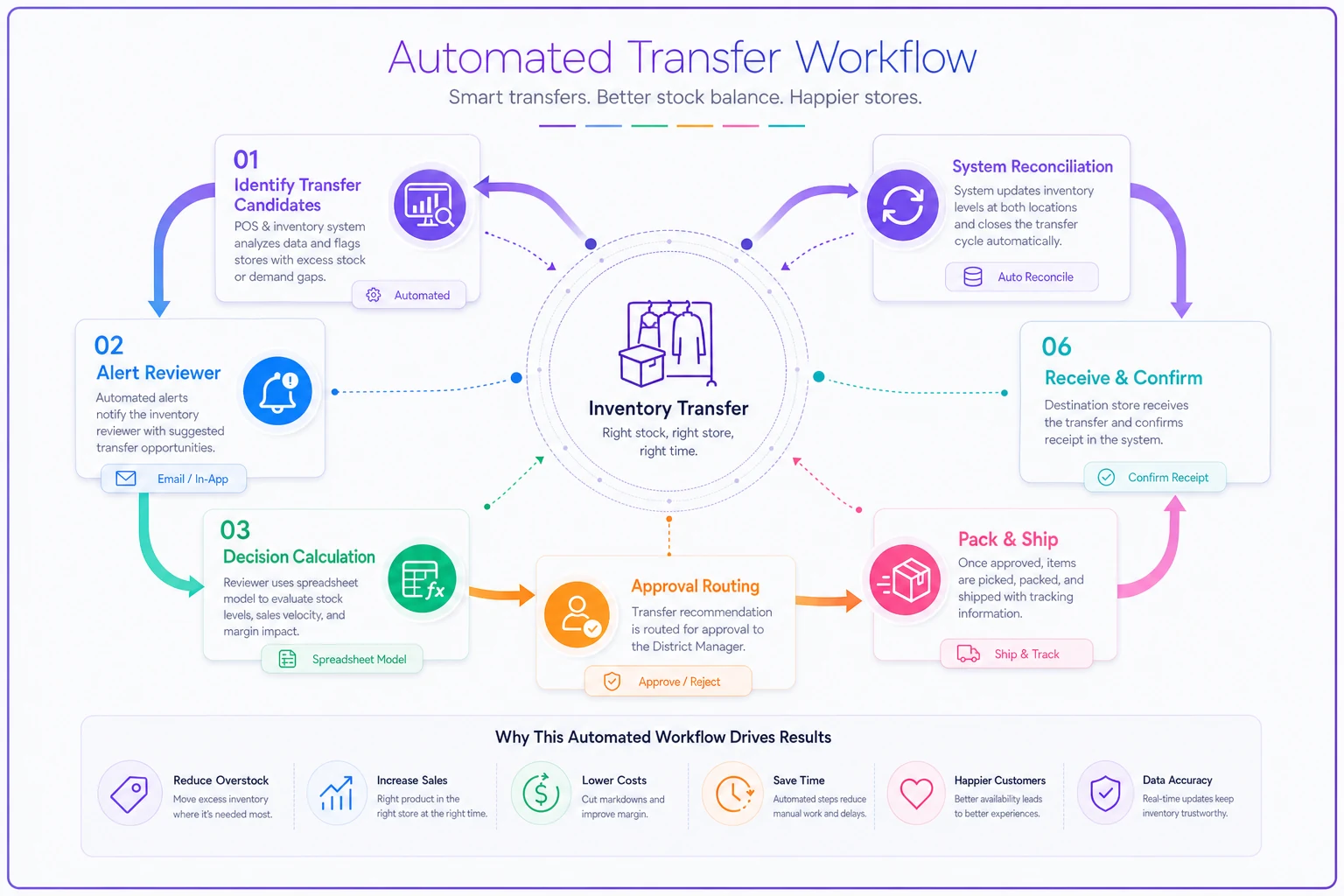
A simple workflow: alert → review → approve → ship → receive → reconcile.
When transfers become your competitive edge
Smart transfer programs separate profitable multi-store operations from ones that struggle with dead stock and markdowns. The framework isn't complicated — clear triggers, documented processes, simple math, fair allocation. But most small chains never implement it properly.
They treat transfers as exceptions rather than strategy. They make emotional decisions instead of following data. They optimize for individual store performance instead of network performance.
Your transfer playbook becomes a competitive advantage when you can move inventory to where it sells before anyone else even notices the opportunity. While competitors are marking down excess inventory, you're selling it at full price two towns over. While they're turning away customers due to stockouts, you've already shifted units from slower locations.
The economics work at almost any scale. Two stores can benefit from weekly transfer reviews. Ten stores can run a more sophisticated transfer network. The principles stay consistent — move inventory from where it's dying to where it's thriving, but only when the math justifies it.
Transfers solve a specific problem: inventory imbalance across locations. They don't fix bad buying decisions, poor visual merchandising, or fundamental demand issues. Use them as part of your broader retail operations framework, not as a bandaid for deeper problems.
Stores that master transfers typically see:
-
8–12% improvement in gross margin
-
20–25% reduction in markdown dollars
-
15–18% improvement in inventory turns
-
30% reduction in customer disappointment from stockouts
These aren't dramatic transformations — they're steady improvements that compound. Each successful transfer builds institutional knowledge. Each refined trigger rule speeds up decision-making. Each documented process reduces friction in execution.
Start simple. Build your transfer cost model. Create basic decision triggers. Document your SLA. Track ROI on every transfer for one month. Then refine based on what you learn. Within a quarter, you'll have a transfer playbook that turns inventory imbalances into real margin gains.
Ready to elevate your apparel business?
Join 2,000+ retailers using Werzly to streamline operations, increase sales, and deepen customer loyalty.