

Most receiving delays don't happen at your dock. They happen weeks earlier, when a purchase order goes out with no packaging expectations attached and no rules about what the supplier's advance ship notice (ASN) has to contain. By the time cartons show up on a Tuesday afternoon with three POs mixed into one box and no packing list taped to the outside, the damage is already done — you're just the one holding the box cutter.
For small apparel buyers, the ASN and packaging standards are genuinely the cheapest lever you have to cut receiving time. You don't need EDI. You don't need a warehouse system. You need a one-page spec that suppliers agree to before the first order ships, and the discipline to send a short remediation email the moment they break it.
That's what this is: a tight, supplier-facing standard scoped for a store that receives a handful of shipments a week, not a distribution center.
What goes wrong when there's no standard
The failure pattern is predictable once you've unloaded enough deliveries.
A shipment arrives with six cartons. No ASN, so nobody knows how many units should be inside or which POs are represented. Carton 1 has 40 units of a style you ordered. Carton 4 is a mix — two styles, three sizes, packed loose. One inner polybag ripped in transit and two blouses picked up grease from the carton flap. The packing slip is buried inside carton 3, so you can't reconcile anything until you've opened everything.
-
No carton labels, so you can't stage by department or floor-ready priority
-
Cartons packed by color instead of by size, which forces a full re-sort before anything hits the floor
-
Mixed POs in one carton, so a partial shipment looks like a short-ship when it isn't
-
Folded goods and hanging goods jammed together, crushing collars and creasing linen
None of these are dramatic on their own. Together they turn a 25-minute receiving job into 90 minutes and hide defects until a customer finds them on the rack.
The insight most buyers miss: a supplier who packs badly is usually packing badly for everyone. That means the fix is systemic on their end — once you get them to change how a carton is built, every future shipment improves. You're not asking for a favor on one order. You're setting a standard.
The minimum ASN: what to require, and what to skip
Big retailers demand dozens of ASN fields. You don't need that. For a small buyer, the ASN exists to answer three questions before the truck arrives: What's coming? How is it packed? Can I reconcile it fast?
Take control of your clothing store operations.
Werzly helps you manage stock, process orders, and engage customers effortlessly.
- Unified inventory and order management
- Automated customer notifications
- Sales and stock analytics
No credit card required
Here's the minimum set worth enforcing, and the fields you can safely ignore.
| Field | Require it? | Why it matters for a small buyer |
|---|---|---|
| PO number(s) per shipment | Required | Lets you reconcile against your own order without opening cartons |
| Ship date + carrier + tracking | Required | Tells you when to expect it; catches "lost" shipments early |
| Total carton count | Required | If 5 of 6 cartons arrive, you know instantly one is missing |
| Units per carton by SKU/size | Required | The single field that eliminates blind counting |
| Carton dimensions/weight | Nice to have | Helps if you're short on staging space |
| One PO per carton (no mixing) | Required (packing rule) | Kills the fake short-ship problem |
| Country of origin / HTS | Skip unless customs-relevant | Rarely useful at store-level receiving |
| Supplier's internal batch codes | Skip | Adds noise, no receiving value |
The field that does the most work is units per carton by size. When the ASN says "Carton 3 = Style 4420, Sizes S(6) M(10) L(8) XL(4)," receiving becomes a verification task, not a discovery task. You open, you count against a printed line, you flag any mismatch. No guessing, no re-sorting to figure out what you even received.
A pattern worth noting: suppliers who can't produce unit-per-carton data usually pack chaotically too. The ASN quality is a proxy for the packing quality. If a vendor pushes back hard on providing it, that tells you something about the cartons you're about to receive.
The packaging standard, in one page
Keep this short enough that a supplier's warehouse team will actually read it. Long specs get ignored; a tight one gets followed.
-
One PO per carton. No mixing orders. If a PO spans multiple cartons, number them (1 of 3, 2 of 3).
-
Pack by size within style, not by color. Size sorting is the slowest part of receiving; make the supplier do it.
-
Polybag individually for folded goods; use hanging cartons or garment rails for anything that creases (linen, structured blazers, silk).
-
Packing list on the outside of carton 1, in a pouch, plus a copy inside.
-
Carton label with PO number, carton X of Y, and a one-line contents summary.
-
Separate defects flag any item the supplier already knows is a second gets bagged and labeled, not slipped into the run.
-
Max carton weight (around 15 kg is reasonable) so one person can lift and stage safely.
-
No tape directly on garments or polybags
-
No staples through product packaging
-
Desiccant only in sealed cartons, never loose against fabric
-
Fold lines aligned so creasing lands where a steamer can fix it, not across a chest print
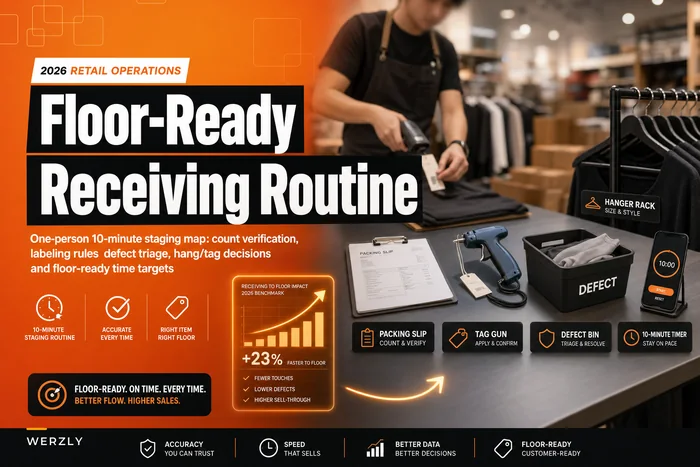
This standard connects directly to what happens after the box is open. If you want the downstream side — how to stage and floor-ready goods quickly once they've passed inspection — that's covered in the floor-ready receiving checklist and one-person staging routine. The packaging standard is what makes that 10-minute routine possible; bad packing blows the whole timeline before you've hung a single item.
A receiving workflow that catches defects instead of hiding them
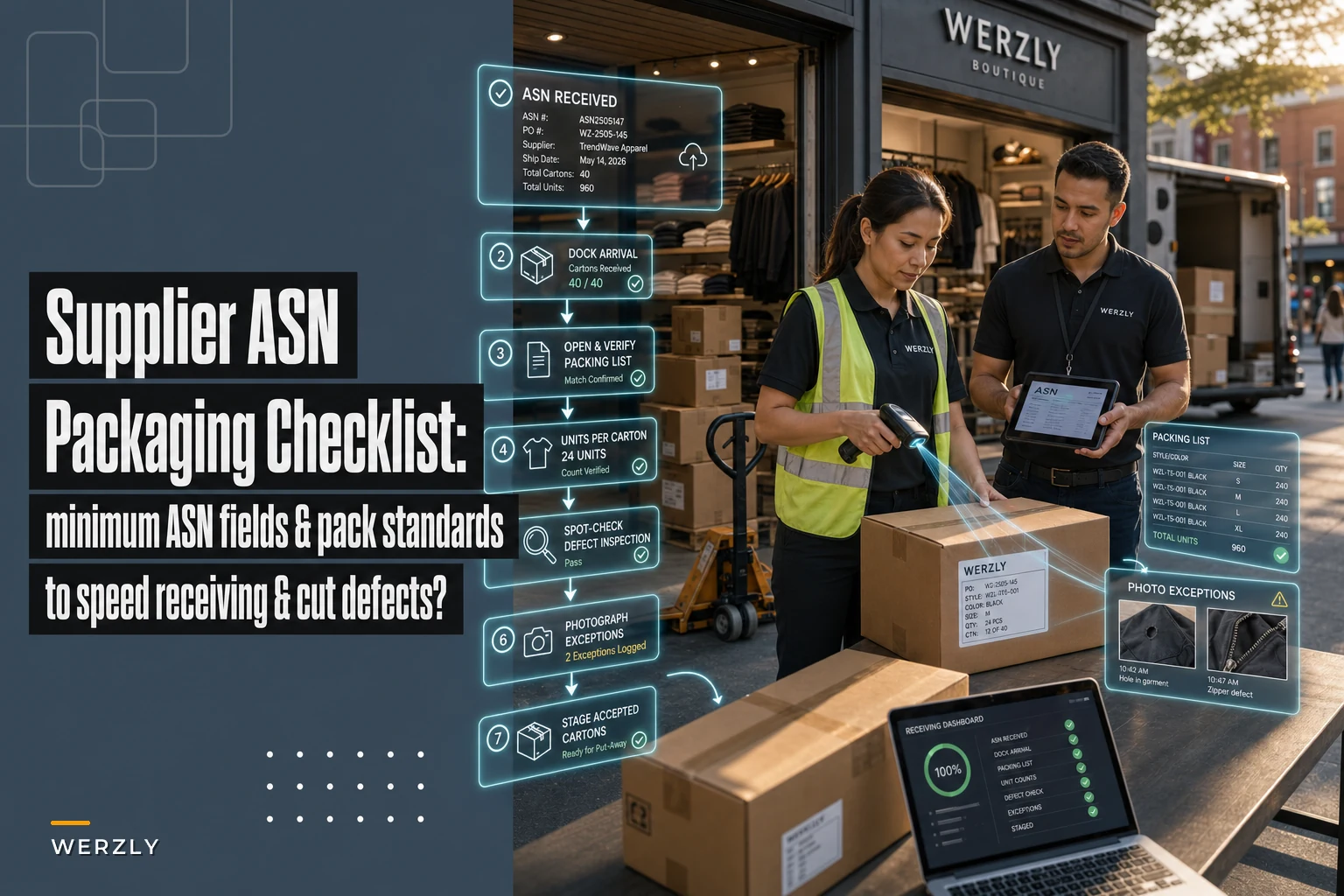
The point of the ASN and packaging rules is to let you receive by exception. You're not inspecting every unit — you're verifying the shipment matches what was declared, and spot-checking for defects.
Here's the flow, start to finish:
-
Before arrival ASN lands in your inbox. Print it or pull it up. You now know carton count and units per carton.
-
At the dock Count cartons against the ASN total. If it says 6 and 5 arrive, note it immediately and photograph the carrier's manifest.
-
Carton 1 first Pull the outside packing list, confirm PO match.
-
Verify, don't discover Open each carton, count against the ASN's per-carton line. Check off matches; circle mismatches.
-
Defect spot-check Pull 3–5 units per carton at random. Inspect seams, prints, closures, and for transit damage (grease, crushing, moisture).
-
Log exceptions on the spot Short-ships, over-ships, wrong sizes, defects — one running list per shipment while the evidence is in front of you.
-
Photograph anything you'll dispute before it moves. A grease-stained polybag photographed in the carton is proof; the same item on a shelf three days later is an argument.
-
Trigger remediation only if there's a real exception. Clean shipments get received and staged, done.
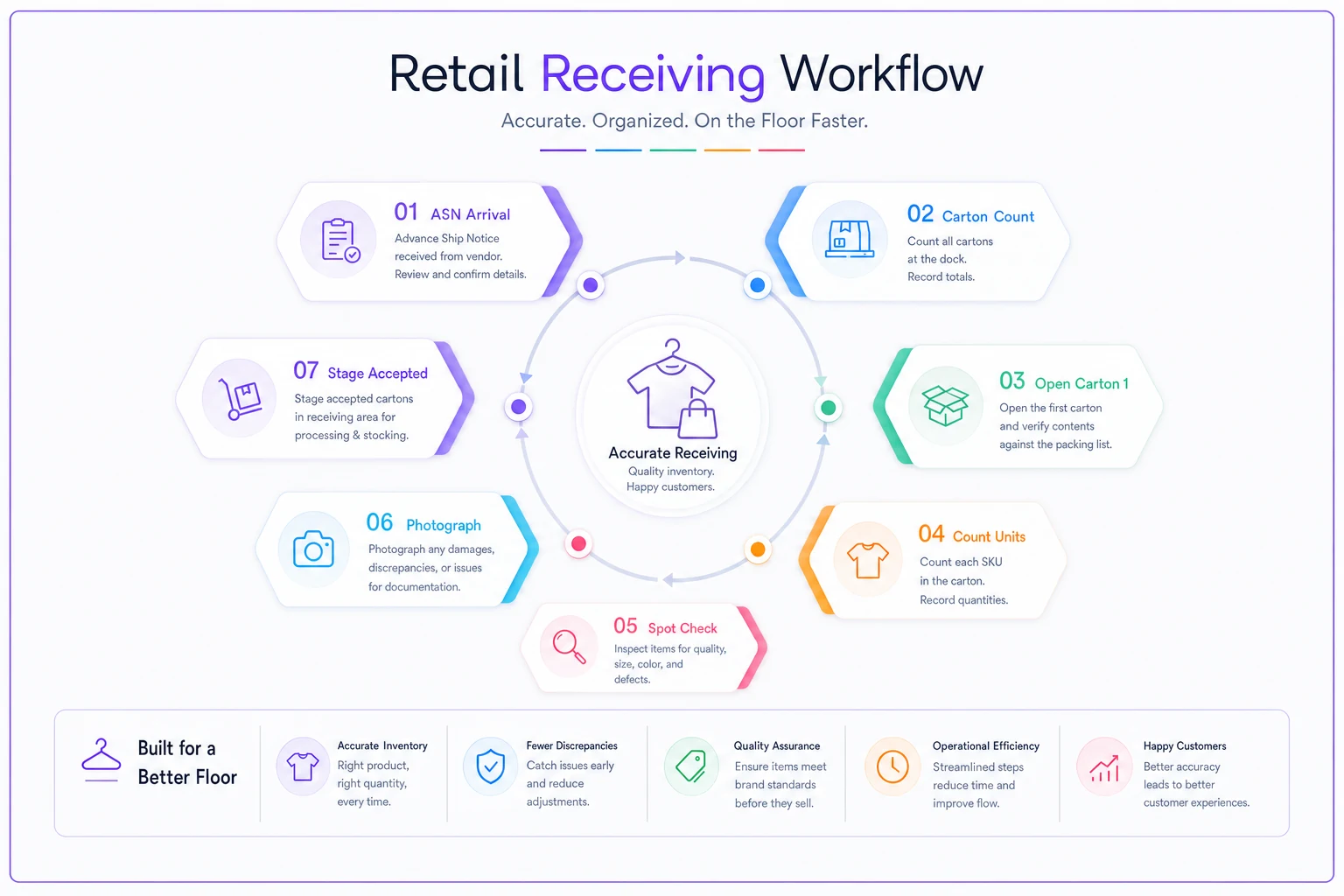
A simple visual to share with staff and suppliers so everyone sees the same steps.
Keep a printed ASN taped to your staging board during unloads so counts and discrepancies are visible to everyone unloading.
The difference between "discover" and "verify" in step 4 is the whole game. Blind counting is slow and error-prone. Verifying against a declared count is fast and creates a clean record for any claim you need to make later.
Where operational software helps here isn't glamorous — it's just that logging exceptions against the PO in one place, instead of on a sticky note that gets lost, means your remediation email writes itself and your supplier scorecard updates without a second data-entry step. If you're already tracking vendor performance the way we laid out in the quarterly supplier scorecard for small apparel buyers, these receiving exceptions are exactly the inputs that make the scorecard honest instead of a gut-feel exercise.
A real scenario: the linen shipment that took two hours
A small women's boutique — roughly 900 SKUs, receiving four to six shipments a week — kept losing its Tuesday afternoons to one supplier's deliveries.
The typical Tuesday looked like this: 5 cartons, no ASN, packing list buried inside. Goods packed by color, so a single style's sizes were spread across three cartons. Folded linen shirts jammed under heavier denim, arriving creased hard down the front. Receiving one shipment ran close to two hours between counting, re-sorting by size, and steaming out the crush marks. About one in twelve linen units needed re-steaming before it could go on the floor, and a couple per shipment were unsellable seconds that hadn't been flagged.
They sent the supplier a one-page standard and a short remediation note (template below). Two changes did most of the work: pack by size within style, and separate the folded linen into its own cartons with lighter loading.
The next several shipments dropped receiving time to roughly 40–50 minutes. The re-steam rate fell to a handful of pieces instead of a dozen-plus, because linen wasn't crushed under denim anymore. And the seconds that used to slip through started arriving bagged and labeled separately — which meant they got credited instead of quietly eating margin on the sales floor. Nothing about the product changed. Only the way the cartons were built.
The remediation email template
When a shipment breaks the standard, you want a message that's firm, specific, and easy to act on. Vague complaints ("packing was bad again") get nowhere. Cite the rule, show the evidence, state the fix.
> Subject: Receiving exception — PO [####] — packing standard correction needed > > Hi [Name], > > We received PO [####] today and logged the following exceptions against our agreed packing standard:
-
Mixed sizes across cartons (rule
pack by size within style). Style 4420 sizes were split across cartons 2, 3, and 5, which required a full re-sort on our end.
-
Folded goods crushed in transit (rule
separate folded/creasable goods, lighter loading). 9 linen units arrived creased and needed re-steaming; photos attached.
-
2 units arrived as unflagged seconds (rule
known defects bagged and labeled separately). Photos and SKUs attached — requesting credit.
> For the next shipment, please confirm:
-
Cartons packed by size within style, labeled X of Y with a contents line.
-
Linen and structured goods in their own cartons, max ~15 kg.
-
ASN with per-carton unit counts sent before dispatch.
> The re-sort and re-steam added about an hour to receiving. These are small changes on your side that save real time on ours. Happy to hop on a quick call if any of it needs clarifying. > > Thanks, > [Name / Store]
When to enforce hard — and when to let it slide
Not every supplier deserves the same pressure, and not every violation is worth an email.
Enforce hard when:
-
The same violation repeats across three or more shipments (it's their process, not a fluke)
-
Defects are reaching the sales floor and customers are finding them
-
The packing problem is adding real labor — 30+ minutes per shipment
-
You're a meaningful account for them and have leverage
Let it slide when:
-
It's a one-off from an otherwise clean supplier
-
The fix would cost the supplier more than the problem costs you, and they're a critical, hard-to-replace source
-
You're a tiny fraction of their volume and the relationship is new — build trust before you start issuing corrections
Who shouldn't bother with a formal standard at all: if you receive from one or two suppliers who already pack cleanly, a full spec is overhead you don't need. Keep the minimum ASN requirement, skip the rest, and revisit only if quality slips. The standard is a tool for managing chaos, not a compliance ritual to run for its own sake.
Rolling it out without wrecking supplier relationships
The mistake buyers make is dumping a strict standard on a vendor mid-relationship and framing it as a complaint. Frame it as a mutual efficiency win instead, because it genuinely is — clean packing means fewer disputes, faster payment, fewer chargebacks. Suppliers hate receiving-related disputes as much as you do.
Introduce the standard at onboarding for new vendors, and at a natural checkpoint (a season change, a reorder) for existing ones. Send the one-page spec, ask them to confirm they can meet it, and note any field they genuinely can't produce. Then hold the line on the two or three rules that matter most — usually units per carton on the ASN, one PO per carton, and pack by size — and be flexible on the rest.
The suppliers who adapt quickly are the ones worth building volume with. The ones who can't produce a basic ASN or pack a carton consistently after a couple of correction cycles are telling you exactly how the relationship will go as you scale. Your receiving dock is one of the earliest, clearest signals of whether a vendor is built to grow with you — and the ASN and packaging standard is how you read that signal before it costs you a season of ruined Tuesdays.
Ready to elevate your apparel business?
Join 2,000+ retailers using Werzly to streamline operations, increase sales, and deepen customer loyalty.