

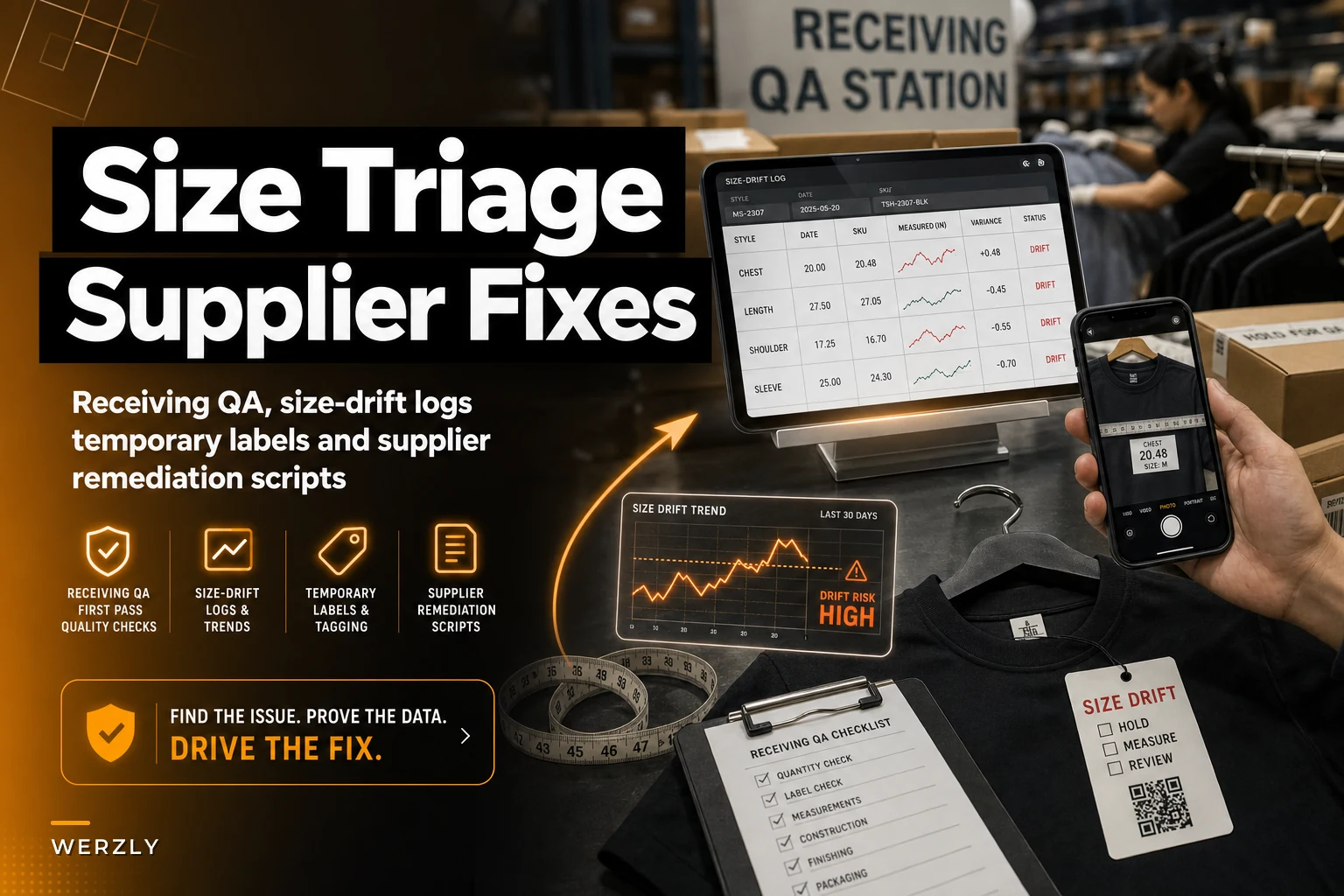

The tricky thing about size drift isn't that a supplier sends you the wrong sizes. It's that they send you sizes that are technically correct on the tag but wrong in reality. A medium tee that measures 20.5" across the chest in your spring order and 22" in the fall reorder. Same SKU. Same tech pack. Same tag. Completely different garment on the body.
By the time you notice, it's usually because a customer is standing at the counter holding two of "the same" shirt asking why one fits and one doesn't. Or your returns spreadsheet starts stacking up on a single style and you can't figure out why — the product page didn't change, but the returns did.
This post is about that specific problem: catching size inconsistency at receiving, logging it in a way that builds a case, and pushing it back to the supplier before it eats your season's margin. Not general QC, not vendor selection. Just this one recurring, expensive headache.
Why size drift slips past most receiving processes
Most receiving checks are built to answer one question — did we get what we ordered? Right SKUs, right quantities, right colors, no obvious damage. Almost none are built to answer is this the same garment we got last time?
-
Factory changed the pattern grader between runs and nobody flagged it upstream.
-
Fabric swap — a supplier substitutes a slightly different jersey with more or less stretch, so a garment that measures identically still fits differently.
-
Shrinkage spec ignored — the garment was cut to spec but washed or finished differently, so it comes off the line 3–4% smaller.
-
Multiple factories, one PO. Larger suppliers split your order across two plants and the grading isn't perfectly aligned between them.
Drift almost never happens on a first order. It shows up on the reorder, when the supplier is trying to hit a price or a deadline and quietly changes something. That's why receiving QA on reorders needs to be stricter than on first buys, not the same. Most stores do the opposite — they relax on reorders because "we already know this style."
The real cost, and why it hides
Size drift is expensive in a sneaky way because the damage spreads across three cost centers that nobody adds together.
Take control of your clothing store operations.
Werzly helps you manage stock, process orders, and engage customers effortlessly.
- Unified inventory and order management
- Automated customer notifications
- Sales and stock analytics
No credit card required
A typical example looks like this. You bring in roughly 240 units of a core tee across a season. The reorder drifts about half an inch tighter in the chest. You don't notice for three weeks.
| Cost center | What happens | Rough hit |
|---|---|---|
| Returns | Return rate on that style jumps from ~8% to ~19% | ~26 extra returns, restocking + shipping if online |
| Markdowns | You mark down the "runs small" batch to clear it | ~$4–$7 lost margin per unit on ~120 units |
| Staff time | Fitting-room reassurance, exchanges, complaint handling | Hard to see, real |
| Reputation | Reviews mentioning "sizing is off now" | Suppresses future full-price sell-through |
Add it up and a single drifting reorder can quietly cost somewhere in the low four figures on one style. Run five or six drifting styles in a year and you're looking at real money that never shows up as a line item called "size drift." It's buried inside returns and markdowns, which is exactly why it survives.
If you already run a monthly shrinkage micro-audit, think of size drift as the same category of loss — small, recurring, and invisible until you go looking for it.
The receiving inspection checklist (built specifically for size drift)
You don't need to measure every unit. You need a sampling routine that's tight enough to catch drift and fast enough that staff will actually do it. This runs after your normal floor-ready receiving check, and it only kicks in on styles that carry sizing risk — fitted, stretch, anything with a history of complaints.
-
[ ] Chest/bust measured flat, pit to pit, laid smooth — no stretching the fabric
-
[ ] Body length from high point of shoulder
-
[ ] Waist where applicable, at the natural narrowing
-
[ ] Sleeve length for anything fitted or long-sleeve
-
[ ] Inseam and front rise for bottoms
-
[ ] Fabric hand check — does the stretch feel like last batch? Subjective, but catches fabric swaps
-
[ ] Tag vs. tech pack — does the printed size match your spec sheet tolerance?
Two rules that make this work in practice:
-
Measure against your last-received batch, not just the tech pack. The tech pack tolerance might be ±0.5", but if last season ran at the top of that tolerance and this one runs at the bottom, that's a full inch swing on the floor even though both technically "pass."
-
Photograph the tape measure on the garment. A photo of the tape reading next to the tag is worth more in a supplier dispute than any number typed into a spreadsheet. Suppliers argue with spreadsheets. They don't argue with photos.
A photo of the tape reading next to the tag will make supplier discussions and claims far more effective than numbers alone.
Pull roughly 3 units per size for small orders, 5 for larger ones, and check the items above. Two rules that make this work in practice are measuring against your last-received batch and photographing the tape on the garment.
The size‑drift logging template
The log is what turns "this batch feels small" into something you can actually act on. Keep it simple or nobody maintains it. One row per size per receiving.
| Field | Example entry |
|---|---|
| Date received | 2024-09-14 |
| Style / SKU | Core Crew — CC-100 |
| Size | M |
| Sample size (units measured) | 5 |
| Spec (tech pack) | 21.0" chest |
| Tolerance | ±0.5" |
| Last batch avg | 20.9" |
| This batch avg | 20.1" |
| Drift vs last batch | −0.8" |
| Within tolerance? | Barely (borderline) |
| Photo link | ✔ |
| Flag | 🔴 Investigate |
The single most useful column is drift vs. last batch. A garment can pass tolerance every single time and still drift a full inch over three reorders because it walks slowly toward the edge. Tracking batch-to-batch delta catches that slow walk that tolerance checks miss entirely.
Set a simple flag rule: green if drift is under 0.3", yellow at 0.3–0.5", red above 0.5" or if two consecutive batches trend the same direction. That trend part matters — one small batch could be measurement noise, two in the same direction is a pattern.
A spreadsheet starts to hurt once you're tracking a few dozen SKUs across multiple receivings. The manual comparison to "last batch" gets skipped, which is exactly when drift sneaks through. Pushing this into whatever inventory or receiving system you already use is worth the effort — not because of anything fancy, but because having last batch's numbers automatically surface next to today's means the comparison happens without someone having to remember to do it.
Temporary web size labels — buying yourself time online
This is the part most stores miss. When drift is confirmed but the stock is already committed and you can't send it back quickly, you still have to sell through it. Selling it silently and eating the return wave is the mistake.
-
"This batch runs about half a size small — if you're between sizes, we'd size up."
-
"Fit note
current stock measures slightly slimmer through the chest than usual."
Simple language. No apology essay. Two things happen: return rates on that batch drop noticeably because customers self-correct at the point of purchase, and the reviews stop filling up with "sizing changed" complaints because you got ahead of it.
-
Tie the label to the batch, not the SKU forever. Pull it the moment corrected stock lands, or you'll be scaring off buyers of a product that's now fine.
-
Put the note near the size selector, not buried in the description tab. Nobody reads the tab.
-
Match the note to your actual measured drift. If you measured −0.8", "runs slightly small" is honest. Saying "true to size" to protect the sale turns a fit note into a trust problem.
The temporary label is a stopgap while remediation runs in the background — not a way to advertise a defect.
Supplier remediation scripts for quick action
The reason drift complaints go nowhere is that they arrive vague and late. "Hey, some customers are saying the mediums run small lately" gives a supplier nothing to act on and every reason to shrug. What gets action is specific, dated, and documented.
-
The measured-fact message (day one). > "On PO #4471 received 9/14, style CC-100 size M measured 20.1" chest across a 5-unit sample vs. 20.9" on the prior batch (PO #4102) and a 21.0" spec. Photos attached showing tape readings. This is outside our expected batch-to-batch consistency. We need to understand what changed in this run."
-
The ask (same message). > "Please confirm
(a) whether the pattern grade, fabric, or finishing changed on this run, (b) whether other sizes are affected, and (c) what remedy you're proposing — corrected replacement, credit, or discount on the affected units."
-
The remedy options (their reply, your call). - Corrected replacement stock (best if timing allows) - Partial credit to fund your markdown on the drifting batch - Discount on the next PO (only if you're confident the root cause is fixed)
-
The prevention commitment (before you reorder again). Get the fix in writing and add a first-article approval requirement to the next PO — they send you a sample from the actual production run before it ships, and you measure it against spec.
Here's a quick visualization of that escalation flow.
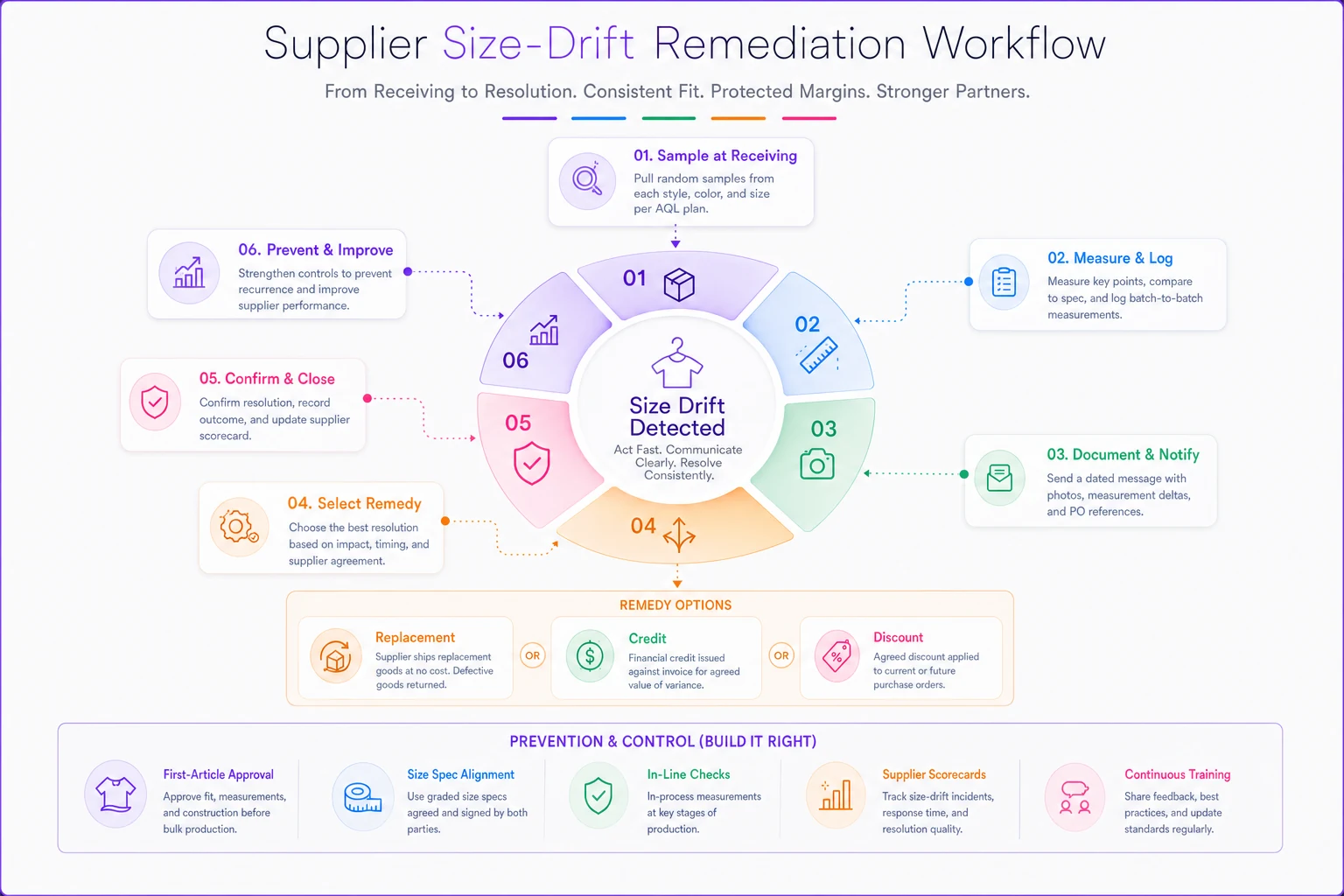
Keep the first message unemotional and short. A wall of frustration invites a defensive reply. Always attach the photo. A supplier who gets a dated PO number, a sample size, before/after averages, and a photo of the tape knows you're keeping records — and stores that keep records get taken more seriously.
This ties directly into your broader vendor onboarding and quarterly scorecard work. A drift incident should ding the supplier's consistency score, not just get resolved and forgotten.
A short real scenario
A small women's apparel shop — two locations, decent online store — kept getting hammered on returns for one bestselling fitted tee. The return rate on that style had crept from around 9% to just under 20% over two reorders, and the owner assumed it was a photography or description issue since the product page hadn't changed.
Once they started sampling five units per size at receiving and logging batch-to-batch numbers, the pattern was obvious in one afternoon: the third reorder had drifted about 0.7" tighter in the chest and roughly 0.4" shorter in body length. The fabric had also been quietly swapped to a firmer knit with less give, which made the smaller measurements feel even tighter than the numbers alone suggested.
They did three things at once: added a temporary "runs slightly small, size up if between sizes" note on the affected batch online, sent the measured-fact message to the supplier with photos, and negotiated a partial credit that covered a controlled markdown on the tight stock. The supplier confirmed a factory change and agreed to a first-article sample on the next run.
Returns on that batch settled back toward the low teens within a few weeks, and the next reorder came in on spec because they measured the pre-production sample before approving it. Nothing dramatic. No new hire, no big system. Just measuring the right things, writing them down, and having a specific conversation instead of a vague one.
When this level of rigor is worth it — and when it isn't
Not every style needs this. Running full drift triage on a boxy graphic tee with near-zero returns is wasted effort.
Worth the full checklist and log: fitted styles, anything with stretch or a specific fit reputation, core reorders you'll buy repeatedly, and any SKU already showing elevated returns. These are where drift converts straight into refunds.
Skip it or go light: loose fits, one-time fashion buys you won't reorder, accessories, and low-return categories. A quick tag-vs-spec glance is enough.
If you're running more than a handful of at-risk SKUs across multiple reorders in a season, manual last-batch comparison will get skipped exactly when you need it most. That's the point where it makes sense to let your receiving or inventory system carry the batch-to-batch comparison automatically — so the flag appears on its own instead of depending on someone remembering to look back three months.
The takeaway that actually matters
Size drift survives because it's measured nowhere and blamed on everything else — bad product photos, picky customers, "sizing just runs weird online." The fix isn't complicated. Sample a few units on at-risk reorders, log the delta against last batch, get ahead of it online with an honest temporary fit note, and send the supplier a dated, photographed, numbers-first message before the returns pile up.
Do that consistently and two things change. Your returns stop spiking on styles you didn't touch, and your suppliers start holding their runs tighter because they know you're the buyer who measures. That reputation — being the store that actually catches drift — is worth more over a few seasons than any single credit you'll negotiate.
Do that consistently and two things change. Your returns stop spiking on styles you didn't touch, and your suppliers start holding their runs tighter because they know you're the buyer who measures. That reputation — being the store that actually catches drift — is worth more over a few seasons than any single credit you'll negotiate.
Ready to elevate your apparel business?
Join 2,000+ retailers using Werzly to streamline operations, increase sales, and deepen customer loyalty.