


Most sustainability programs at small clothing stores fail for a boring reason: nobody owns the numbers. Resale gets launched as a rack in the corner. Repairs happen when a nice customer asks. Donations go out the back door with no record of what left or why. Six months later the owner has a vague sense they're "doing good" and no idea whether any of it makes or loses money.
That's the wrong way to think about circularity. Resale, repair, take-back, and donation aren't charity. They're channels. And like every channel in your store — full-price floor, markdown, online, pop-up — they either carry their weight or they quietly eat labor hours and floor space you can't spare.
This is a playbook for running circularity like an operating channel: staged pilots so you don't overcommit, partner scorecards so you know who's actually worth working with, and P&L guardrails so a "sustainability initiative" never turns into a slow margin leak you don't notice until tax season.
Why circularity usually breaks at small retailers
The common pattern isn't lack of intention. Owners genuinely want to reduce waste, and customers increasingly ask about it. The break happens at the operational layer.
Circular flows create inbound inventory that behaves nothing like the product you buy from vendors. A trade-in jacket arrives with no SKU, no size verified against your standards, unknown condition, and zero cost basis. Your entire back-of-house — receiving, tagging, pricing, forecasting — is built around clean vendor deliveries. Toss used goods into that machine and it jams.
Then there's labor. A single resale item can require inspection, cleaning, minor repair, re-pricing, photographing, and listing. That's 15–25 minutes of skilled time on an item that might sell for $22. Nobody costs this out at launch, so the program looks profitable on the surface and loses money per unit underneath.
Coordination fails quietly too. Floor staff doesn't know which donation partner takes what. The person handling repairs isn't the person who quoted the customer a timeline. Take-back credits get issued inconsistently. None of it lives in a system, so it lives in someone's head — and that person eventually quits or gets buried in something else.
What breaks at scale is predictable: the more successful your circular program gets, the more it strains the exact same people and space your core business depends on. Success becomes the problem.
The channel mindset: give circularity a P&L, not a mission statement
Before you launch anything, decide what you're actually optimizing for. There are three legitimate goals, and they demand different guardrails:
Take control of your clothing store operations.
Werzly helps you manage stock, process orders, and engage customers effortlessly.
- Unified inventory and order management
- Automated customer notifications
- Sales and stock analytics
No credit card required
-
Margin-positive resale — you want the channel to contribute profit, full stop.
-
Customer acquisition / retention — take-back and repair exist to pull people back into the store, and you'll tolerate thin or breakeven margins.
-
Waste diversion — donation and recycling exist to move product responsibly, and the goal is cost control, not profit.
Most owners never separate these, so they judge a donation program by profit (it has none) or a resale rack by foot traffic (not the point). Name the goal per flow, then measure against that goal only.
Here's a simple frame for how the four circular flows differ operationally:
| Flow | Primary goal | Labor intensity | Margin profile | Biggest failure risk |
|---|---|---|---|---|
| Resale (owned) | Profit | High | Positive if priced right | Labor cost hidden per unit |
| Repair service | Retention + revenue | High, skilled | Positive if quoted right | Underquoting time |
| Take-back / trade-in | Retention | Medium | Breakeven by design | Credit issued too generously |
| Donation / recycle | Diversion | Low | Cost center | No record of what left |
The point of the table isn't the categories themselves — it's that treating all four the same is where owners lose the plot. A recycle bin and a resale rack are not the same business.
Stage your pilots — don't launch a program, run an experiment
Stores that actually make circularity work don't "roll out sustainability." They run a narrow pilot, watch the numbers, and expand only what earns it.
-
Pick one flow and one narrow scope. Not "we now do resale." Instead: "we'll resell women's outerwear in good condition, 30 units max, for six weeks." Constraints make the pilot measurable.
-
Set a hard labor budget. Decide up front you'll spend no more than, say, 6 hours a week processing pilot inventory. If it takes more, that's data — the unit economics don't work at your current price point.
-
Track true cost per unit. Acquisition cost (or credit issued) + processing minutes × loaded labor rate + any repair materials. Write it on the tag. You can't judge the pilot without this.
-
Run for a fixed window, then decide. At the end, three outcomes only: expand, adjust, or kill. No "let's just keep it going and see."
-
Document the SOP as you go. The pilot's real output isn't revenue — it's a repeatable process you can hand to staff.
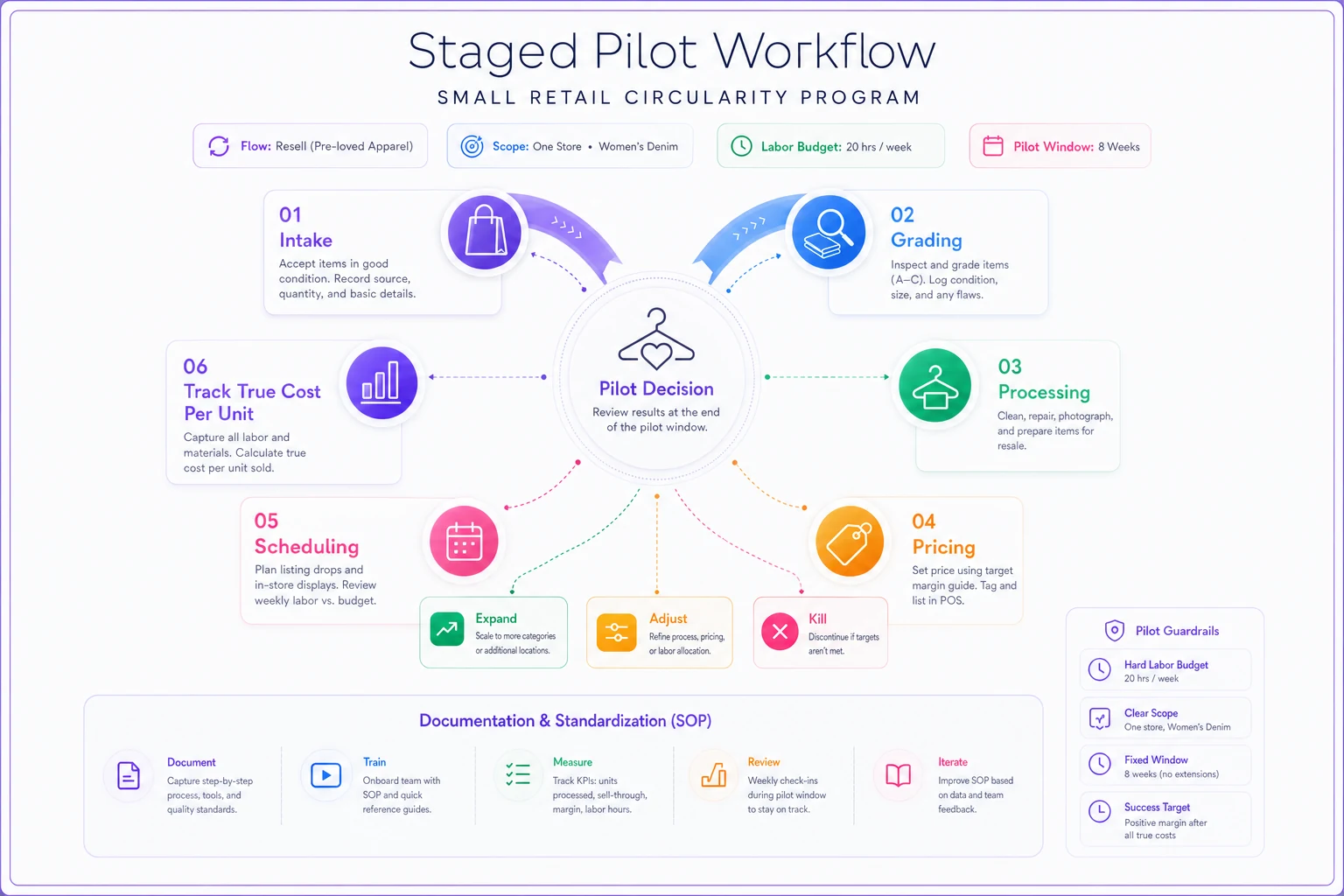
This illustrates the staged pilot flow from pick through decision, highlighting constraints and measurement points.
The mistake is launching all four flows at once because they all feel virtuous. You end up with four half-run experiments and no clean read on any of them. One flow, done properly, teaches you more.
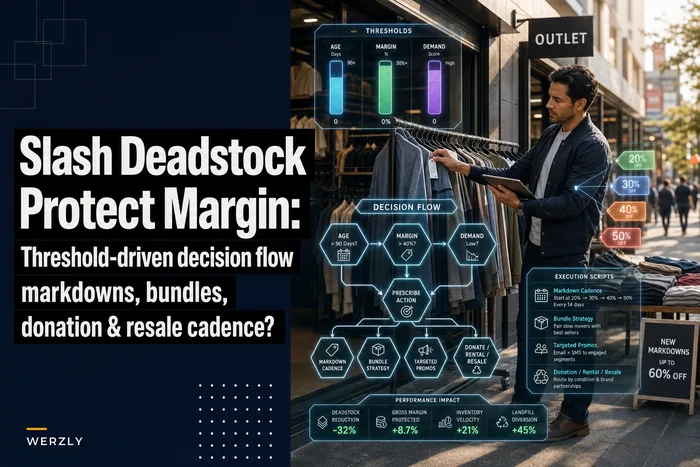
If slow-moving inventory is part of what's pushing you toward resale and diversion in the first place, it's worth tightening that upstream first — a lot of "we need a circular outlet" pressure is really a buying and markdown problem. Our step-by-step decision flow for slow-moving SKUs covers where deadstock should actually go before it ever reaches a circular channel.
The resale pilot checklist
Before you take in a single trade-in or consignment piece, run through this. It's the difference between a clean pilot and a back room full of unsellable clutter.
-
[ ] Condition standard written down. Define A/B/C grades with photos. "Good condition" means nothing until it's on paper.
-
[ ] Intake cap set. Max units per week so you don't drown.
-
[ ] Loaded labor rate calculated. Wage + payroll burden ÷ productive hours. You'll need this for every unit.
-
[ ] Pricing rule defined. Percentage of original retail, or fixed tiers by grade — decided before, not per-item.
-
[ ] Reject criteria clear. What you refuse (stains, heavy wear, brands you can't move) and a polite script for staff.
-
[ ] Storage lane assigned. Physical space for intake, in-process, and ready-to-sell. Circular inventory needs its own zone or it contaminates everything.
-
[ ] Disposition path for rejects. What happens to items you take but can't sell — donate, return, recycle. Decide before intake.
-
[ ] Break-even price identified. Below this number, the unit loses money. Anything at or below it doesn't go on the floor.
That last item is where most resale pilots quietly bleed. If your break-even on a processed item is $18 and your grading pushes half of intake into a tier that sells for $15, the channel is negative and no amount of foot-traffic goodwill fixes it.
Attach the calculated break-even to the item tag so decisions are visible at the point of sale and staff can see unit economics.
If your break-even on a processed item is $18 and your grading pushes half of intake into a tier that sells for $15, the channel is negative and no amount of foot-traffic goodwill fixes it.
Repair SOPs that don't underquote your own time
Repair is the flow owners most consistently lose money on, because it's the one where you're most tempted to be generous. A hem, a button, a zipper swap — "it'll only take a minute." It never takes a minute.
A workable repair SOP needs four things nailed down:
1. A time-based quote table. Pre-set your prices by repair type and estimated minutes, not by eyeballing each job. Button: 10 min. Hemming: 20–30 min. Zipper replacement: 45–60 min plus materials. Price each at your loaded labor rate plus a margin, and post it so quotes are consistent no matter who's at the counter.
2. A written intake ticket. Item description, requested work, quoted price, promised date, and a photo of the item's pre-repair condition. The photo alone kills most "it wasn't damaged before" disputes.
3. A realistic turnaround commitment. The fastest way to poison a repair program is over-promising. If your one seamstress works Tuesdays and Thursdays, don't quote "by Friday." Build the schedule into the promise.
4. A margin floor. Any repair quoted below a set dollar amount either gets bundled or declined. A $4 button repair that takes 12 minutes of skilled labor plus counter time is a loss you're eating for free.
The thing most people miss: repair only works as a channel when it's scheduled, not squeezed in. The moment it becomes "whenever someone has a free minute," turnaround slips, quotes get inconsistent, and the whole thing feels like a favor instead of a service. Batch repairs into fixed blocks and the economics hold.
The donation and partner scorecard
Every circular flow that involves an outside party — donation charities, recyclers, consignment platforms, textile processors — needs to be scored. Not because you're being harsh, but because "we've always used them" is how stores end up with a partner who's unreliable, opaque, or quietly costs more than they should.
Score each partner quarterly on a simple 1–5 scale:
| Criteria | What you're checking | Weight |
|---|---|---|
| Reliability | Do they pick up / accept on schedule? | High |
| Volume capacity | Can they absorb your peak (post-season) loads? | High |
| Documentation | Do they give you records for tax / reporting? | Medium |
| Cost / value returned | Fees charged, or resale split, or tax value | High |
| Transparency | Do you know where product actually ends up? | Medium |
| Ease of coordination | How much staff time per handoff? | Medium |
Anything scoring 2 or below on a high-weight criterion goes on a remediation conversation or a replacement search. The pattern worth watching: a donation partner that's easy in your slow season often can't handle your January or post-summer clear-out volume, and you find out exactly when you can least afford it. Capacity is the criterion stores consistently under-test.
Documentation deserves special attention if donations feed any tax reporting. "We gave a bunch of stuff to a shelter" is not a record. You want itemized receipts with quantities and fair-market values, landing in the same place as the rest of your financials — not in a shoebox.
Channel-level P&L guardrails
This is the part that keeps sustainability from turning into a slow leak. Each circular flow gets guardrails — automatic triggers that tell you when something's off, before it compounds.
Resale guardrails:
-
If cost-per-unit exceeds your break-even on more than 20% of intake, pause intake and re-grade your standards.
-
If ready-to-sell inventory sits longer than a set aging window (say 45 days), it markdowns or moves to donation. Circular stock deadstocks just like regular stock.
-
If processing labor exceeds your weekly budget two weeks running, you're either overpricing intake or over-accepting.
Repair guardrails:
-
If average repair margin drops below your floor, audit your quote table — you're probably underquoting time.
-
If turnaround promises slip past a threshold rate, you've over-committed capacity; cap intake.
Take-back guardrails:
-
If credit issued per period exceeds a percentage of what those trade-ins actually generate in resale, your credit is too generous. This one runs negative silently for months if you don't watch it.
Donation guardrails:
-
If diversion cost per unit exceeds your simple disposal cost with no offsetting benefit (tax, brand, retention), question the partner or the flow.
The unifying principle: every guardrail is a number with a trigger and an action, not a vibe. "Keep an eye on resale" isn't a guardrail. "Pause intake at 20% break-even breach" is.
None of this works if your circular inventory lives outside your main system. The whole reason these flows leak is that trade-ins, repairs, and resale items don't get the same tracking, aging, and margin visibility as vendor stock. If you've already built clean inventory economics — the kind of sell-through-to-markdown threshold system that governs your core buy — extend those same thresholds to circular stock rather than treating it as a separate, untracked pool.
When circularity actually makes sense — and when it doesn't
When it makes sense:
-
Your customer base already asks about it, and you're losing goodwill by having no answer.
-
You have slow-moving or returned inventory that has a better home than the clearance rack.
-
You have at least one person who can own the SOPs without dropping their core job.
-
Your margins on the core business are healthy enough to absorb a pilot that might break even.
When it's a bad idea right now:
-
Your back-of-house is already overwhelmed. Circular inbound will make receiving and floor prep worse, not better.
-
You're running thin on labor and can't carve out scheduled processing time.
-
Your inventory data is a mess. If you can't track your regular stock cleanly, circular stock will disappear into the chaos.
-
You're launching it primarily to look good rather than to solve a real customer or waste problem. Programs with no operational goal don't survive their first busy season.
Stores that haven't stabilized their core forecasting and buying should hold off entirely. Circularity adds inventory complexity, and if you're already fighting stockouts and overstocks, adding an unpredictable inbound stream makes it worse. Get your inventory forecasting tightened up first — a circular channel layered on top of a shaky forecast just amplifies the noise.
A real scenario
A women's apparel shop — two locations, roughly $1.1M combined annual revenue — kept getting asked about take-back and resale by younger regulars. Instead of a full launch, they ran a six-week resale pilot at one store: outerwear only, 25-unit cap, grades A and B, priced at 35–45% of original retail.
The first read was ugly. Processing was taking around 22 minutes per unit, and nearly a third of intake was landing in a tier that barely cleared break-even. Their loaded labor rate made those units a wash at best. So they adjusted: tightened the condition standard, dropped grade C entirely, and batched processing into two scheduled blocks a week instead of squeezing it in throughout the day.
By the end of the window, processing time per unit dropped to the low teens in minutes, and the channel moved from roughly breakeven to a modest but real contribution — a few hundred dollars a month on a small unit count. More useful than the money: the take-back credits pulled a noticeable share of those customers back in within 30 days, and several bought full-price product on the same visit.
They didn't expand to both stores until the SOP was documented and the guardrails were set. The pilot's real output wasn't the profit — it was knowing exactly which conditions made the channel work and which ones sank it.
Bringing it together
Circularity fails at small retailers when it runs on good intentions and lives in someone's head. It works when it's treated like every other channel you already manage: a defined goal per flow, staged pilots with hard budgets, partners you actually score, and guardrails that trigger action before a leak becomes a habit.
The stores getting real value from resale, repair, and take-back aren't the ones with the biggest sustainability statements. They're the ones who treated it as an operational discipline — measured the labor, priced against a real break-even, and killed the flows that didn't earn their space. Give circularity a P&L and it becomes a genuine part of the business. Give it a mission statement and it becomes a slow, well-meaning drain.
Circularity fails at small retailers when it runs on good intentions and lives in someone's head. It works when it's treated like every other channel you already manage: a defined goal per flow, staged pilots with hard budgets, partners you actually score, and guardrails that trigger action before a leak becomes a habit.
The stores getting real value from resale, repair, and take-back aren't the ones with the biggest sustainability statements. They're the ones who treated it as an operational discipline — measured the labor, priced against a real break-even, and killed the flows that didn't earn their space. Give circularity a P&L and it becomes a genuine part of the business. Give it a mission statement and it becomes a slow, well-meaning drain.
Ready to elevate your apparel business?
Join 2,000+ retailers using Werzly to streamline operations, increase sales, and deepen customer loyalty.