



Most small apparel buying doesn't fail because someone made a bad call. It fails because nobody was clear on who was allowed to make the call, when it should have been made, and what data they needed before deciding. The reorder that should've happened three weeks ago sits in a mental to-do list. The markdown that should've been triggered by sell-through gets pushed because "let's give it another weekend." The test buy that flopped never officially gets killed — it just quietly rots on the back wall.
This is a governance problem dressed up as a merchandising problem. And it gets worse, not better, as you add square footage, staff, or a second location.
A buyer decision matrix for retail is basically a contract with yourself: for each type of buying decision, you pre-decide who owns it, how often you look at it, and which numbers justify pulling the trigger. Once that's written down, most of the second-guessing disappears — because the decision already got made in principle. You're just executing the rule.
Below is how this actually works, where it breaks at different store sizes, and templates you can copy this week.
The four decisions that actually matter
Strip away the noise and almost every buying action collapses into four decisions:
-
Reorder — buy more of something that's already working
-
Test buy — bring in something new, small, to see if it sells
-
Markdown — cut price to move stock that isn't hitting velocity targets
-
Kill — stop buying a SKU/vendor/category entirely and clear what's left
Each of these has a natural rhythm. Reorders on fast movers need to be looked at weekly or you stock out. Kills are quarterly calls — you don't want to euthanize a style after one slow week. Test buys sit in the middle. Markdowns depend on your season, but the review of markdown candidates should be a fixed cadence, not a mood.
The mistake most owners make is treating all four on the same schedule — usually "whenever I sit down to do buying." So the slow-decision (kill) and the fast-decision (reorder) compete for the same attention, and the fast one loses because it's less dramatic. Reordering a basic tee that's quietly selling out feels boring next to agonizing over whether to drop a whole vendor. Boring wins you money. Drama usually costs it.
Why decision rights blur as you grow
At one owner, one store, everything runs through your head. That works, sort of, until it doesn't. The problem isn't that you make bad decisions — it's that you're the single point of failure for all decisions, so anything you don't personally get to just... doesn't happen.
Take control of your clothing store operations.
Werzly helps you manage stock, process orders, and engage customers effortlessly.
- Unified inventory and order management
- Automated customer notifications
- Sales and stock analytics
No credit card required
Solo / single store. You own all four decisions. The failure point is bandwidth and consistency. You reorder when you remember. You markdown when the rack looks ugly. There's no cadence, so timing is random, and random timing on markdowns quietly bleeds margin.
2–4 staff, still one store. Now you've got someone helping on the floor who sees the stockouts before you do — but they have no authority to reorder, so they tell you "we're out of the black joggers again" and by the time you act, you've lost two weeks of sales. The information and the authority live in different people. That gap is the whole ballgame.
Two-plus locations. Now allocation enters the picture and decision rights get genuinely messy. Who decides whether to reorder for the whole company or transfer between stores? Who owns the markdown call when a style is dead at store A but moving at store B? If you haven't written this down, both managers assume the other is handling it, and the stock sits.
The pattern underneath all of this: decisions need to sit with whoever has the fastest access to the triggering data — as long as that person has a clear rule to follow. A floor lead can absolutely own reorder execution on core basics if the rule is "when on-hand drops below X weeks of cover, reorder to Y." That's not judgment. That's arithmetic. You keep the judgment calls (kills, new vendors, big test buys) and delegate the arithmetic.
The decision-rights matrix
Here's the core template. Adjust the thresholds to your economics — the structure is what matters.
| Decision | Cadence | Who owns it (by store size) | Required data inputs | Trigger rule (example) |
|---|---|---|---|---|
| Reorder (core/basics) | Weekly | Solo: owner · 2–4 staff: floor lead · Multi: store manager | On-hand units, weeks-of-cover, sell-through %, vendor lead time | Weeks-of-cover < lead time + 2 → reorder to target |
| Reorder (fashion/seasonal) | Weekly review, buyer decides | Owner/buyer at all sizes | Sell-through by week, size-curve health, remaining season weeks | ST > 60% at week 3 AND >4 weeks left → chase |
| Test buy | Monthly | Owner/buyer | Category gaps, vendor terms, open-to-buy remaining, prior test win-rate | Cap test buys at set % of monthly OTB |
| Markdown | Monthly review (weekly in peak) | Solo: owner · Multi: manager recommends, buyer approves | Age since receipt, sell-through vs. plan, current margin, sell-through velocity | ST < 40% at week 6 → first markdown tier |
| Kill (SKU/vendor) | Quarterly | Owner/buyer only | Full-life sell-through, return rate, GMROI, vendor scorecard | GMROI below floor 2 quarters running → kill |
A few things worth calling out.
Reorder is split into two rows intentionally. Core basics and fashion pieces are not the same decision and shouldn't follow the same rule. Basics are about never stocking out — pure replenishment math you can delegate. Fashion is about reading early signal and chasing a winner before the season closes — that stays with the buyer. Lumping them together is why so many small stores both stock out of their bread-and-butter and over-chase a trend that already peaked.
Kill is quarterly and owner-only. Killing a vendor has ripple effects — open POs, minimums, the relationship. That's not a decision you want made in a Tuesday-morning rush. Giving it a slow, deliberate cadence protects you from emotional kills after one bad month.
Here's a simple visualization of how the matrix connects people, cadence, and triggers.
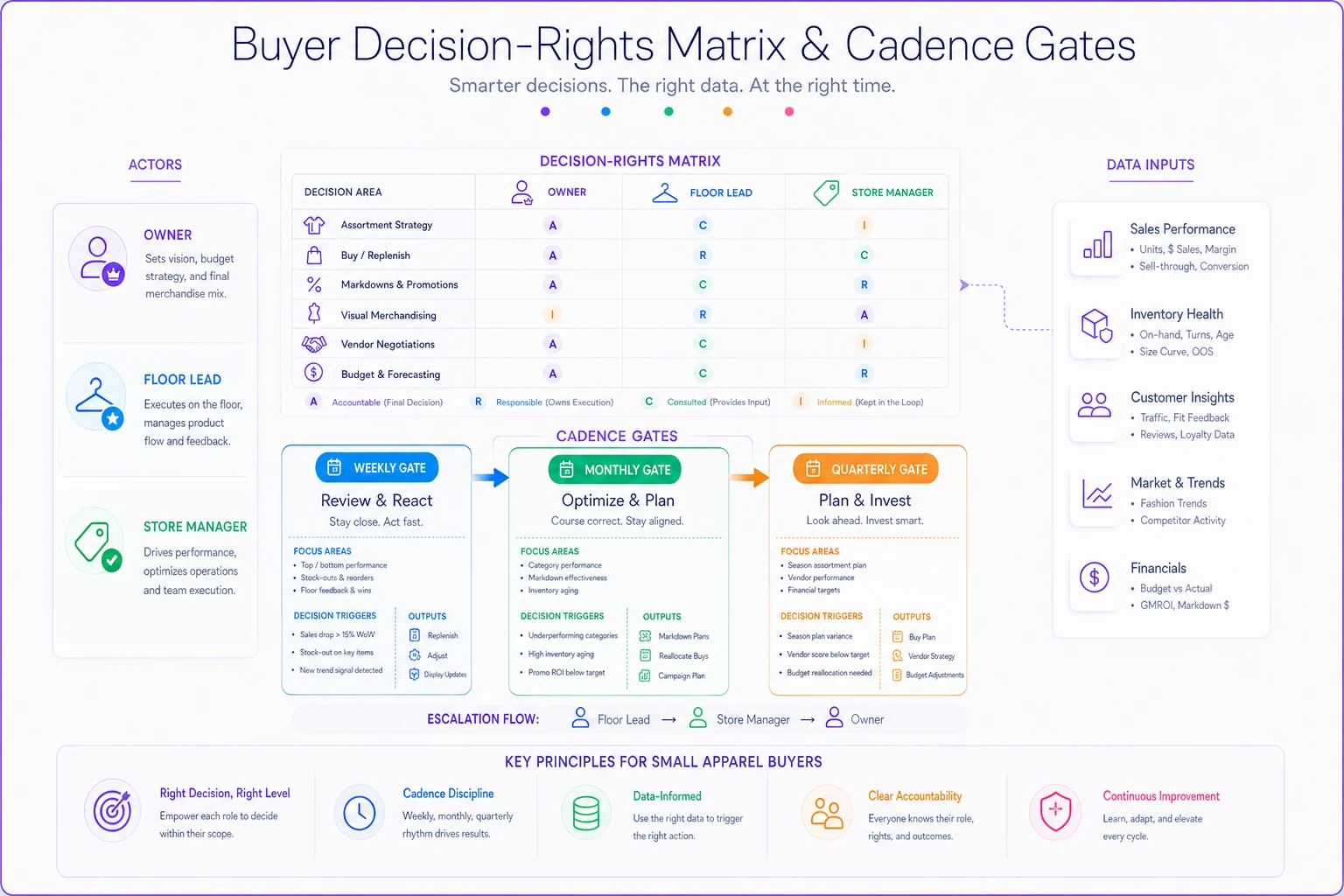
This shows the flow from data inputs to owner/floor lead actions across weekly, monthly, and quarterly gates.
The cadence gates: weekly, monthly, quarterly
The matrix tells you who and what. The cadence gates tell you when — and just as importantly, they batch decisions so you're not making them scattered across the week.
Weekly gate (15–20 minutes)
This is the replenishment and early-signal pass. Fast, mostly mechanical.
-
Units sold last 7 days, by SKU (top and bottom movers)
-
Current on-hand and weeks-of-cover on all core SKUs
-
Any style that stocked out this week (so you can decide chase vs. let-die)
-
Fashion pieces now at week 3–4 of their life, with sell-through %
The weekly gate produces two outputs: reorders on basics (execute) and a shortlist of fashion styles to either chase or flag. That's it. You are not making markdown or kill calls here. Keeping the weekly gate narrow is what makes it sustainable long-term — the second it becomes a two-hour meeting, people stop doing it.
Keep the weekly gate under 20 minutes to keep it sustainable.
Monthly gate (60–90 minutes)
This is where markdown review and test-buy decisions live.
-
Sell-through vs. plan for every style received 4+ weeks ago
-
Aged inventory report (anything past its expected sell-window)
-
Open-to-buy remaining for the month and quarter
-
Category performance vs. plan — where are you over/under bought
-
Return rates on recent receipts (a spike changes whether you reorder)
Your monthly gate should tie directly to your inventory economics. If you've built out sell-through thresholds that convert into buy and markdown signals — the kind of system covered in a retail P&L and inventory-economics approach that turns sell-through into monthly buy/markdown thresholds — this gate is just where you read those signals and act. The threshold work happens once; the monthly gate is the recurring checkpoint.
Quarterly gate (half a day)
The strategic pass. Kills, vendor decisions, category re-balancing.
-
Full-life sell-through and GMROI by vendor and category
-
Vendor scorecards (fill rate, defect rate, lead-time reliability)
-
Category role review — are your traffic-drivers still driving traffic?
-
Deadstock aging into markdown-of-last-resort territory
-
Next-season open-to-buy framing
The quarterly gate is where you decide what not to buy again. This connects tightly to how you've defined category roles and velocity bands — if you've set up an assortment architecture with category roles and velocity bands, the quarterly kill decisions basically fall out of it. A style that was supposed to be a velocity driver but sat in the bottom band for two quarters isn't a judgment call anymore. It's a documented miss.
A worked example across three store sizes
Same decision — reorder on a core legging that's selling — playing out at three scales.
Small store (solo owner, ~$400k/yr). Owner runs the weekly gate Monday morning. Sees the black legging is down to 6 units, weeks-of-cover about 1.5, lead time 3 weeks. Rule says reorder. Owner places it in 4 minutes. Total decision cost: negligible. The risk here is skipping the gate — one busy Monday and the reorder slips, and now you're out of your best seller for a week.
Mid store (owner + 3 staff, ~$900k/yr). Owner delegated basic reorders to the floor lead with a written rule and a target-cover table. The floor lead runs the weekly numbers, flags the legging, and reorders to target without asking. Owner reviews the reorder log after the fact. This is the leap most stores fumble — they want to delegate but never write the rule, so the floor lead has to ask permission every time, which defeats the point.
Two locations (~$1.6M combined). Now it's an allocation decision, not just a reorder. Store A is out; store B has 14 units moving slowly. The rule needs to say whether to transfer or buy. A good matrix pre-decides this: "If sister store has >2 weeks cover above target, transfer before reordering." That single rule prevents both the double-buy (both stores order, both overstock) and the stalemate (each waits for the other). Margin-aware allocation logic like this — deciding where a unit earns most — is the heart of a margin-adjusted omnichannel allocation matrix, and at two-plus locations it stops being optional.
A short real scenario
A women's boutique doing roughly $750k a year, one location, owner plus two part-timers. The owner did all buying "on feel," usually Sunday nights, all four decision types crammed into one session. Reorders on basics were chronically late — she'd stock out of core denim for a week or two most months. Markdowns happened only when a rack looked embarrassing, which meant she was often marking down at week 10 or 11 with almost nothing left to salvage.
She split the work into the three gates. Weekly gate delegated to her most reliable part-timer using a simple cover-target rule on about 40 core SKUs. Monthly gate stayed with her for markdowns, tied to a sell-through-at-week-6 trigger. Quarterly for kills.
Over the following couple of quarters, core stockouts dropped off noticeably — she wasn't losing those routine denim sales anymore. Because markdowns were now triggered at week 6 instead of week 10, her average markdown depth came down; she was taking 20–30% off a style with weeks left to sell instead of dumping it at 60% at the end. Nothing dramatic month to month, but the margin recovery across a season was real. And — maybe more valuable — Sunday nights stopped being a three-hour buying panic.
When this makes sense (and when it doesn't)
When it's worth building: the moment you have more than one person who touches inventory, or more than roughly 150–200 active SKUs, or any second location. Below that, a lightweight version is fine, but even a solo owner benefits from the cadence discipline even if all four decisions still route to them.
When it's overkill: if you're a true micro-shop with under ~100 SKUs and one person, a full matrix with delegated rights is bureaucracy you don't need. Keep the weekly/monthly/quarterly rhythm but skip the who-owns-what rows — it's all you anyway.
Who should NOT delegate reorder authority: anyone who hasn't yet written down the actual trigger rule and target-cover numbers. Delegation without a rule isn't delegation — it's just moving the guessing to someone with less context. Get the rule right first, on paper, then hand it off.
Where a system beats a spreadsheet
You can run all of this in a spreadsheet, and plenty of stores do. The friction shows up in the data-gathering, not the deciding. Every gate above needs current numbers — weeks-of-cover, sell-through by week, aging, GMROI by vendor — and if pulling those numbers takes 40 minutes, you'll skip the gate on busy weeks. Skipped gates are where the whole system quietly falls apart.
That's the honest case for AI-powered operational software that keeps your SKU, sales, and inventory data in one place with reports pre-built: it's not that the software makes decisions for you. It's that it puts the right data in front of the right person at the right cadence so the gate takes 15 minutes instead of an hour. When the weekly cover report and the monthly sell-through-vs-plan report generate themselves, the discipline actually holds. The matrix defines the decision; the tooling removes the excuse to skip it.
Bringing it together
A buyer decision matrix for retail isn't a merchandising theory — it's an operating agreement about who decides what, when they look at it, and what numbers they need. Split your decisions into reorder, test, markdown, and kill. Give each a cadence that matches how fast it actually needs to move. Push the arithmetic decisions to whoever's closest to the data, keep the judgment calls for yourself, and write the rules down so delegation is real instead of theatrical.
Do that, and the two most expensive failures in small apparel buying — stocking out of your winners and marking down your losers too late — stop being recurring accidents and start being decisions you actually made on time.
A buyer decision matrix for retail isn't a merchandising theory — it's an operating agreement about who decides what, when they look at it, and what numbers they need. Split your decisions into reorder, test, markdown, and kill. Give each a cadence that matches how fast it actually needs to move. Push the arithmetic decisions to whoever's closest to the data, keep the judgment calls for yourself, and write the rules down so delegation is real instead of theatrical.
Do that, and the two most expensive failures in small apparel buying — stocking out of your winners and marking down your losers too late — stop being recurring accidents and start being decisions you actually made on time.
Ready to elevate your apparel business?
Join 2,000+ retailers using Werzly to streamline operations, increase sales, and deepen customer loyalty.