


Most clothing store owners think their SKU problem is an inventory problem. It's not. It's a naming problem that looks like an inventory problem three weeks later, when the numbers stop matching reality and nobody can explain why the "Navy Crew L" on the report doesn't exist on the floor.
Here's the pattern. You start with one person entering products. They know "BLK" means black, that a men's medium and a women's medium live in different worlds, and that the vendor shipping size runs as "S/M/L/XL" is different from the one shipping "2/4/6/8." That knowledge lives entirely in their head. Then you hire a second person. You add an ecommerce channel. A vendor changes their size codes mid-season. Suddenly you've got three SKUs for the same shirt, two of them with stock counts you can't trust, and a POS that throws errors at checkout.
This isn't about being more careful. Careful people create the same mess — just slower. The fix is a SKU master data single source of truth: one place, with real rules, that every channel and every person defers to. Not enterprise master data management with a six-figure consultant. Something a tiny team can actually maintain in an afternoon a week.
What actually breaks, and why it always happens the same way
The breakdowns aren't random. They cluster around a handful of predictable failure points.
The naming free-for-all. One person types "T-Shirt," another types "Tee," another types "SS Tee." Search stops working. Reporting fragments. You look up how many tees you sold and the number is wrong because a third of them are filed under a name you forgot you used.
The size-code collision. This is the quiet killer. A vendor sends you a "L" that fits like an "M." Another vendor uses numeric sizing. Your POS treats all "L"s as identical, so your size-curve reports are garbage, your reorders are off, and returns creep up because customers can't trust the size label. If you've dealt with vendor size drift before, you already know a clean size-code standard is what makes the whole thing manageable.
The vendor-name multiplicity. "Acme," "Acme Apparel," "Acme Apparel Inc.," and "ACME (new rep)." Four spellings, one vendor, and now your scorecard splits their performance across four rows so nobody looks bad enough to act on.
The orphaned SKU. A product gets created for a one-off, never gets a status, never gets archived, and sits in your active list forever — showing up in counts, cluttering search, occasionally getting accidentally reordered.
These four failures compound. A naming inconsistency creates a duplicate SKU. The duplicate splits the stock count. The split count triggers a phantom reorder. The reorder arrives, gets received under a third name, and now the size curve is wrong too. One sloppy field at creation cascades into a buying mistake two months later.
Governance is a creation-time problem, not a cleanup problem
Almost everyone treats data quality as something you fix periodically. You do a big messy audit, clean a few hundred records, feel good about it, and then it rots again because nothing changed about how records get created.
Take control of your clothing store operations.
Werzly helps you manage stock, process orders, and engage customers effortlessly.
- Unified inventory and order management
- Automated customer notifications
- Sales and stock analytics
No credit card required
Good governance moves the control point to the moment of creation. If a SKU is impossible to create wrong, you never have to clean it up. That's the whole game. Every rule below exists to make the right entry the easy entry.
For a tiny team, that means a fixed template, a controlled vocabulary for the parts that repeat, and a couple of lightweight audit rules that catch drift before it spreads.
A field-standard SKU naming template that survives growth
Your SKU should encode enough to be human-readable at a glance, but not so much that it becomes a novel. The sweet spot for apparel is a segmented code where each segment has a fixed, controlled value set.
A structure that holds up as you scale: [VENDOR]-[CATEGORY]-[STYLE]-[COLOR]-[SIZE] ACM-TEE-0142-BLK-M
-
Every segment uses codes, not free text. Vendors get a 3-letter code. Categories get a fixed 3-letter code (TEE, DEN, JKT, DRS). Colors get a standardized 3-letter code from a list you control. No exceptions.
-
Style is a number, not a name. Names change. "Boyfriend Tee" becomes "Relaxed Tee" next season and now you've got two style names for one silhouette. A number is stable and neutral.
-
Fixed segment lengths. Padding matters. Style 142 is
0142, not142. This keeps sorting clean and makes bad entries visually obvious. -
Parent style and variant are linked.
ACM-TEE-0142is the style. The full string with color and size is the variant. Reporting rolls up to the parent automatically when the naming is consistent.
Color and size codes should come from a master list.
The most important discipline: color and size codes come from a master list, not from whatever the person typing feels like. Ninety percent of duplicate SKUs originate in color and size fields, because that's where creativity sneaks in. "Navy" vs "NVY" vs "Dark Blue" is three colors to your system and one color to a human. Kill that.
Size-code templates: where apparel specifically goes wrong
General inventory advice ignores the thing that makes clothing hard — sizing isn't universal. A men's shirt size, a women's dress size, a numeric bottom size, and a shoe size are four different systems, and your SKU has to know which one it's dealing with.
The fix is a size-code namespace. Prefix the size with what type of size it is:
| Size Type | Namespace | Example codes |
|---|---|---|
| Alpha (unisex/men's/women's tops) | A | A-XS, A-S, A-M, A-L, A-XL |
| Numeric women's | W | W-00, W-02, W-04, W-06 |
| Numeric men's waist | M | M-30, M-32, M-34 |
| Waist/inseam (denim) | D | D-32x30, D-34x32 |
| Footwear | F | F-8, F-8H, F-9 |
| One size | O | O-OS |
This looks like overkill until the first time a report actually makes sense. When every size lives in a labeled namespace, your size-curve analysis stops mixing a women's size 6 with a men's size 6, and your reorders start reflecting what customers actually buy. It also gives you a clean hook to track vendor size drift — if ACM's "A-M" runs small, that's a note attached to a specific, unambiguous code, not a vague memory.
Worth being honest about: this adds a little friction at creation. Someone has to pick the right namespace. That's fine — it's friction that prevents the expensive kind of chaos downstream, and it takes about two days of practice before it feels automatic.
The vendor master: one row per vendor, forever
Your vendor list should be the shortest, cleanest table in your operation. It almost never is.
-
One canonical name per vendor. Pick it once.
ACM= Acme Apparel Inc., and that's the only way it ever gets spelled. -
The vendor code is assigned centrally, not invented at receiving. If a new vendor shows up on a shipment, someone with authority creates the code before the product gets entered — never during a rushed receiving session.
-
Every vendor record links to their size conventions, lead-time history, and defect notes.
That last point connects directly to buying decisions. When your vendor data is clean, your reorder logic can account for real lead-time variability instead of guessing, and your quarterly supplier scorecards stop splitting one vendor across four misspelled rows. Clean vendor data isn't housekeeping — it's what makes every downstream buying and receiving decision trustworthy.
Daily and weekly audit rules for tiny teams
You don't need a data team. You need two lightweight audits that catch drift before it compounds. Small and frequent beats big and rare, every time.
Daily (about 5 minutes, whoever closes):
-
Scan the day's newly created SKUs. Do all segments use approved codes? Any free-text color or size sneak in?
-
Flag any SKU created without a status (active/hold/clearance/archive).
-
Check for POS errors logged during the day that trace back to a bad or missing SKU.
Weekly (about 20 minutes, owner or manager):
-
Run a duplicate-suspect check
same style number, same color, but two SKUs. That's almost always a naming collision.
-
Check for new vendor names that don't match a code in the vendor master.
-
Look for orphaned SKUs — active status, zero movement in 60+ days, no clearance plan.
-
Spot-check five random SKUs against the physical product. Do the color and size codes actually match what's on the tag?
The weekly duplicate check is the highest-value habit on this list. Duplicates quietly poison your stock counts, and they're trivial to catch weekly and miserable to untangle quarterly.
Consistent, well-structured codes also feed straight into your barcode and labeling standards, because a barcode is only as reliable as the SKU behind it.
A 30-day remediation plan to fix the mess you already have
If your data is already a swamp, don't try to fix everything at once. Here's a sequence that works for a small team without shutting down the store.
-
Days 1–3
Freeze the bleeding.
Lock down SKU creation to one or two trained people. Everyone else routes new-product requests to them. This alone stops the problem from getting worse while you fix what's already there. -
Days 4–7
Build the master lists.
Finalize your vendor codes, category codes, color codes, and size namespaces. Write them down somewhere everyone can see. This is the reference the rest of the cleanup depends on. -
Days 8–14
Attack duplicates first.
Duplicates cause the worst downstream damage. Pull a report of same-style/same-color pairs, merge them, and reconcile the combined stock count against a physical check. Prioritize top sellers — that's where wrong counts cost real money. -
Days 15–21
Standardize sizes.
Remap every existing size value into the namespace system. This is tedious but mechanical. Work category by category so you don't lose your place. -
Days 22–26
Clean the vendor master.
Collapse every duplicate vendor spelling into its canonical code. Update historical records so your scorecards and lead-time data finally aggregate correctly. -
Days 27–30
Retire the orphans.
Move dead, zero-movement SKUs with no plan into archive status. Then turn on the daily and weekly audits so the mess doesn't come back.
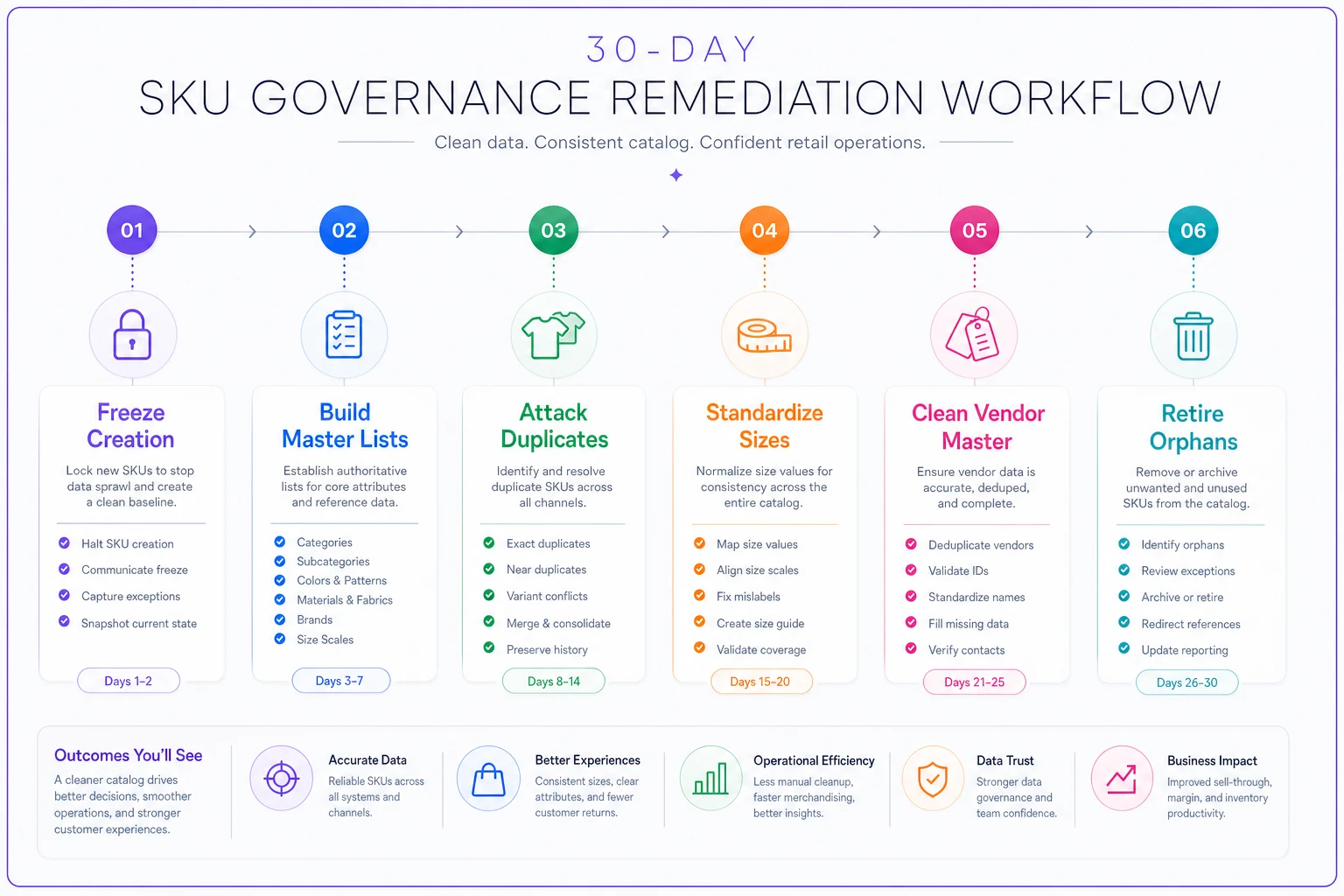
The order matters. Duplicates before sizes before vendors before archiving. Do it out of order and you'll re-touch the same records three times.
A real scenario: a two-location boutique
A womenswear boutique running two small locations had around 2,400 active SKUs on paper. In reality, maybe 1,800 were real — the rest were duplicates and orphans. The symptoms were familiar: online stock said "in stock" when the floor was empty, size reports were useless, and one core denim vendor showed up under three different names, so nobody realized how often that vendor shipped late.
The 30-day cleanup found roughly 300 duplicate SKUs and a few hundred dead records. After merging duplicates, inventory accuracy on top sellers went from "we don't trust it" to close to 96%. Phantom reorders — buying stock they already had — basically stopped, which freed up a few thousand dollars a month in open-to-buy they'd been quietly wasting. And once the denim vendor's three names collapsed into one row, the late-shipment pattern became obvious. They renegotiated the terms.
Nothing dramatic. Just the compounding effect of clean data feeding better decisions. That same clarity extends to supplier lead times — when vendor records are consolidated and accurate, lead-time tracking actually reflects reality instead of averaging across fragmented rows.
When this is worth it, and when it isn't
When it makes sense: You've got more than one person entering products, more than one sales channel, or more than a few hundred SKUs. Any two of those three and you need real governance now, not later.
When it's overkill: A single-location shop with under a hundred SKUs and one person doing everything can get away with lighter discipline — though even then, the naming template pays for itself the moment you hire someone new.
Who should not turn this into a monster: If you find yourself building 12-segment SKUs that encode fabric weight and country of origin, stop. You're recreating the enterprise complexity you were trying to avoid. The goal is enough structure to be reliable, not maximum structure. A small team that overbuilds its own governance will abandon it within a month.
Where software quietly helps
Most of this you can run in a spreadsheet with a disciplined team. The part that's genuinely hard to do manually is enforcement at creation — stopping a bad SKU before it exists, catching a duplicate the instant someone tries to make one, flagging a vendor name that doesn't match the master.
That's where an AI-assisted operational platform earns its place. Instead of relying on someone to remember every color code, the system validates entries against your master lists in real time, surfaces likely duplicates as they're typed, and flags orphaned or status-less SKUs during your weekly review. Nothing magical — it's just applying your own rules consistently, every single time, which is exactly what breaks down when the store gets busy. The rules stay yours. The automation just makes sure they actually hold.
The takeaway
Your SKU, size, and vendor data is the foundation everything else runs on. Reorders, markdowns, transfers, scorecards, POS accuracy, return rates — all of it inherits whatever quality your master data has. When that foundation is messy, every downstream system spends energy compensating for it, and you end up making buying decisions on numbers that were already wrong before you looked at them.
Building a single source of truth isn't glamorous. It's a template, a few controlled lists, two short audits, and a month of focused cleanup. But it's the difference between a store where the numbers guide you and one where you're constantly second-guessing your own reports. Fix the creation point, keep the audits short and frequent, and the whole operation gets quieter — fewer surprises, fewer phantom reorders, and reports you can actually act on without checking twice.
Ready to elevate your apparel business?
Join 2,000+ retailers using Werzly to streamline operations, increase sales, and deepen customer loyalty.