



Most margin leaks in small clothing stores don't come from one bad decision. They come from four decent decisions made in isolation.
The buyer commits to a fall outerwear order in July. The person running Instagram promises free shipping for a weekend flash sale in October. Whoever handles pricing marks down last season's coats to clear space. And fulfillment is quietly eating shipping costs on every online order because nobody set a threshold. Each of those choices made sense on its own. Together, they turned a 58% target margin into something closer to 41% — and nobody noticed until the year-end P&L looked weird.
That's the real problem with cross-functional work in a 1–5 person shop. Everyone is wearing multiple hats, which means the "handoffs" between functions happen inside one person's head, on a busy Saturday, with no record. There's no meeting where buying tells marketing "don't discount that SKU, we bought it thin." There's no rule stopping fulfillment from absorbing costs a promo already gave away. The functions are technically connected — they're just connected by chaos.
This article is about building the opposite: a single, executable one-page artifact that ties buying, pricing, fulfillment, and marketing together so those silent margin collisions stop happening. Not a binder of SOPs nobody reads. One page you can actually implement in a week.
Why tiny teams break differently than big ones
Big retailers have the opposite problem from you. They have too many people, too many approval layers, and decisions crawl. Their governance exists to slow things down so mistakes get caught.
Yours needs to do something almost opposite. In a 3-person shop, decisions happen fast and constantly. Governance isn't there to add friction — it's there to make sure the fast decisions don't contradict each other. The failure mode isn't bureaucracy. It's four people (or one person on four different days) each optimizing their own lane while the shared margin quietly bleeds.
The smaller the team, the more invisible the cross-functional dependencies become. When ten people work on buying, at least someone owns the relationship with pricing. When one person does buying and pricing and posts to social, they assume it's all coordinated because it's all in their head. It isn't. Yesterday-you and today-you don't actually talk to each other. The head is not a system.
Here's what that looks like across the four functions:
| Function | Local decision that feels smart | The cross-functional damage it causes |
|---|---|---|
| Buying | Ordering a trend piece deep because the vendor gave a break at higher quantity | Pricing later has to markdown hard to clear it; marketing burns ad spend pushing a low-margin item |
| Pricing | Blanket 40% off end-of-season to move everything | Kills margin on styles that were actually selling fine at full price |
| Fulfillment | Free shipping to stay competitive online | Wipes out margin on small-basket orders; nobody set a minimum |
| Marketing | Flash sale to hit a monthly revenue number | Discounts inventory that buying purchased at a thin initial markup |
None of these people are wrong at their own job. That's exactly why it's hard to catch. Governance is the thing that makes their jobs aware of each other.
The three-part artifact
The one-pager has three components. Anything more and it stops being a one-pager, which means it stops being used.
Take control of your clothing store operations.
Werzly helps you manage stock, process orders, and engage customers effortlessly.
- Unified inventory and order management
- Automated customer notifications
- Sales and stock analytics
No credit card required
-
A role matrix — who decides, who's consulted, who just needs to know, for each recurring decision.
-
A cadence — what gets reviewed weekly, monthly, and quarterly, so nothing important waits for a crisis to get attention.
-
Exception routing — the rules for what happens when something falls outside normal, and who breaks the tie.
The magic isn't in any single component. It's that all three sit on one visible page, so a decision in buying can be checked against a pricing rule against a fulfillment reality in about ten seconds.
Part 1: The role matrix
Forget elaborate RACI charts. In a small store you need four columns and maybe eight to twelve rows. The columns:
-
Decides — the one person who makes the final call
-
Must consult — who has to weigh in before the decision
-
Informed — who finds out after
-
Guardrail — the number or rule the decision can't violate without triggering an exception
The rows are your recurring cross-functional decisions. A realistic set for a small multi-channel apparel shop:
-
Placing a new season buy
-
Reorders / chase inventory
-
Setting initial retail price / markup
-
Timing and depth of markdowns
-
Approving a promotion or sale event
-
Free shipping thresholds and promo shipping
-
Channel allocation (what stock goes online vs. floor)
-
Vendor terms changes
The "Guardrail" column is the part most people skip, and it's the most valuable. That's where you write the number that connects functions. For markdowns, the guardrail might be "no blanket discount above 30% without checking initial markup by SKU." For promotions, "any sale that includes free shipping requires a minimum basket set by whoever owns fulfillment." That single column is what stops the four-decisions-collide problem.
A worked example. Say your buyer wants to reorder a bestselling dress mid-season.
-
Decides buyer
-
Must consult whoever owns pricing (is it still full-price? are we about to markdown the category?)
-
Informed marketing (so they can feature it), fulfillment (incoming stock)
-
Guardrail reorder only if sell-through supports it AND no markdown planned for that category in the next 4 weeks
That last clause has saved more margin than any clever pricing trick. Reordering something you're about to discount is one of the most common and expensive contradictions in small retail, and it happens purely because buying and pricing weren't looking at the same calendar.
Part 2: The cadence
The role matrix says who. The cadence says when. Without a rhythm, cross-functional review only happens reactively — usually after the damage.
Weekly (15–20 minutes, even solo):
-
Sell-through by category vs. plan — any surprises?
-
Anything hitting a markdown trigger this week?
-
Any promo running or launching, and does fulfillment/pricing know?
-
Fulfillment cost creep — are we absorbing more shipping than expected?
Monthly (45–60 minutes):
-
Margin by channel — are online orders actually profitable after shipping and returns?
-
Markdown effectiveness — did last month's discounts clear the right stuff?
-
Buying vs. selling alignment — are we buying more of what's working?
-
Any guardrail that got breached, and why?
Quarterly (a longer sit-down):
-
Assortment role review — are categories doing the job they were bought to do?
-
Vendor terms and performance
-
Channel strategy — is the mix between floor and online still right?
-
Update the one-pager itself
The weekly cadence catches speed problems. The monthly catches money problems. The quarterly catches strategy drift. If you're a solo operator, this feels like overhead until the first time your Sunday-morning 15 minutes catches a promo about to run on inventory you bought thin. Then it pays for itself.
One thing worth noting: the weekly review dies first, and it's the one you most need. It gets skipped because "nothing's on fire." The whole point is that nothing's on fire yet. Protect the weekly slot like it's a vendor appointment.
Part 3: Exception routing
This is where governance actually earns its keep. Normal decisions follow the matrix. But retail is a business of exceptions — the surprise markdown request, the vendor who suddenly changes terms, the flash-sale idea someone floats on Thursday for Saturday.
Exception routing answers: when something falls outside the guardrail, what happens?
The rule structure is simple: any decision that breaches a guardrail must be logged, routed to a named tie-breaker, and decided within a set window.
A practical routing flow:
-
Someone wants to do something outside a guardrail (e.g., a 45% markdown when the rule is 30%).
-
They write one line
what, why, expected margin impact.
-
It routes to the designated decision-maker for that domain — usually the owner in a tiny shop, but ideally a named person so it's not ambiguous.
-
Decision happens same-day or within 24 hours, and the outcome gets noted.
Write one-line exception entries: what, why, expected margin impact.
The logging matters more than it sounds. Not for paperwork — for pattern recognition. If you look back after a quarter and see that "emergency" deep markdowns keep coming from the same three categories, that's not an exception problem. That's a buying problem masquerading as a pricing problem. Exception logs are how you find the root cause of recurring margin damage.
A typical example: a store kept approving free-shipping promos as "one-time exceptions." By quarter's end, the log showed eleven of them. What felt like rare special cases was actually the store's default marketing move, costing roughly $6–8 per online order across a few hundred transactions. The exception log turned an invisible habit into a visible line item they could actually decide on.
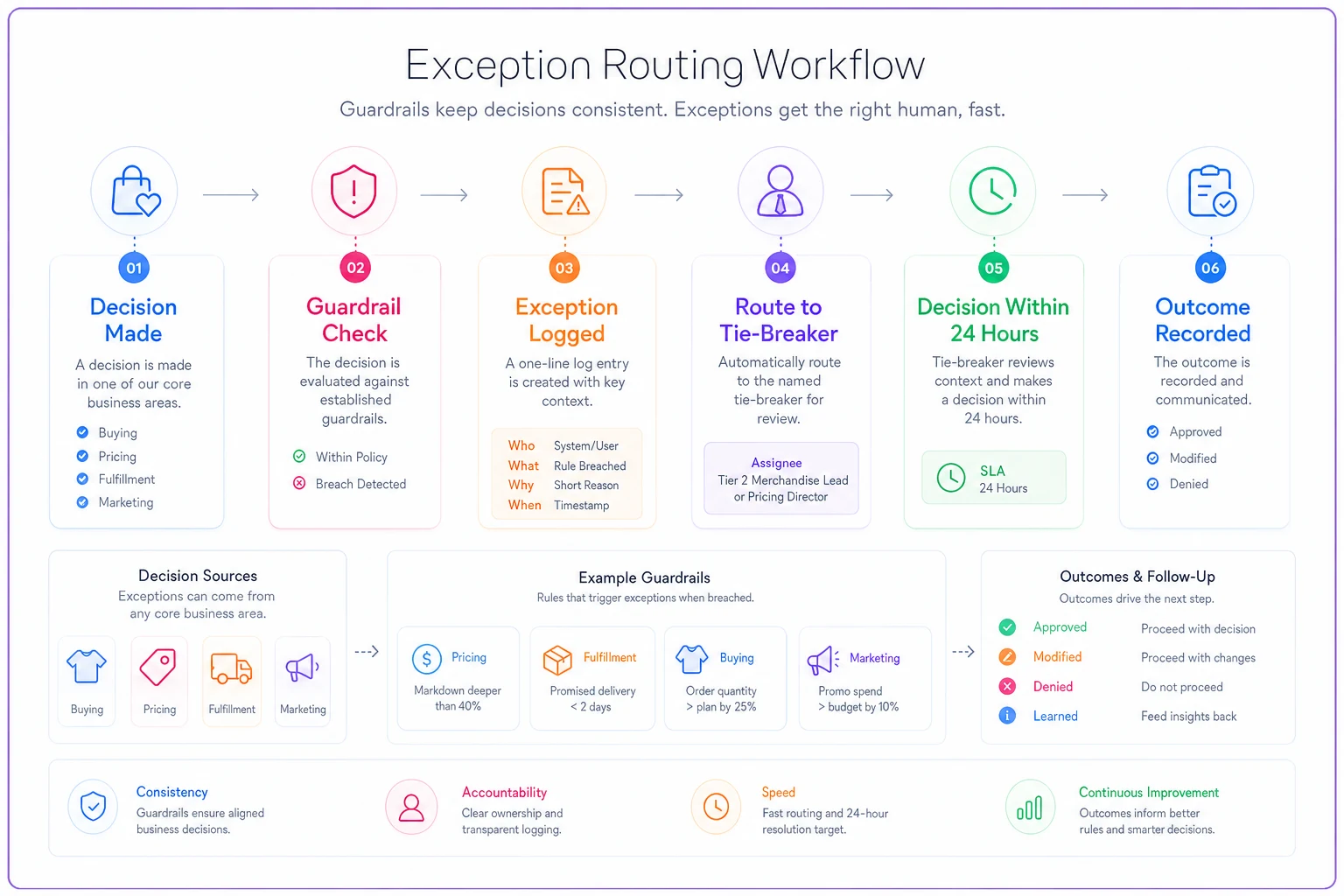
A small flow like this makes the routing obvious so people actually follow it.
How the pieces work together — a walkthrough
Run a real decision through the whole system and the connective tissue becomes obvious.
-
The promo is a "sale event" row on the matrix. Decides owner. Must consult: pricing and buying.
-
Pricing checks initial markup on the outerwear. Turns out two jacket styles were bought thin — 25% off puts them barely above cost.
-
Buying flags that one of those styles is reordering well and shouldn't be discounted at all.
-
The free-shipping component hits the fulfillment guardrail
minimum basket required. Whoever owns fulfillment sets it based on real shipping cost, not a guess.
-
The event runs — but on the right inventory, at a threshold that protects margin, with the two thin styles excluded.
Same promo. Same weekend. Same revenue goal. But the version that went through the one-pager probably preserved several points of margin the chaos version would have given away without anyone realizing.
That's the whole thesis. The one-pager doesn't make you slower. It makes the fast decisions compatible with each other.
This connects tightly to how you structure your assortment in the first place — the guardrails in your buying rows should reflect the category roles you've defined in your enterprise-lite assortment architecture. And your fulfillment guardrails will only be as good as the underlying SLAs, which is why it pays to have your BOPIS and ship-from-store playbook already sorted before you write shipping thresholds into the matrix.
What changes as you grow
The one-pager isn't static. It should evolve with headcount, and knowing how saves you from rebuilding it constantly.
Solo operator (1 person): The matrix is really a personal checklist. The "consult" step is you deliberately switching hats and asking the other function's question before you commit. Sounds a little silly; it works. The cadence is a recurring calendar block. Exception routing is a rule that says "if it breaks a guardrail, sleep on it and log it."
2–3 people: Now the matrix gets real teeth because decisions actually cross between people. This is the stage where things break most — you've divided the labor but not the coordination. The consult column stops being optional. The weekly review becomes a genuine sync, not solo reflection.
4–5 people: You start needing named decision-makers per domain and slightly more formal exception logs. The quarterly review starts driving actual strategy changes. Channel allocation decisions also get complex enough that you want real math behind them rather than gut — worth pairing the matrix with a proper margin-adjusted allocation approach so the "what goes online vs. floor" row isn't decided by whoever shouts loudest.
The mistake growing stores make: they wait until they've hired the fourth person to build governance. By then, three months of contradictory decisions have already baked bad habits into the operation. Build the one-pager at two people. It's cheap insurance that only gets more valuable as you scale.
When this actually makes sense — and when it doesn't
This isn't for everyone, and it's better to skip it than build a version you won't use.
It makes sense when:
-
You sell across more than one channel (floor + online, or floor + marketplace + pop-ups)
-
More than one type of decision — buying, pricing, promo, fulfillment — gets made by different people or by the same person in different modes
-
You've been surprised by your own margin at least once
-
You're planning to grow the team
It's probably overkill when:
-
You're a single channel, single decision-maker, and your margin is predictable and healthy
-
Your volume is low enough that one contradictory decision doesn't move the needle
-
You're in pure survival mode and adding any process feels impossible — fix cash first, come back to this
Who should skip this for now: brand-new stores in their first season. You don't have enough data to set meaningful guardrails, and you'll just be guessing at numbers. Run a season or two, learn where your actual margin leaks are, then build guardrails that reflect real patterns rather than theory.
The one-page governance checklist
If you do nothing else from this article, do this. It's a week of work, spread out.
-
[ ] List your 8–12 recurring cross-functional decisions (buying, pricing, markdowns, promos, shipping, allocation, vendor terms)
-
[ ] For each, name who Decides — one person, no committees
-
[ ] For each, name who Must consult before the decision
-
[ ] Write one Guardrail number or rule per decision — the line that can't be crossed without an exception
-
[ ] Set your weekly review slot (15–20 min) and put it on the calendar as recurring
-
[ ] Define your monthly margin-by-channel and markdown-effectiveness review
-
[ ] Schedule the quarterly assortment and strategy sit-down
-
[ ] Write the exception rule
breach a guardrail → log it in one line → route to named tie-breaker → decide within 24 hrs
-
[ ] Pick where the log lives (a shared note, a spreadsheet tab — anywhere everyone can see it)
-
[ ] Print the whole thing on one page and put it where decisions get made
-
[ ] Review and update the page at the quarterly meeting
That's the entire framework. The guardrail column and the exception log do the heavy lifting — most stores already have some sense of who decides what, but almost nobody has written down the numbers that connect the functions or built a habit of catching breaches before they compound.
A real scenario
A small women's apparel shop — floor plus a growing online channel, three people total — kept hitting revenue targets but watched their blended margin drift down two seasons in a row, from the high 50s into the mid-40s. No single obvious culprit. Sales were fine.
When they mapped their decisions onto a role matrix, the collision was obvious in about an hour. The person running online was setting free shipping with no minimum. The owner was approving markdowns by category rather than by SKU, so styles bought thin were getting discounted alongside styles bought fat. And reorders occasionally landed on items that got marked down two weeks later.
They didn't add software or hire anyone. They wrote the one-pager, set three guardrails — SKU-level markdown check, a free-shipping minimum tied to actual shipping cost, and a "no reorder if markdown planned" rule — and started a 20-minute Sunday review with an exception log.
Over the following two quarters, blended margin climbed several points. Not all the way back, but a clear, sustained move in the right direction, with essentially the same revenue and the same team. The fix wasn't working harder. It was making four sets of decisions stop contradicting each other.
Where the one-page discipline usually cracks
The framework fails in predictable ways, and they're all human, not technical.
The weekly review gets skipped when things are calm, and the store loses the early-warning habit. Guardrail numbers get set once and never revisited, so they drift out of sync with actual costs — a free-shipping minimum calibrated to last year's carrier rates is quietly wrong by now. And the exception log becomes a graveyard: things get logged but never reviewed, so the pattern-recognition payoff never arrives.
The stores that make it stick treat the one-pager as a living document reviewed every quarter, keep the log short enough that reviewing it takes five minutes, and protect the weekly slot even when nothing looks wrong. Governance that only shows up during crises isn't governance. It's firefighting with a nicer name.
You don't need enterprise systems or a big team to run a multi-channel store without bleeding margin. You need the four functions to be aware of each other, a rhythm that catches problems before they compound, and a clear rule for what happens when reality doesn't fit the plan. That fits on one page. And once it's on the wall where decisions actually get made, the contradictions that used to cost you points of margin every season simply stop happening quietly — because now, someone or some rule is actually looking.
Ready to elevate your apparel business?
Join 2,000+ retailers using Werzly to streamline operations, increase sales, and deepen customer loyalty.