

Most small apparel owners don't have a people problem. They have a clarity problem that disguises itself as one.
When your whole team fits in a single group text, it's easy to tell yourself you don't need a real operating model. Everyone knows what to do. Everyone pitches in. And that works — right up until one person quietly becomes the only one who knows how to process a return, or bonus season rolls around and nobody can explain why one associate got more than another, or your best part-timer gives notice and takes half your institutional knowledge with her.
People ops for small apparel retailers isn't about policies and handbooks. At this size it's about making roles, pay, cross-training, and feedback legible — to you and to the three or four people who actually run the floor. This is a 90-day build. You're not launching all of it at once. You're sequencing it so each piece reinforces the next.
Why the "everyone does everything" model quietly fails
The appeal of a tiny team is flexibility. One person opens, one closes, everyone covers the register, everyone folds. On a slow Tuesday that's great. The problem is that flexibility without definition turns into ambiguity, and ambiguity is expensive in ways that don't show up on the P&L until later.
The pattern usually looks like this: in a 3-person shop, responsibilities don't get assigned — they get absorbed. One person turns out to be slightly better at talking to vendors, so vendor stuff drifts to them. Someone else is good with the POS, so reconciliation becomes "their thing." Nobody decided any of this. It just accreted. Six months later you have a team where every critical task has exactly one person who can do it and zero documentation of how.
That's single-point-of-failure risk, and it's the number one thing that bites small shops. The day your vendor-whisperer is out sick during a delivery window, the whole receiving flow stalls — and you discover nobody else knows the login, the standing instructions, or which boxes go where.
The second failure is pay. When there's no structure, comp conversations become emotional negotiations. The associate who asks gets a raise; the one who doesn't, doesn't — even if she's the more valuable person. You're not being unfair on purpose. You just never built a frame that connects pay to anything a person can actually influence.
Both failures share the same root: nothing is written down in a way that's simple enough to actually maintain. The fix is a lightweight system, not a corporate one.
The one-page operating model (do this in week 1–2)
Forget org charts. For a 1–5 person team you need one page that answers three questions for every person: what you own, what you back up, and what you're learning.
Take control of your clothing store operations.
Werzly helps you manage stock, process orders, and engage customers effortlessly.
- Unified inventory and order management
- Automated customer notifications
- Sales and stock analytics
No credit card required
The trick is defining ownership without pretending people don't flex. Ownership means you're accountable for the outcome and the process stays current — not that you're the only one who ever touches it.
A workable structure for a small shop:
| Role | Owns (accountable) | Backs up | Currently learning |
|---|---|---|---|
| Owner / Lead | Buying, cash, pricing, final scheduling | Everything | — |
| Floor Lead | Open/close, daily merchandising, staff prompts | Buying admin | Vendor comms |
| Associate A | Returns & exchanges, POS reconciliation | Floor open/close | Receiving |
| Associate B | Receiving & staging, online order pick/pack | Returns | Merchandising |
| Part-timer | Register, restock, fitting-room support | Receiving | POS reconciliation |
Three things make this work that owners usually miss:
-
Every critical task has a named backup. If a task only has an owner, it's a liability. The backup column is the whole point.
-
"Currently learning" is a role field, not a nice-to-have. It's how you kill single-point-of-failure risk on a schedule instead of in a crisis.
-
The owner owns the fewest operational tasks that only they can do. If you're the only one who can open the shop, you can never take a day off. That's a design flaw, not loyalty.
This connects directly to how you build shifts. If you've already worked through shift templates and a weekly review rhythm, the operating model is the layer that sits on top — it tells the schedule who's qualified to cover what, which makes gaps visible before you publish the week.
Commission and bonus templates that don't create admin hell
Small shops either overthink this or avoid it entirely. Owners who avoid it end up with resentment. Owners who overthink it build a tiered individual-commission scheme that takes two hours a month to calculate and quietly pits a 3-person team against each other on the floor.
For a tiny team, individual sales commission is usually the wrong tool. On a small floor, sales are a team sport — the person who built the fitting-room relationship isn't always the one who rings it up. Reward the thing you can actually measure fairly and that reflects how the shop really runs.
Three low-admin structures, sized for how small you are:
1. Flat team pool on a store KPI. Pick one number — say, monthly sell-through or total revenue over a threshold. If the store beats target, a fixed pool (e.g., $300–$500) splits by hours worked that month. One calculation. Everyone rows in the same direction. This is the default I'd recommend for 1–3 people.
2. Simple per-metric micro-bonuses. Attach small dollar amounts to a few operational outcomes people actually control: a clean monthly reconciliation with no unexplained variance, return rate held under target, online orders shipped same-day all month. Each is $25–$75. These reward operational discipline, which is exactly what tiny teams under-reward.
3. Milestone bonuses tied to cross-training. Pay a one-time bump ($100–$150) when someone fully cross-trains into a new role from the matrix. This directly funds the thing that de-risks your business.
A realistic blend for a 4-person shop: a modest team pool on revenue, two micro-bonuses on reconciliation accuracy and return rate, and cross-training milestones. Total variable comp maybe $400–$700 in a good month, calculated in about ten minutes.
If your POS provides store revenue by month, use that as the canonical figure for the team pool calculation.
One hard rule: if you can't calculate a bonus from numbers already in your POS or spreadsheet, don't use it. The moment comp requires manual tracking someone has to remember to do, it rots. The best structure is the one that's still running in month nine.
The cross-training matrix — your actual insurance policy
The operating model shows who owns what today. The cross-training matrix shows how exposed you are and where to spend training time next.
Build a simple grid: tasks down the side, people across the top. Score each cell:
-
0 — can't do it
-
1 — can do it with the SOP in front of them
-
2 — can do it unsupervised
-
3 — can teach it
Now look at your rows. Any task where only one person scores a 2 or 3 is a red row — a single point of failure. Count your red rows. That number is your real operational fragility, more honest than any revenue metric.
The goal isn't all 3s everywhere — that's wasted effort on a small team. The goal is at least two people at level 2 on every critical task. Receiving, returns, open/close, reconciliation, online fulfillment. Those are the ones that stall the whole shop when the solo expert is out.
Something worth noticing: the tasks most likely to be red rows are the boring back-office ones — reconciliation, vendor portals, label printing — precisely because nobody volunteered to learn them. Front-of-house skills cross-train naturally because people enjoy them. Back-office skills need to be assigned learning, which is why they belong in the "currently learning" column and get a milestone bonus.
This only works if the knowledge actually exists somewhere a learner can reach it. A matrix pointing at tasks with no written SOP is just a list of things one person knows. Pairing the matrix with a compact knowledge system for your team is what turns "John knows how" into "anyone can learn it in twenty minutes."
The 20-minute weekly cadence (mapped to real store KPIs)
Most small shops do performance management once a year, badly, in a panic, right before someone quits. The fix is a tiny, boring, consistent rhythm. Twenty minutes, same time every week, same five things.
Feedback that arrives seven months late isn't feedback — it's an ambush. A quick weekly loop keeps small issues small and makes the yearly conversation a non-event.
What to cover in 20 minutes:
-
Last week's store numbers, out loud (3 min). Conversion, revenue vs. target, return rate, same-day fulfillment. Everyone hears the same reality. Pick metrics that drive action, not vanity — if you need help separating the two, the KPI framework for small stores sorts signal from noise.
-
One thing that went well (3 min). Name it specifically. "The way you re-merchandised the front table — conversion was up." Specific beats generic every time.
-
One thing to fix (4 min). One. Not a list. Tie it to a number when you can.
-
Cross-training check (5 min). What's each person learning, what's blocking it, one concrete step this week.
-
Blockers and asks (5 min). What's getting in their way that you can remove.
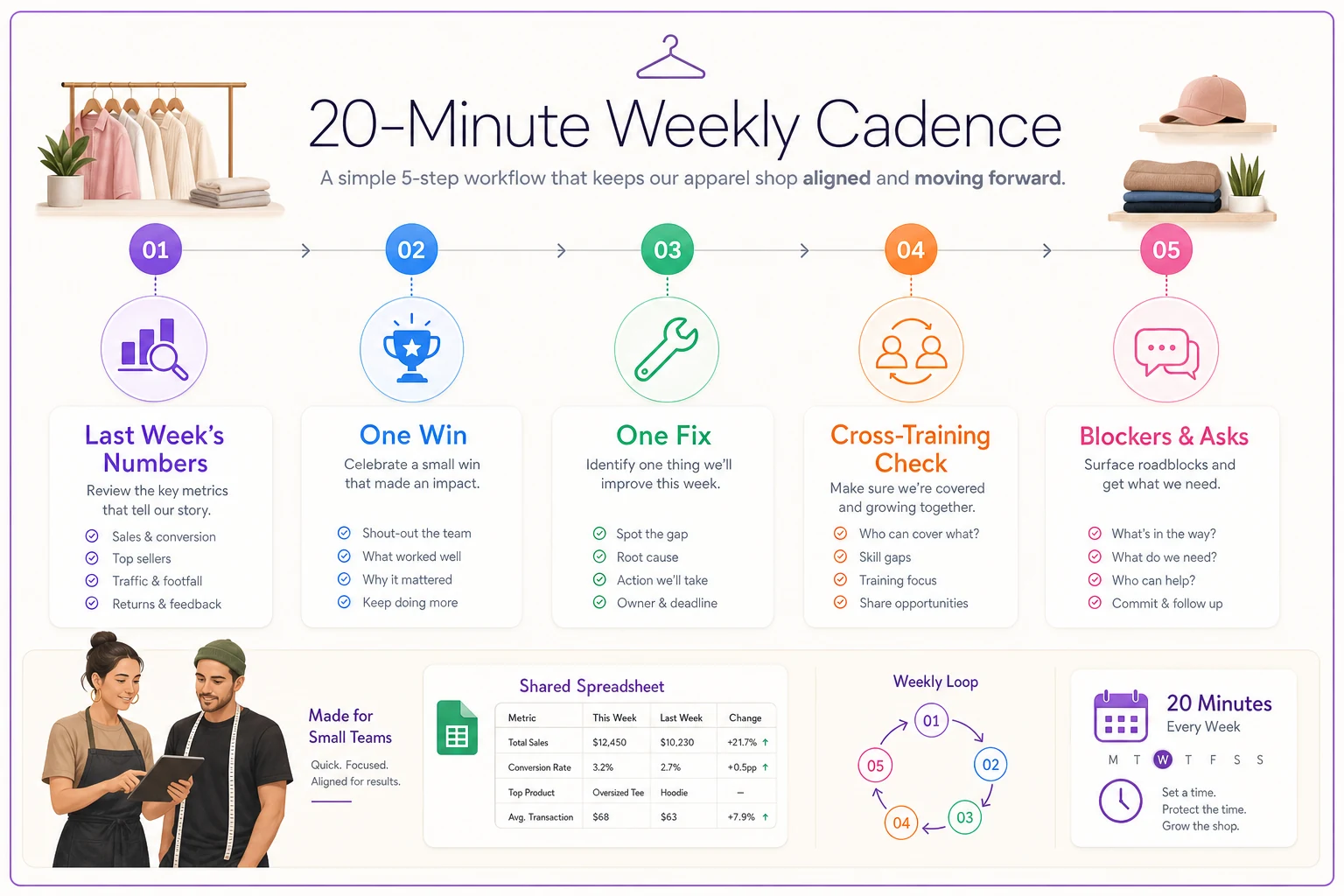
A quick visual of the weekly loop makes it easier to keep the 20 minutes focused.
The discipline is in the constraints. One win, one fix, one learning step. A tiny team can absorb one change a week. It cannot absorb ten, and ten is what you dump on them when you've saved everything for a quarterly review.
A note on where things actually track
You don't need software to run any of this. A shared spreadsheet and a recurring calendar block will carry a 3-person shop a long way. Where owners start wanting something more structured is around month four, when the matrix, the weekly notes, and the bonus calcs live in three different places and nobody updates two of them.
That's the point where a lightweight operational platform earns its keep — not because it does anything magical, but because it keeps the operating model, cross-training scores, and KPI data in one view so the weekly 20 minutes doesn't turn into 20 minutes of hunting for files. The tool should reduce the admin, not become the job. If maintaining the system takes longer than running the shop, you've over-built it.
A simple remediation flow (for when someone's actually struggling)
Performance problems on a tiny team are brutal precisely because it's tiny. You can't quietly reassign someone. There's no hiding a weak link across 40 people — it's 1 of 4, and the whole floor feels it.
The mistake owners make is either ignoring it for months or jumping straight to letting someone go. There's a middle path that's fair, fast, and documented enough to protect everyone.
A proportionate flow for a small shop:
-
Name it early, in the weekly 1-on-1. Specific, number-attached, once. "Reconciliation has had a variance three weeks running — let's fix the process." This is a conversation, not a warning.
-
Clarify the gap
can't vs. won't.
Is it a skill problem (they were never properly trained) or an effort problem? These need completely different responses, and owners constantly conflate them. -
If it's can't — retrain with the SOP, pair them with the level-3 owner, set a two-week check-in. Half of what looks like a performance issue is actually a training gap the operating model should have caught earlier.
-
If it's won't — one clear, written expectation with a date. Keep it short. "Same-day fulfillment, consistently, by the 15th." Then follow up on that date. Every time.
-
Review at the checkpoint. Improved — close it and say so out loud. Didn't — you now have a documented, fair basis for the harder decision, and so do they.
The whole flow runs inside the weekly cadence you already have. No separate process, no dramatic sit-down. Remediation that lives inside your normal rhythm gets used; remediation that requires a special meeting gets avoided.
A real scenario: a 4-person boutique
A women's apparel shop — owner plus three part-timers, roughly $40k–$50k a month in revenue — hit the classic wall. One associate owned receiving and the vendor portal entirely. When she moved out of state with two weeks' notice, two deliveries landed mid-transition and sat unprocessed for days. Floor stock gapped. The owner ended up doing receiving herself at 11pm.
They rebuilt over a quarter. One-page operating model with named backups. A cross-training matrix that exposed four red rows — all back-office. A flat team pool on monthly revenue plus a $100 milestone per role cross-trained. The 20-minute weekly cadence replaced the "we'll talk when there's a problem" approach.
By month three, every critical task had two people at level 2. Receiving no longer depended on one person. The weekly rhythm surfaced a reconciliation variance early enough to fix it as a process issue instead of a blowup. Turnover didn't magically disappear — but the cost of turnover did, because losing a person stopped meaning losing a capability.
The owner put it simply: "I stopped being the backup for everything." That's the real win. Not a revenue number — the fact that the business could survive someone leaving.
Sequencing the 90 days
Don't build it all at once. Order matters:
-
Weeks 1–2 One-page operating model. Just get ownership and backups written down.
-
Weeks 3–4 Cross-training matrix. Score honestly, count your red rows, pick the top two to close first.
-
Weeks 5–6 Start the 20-minute weekly cadence. Rough is fine — consistency beats polish.
-
Weeks 7–8 Introduce comp structure. Start with the simplest thing (team pool) and one micro-bonus.
-
Weeks 9–12 Run the remediation flow as needed, close your first cross-training milestones, and tune. By now it should feel like how the shop runs, not a project.
By now it should feel like how the shop runs, not a project.
When this is worth it — and when it isn't
If you're genuinely a 1-person shop with one occasional helper, don't build all five pieces. You need the cross-training basics so a helper can cover, and nothing else. The full system is overkill.
The sweet spot is 2–5 people, where you're too big for everything to live in your head but too small to afford real HR. That's exactly where undefined roles and ad-hoc pay cause the most damage.
And if you're about to scale past five or add a second location, build this now, while it's small enough to design deliberately. Retrofitting role clarity and fair comp onto an established team is far harder than onboarding a new hire into a system that already exists.
The thread running through all of it: people ops at this size is really about reducing fragility. Who can cover what, how pay connects to things people control, how feedback stays current. Get those legible and the tiny-team disadvantages — single points of failure, murky pay, fuzzy accountability — mostly disappear. Not because you hired an HR person. Because you stopped carrying the whole operating model around in your own head.
Ready to elevate your apparel business?
Join 2,000+ retailers using Werzly to streamline operations, increase sales, and deepen customer loyalty.