



Most indie apparel shops don't have a pricing problem. They have a pricing coordination problem. The initial markups are usually fine. The issue shows up three months later, when a heritage denim style is somehow sitting at 40% off on the website while it's still full price on the floor, and nobody can say who authorized the markdown or why.
That's not a discounting mistake. That's an architecture gap.
Pricing architecture for indie apparel retailers is the connective tissue between four things that usually live in separate heads: what role a SKU plays in your assortment, what margin it has to earn, where it is in its lifecycle, and which channels it's allowed to sell through at which price. When those four things aren't wired together with clear rules, margin leaks quietly — not in dramatic blowups, but in dozens of small, uncoordinated decisions that add up to a bad quarter.
Here's how the whole thing fits together, and where it tends to break.
The four layers that have to agree with each other
Think of pricing not as a single number but as a stack of decisions, each constraining the one below it.
Layer 1 — SKU role. Every style you buy is doing a job. Some are traffic drivers (the $38 tee everyone knows the price of). Some are margin anchors (the elevated knit nobody comparison-shops). Some are statement pieces that justify your positioning but barely move units. The role drives everything downstream.
Layer 2 — IMU and GM targets. Initial markup is what you set. Gross margin is what you keep after markdowns, shrink, and returns. The gap between those two numbers is where most shops lie to themselves. A 62% IMU that ends the season at 41% realized GM is not a 62% product. Your architecture has to carry both numbers per role, because the acceptable gap is different for a traffic driver than for a margin anchor.
Layer 3 — lifecycle stage. New arrival, core/replenishment, mature, late-season, clearance, archive. Each stage has different pricing permissions. The mistake is treating lifecycle as a vibe ("this feels old") instead of a status with rules attached.
Layer 4 — channel rules. Floor, website, marketplace, pop-up, wholesale, resale. Each channel has different cost-to-serve and different price elasticity. A price that protects margin in-store can destroy it on a marketplace after fees.
The whole point of an architecture is that these layers talk to each other. SKU role sets the GM target. The GM target plus lifecycle stage sets the allowable price band. Channel rules then decide which prices within that band are legal in which place. When a markdown gets requested, the system should already know whether it's allowed — before a human has to argue about it.
Why this breaks across almost every growing shop
In a one-location store with one person doing the buying, pricing lives in that person's head and it mostly works. The owner knows the denim is the anchor, knows the tees drive traffic, knows what's getting stale. The architecture exists — it's just undocumented.
Take control of your clothing store operations.
Werzly helps you manage stock, process orders, and engage customers effortlessly.
- Unified inventory and order management
- Automated customer notifications
- Sales and stock analytics
No credit card required
Then you add a website. Then a marketplace. Then a second person who can approve markdowns. Suddenly the undocumented architecture has to be shared across people and channels who don't carry the same mental model. That's the moment it stops working.
The pattern that shows up repeatedly: pricing logic doesn't fail at the decision level. It fails at the coordination level.
-
The buyer sets smart IMU targets, but nobody enforces GM targets after markdowns begin.
-
The floor manager runs a clearance rack, but the website keeps selling the same SKU at full price — or worse, undercuts the floor.
-
A promo calendar gets planned in a spreadsheet, but individual staff run "quiet" discounts that collide with it.
-
Marketplace listings auto-sync from POS, so an in-store markdown silently torches margin after the marketplace takes its 15%.
Each of these is a small thing. Together they're the difference between a 48% realized margin and a 54% one — which, on a shop doing $900k, is roughly $54k that either stays with you or evaporates.
A worked example: one SKU, four ways it can leak
Take a single style through the architecture so the connections are concrete.
Style: "Harbor" wool overshirt
-
Cost
$44
-
IMU target (margin anchor role)
60% → retail $110
-
GM floor before it must be reviewed
45%
Here's how the same product performs depending on whether the architecture holds.
| Scenario | What happened | Realized price | Channel cost | Realized GM |
|---|---|---|---|---|
| Architecture holds | Sold full price on floor, timed 20% late-season markdown | $88 | ~$0 | 50% |
| Uncoordinated markdown | Staff ran a surprise 35% "move it" discount early | $71.50 | ~$0 | 38% |
| Channel collision | In-store markdown synced to marketplace, then sold there | $71.50 | 15% fee (~$10.70) | 23% |
| Promo stacking | Sitewide 25% + loyalty 10% both applied | $74.25 | ~$3 shipping share | 38% |
Same product. Same cost. The realized margin swings from 50% down to 23% depending entirely on governance, not on the original pricing decision. The $110 retail price was never the problem.
The channel-collision row is worth sitting with — it's the one shops almost never catch, because the in-store markdown looked reasonable in isolation. This is exactly the failure that a margin-adjusted omnichannel allocation approach is built to prevent: a price that's fine on one channel being poison on another.
The lifecycle-to-price map
Lifecycle stage is the layer that connects your assortment plan to your markdown cadence. The cleanest way to run it is to tie price permissions to status, so the question "can I discount this?" is answered by the system instead of by a judgment call on the floor.
-
New arrival (weeks 0–6) Full price only. No markdowns without buyer sign-off, regardless of sell-through panic. This is where impatient shops destroy the most margin — discounting newness before it's had a real chance.
-
Core/replenishment Full price; eligible for planned promo events only, never ad-hoc. If it's a replenishable core style, it should almost never reach clearance.
-
Mature (slowing but not dead) First controlled markdown allowed, capped at a band tied to the GM floor. For Harbor, that's whatever keeps realized GM at or above 45%.
-
Late-season Timed, calendared markdowns on a schedule — not reactive ones. The logic for building that schedule is covered in the guide on timed markdowns for seasonal outerwear, and the key point is that the cadence is set in advance, so nobody's inventing discounts under pressure.
-
Clearance Below the GM floor is now permitted, but channel rules tighten — clearance stays on the floor and website, off the marketplace where fees would push it negative.
-
Archive Pulled from active channels entirely; routed to outlet, bundle, or donation.
The insight most shops miss: the earlier lifecycle stages need the strictest permissions, not the loosest. The instinct is to guard clearance tightly and let new stuff float. It should be the opposite. New-arrival discounting is where anchor margin dies youngest.
Governance templates you can actually apply
Architecture without governance is just a nice diagram. Two guardrail structures do the most work in practice.
Promo calendar guardrails
-
Eligible SKU roles. Traffic drivers and clearance only — margin anchors excluded from sitewide promos by default.
-
Max stack depth. Can loyalty discounts combine with the promo? Pick one. Stacking is the single most common silent margin killer.
-
GM floor override list. The few SKUs that can go below floor during this event, named explicitly, with a reason.
-
Channel scope. Floor-only, online-only, or both — stated per event.
-
Blackout styles. New arrivals and replenishment cores that are off-limits no matter what.
Cross-channel exclusion rules
-
Clearance-status SKUs do not auto-list to marketplaces.
-
In-store ad-hoc markdowns do not sync to channels with fees above a set threshold without review.
-
Wholesale and resale channels carry their own price books, never inheriting retail markdowns automatically.
-
Any discount that would push realized GM below the role's floor requires a named approver — and that approval gets logged.
That last line is the whole game. Most margin leakage isn't malicious or even careless; it's just invisible. Nobody can see that the sum of small decisions crossed a line, because no line was ever drawn where the system could see it.
Where tooling quietly earns its keep
You can run this architecture on spreadsheets at one location. The math isn't hard. What's hard is keeping the layers in agreement once prices live in a POS, a website, and a marketplace at the same time, each capable of changing a price without telling the others.
This is where operational software that treats pricing rules as data — rather than scattered settings across three different systems — starts to matter. The useful version isn't a tool that sets prices for you. It's one that holds the architecture: tags each SKU with its role and GM floor, tracks lifecycle status, and flags when a requested markdown or a channel sync would break a rule before it executes. A quiet exception alert that says "this discount pushes Harbor below its 45% floor on a fee-bearing channel" is worth more than any dashboard, because it catches the leak at the moment it would happen.
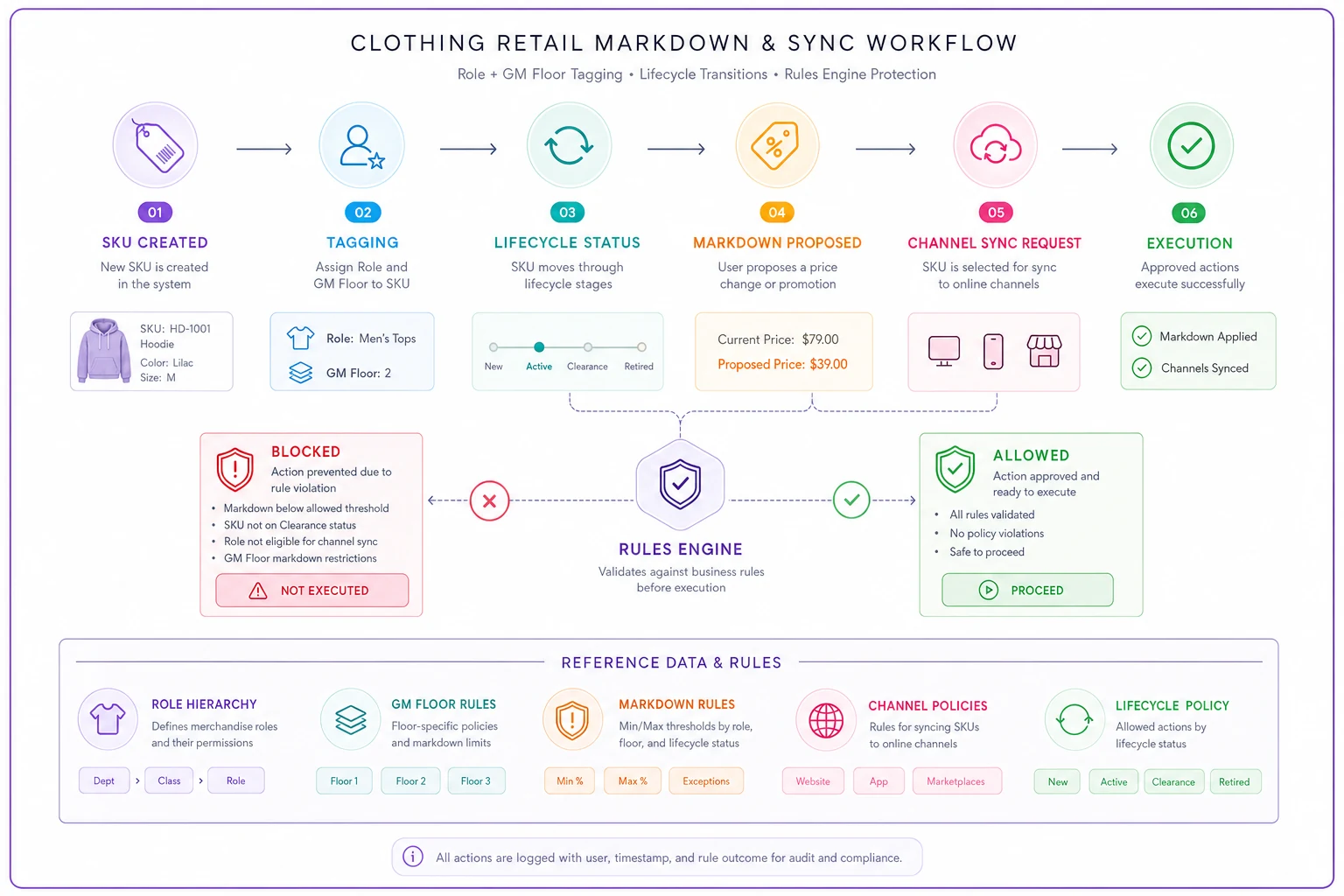
A simple visualization of the tagging → rules check → exception alert flow makes it obvious why the software is valuable: it stops bad combinations before they happen.
The connection to the rest of your numbers matters too. Realized margin only becomes real when it flows into your P&L, and the system that turns sell-through into monthly buy and markdown thresholds is what closes the loop — showing you whether your architecture actually held over the month or just looked good on paper.
A real scenario
A two-location contemporary womenswear shop with a growing online store — roughly $1.1M in annual revenue — kept hitting the same wall: healthy IMU on paper, disappointing realized margin at close. When they traced it, the culprit wasn't buying. It was coordination.
About 30% of their markdowns were ad-hoc floor decisions that never got mirrored online, so the two channels undercut each other constantly. Their marketplace auto-synced POS prices, meaning any in-store clearance quietly sold at a loss after fees. And loyalty discounts stacked on top of two sitewide promos a season without anyone catching it.
They didn't change a single initial price. They built the architecture: SKU roles with GM floors, lifecycle statuses with price permissions, and a one-page set of promo guardrails and cross-channel exclusions. They pulled clearance SKUs off the marketplace entirely and killed discount stacking.
Over the following two seasons, realized gross margin moved from around 46% to just over 51%. On their volume that's somewhere in the neighborhood of $55k that stayed in the business — almost none of it from charging customers more. It came entirely from closing the gaps between decisions.
When this is worth it — and when it isn't
When it makes sense: You're running more than one channel, or more than one person can approve a markdown, or you've noticed that IMU and realized GM keep drifting apart with no clear reason. Multi-channel shops past roughly $500k–$600k almost always have hidden collision losses.
When it's premature: Single location, single decision-maker, no online channel, under maybe $300k. At that size the architecture lives fine in one person's head, and formalizing it is overhead you don't need yet. Write the rules down anyway — but a lightweight doc is plenty.
Who should not bother right now: If you don't yet have clean SKU-level cost and margin data, start there. Pricing architecture built on unreliable cost numbers just automates bad decisions faster. Get the data trustworthy first, then layer the rules on top.
The real takeaway
The shops that protect margin aren't the ones with the cleverest initial markups. They're the ones where the four layers — role, margin target, lifecycle, channel — can't contradict each other, because the rules connecting them are written down and enforced somewhere other than one person's memory.
Pricing isn't a number. It's a system of agreements between decisions made by different people, in different channels, at different moments. Build the architecture so those agreements hold on their own, and the margin stops leaking in all the small places nobody was watching.
Ready to elevate your apparel business?
Join 2,000+ retailers using Werzly to streamline operations, increase sales, and deepen customer loyalty.